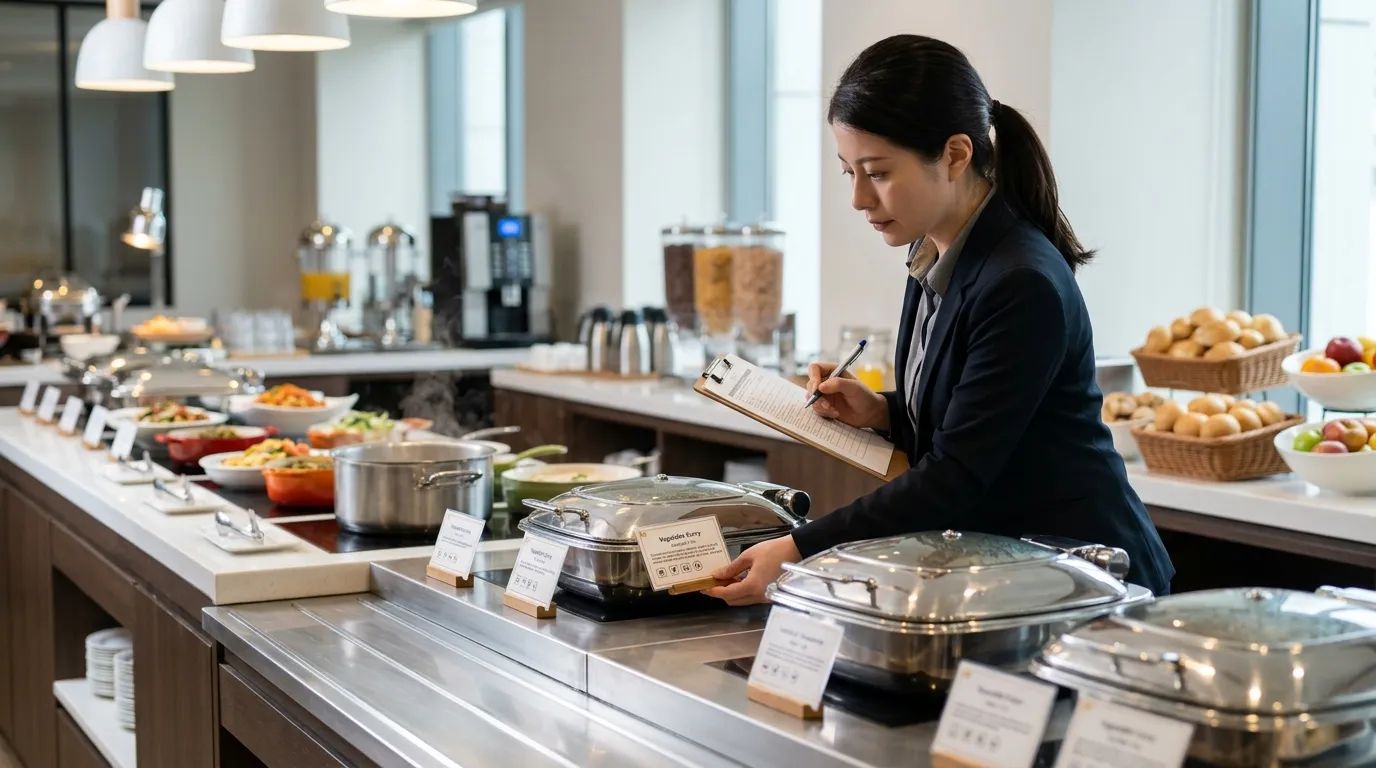
Most people picture the buffet manager somewhere in the back, watching the fryer or counting inventory. They’re not.
The second those doors open, before a single plate is grabbed, a trained manager is already scanning the room, running through a mental checklist most diners never see. Some of it would genuinely surprise you.
Turns out, the moments that make or break a buffet’s safety and reputation happen in the first few minutes of service, not during it. Here’s what industry insiders actually look for before you ever sit down.
#15 – The Temperature of Every Hot Holding Unit
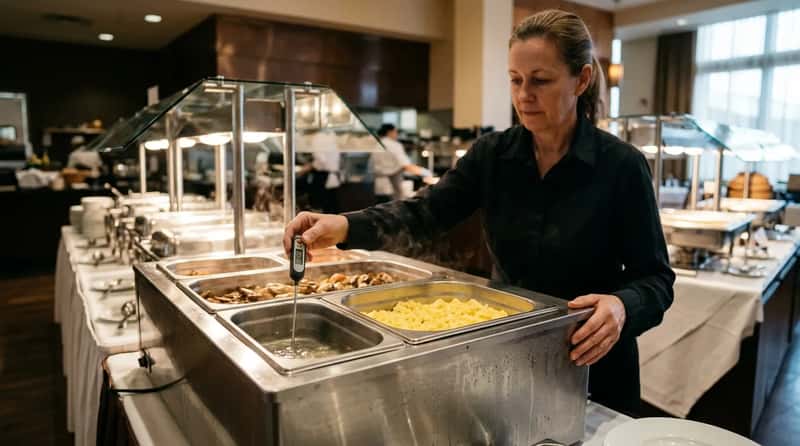
The first thing a sharp buffet manager does is grab a thermometer, not a coffee.
Hot food must be held at 140°F or higher, and cold food must be held at 40°F or lower. That gap isn’t a suggestion, it’s the legal line between a safe buffet and a health code violation.
Hot holding equipment like chafing dishes, steam tables, and heat lamps must be preheated to the correct temperature before food ever touches the line. A manager who skips this step is setting up for failure before service even starts.
The single most common violation inspectors find? Cold-held foods not cold enough. Experts note that the biggest issue most health inspectors uncover in buffet-style service is cold food sitting above 41°F.
Fast Facts
- The “danger zone” runs from 40°F to 140°F, and bacteria can double in as little as 20 minutes inside it.
- Hot food must stay at 140°F or above; cold food must stay at 40°F or below.
- Food can’t sit at room temperature more than 2 hours – just 1 hour if the room is above 90°F.
But temperature is just the opening move. Wait until you see what #14 reveals about the clock ticking on every dish…
#14 – When Each Dish Was Put Out (The Two-Hour Clock)
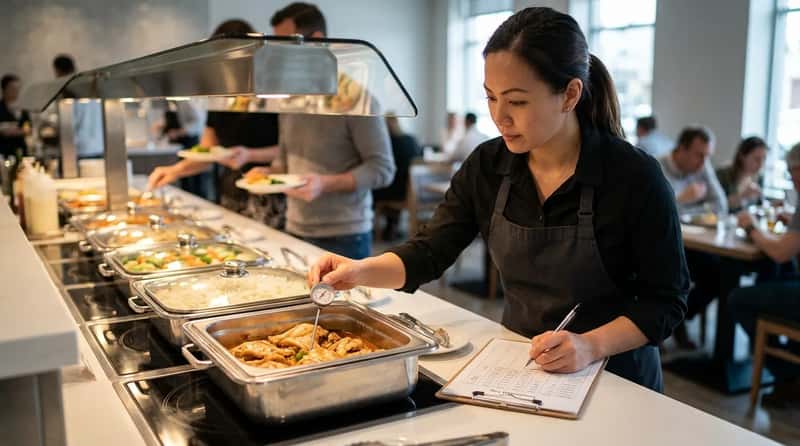
Every item on a buffet has an invisible expiration timer ticking the moment it hits the line.
Foods should not sit at room temperature for more than two hours. Experienced managers track this obsessively, because once that window closes, the food goes – no exceptions, no “it still looks fine.”
Hot holding temperatures should be documented at least every two hours during service. That logging isn’t paperwork for its own sake, it’s a legal record proving the food was safe.
A manager without those logs in order is gambling with every plate served. Crucially, new food should never be mixed with food already on display, since that trick can hide old food that’s been sitting far too long.
That rule about not topping off trays leads directly into what #13 reveals about how the line is actually stocked…
#13 – Whether Serving Utensils Are Placed Correctly
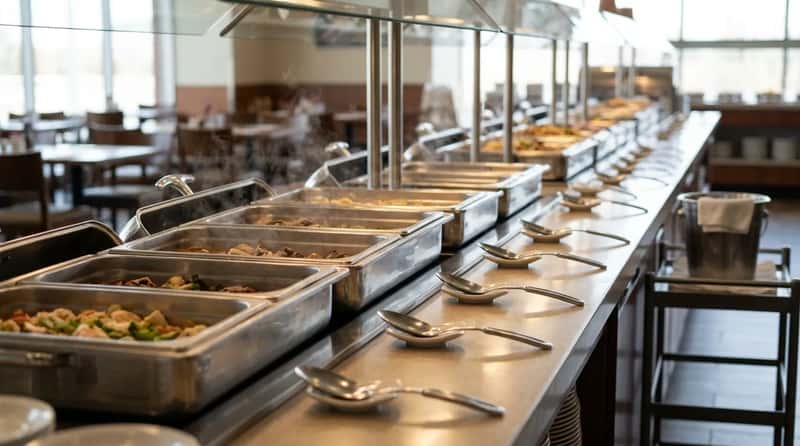
This one looks like a small detail. It’s actually a major contamination risk hiding in plain sight.
Regulations require every self-service container to have its own dedicated serving utensil. Cross-using utensils is one of the fastest ways allergens and bacteria spread across a buffet line.
Self-service utensils must be cleaned and sanitized at least every four hours. A manager checking the line before service confirms every utensil is clean, correctly sized, and properly stored.
The placement of a single misplaced spoon can legally constitute a health code violation. Accidental contamination often happens when guests use the same serving utensil for different dishes, which is especially dangerous for people with food allergies.
But utensil placement is only half the story. #12 reveals the piece of equipment almost no one thinks about…
#12 – The Sneeze Guard: Height, Cleanliness, and Coverage
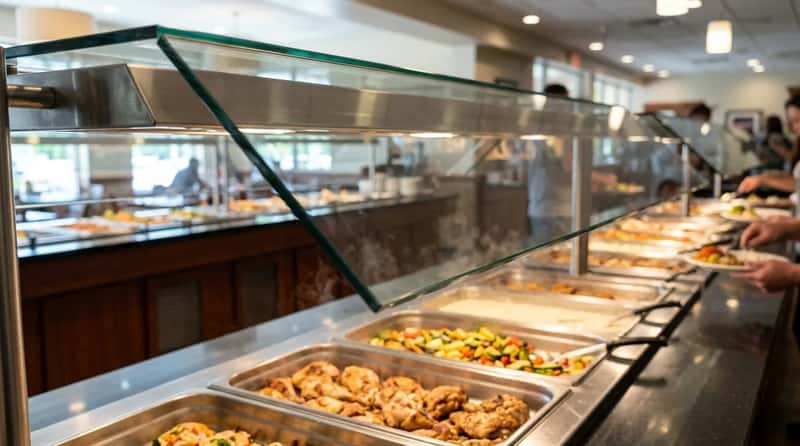
Most guests glance at the sneeze guard and assume it’s doing its job. Managers actually inspect it.
Displayed food must be protected by a sneeze guard, or placed under a tight-fitting lid. Before service begins, a manager checks that the guard is positioned correctly, fully intact, and covering the entire display area.
Most states require these shields to stand roughly 5 to 6 feet tall, about the height of the average diner. A cracked, dirty, or improperly positioned guard is an immediate red flag.
A smudged or poorly angled sneeze guard can actually make contamination worse by creating a false sense of protection. The whole point is for guests to look through the glass as they serve themselves, not reach under or around it.
#11 is about something far less glamorous, and far more telling about the overall operation…
#11 – The State of the Floor Directly Under the Line
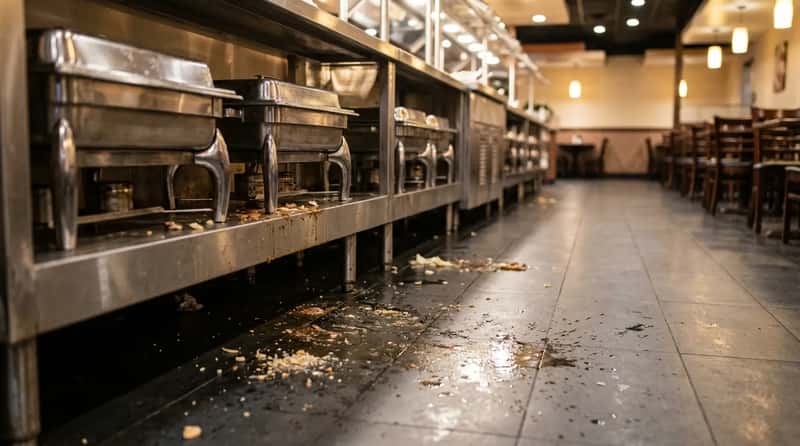
Before the first guest walks in, a buffet manager checks the floor, especially the strip directly under the serving stations.
Drips, spills, and dropped food underneath chafing dishes pile up fast during service. A floor that’s already dirty before doors open tells a manager exactly how the last shift ended.
Every surface in the restaurant needs to be visibly clean and disinfected to stop the spread of bacteria, viruses, and fungi. The floor beneath the buffet counts as a surface too.
Grease and food residue on the floor is one of the first things a health inspector photographs during an unannounced visit. A dirty floor also signals a deeper problem: a team that cuts corners.
And cutting corners is exactly what #10 is about…
#10 – Staff Hygiene Before a Single Dish Is Touched
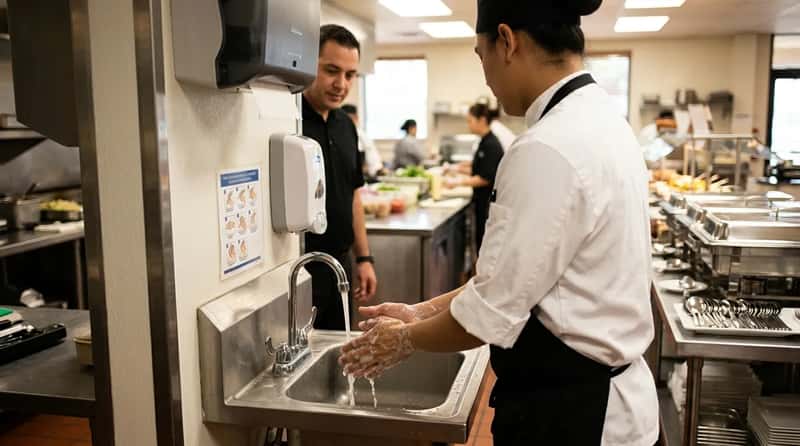
A manager worth their salt watches every staff member’s hands before service starts, not after.
Hands should always be washed in a designated handwashing sink, never one used for food prep or dishwashing, for a minimum of 20 seconds in water at least 100°F.
More than half of restaurant employees admit to coming into a shift while sick, which is exactly why pre-service health checks are non-negotiable in a well-run operation.
A manager who doesn’t scan staff for obvious illness signs before service begins is skipping one of the most fundamental safeguards in the building. When symptoms are apparent, that employee needs to stop work and leave immediately.
What #9 reveals about food labeling will make you look at buffet signs very differently…
#9 – Allergen Labels and Dish Identification Signage
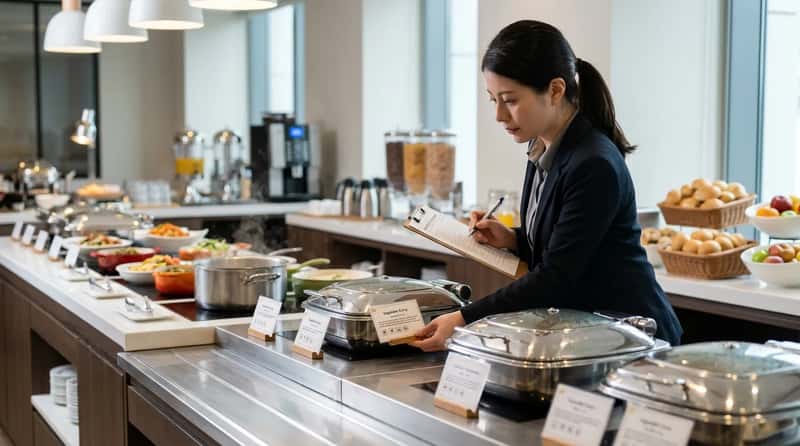
Here’s something most guests overlook entirely: the small signs in front of each dish are legally significant, not decorative.
Allergen management is the area where one small lapse can send a guest to the hospital. Displaying allergen information next to every dish is a baseline requirement, not a courtesy.
A thorough pre-service check covers beverage stations, cereals, breads, dairy, fruit, and every label on the line. Every item needs a sign, and every sign needs to match that day’s actual recipe.
A dish made with a different oil or ingredient than yesterday needs updated signage – and most venues don’t catch this until it’s too late.
Worth Knowing
- The FDA recognizes 9 major food allergens: milk, eggs, peanuts, tree nuts, wheat, soy, fish, shellfish, and sesame.
- Food allergies affect tens of millions of Americans, and many cases go undiagnosed until a reaction happens.
- Cross-contact – not just cross-contamination – can trigger a serious reaction even without direct ingredient exposure.
#8 shifts from what’s on the food to what’s around the food, and it’s something managers check without guests ever noticing…
#8 – Signs of Pests Near the Line or Storage Areas
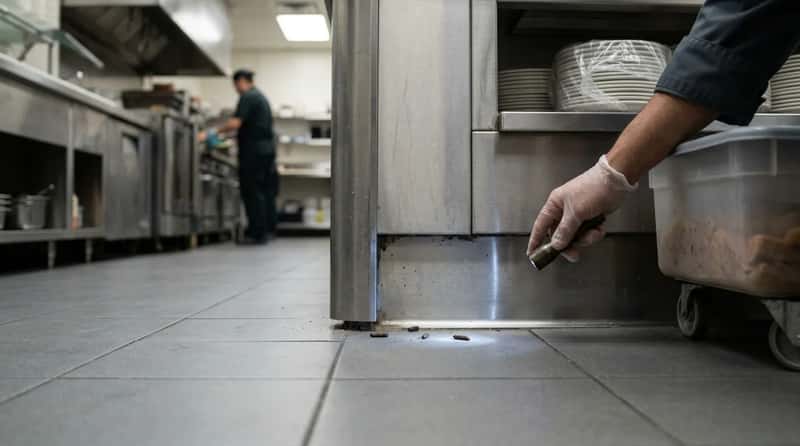
No manager will ever say this out loud to a guest, but pest evidence is the first thing that triggers an emergency closure.
Droppings, nests, or any sign of rodents or insects are a major red flag during inspection. Before service, a sharp manager scans the perimeter of the buffet, behind equipment, and along baseboards for fresh evidence.
Doors and windows must close tightly, and garbage areas must stay tidy to keep pests out during peak hours.
A single rodent dropping near a food display is enough to shut a restaurant down on the spot – no warnings, no grace period. That’s why experienced managers treat the pre-service walk-through as a pest patrol, not just a quality check.
What #7 reveals about food storage order is something most guests would never think to question…
#7 – Whether the FIFO Rule Is Being Followed in Storage
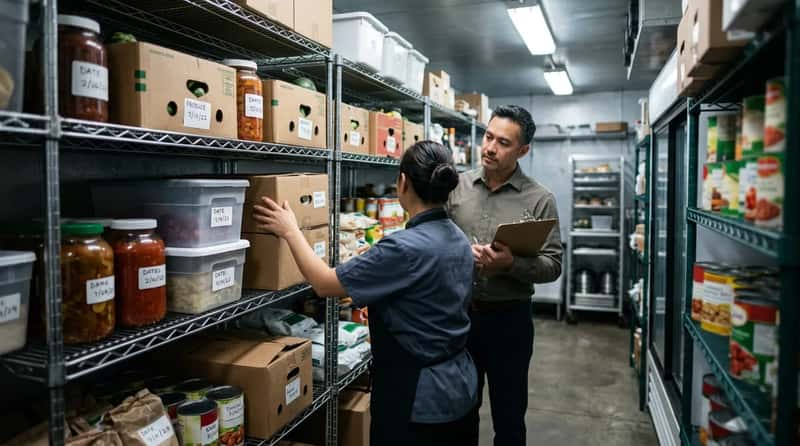
Before anyone sees the buffet line, a manager already knows whether the kitchen is rotating stock correctly, and it matters more than you’d think.
Food should be stored using the FIFO method, First In, First Out, meaning the oldest product gets used first. When this breaks down, old inventory quietly slips into service long past its prime.
A buffet that looks fresh on the outside can be running on yesterday’s, or last week’s, stock in the back. A manager doing their job checks the storage area before the line is stocked, not after complaints come in.
#6 will change how you think about the plates stacked at the start of the line…
#6 – Plate, Tray, and Flatware Cleanliness at the Start of the Line
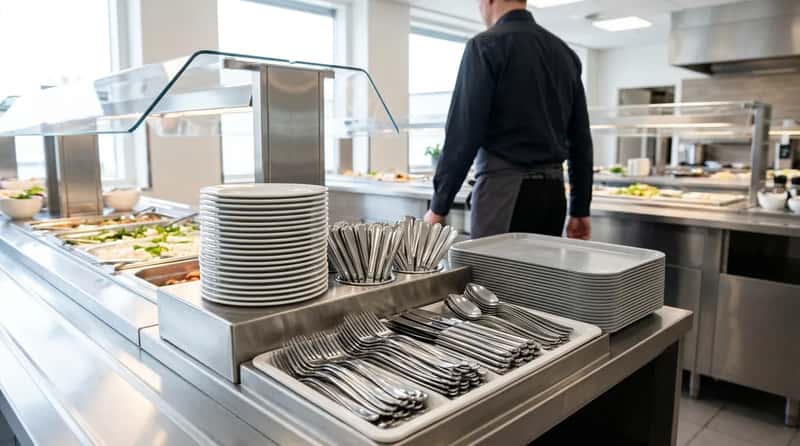
The stack of plates at the entrance of a buffet is the first thing every guest touches, and one of the last things staff actually inspects.
Utensils and plates must be displayed with food-contact surfaces protected, handles up, cups stacked face down. A manager checks this before guests arrive, not during the rush.
Reusing a plate for seconds might feel harmless, but it risks contaminating serving utensils and mixing old crumbs into fresh food. That’s why the stack of clean plates exists in the first place.
Water spots and lipstick marks on plates signal a dishwashing failure – and a manager who misses this before service starts is setting up for dozens of guest complaints.
#5 is where things get genuinely surprising – most people have never even heard of this check…
#5 – Temperature Logs From the Previous Service
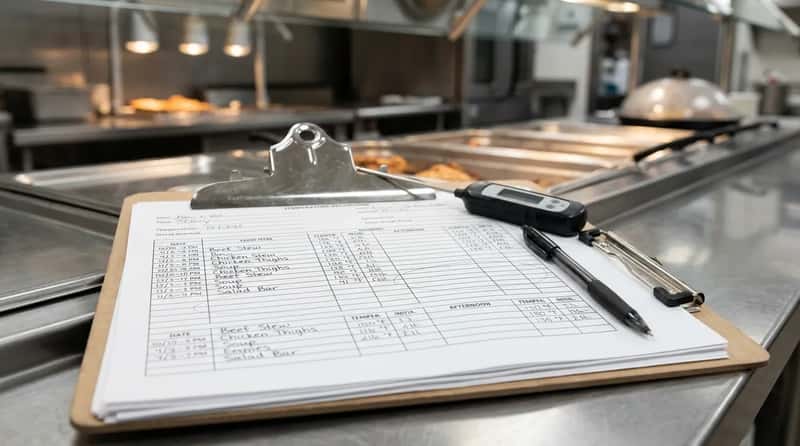
This one happens completely behind the scenes, but it’s non-negotiable in any serious operation.
Temperature logs, cleaning schedules, and staff certifications must be kept on hand at all times. Before a new service period starts, a diligent manager reviews the last one, looking for dips, corrective actions, and flagged items.
Calibrated thermometers check food at receiving, storage, cooking, holding, and cooling, with every reading logged by time, item, temperature, and initials.
If a temperature log shows a gap – a two-hour window with no recorded reading – that’s a liability red flag, not just a paperwork problem. A missing entry in the middle of a busy shift could mean food sat in the danger zone with nobody checking it.
#4 brings us to the thing that separates a great buffet manager from an average one, and it has nothing to do with food…
#4 – The Ambient Smell of the Room
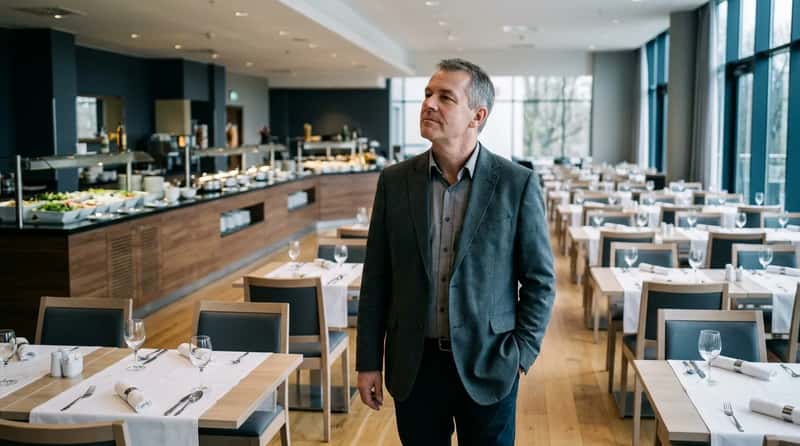
Experienced managers use their nose the moment they walk in, and it tells them more than any checklist.
A room that smells sour, musty, or like a drain has a problem that no amount of presentation will cover. Grease in the vents, standing water, and old food residue in hidden corners all have distinct smells that register instantly to a trained nose.
A fresh, neutral smell confirms the closing team did their job and there are no hidden sanitation problems.
Most foodborne illness outbreaks are traced back not to the food itself, but to cross-contamination on surfaces that were visually clean but biologically dirty.
The smell check is invisible to guests but immediately separates a well-run operation from a struggling one. And #3 is about something almost every diner ignores entirely…
#3 – The Condition of Chafing Dish Water Pans
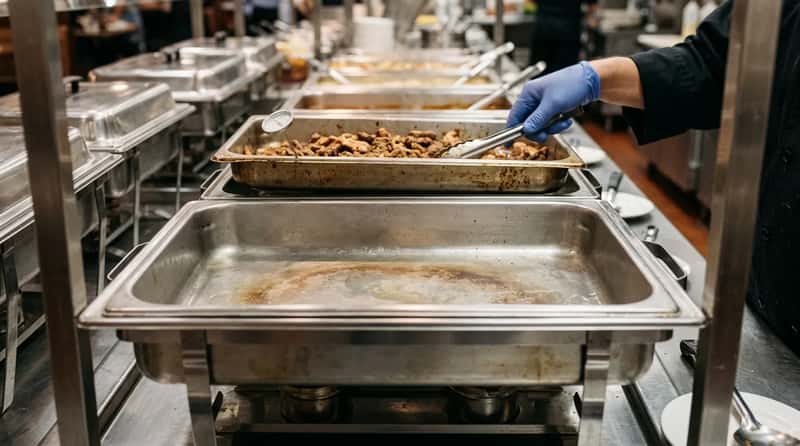
This is the one detail that separates a technically compliant buffet from a truly well-run one.
Chafing dishes use water in a lower pan to keep food heated evenly from below. When that water evaporates completely, the heat turns uneven and food temperatures can drop into the danger zone without any visible warning.
A manager who knows their operation checks water levels before service and assigns someone to monitor refills all shift long.
Empty or nearly-empty water pans are one of the most common reasons hot food dips below the legal holding temperature – and guests have absolutely no way to detect it.
Quick Compare
- Full water pan: steady steam heat, food holds safely above 140°F for hours.
- Dry water pan: heat turns direct and uneven, food can slip below 140°F with zero visible warning.
- Overfilled pan: risk of splashing or spillage every time the food pan is lifted or replaced.
Now we’re down to the top two, and #2 is the one that most restaurant owners argue about the most…
#2 – Whether the Staff Actually Knows the Menu That Day
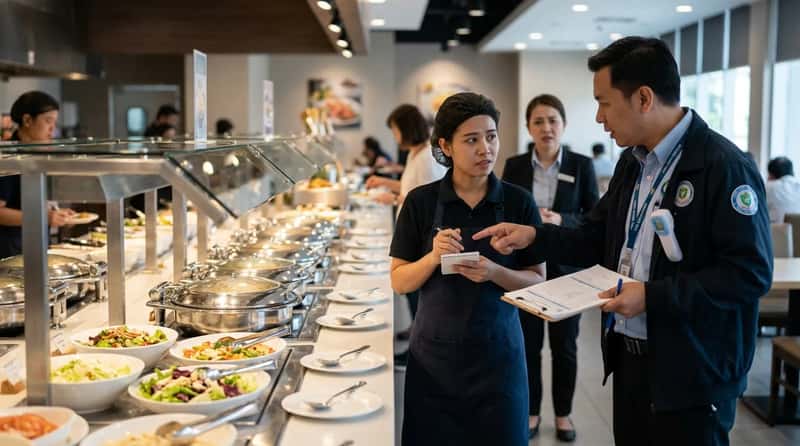
This one’s controversial: many buffet managers don’t brief their floor staff on the exact ingredients of every dish before service, and that’s a genuine problem.
Inspectors don’t just check procedures, they ask staff what’s actually in the food. A server who can’t answer a guest’s allergy question isn’t just unhelpful, they’re a liability.
New employee orientation should include food safety training before that staff member ever touches food.
The most dangerous person on a buffet floor is a new staff member who hasn’t been briefed and guesses when a guest asks about a nut allergy.
A confident, informed staff member is the final layer of protection between a safe meal and a medical emergency. Which brings us to the single biggest thing buffet managers notice, and it’s happening before anyone even touches a plate…
#1 – The First Guest Who Walks Through the Door
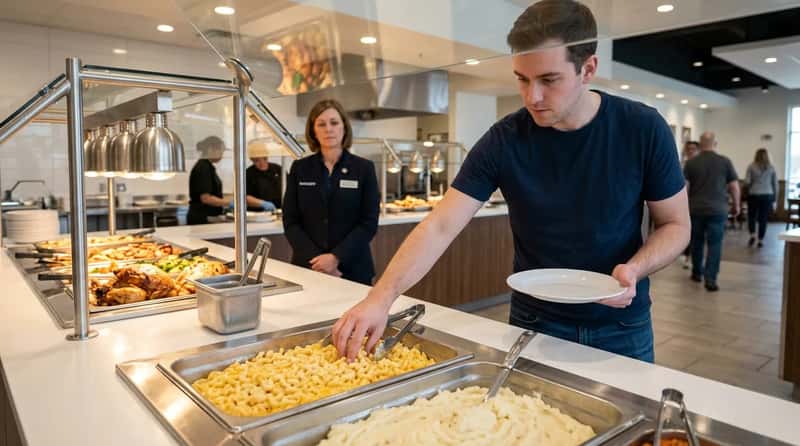
Here’s the thing no buffet manual will ever tell you: the most experienced managers spend the first 60 seconds of service watching the customers, not the food.
They’re looking for the person who grabs food with their hands instead of tongs. The guest who tries to refill their dirty plate. The kid who sticks a finger into the macaroni before a parent notices.
Guests contaminate food constantly without meaning to – refilling dirty plates, reusing dirty utensils, grabbing with bare hands, or leaning under the sneeze guard to reach further back.
A single careless guest in the first two minutes of service can contaminate an entire dish that 200 people will eat from over the next two hours.
Eating while standing in the buffet line is another major risk – saliva can spray onto food and pass bacteria to other consumers.
USDA Food Safety Guidance
The best managers position themselves at the corner of the room with a clear sightline to the entire line, not out of paranoia, but because that first wave of guests sets the contamination baseline for the entire service. Most people think the manager is the last line of defense. Turns out, they’re the first.
The Bottom Line
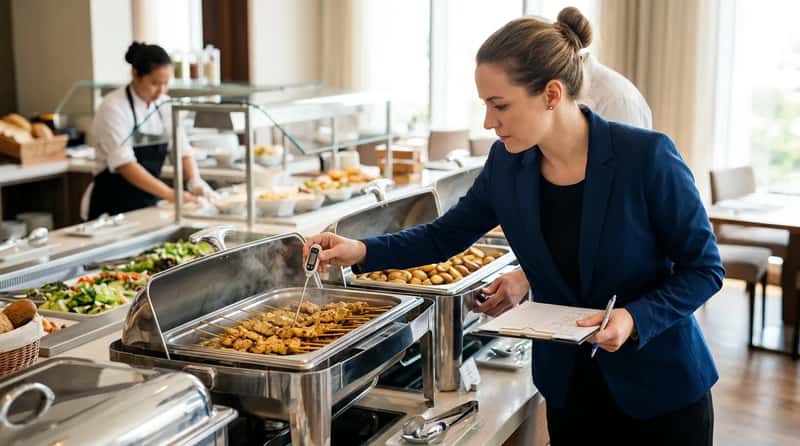
Buffet managers are running a live food safety operation every single service, and most of the critical work happens before you ever pick up a plate.
From temperature logs and chafing dish water levels to watching how the first customers serve themselves, the checklist is longer and more specific than most guests ever imagine.
The two-hour rule, correct utensil placement, and allergen labeling aren’t guidelines – they’re legal requirements with real consequences.
At a Glance
- Hot food: 140°F or above. Cold food: 40°F or below.
- Room-temperature limit: 2 hours max, just 1 hour if the room tops 90°F.
- Self-service utensils: sanitized at least every 4 hours.
- Every dish gets its own utensil – and its own accurate allergen label.
Next time you walk into a buffet, notice where the manager is standing. If they’re at the corner of the room scanning the line before the rush hits, you’re probably in good hands.
Did we miss one? Drop it in the comments below.