
Somewhere in your parents’ house – probably a closet, maybe under a bed – there’s a shoebox. Inside it are photos that have no business being as vivid as they are. Slightly washed out, edges soft from years of humidity, but unmistakably real. The 1980s produced a specific kind of family vacation photo that no filter can fake: the grainy film stock, the neon swimsuits, the wide grins in front of something massive and barely in frame. Nobody had a ring light. Nobody curated anything. They just pointed a chunky 35mm or a disposable camera at life and clicked.
Here’s the strange part – almost every American family from that era has the exact same fifteen photos. Just with different faces. The station wagon looks the same. The motel pool looks the same. Even the slightly defeated expression on mom’s face at the roadside diner looks the same. Some of these will make you laugh. At least one will hit harder than you expect.
#15 – The Station Wagon Packed to the Ceiling
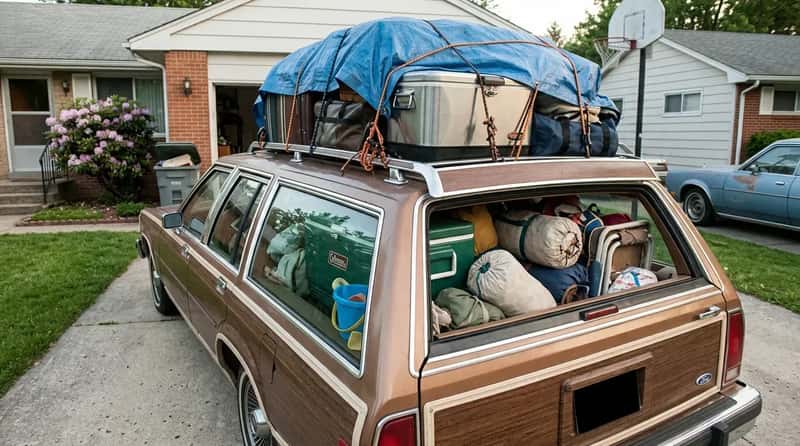
Before the trip even starts, someone grabs the camera and photographs the car. Not because the car is interesting – but because the sheer volume of stuff crammed into it deserves documentation. Suitcases on the roof rack under a tarp bungee-corded into place. A cooler wedged against the back seat. Sleeping bags compressed into tubes. This photo exists in approximately every American family album from 1980 to 1989.
The wood-paneled station wagon was the defining vehicle of the decade’s family road trip. These weren’t just cars – they were, as one era observer put it, “mobile command centers for families who needed space, reliability, and enough room for everyone’s gear.” Air conditioning was a luxury, not a given. Many families just rolled down the windows and let the highway roar drown out the arguments. That photo of the loaded wagon was the starting gun. Everything after it was the actual trip.
Fast Facts
- The Ford LTD Country Squire and Oldsmobile Custom Cruiser were among the most popular family wagons of the early 1980s – both could seat up to eight passengers.
- The 1980s marked both the peak and the beginning of the end for the full-size station wagon, as minivans began muscling in on their territory by mid-decade.
- National Lampoon’s Vacation (1983) featured a heavily modified 1979 Ford LTD Country Squire – five versions of the car were built just to be wrecked for the film.
- The Chevy Chase film is widely credited with accelerating the station wagon’s decline; minivan sales surged in the years that followed.
#14 – Kids in the Rear-Facing Back Seat, Waving
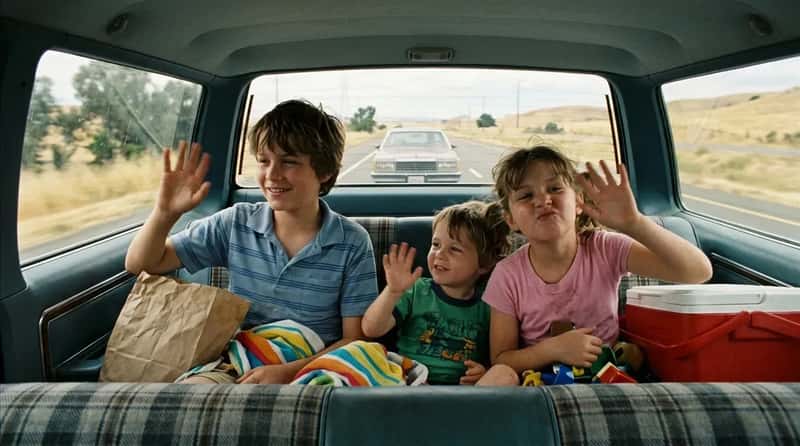
This one has a very specific composition: three kids crammed into the very back of the wagon, facing backward, pressing their faces or hands against the glass. Sometimes they’re waving at whoever is in the car behind you. Sometimes they’re just watching the road disappear behind them with a particular kind of bored wonder that children of the digital age may never fully experience.
Those kids weren’t just passengers – they had a front-row seat to everything the trip was leaving behind, watching the world unspool away from them mile by mile. No screens. No tablets. Just license-plate games, a crinkled AAA map spread across someone’s lap, and the hypnotic rhythm of highway lines. That backward-facing boredom somehow produced better memories than any entertainment system ever could.
#13 – Dad With the Paper Map at a Gas Station
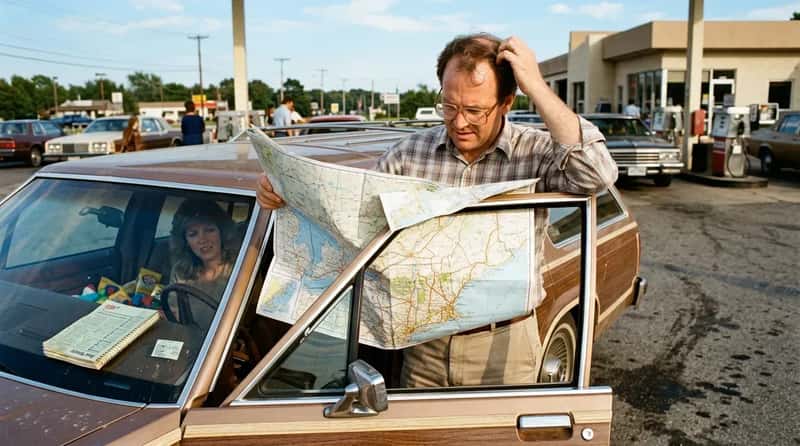
This photo is almost always identical: Dad standing next to the car, one hand on the open door, a paper map unfolded to a completely impractical size, looking either fully confident or deeply, silently lost. There is no GPS. There is no smartphone. There is a AAA TripTik tucked into the sun visor and a man who will not ask for directions under any circumstances whatsoever.
The AAA TripTik – a spiral-bound, custom-made route planner with detailed maps, highlighted paths, rest-stop notes, and recommended diners – was a genuine staple of the era. Families hit the road armed with these paper guides, cassette tapes, and total navigational independence, for better or worse. The wrong turn this photo eventually caused was usually where the best story came from.
#12 – The Motel Pool at Dusk
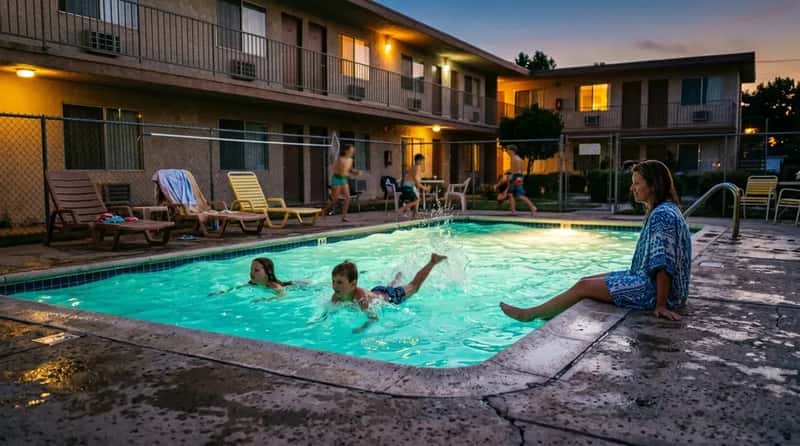
Every 1980s family vacation involved at least one night in a roadside motel, and every roadside motel had a pool that looked considerably better in the brochure. The photo from this moment is always taken at dusk – the water glowing aqua from an underwater light, a couple of kids mid-splash, someone’s mom sitting on the edge with her feet in, still wearing her cover-up.
These weren’t resort pools. They were rectangular, slightly over-chlorinated, ringed by faded concrete and plastic lounge chairs. But to a kid who had been in a car for eight hours, that motel pool was the most exciting place on earth – and the photo proves it. Nobody is looking at the camera. Everyone is in motion. The whole frame has the energy of pure, uncomplicated relief, which is exactly what makes it worth keeping.
#11 – The Entire Family in Front of a Giant Roadside Attraction
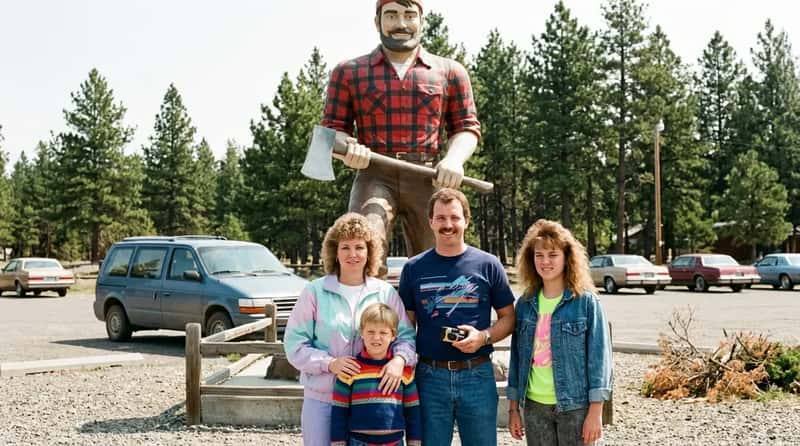
It might be a massive fiberglass Paul Bunyan. It might be the World’s Largest Ball of Twine – which began in 1953 when Kansas farmer Frank Stoeber started winding leftover twine into a sphere. It might be the Corn Palace in South Dakota, whose exterior murals are constructed from real ears of corn and redesigned every single year, drawing more than half a million visitors annually. Whatever it is, the whole family is lined up in front of it, squinting into the sun, and at least one child looks genuinely confused about why this was worth stopping for.
These roadside attractions weren’t just pit stops – they were destination-worthy oddities that families built entire detours around, and they generated photos with actual personality. Wall Drug. The Mystery Spot. Carhenge, built in 1987 from 38 vintage cars arranged in the same proportions as Stonehenge. Most of these places still exist but have lost the novelty that once made them legendary. The shoebox photo is the only record that your family cared this much about a giant corn building, and that makes it irreplaceable.
At a Glance: Classic 1980s Roadside Stops
- Wall Drug (Wall, SD) – Originally famous for “free ice water” since 1931; now draws more than 2 million visitors a year.
- Corn Palace (Mitchell, SD) – Built in 1892; its exterior is redone annually with roughly 325,000 ears of corn in 12 different shades.
- World’s Largest Ball of Twine (Cawker City, KS) – Started by one farmer in 1953; townspeople still add to it.
- Carhenge (Alliance, NE) – Built in 1987 using 38 vintage cars; one of the more surreal stops on any Midwest road trip.
- Mystery Spot (Santa Cruz, CA) – Open since 1940; its optical illusions made it famous enough to spawn a nationwide bumper-sticker craze.
#10 – Sunburned Kids on a Beach Towel

Nobody had SPF 50 in 1984. They had Coppertone and ambition. This photo captures the aftermath: at least two kids stretched out on a striped beach towel, shoulders a deep lobster red, possibly asleep, possibly just done with everything. There’s a plastic sand bucket nearby. Someone’s flip-flop got buried and was never recovered.
The 1980s beach photo is instantly recognizable by its color palette – the washed-out pastels of overexposed film combined with the neon of the swimsuits created a look that no Instagram filter has ever fully replicated. Sunscreen was applied once, maybe twice, and almost never to the shoulders. The burn was worn the next day like a badge of survival. And mom’s expression in the background says, clearly, that she told everyone this would happen.
#9 – Mom Carrying Everything While Dad Takes the Photo
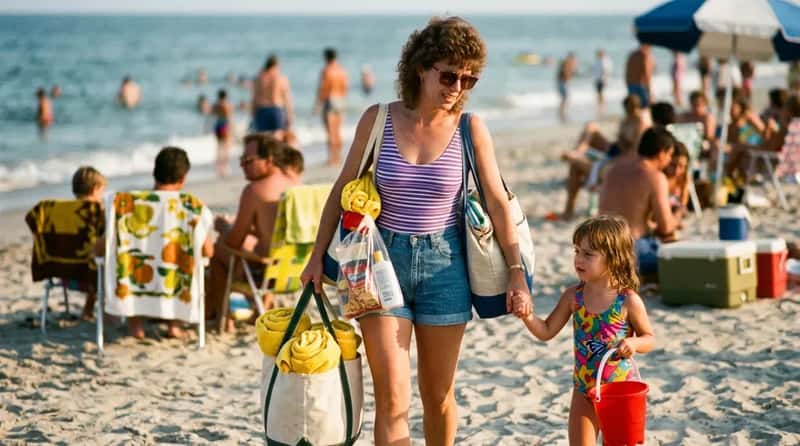
This one needs no caption. Mom has the tote bag, the snacks, the sunscreen, the extra towels, and at least one child holding her hand. Dad has the camera. The photo is in focus, which means dad did his job. Whether mom agreed with this division of labor is information the photo diplomatically withholds.
It shows up in almost every 1980s family vacation album in some variation – the beach version, the theme park version, the “walking into the motel lobby” version. What makes these photos unexpectedly powerful decades later is that they show what family life actually looked like when nobody was performing for an audience. The effort is unfiltered. The exhaustion is real. And the fact that mom kept these photos anyway says more about love than most things written about it.
#8 – The Blurry Shot of a Famous Landmark
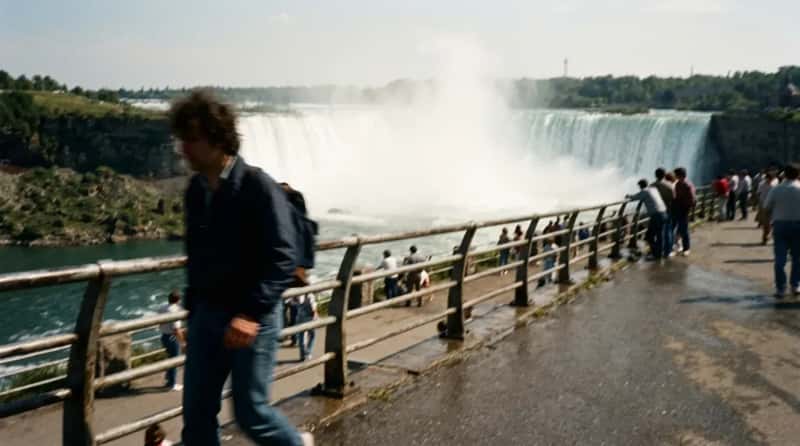
The Grand Canyon. Mount Rushmore. The Statue of Liberty. Niagara Falls. Every family visited at least one of these, and every family came home with a photo in which the actual landmark is slightly out of focus, too far away, or partially blocked by a stranger who wandered into the frame at exactly the wrong moment. The photographer – usually dad, sometimes a reluctant older sibling – did their best.
You could see the real view on a postcard. What the shoebox photo shows is that your family was actually there – actually present, actually squinting into the same sun. The blurry, badly composed shot is somehow the most honest document of the whole experience. The landmark just happened to be in the background.
#7 – Kids Posing With a Theme Park Character
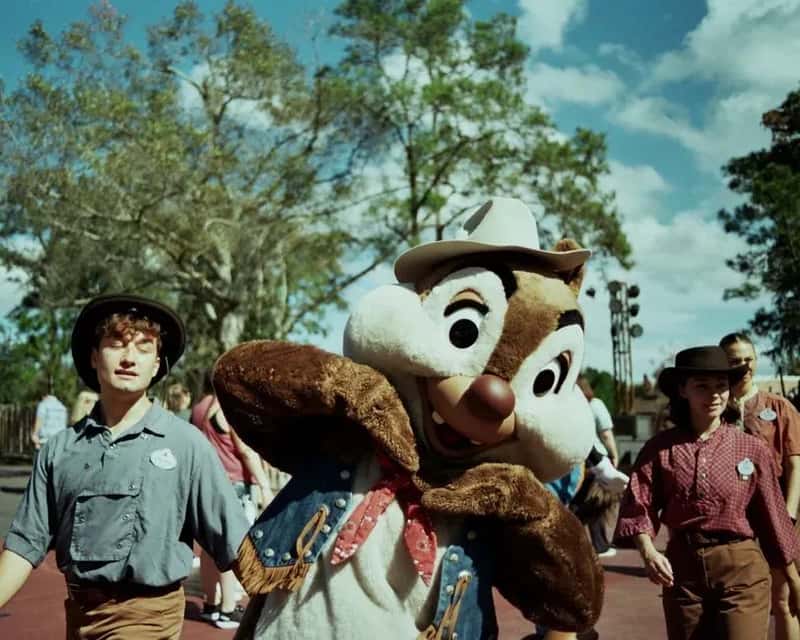
This photo has a very specific energy. The character is large, brightly colored, and professionally enthusiastic. One child is delighted. One child is terrified and doing a poor job of hiding it. Someone’s Mickey ears are crooked. The line behind them stretches back about forty people. Everyone is sweating because it is July in Florida and the costume weighs thirty pounds.
Disney World and Disneyland were the crown jewels of the 1980s family vacation circuit. EPCOT Center opened on October 1, 1982, as the resort’s second theme park, and through the mid-to-late 1980s Disney kept adding new pavilions – Horizons in 1983, The Living Seas in 1986, Norway in 1988 – pulling millions of families through the gates. That character photo became a genuine rite of passage: the physical proof that you made it, that the drive was worth it. Kids who were clearly terrified in the photo usually asked to take another one immediately after.
Worth Knowing: The Camera That Shot It All
- Most 1980s family vacation photos were taken on 35mm film cameras – each roll typically held 24 or 36 exposures, so every frame mattered.
- Fujifilm launched the first mass-market disposable camera, the QuickSnap, in 1986; Kodak followed with its own single-use camera, the Fling, in 1987.
- Those early disposables were priced around $10 and required no technical skill – point, press, done.
- Because film had to be developed after the trip, families often waited weeks to see whether the photos had turned out at all.
- The Kodak Carousel slide projector – the machine behind countless post-vacation living room shows – held 80 or 140 slides per tray and was in production from 1962 until October 2004.
#6 – The Roadside Diner Booth Shot
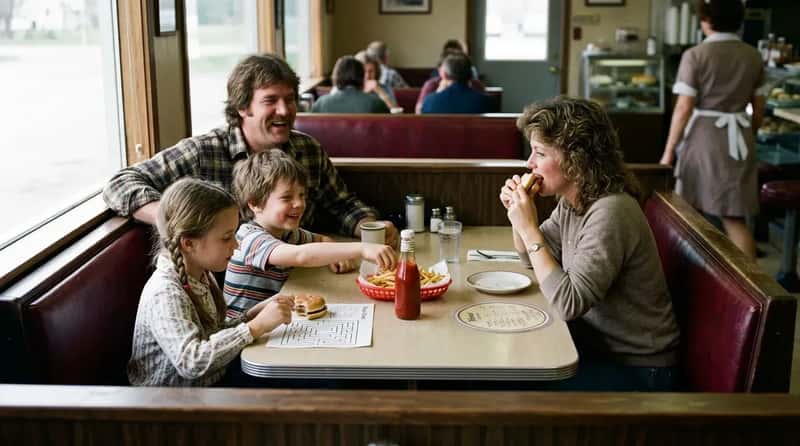
Somewhere between the interstate and the destination, the family pulled off for lunch. Not a chain – a real diner, the kind with laminated menus, a pie case by the register, and a waitress who calls everyone “hon.” The photo captures the booth: kids on one side, parents on the other, paper placemats, a shared basket of fries in the middle of the table.
An American road trip without a diner is just driving.
Charles Kuralt
The roadside diner was the social heart of the American road trip, and it produced some of the most unguarded family photos of the era – because nobody was posing for anything. They were just eating. Someone is mid-bite. Someone is laughing at something off-camera. Someone has ketchup on their shirt. These photos don’t look like vacation photos. They look like Tuesday. That’s exactly why they’re worth more than every posed landmark shot in the same shoebox.
#5 – Kids Asleep in the Back Seat on the Way Home
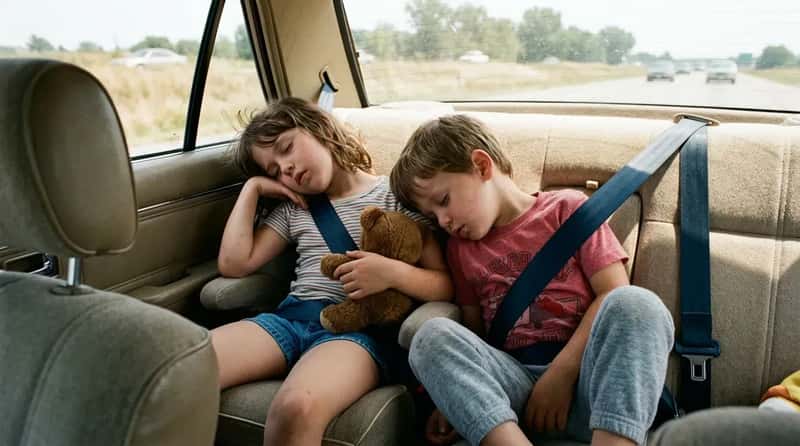
The trip is over. The cooler is empty. The souvenir bag is open and its contents are already slightly broken. And in the back seat, somewhere around hour three of the drive home, the kids crashed. Arms at impossible angles. Someone’s head resting on someone else’s shoulder. A stuffed animal from the gift shop clutched in one hand.
This photo was almost always taken by mom, quietly, from the front passenger seat. It is nearly universally the most tender photo in any 1980s vacation collection – not because it captures a landmark or a planned moment, but because it’s completely accidental. Nobody performed for it. It just happened. Decades later, the grown-up versions of those sleeping kids often say this is their favorite photo from any childhood vacation.
#4 – The Matching Outfit Family Portrait
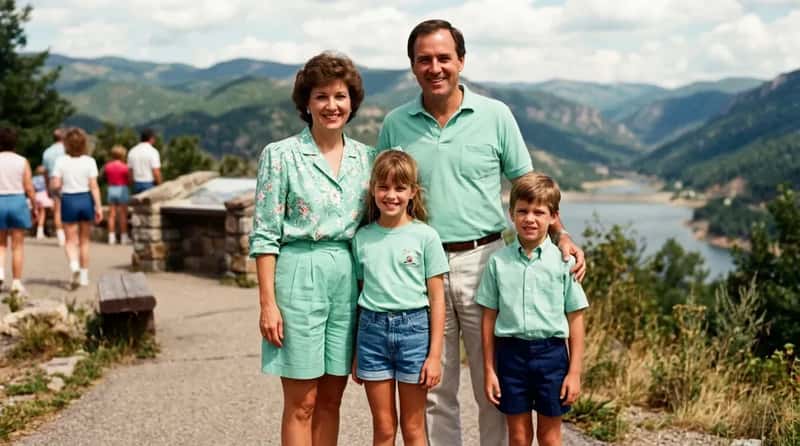
Someone decided the family should coordinate. Maybe it was mom’s idea. Maybe it was dad’s surprising moment of enthusiasm. Either way, everyone is wearing a variation of the same color – usually mint green, coral, or bright yellow – and lined up in front of something photogenic. The kids have been bribed or threatened into smiling. Dad is doing his absolute best.
Neon colors dominated 1980s fashion, and the matching vacation portrait was the decade’s answer to the Christmas card photo – it required effort, produced mild family conflict, and resulted in a document that is both deeply embarrassing and completely priceless. Nobody coordinates vacation outfits in quite the same earnest, all-in way they did in 1986. That total commitment to the bit is what makes the photo unforgettable forty years later.
#3 – Someone Holding a Tiny Souvenir in Front of the Real Thing
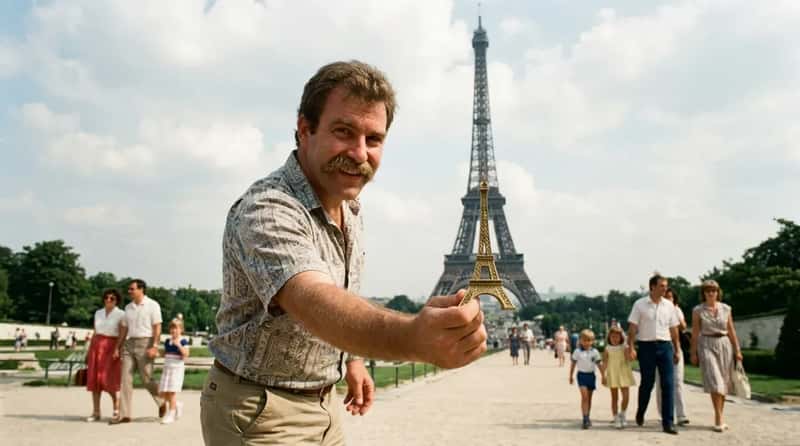
This is the optical illusion photo, and every 1980s dad believed he invented it. You hold up a miniature of the Eiffel Tower, or a snow globe of the Grand Canyon, or a ceramic Statue of Liberty from the gift shop, and you position it so it appears to be the same size as the actual thing behind you. The composition never quite works. The laugh it gets anyway is enormous.
This exact photo exists in millions of American shoeboxes, and yet every family that took it believed for a moment they were being uniquely clever. That’s part of what makes 1980s vacation photography so charming – people were genuinely inventing ways to make memories without any template to follow. They hadn’t seen a thousand versions of this shot online first. They just thought of it, tried it, and handed the camera to a stranger. The stranger usually cut off someone’s feet.
#2 – The Post-Vacation Slide Show Setup
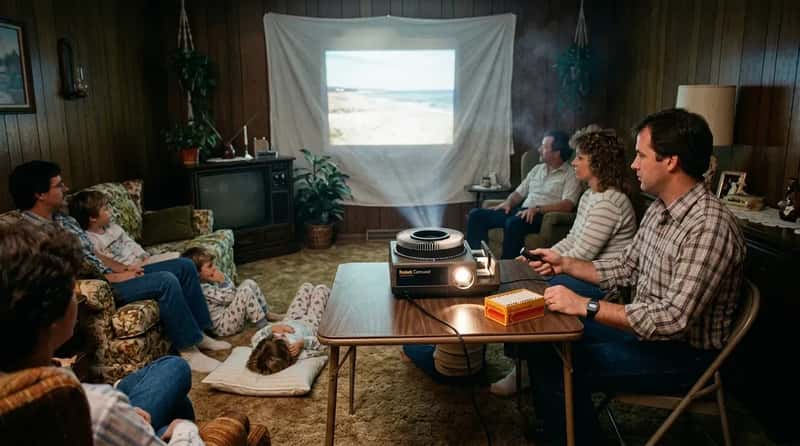
This one isn’t taken on the trip. It’s taken after. The living room furniture has been rearranged. A bedsheet has been pinned to the wall. The Kodak Carousel projector is humming on a folding table. Dad is in charge of the clicker. Neighbors have been invited. The kids have been allowed to stay up past their bedtime because this is a social occasion.
The post-vacation slide show was a genuine American ritual – a communal performance where the whole family relived every moment of the trip through glowing 35mm slides, whether they wanted to or not. You couldn’t fast-forward. You couldn’t skip to your favorites. You absolutely could not scroll past the boring ones. Boxes of old Kodachrome slides are now turning up at estate sales and in attic cleanouts across the country, and services that digitize them have grown steadily as grown children discover that their parents shot hundreds of slides through the 1970s and ’80s that nobody has looked at since. The photo of the setup itself – the projector, the pinned sheet, the folding chairs in a row – is rarer and stranger than any landmark shot, and worth twice as much.
Quick Compare: Then vs. Now
- Navigation: AAA TripTik spiral booklet and a fold-out paper map → Google Maps with turn-by-turn audio
- Camera: 35mm film (24–36 shots per roll, developed days or weeks later) → Smartphone with unlimited storage and instant preview
- Sharing the trip: Post-vacation slide show in the living room for neighbors → Instagram Stories posted in real time
- In-car entertainment: License plate games, cassette tapes, and the invisible territorial line → Individual screens, streaming, noise-canceling headphones
- Roadside discovery: Stumbled onto a giant concrete Brontosaurus by accident → Pre-researched, reviewed, and geotagged before leaving home
#1 – The Candid Laugh Nobody Planned
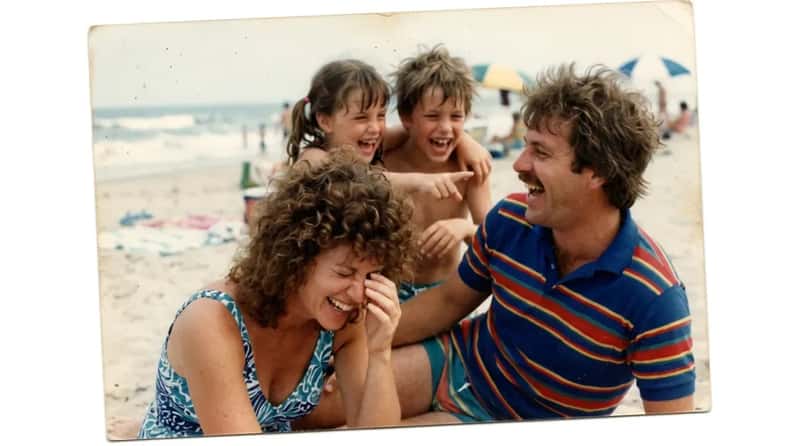
This is the one. Buried deepest in the shoebox, usually stuck to another photo because the humidity got to them both. Nobody is posed. Nobody is looking at the camera. Something happened – a seagull stole a sandwich, a wave caught someone off guard, dad said something ridiculous – and the moment was caught mid-laugh. Hair is everywhere. Eyes are half-closed. The composition is terrible. It is, without question, the best photo from the entire trip.
These unplanned, candid moments are what people actually remember most about 1980s vacations – not the landmarks, not the theme parks, not the matching outfits. The chaos. The laughter that could never be recreated if you tried. Every shoebox has one of these, and it’s always the last one people put down when they finally open the box after twenty years. It’s the one that makes someone say, out loud, to nobody in particular: “I forgot how good that trip was.” That photo is the whole point.
Go dig up that shoebox. It’s worth the excavation.