Most cruisers figure cabin trouble starts around night three, when the room looks like a suitcase exploded and the only outlet is already taken. Seasoned sailors know the real fixes happen in the first few minutes aboard, before a single zipper opens.
Some of these moves take ten seconds, and skipping them can cost you sleep, gear or a peaceful first evening. Here’s what cruise-line rules, ship bloggers and veteran cruisers actually say, and the last item has caught out plenty of people who packed it on purpose.
#16 – The Thermostat Nobody Checks

Seasoned cruisers often touch one small dial before they even look at the bed. One Royal Caribbean Blog writer says it’s the first thing they do after opening the cabin door.
You control the air conditioning or heat in your room, and newer Royal Caribbean ships let you pick an exact temperature while older ships use a slider. It’s not unusual to walk in and find the cabin too hot or too cold.
That writer sets the thermostat to the coldest setting in warmer months, and says balcony rooms heat up faster than inside rooms because of the sun pouring in. Whether ‘coldest’ is overkill is a fair debate, since it’s one cruiser’s preference and not a rule.
Set it now, and the room has hours to settle before you crawl into bed. Wait, and you’re the one lying awake at 2 a.m., wondering why the cabin feels like a sauna.
Comfort is sorted, but the next fix depends on a person who is about to become the most useful human on the ship.
#15 – The Steward You Haven’t Met

Your cabin steward can fix half this list, but only if you ask early. Most people don’t realize how much is negotiable.
Sometime after boarding you’ll likely meet your cabin attendant, who is very busy at that point but will usually take a few minutes to introduce themselves and explain how often they’ll clean. That’s a good moment for requests such as extra hangers, extra bathroom towels, or a daily refill of the ice bucket.
Cruise Critic also suggests using day one to ask about extra towels, pillows or bed changes. Be prepared for the cabin not to be ready at first, since stewards may still be cleaning or making beds.
A quick, friendly hello also puts a face to your name for the person who will be in and out of your room all week.
Sorting this out now also sets up the next fix, which has to do with how you actually sleep.
#14 – A Bed That Isn’t Set Up For You
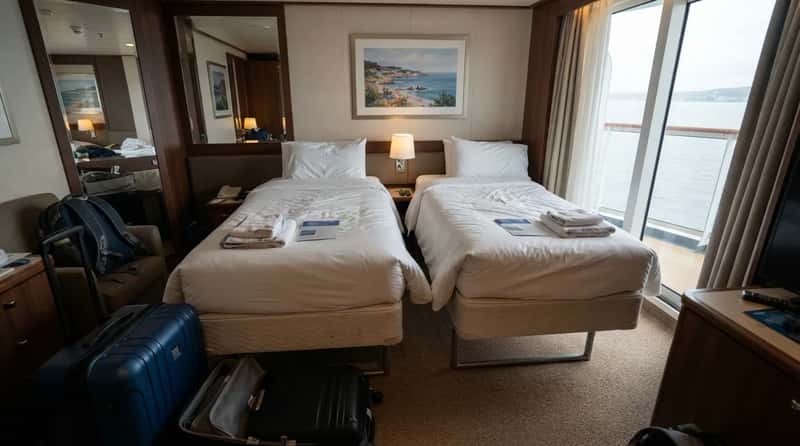
The bed you walk into may not be the bed you want. Discovering that at 11 p.m., with luggage everywhere, is a lousy way to end embarkation day.
Cruise Critic’s list of cabin tips covers everything from bed configurations to extra storage. The idea is simple: cabins often let you choose between beds set apart or pushed together, depending on the ship and cabin category.
Check that before your bags are open, because moving beds around is harder once suitcases are tucked beneath them. Life Well Cruised also lists a mattress cover among the things you can ask your steward for, if you want the bed to feel more comfortable.
Here’s the catch: mattress comfort is the thing many travelers don’t mention until night two. The steward can only adjust what they know about, so say it early.
And the next thing to handle is the one most people leave lying on the desk.
#13 – Valuables Left in the Open
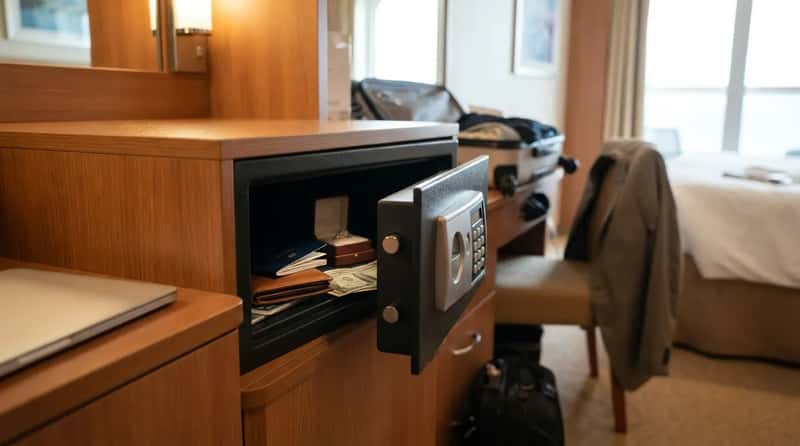
The safe is the first thing veterans use and the last thing first-timers remember. Embarkation day is exactly when things are easiest to misplace.
Cruisemummy advises putting anything important in the safe once you’ve looked around, including passports, spare cash, jewellery, laptops and wallets. Cruise cabins are generally very safe, and your steward will be in and out cleaning during the sailing.
The real risk is a busy day and a distracted brain. The same guide says to keep your cruise card with you and stash the rest.
Picture the alternative: a passport tucked into a jacket pocket, or a wallet buried under a pile of fresh towels.
It sounds cautious, but the bigger delay of day one is something else entirely, and it involves your suitcase.
#12 – The Suitcase That Hasn’t Arrived
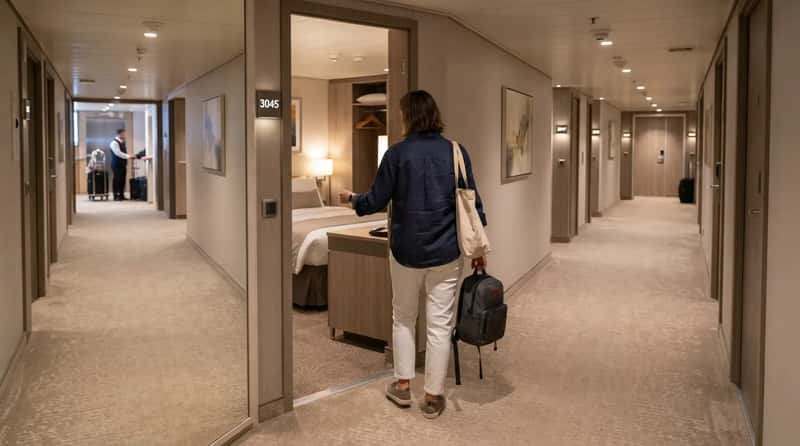
Your luggage may not be waiting at your door, and that’s normal. Plenty of first-timers panic.
It can take a few hours for crew to deliver thousands of bags from the quayside to the correct doors. By the time the ship sails away, your luggage will likely have been delivered.
Iglu Cruise recommends packing a change of outfit in your carry-on so you can get changed without waiting for your main luggage. Cruise.Blog adds that the carry-on should hold essentials such as chargers, medication, sunscreen, jewelry and a swimsuit.
Fast Facts
- Bag delivery can take a few hours after you board.
- Pack one full change of clothes in your carry-on.
- Keep chargers and medication with you, not in the big bag.
- Add sunscreen and a swimsuit so you can hit the pool right away.
The mistake is sending the important items into the big bag, then standing in the corridor waiting for it. The carry-on is effectively your cabin for the first few hours.
A swimsuit in that bag means you can be at the pool while your suitcase is still working its way through the ship.
Once the cases do arrive, one safety task matters more than any of them, and it has a deadline.
#11 – The Muster Station You Haven’t Found
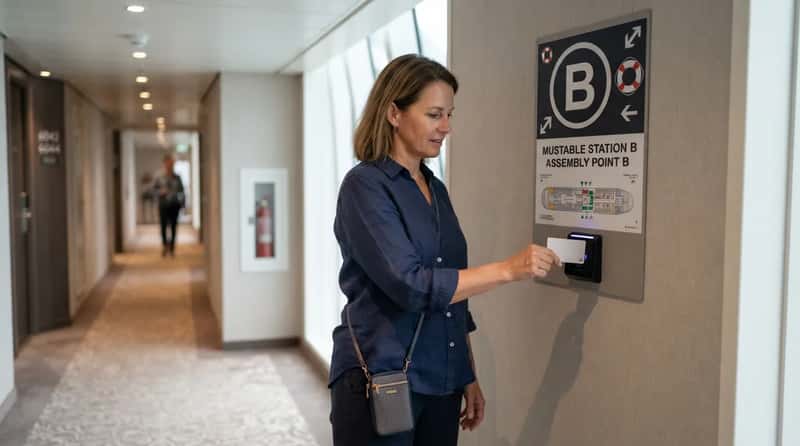
There’s one cabin task you can’t skip, and it isn’t optional. Cruise lines require it.
Cruise Critic says to locate your muster station right away, using the cabin-door map, cruise card, app or steward, since drill attendance is required within 24 hours. Iglu Cruise points to the safety map on the back of your cabin door.
With an e-muster, you watch the safety video in your cabin and then go to your station, where you tap your cruise card on a reader. Getting it done early means nothing hangs over your first sail-away.
It also spares you the awkward moment of wandering unfamiliar corridors, hunting for a station number.
That’s the serious part handled, so the next one is about a record most people never think to make.
#10 – The Photo You’ll Wish You’d Taken
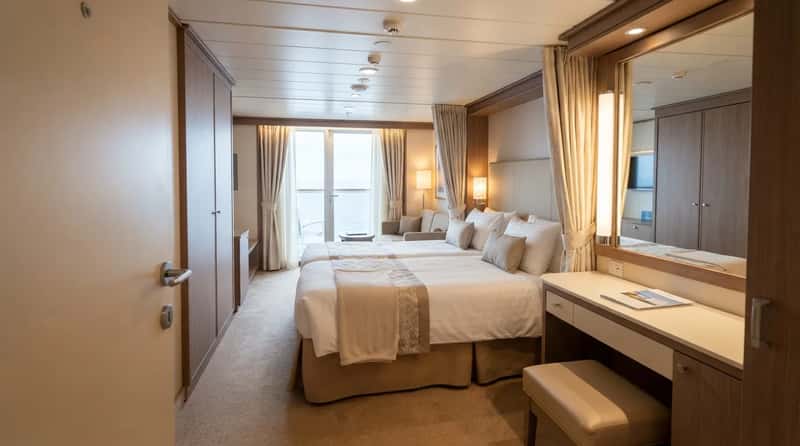
Your cabin will never look this good again. Veterans know the best time to photograph it is the second you walk in.
From chargers on the vanity to shoes and clothes sprawled about, the cabin will never be as put together as when you first enter. Iglu Cruise suggests taking a few photos or a video while the room is still tidy.
There’s a practical payoff beyond the social media post. The photos help you remember where things belong when packing up at the end of the cruise.
They’re also a way to remember your cabin number or layout if you plan to book the same ship again. A two-minute video can double as a packing checklist.
Once the record exists, it’s time to deal with where everything will actually go.
#9 – Suitcases With Nowhere To Hide
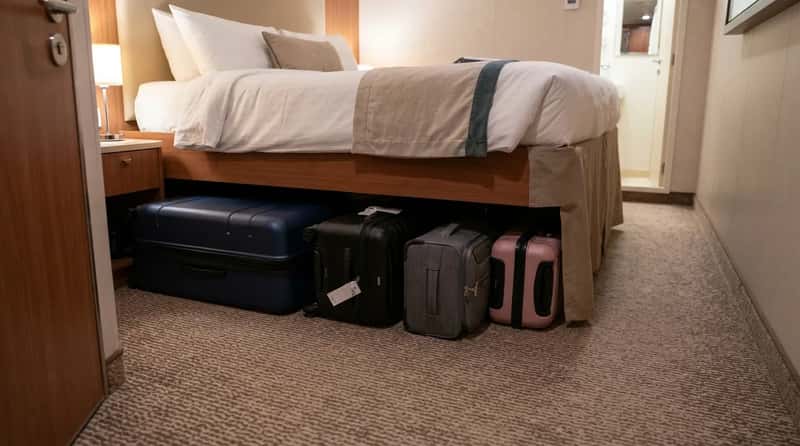
A cabin looks roomy until four suitcases are open. The fix is hiding in plain sight.
Cruise Critic says to use the space under the beds for suitcases and less-used gear, and to ask the steward to leave access clear for bedmaking. That single move clears the floor, which matters most in tight inside cabins.
Empty cases slid out of sight also keep the path from bed to bathroom clear. That’s the walk you’ll make a hundred times, often in the dark.
Life Well Cruised advises hanging what you can, and using packing cubes to keep folded clothes organized on shelves and in drawers. The same site says unpacking should be done as soon as you can on day one.
At a Glance
- Empty suitcases go under the beds.
- Hang what you can, right away.
- Packing cubes keep shelves and drawers tidy.
- Leave clear access under the bed so the steward can make it.
Here’s where opinions split: some cruisers live out of their cases all week, while others unpack everything. The case for unpacking is simple: the mess you avoid on day one is the one you won’t be digging through on day five.
But the biggest space trick of all is on the walls, and it’s the one almost everyone underuses.
#8 – Walls That Secretly Work As Storage
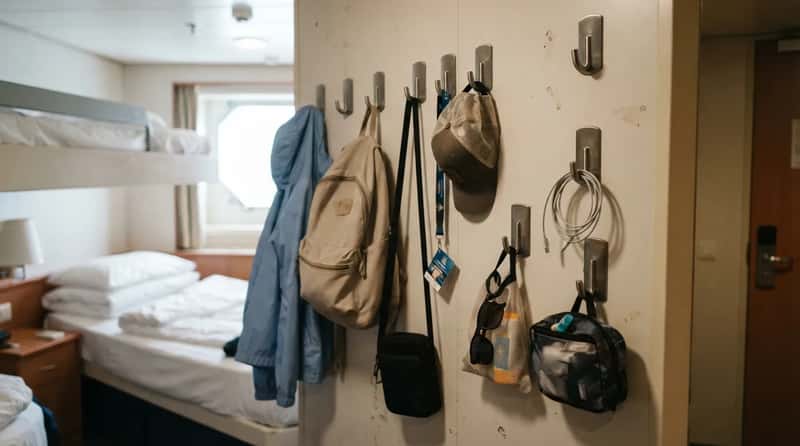
Your cabin has a hidden storage system, and it’s made of steel. Seasoned cruisers bring magnets to use it.
Cruise Critic notes that cabin walls are magnetic, so magnetic hooks can create extra storage. Members recommend hooks designed for barbecue utensils that hold at least 10 pounds, enough for jackets or backpacks.
One member brings about 20 magnets and warns anyone who hasn’t bought yet to avoid the ones that only hold 5 pounds. One gear review site puts six hooks as a working minimum for a couple, and ten or more for families.
That last number is one site’s guideline, not a rule, so treat it as a starting point. A weak magnet isn’t a bargain; it’s a jacket on the floor.
But hooks have a flaw that nobody mentions on the packaging, and it’s coming up next.
#7 – Hooks That Slowly Slide Off
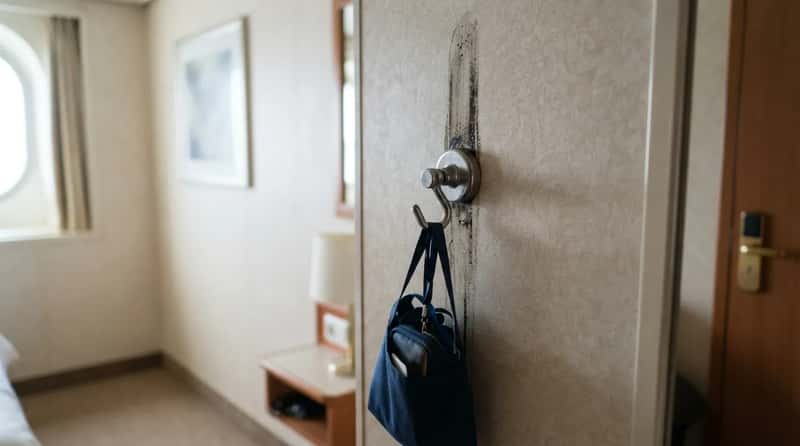
That ’30-pound’ rating on the box probably doesn’t mean what you think. Wall hooks fail for reasons worth understanding.
Many cabins have paint or wallpaper over the steel, and even a thin layer creates a gap that lowers the magnet’s effective pull. The further an item sticks out from the wall, the more leverage there is to tip it or pull it off.
Think of a fridge magnet holding up a page under a thick sheet of paper: the pull is still there, just weaker.
One cruise blogger says that a hook rated for 22 pounds on a ceiling will support only around 5 pounds on a wall before slipping. Another review site’s advice is simple: buy stronger than you think you need.
Worth Knowing
- Keep hooks out of your walking path, including by the entry door.
- Avoid the tight space between bed and wall, where you’ll bump them.
- Watch for nearby ceiling sprinklers and wall-mounted sensors.
- Heavier or bulkier items need a stronger magnet than the box suggests.
So the magnets are sorted, but the next room in the cabin breaks the rules entirely.
#6 – The Bathroom That Ignores Your Plan
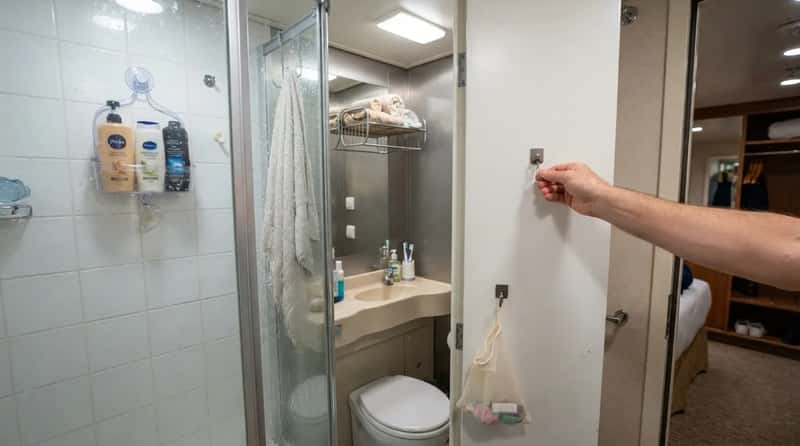
The bathroom is where good cabin hacks go to die. The wall rules change in there.
Cruise Critic says to bring magnetic hooks for steel walls and doors, but to use suction accessories in showers because magnets won’t stick there. Another guide agrees that areas within the bathroom may be less magnetically receptive than the rest of the stateroom.
That means your shampoo shelf and towel plan need a different answer than your jacket hooks. Test a hook on the bathroom door before you rely on it.
It’s a small detail, yet it decides whether your toiletries stay put when the ship moves. The one wall you’d most like to use may be the one that can’t hold a magnet.
And once the bathroom is dealt with, there’s a problem that can’t be seen on any checklist but can be heard all night.
#5 – The Noise Hiding Above and Below You
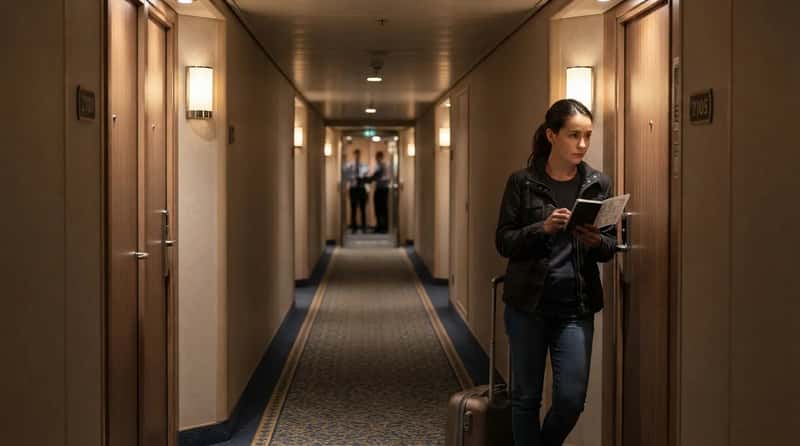
Your cabin’s worst feature may not be in the cabin at all. It might be on the deck above or below it.
One guide says to check what is above and below the cabin so you don’t solve motion and create a noise problem. Lower-deck cabins can sometimes be noisier because of proximity to the engine room, crew spaces and anchor mechanism.
Cruisebound adds that very low decks can feel more mechanical noise or vibration, particularly toward the aft. One forum guide claims kitchen exhaust and plate clanging below a main dining room begin around 5 a.m.
Sources don’t fully agree. One publication says the aft tends to be the quietest part of the ship, while another links the stern to more engine and thruster noise.
If something is wrong, tell guest services on day one, because the next problem is one that noise only makes worse.
#4 – The Motion You Can Plan Around

The ‘best’ deck on the map may be the worst one for your stomach. That’s a bold claim, and cruise-forum wisdom backs at least part of it.
The widely repeated answer is a low-deck, midship cabin as the best place to minimize seasickness. One forum guide argues a midship Deck 5 cabin on an Oasis-class ship will feel far steadier than a forward Deck 12 cabin, even though Deck 12 sounds more desirable.
Some cruisers now argue that paying extra for a high deck is a mistake if you’re motion-sensitive. Cruisebound notes that rolling may feel more pronounced higher up.
But a Royal Caribbean Blog writer says a balcony helps too, since seeing the horizon and getting fresh air can settle your brain. Bring medication, wristbands or patches if you’re extremely prone to seasickness.
Even a perfectly placed cabin fails if your phone is dead, and that’s where the next two get interesting.
#3 – Outlets That Don’t Exist
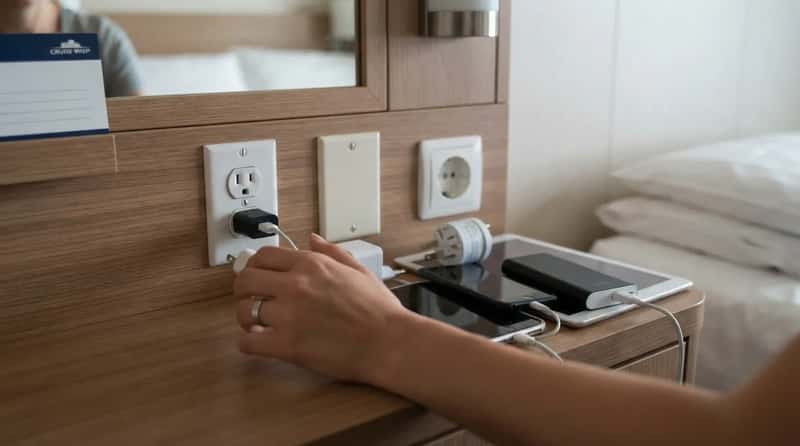
Your cabin probably has far fewer outlets than your devices need. Count them before you unpack a single charger.
PlugHopper says most ships have one or two usable outlets in a cabin. Another guide says most cabins have one usable 110V outlet near the desk or vanity, and sometimes a second behind the TV or near the bed.
Cruise Critic also flags that some cabins have only round European two-prong outlets, so you may need an adaptor. And on an older ship, the cabin may be sparse in the outlet department.
The smart move is to find every outlet and USB port in the first minute. In a shared cabin, whoever finds them first usually claims the bedside spot.
Charging in the cabin is only half the story, because the real battery drain happens the moment you leave.
#2 – The Dead Phone on Port Day

The real power problem begins when you step off the ship. Cabin charging is what saves you.
Picture a foreign pier at 4 percent battery, with no map and a tour meeting point you can’t find.
One outlet guide says a 20,000 mAh power bank charged in your cabin overnight covers an entire day ashore. The same guide warns that the few outlets near the pool bar are perpetually occupied.
It also notes that tour buses in the Caribbean and Mediterranean rarely have USB ports, and suggests planning for offline maps and taking fewer photos. That’s one guide’s view, but the logic holds up.
So the bank goes on charge first, before the phone, before the camera. The device that can rescue your phone is the one most people forget to charge.
But there’s one charging shortcut that has cost plenty of passengers a gadget, and it’s the final item.
#1 – The Power Strip That Gets Confiscated
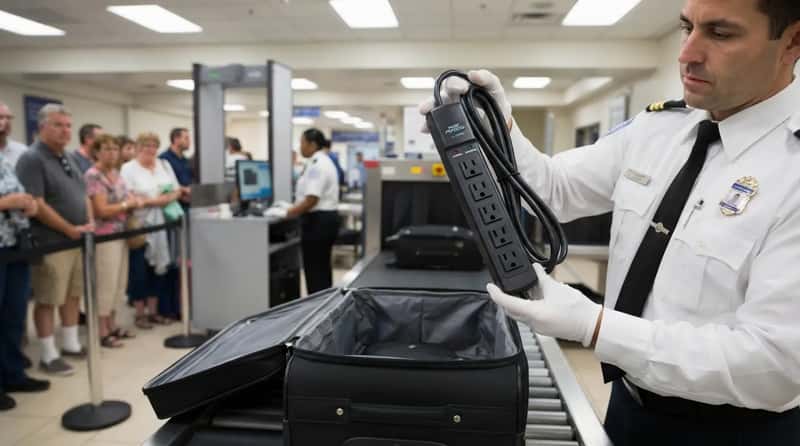
The ‘harmless’ power strip from your desk is a classic item cruise security pulls from bags. It’s the mistake that catches even experienced cruisers, sometimes right at the scanner.
Surge protectors are banned on every major cruise line, and security will confiscate them. Their circuitry is built for a building’s grounded system, and on a ship’s isolated ground it can reportedly fail in ways the vessel’s fault detection treats as a fire risk.
Royal Caribbean is the strictest of the bunch, and current guides say it bars all power strips, multi-plug adapters and extension cords. Several other major lines, including Carnival, Norwegian, Princess and Disney, have allowed non-surge power strips, though rules vary.
Quick Compare
- Surge protectors: banned on every major line and confiscated.
- Royal Caribbean: bars all power strips, multi-plug adapters and extension cords.
- Carnival, Norwegian, Princess, Disney: have allowed non-surge strips, but rules vary.
One guide says that if security pulls a surge protector, it goes into a holding locker and is returned at debarkation. Even a strip without surge protection can be banned, depending on your cruise line.
That’s the list, and the pattern across all sixteen is worth a final look.
The Bottom Line
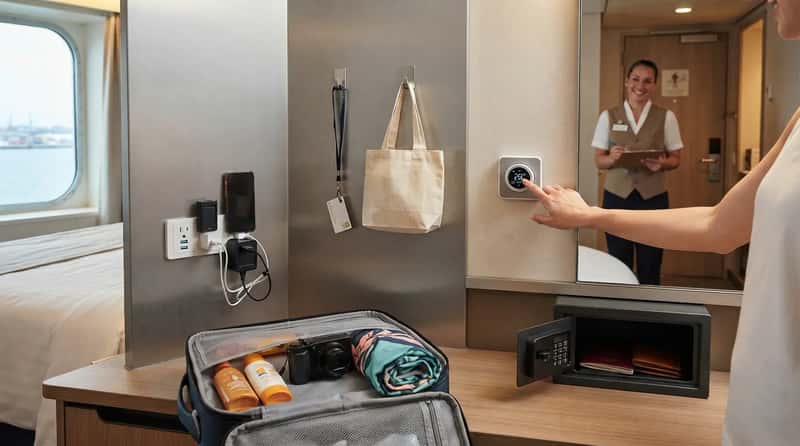
Most cabin problems are solved in the first ten minutes: thermostat, steward, safe, muster station and a quick photo. The rest depends on choices made before boarding, from cabin location to what’s in your carry-on.
The most surprising findings are the practical ones. Wall hooks can lose much of their rated strength on painted steel, and a power strip that works at home can be confiscated at the terminal.
A cabin is a small rented room that has to survive a week of sunscreen, souvenirs and wet swimsuits. The cruisers who enjoy it most treat those first ten minutes like setting the stage.
Cruise-line rules change, so confirm the details with your own line before you sail.
Which of these did you learn the hard way, and which cabin fix would you add to the list?
Bonus: The Five-Minute Cabin Test Most Cruisers Skip
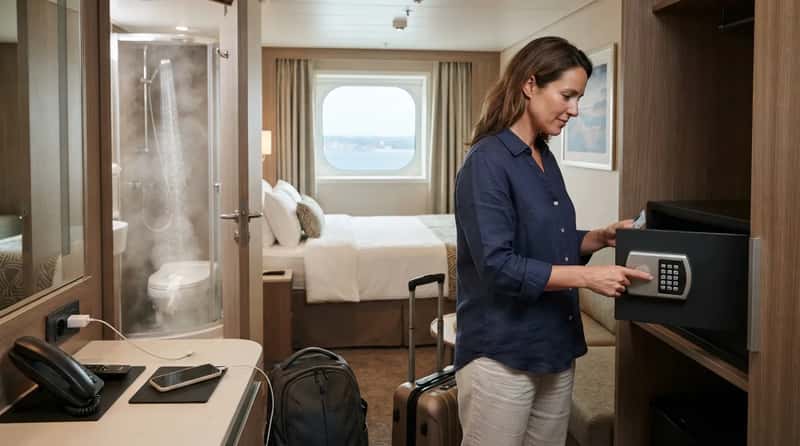
Before you unpack anything, treat your cabin like a rental car and test everything that can break. A fault reported on day one is far easier to fix than one you mention on day five.
- Test the safe empty first. Set your code, lock it, then open it again with the door shut behind you. Only then put your passport inside.
- Run the shower and flush the toilet. Let the water run until it turns hot, and listen for leaks or weak flushing.
- Check the basics. Try the lights, TV, cabin phone and every outlet with a phone charger.
- Photograph any stains or damage. Report them by cabin phone or at guest services right away.
Ask about a fix or a different cabin that same afternoon. Ships tend to be fullest and most stretched later in the voyage, so early reports give staff the most options.
Do this while your bags are still in the hallway or on their way. It costs five minutes and protects the other six days.