
Walk up to the counter, mention you’re 65, and expect the bag fee to vanish? Actually, that almost never works. Most major U.S. airlines no longer offer a blanket senior discount, and checked-bag fees keep climbing, with some carriers now charging about $45 for a first bag. But the desk really can drop certain baggage charges, and plenty of older travelers qualify for them without knowing it.
Here’s the twist: your birthday isn’t what unlocks the waiver. The reason you give is. Some of these rules are federal law, a couple are refunds you’re already owed, and one is a genuine over-65 perk hiding on another continent.
#15 – The Medical-Only Bag That Skips the Fee Entirely

A bag packed with nothing but medical gear is treated differently from regular luggage. Frontier says bags containing only medical devices and supplies are exempt from carry-on and checked bag fees. Delta likewise allows medical supplies or equipment on board as additional items at no extra charge. That means the bag of supplies can travel free next to your normal luggage.
Here’s the catch most people miss. If your supplies sit inside a larger bag with other non-essential items, Delta says that bag is not free and normal fees apply. One stray pair of shoes can turn a free bag into a full-price bag. That’s nothing compared to what budget carriers do with carry-ons, which is #14.
#14 – The CPAP Carry-On That Doesn’t Count as Your Carry-On

Budget airlines often charge for a carry-on, which makes this one a real money-saver. The Air Carrier Access Act is the rule every airline must follow here, and the DOT’s Part 382 says assistive devices and aids can’t be counted against carry-on limits. A CPAP case is the classic example. It rides along without using up your allowance.
At a Glance
- The rule: Air Carrier Access Act, backed by DOT Part 382
- Counts against carry-on limits: No, for CPAPs and portable oxygen concentrators
- Still required: It must fit in the overhead bin or under the seat
- Heads-up window: Up to 48 hours’ notice if you plan to use a device in flight
The fine print matters, though. These devices still follow the usual size rules, and advance notice makes the desk conversation far smoother. That one phone call can decide whether the desk waives anything at all. The next item is even more routine, and almost nobody uses it.
#13 – Hearing Aids and Pill Bags That Ride Free

Medication is the one thing airlines tell you never to check. Frontier advises always packing medicine in your carry-on, so you can reach it during the flight and so delays or temperature swings can’t hurt it. The good news is that you shouldn’t pay extra for it either.
This is where the desk conversation helps. If an agent tries to count that little pouch against your carry-on allowance, calmly say it’s a medical item. The smallest bag on the plane is often the one with the strongest backing. Next up is a fee that sneaks in when you check something bigger.
#12 – The Second-Bag Fee That Shouldn’t Apply to Your Walker
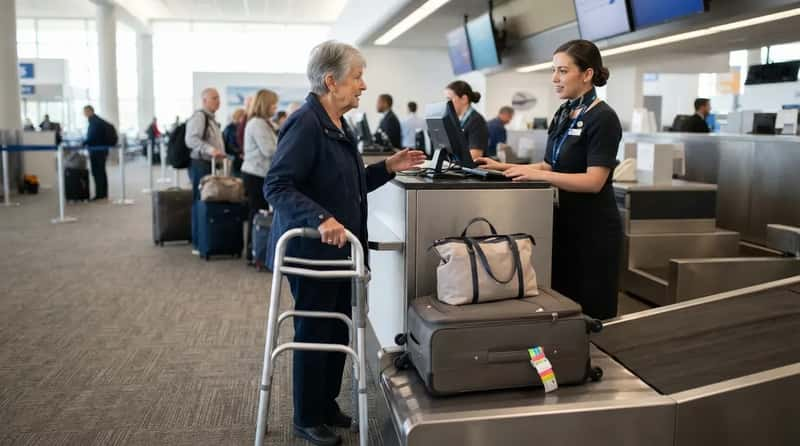
Many people count a folding walker or cane as one of their bags. They shouldn’t. According to the DOT, assistive devices do not count toward your baggage limit. So a walker doesn’t push your suitcase into “second bag” pricing.
The DOT is also clear about the limits. If a bag also contains personal items, the airline can count it toward the baggage limit, and a fee may apply. That means the device has to travel on its own, not buried in a suitcase. Second bags often cost more than the first, so the stakes are real. It gets more interesting when the device is too big to carry on, which is #11.
#11 – The Fee for a Wheelchair Stowed in the Cargo Hold
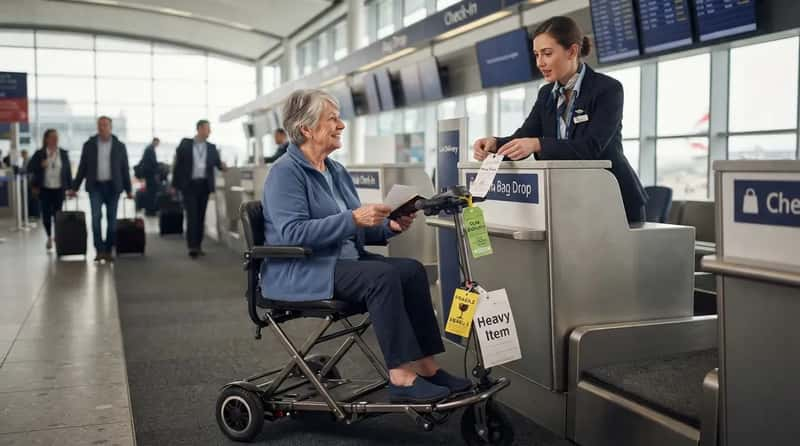
If a mobility device can’t fit in the cabin, you shouldn’t pay to check it. The DOT’s consumer guidance treats assistive devices differently from ordinary luggage. Your device must be returned as close as possible to the aircraft door, unless you ask to pick it up in baggage claim. That alone changes the whole airport experience.
Preparation helps here. The DOT recommends sharing the device’s size, weight and battery type so the airline can handle it safely. Airlines must also check it and return it in the same condition it was received. A powered chair is not “luggage,” and federal rules treat it that way. The next fee isn’t about disability at all.
#10 – The Wrong Charge the Agent Added by Mistake

Sometimes the baggage fee is simply an error. A tired agent sees a CPAP case, a folded walker and a suitcase, and charges for all three. If you spot it at the desk, ask for it to be reversed right then. It’s far faster than disputing it from your kitchen table a week later.
If it’s too late, you still have options. The DOT doesn’t mandate automatic compensation, but airlines are required to process refund requests for erroneous charges. Keep your receipt and boarding pass. Plenty of travelers never ask, so the airline keeps money it shouldn’t. Another refund applies even when the agent did everything right, as the next item shows.
#9 – The Bag Fee You Can Get Back When Your Suitcase Shows Up Late

Paying to check a bag that then arrives a day late is one of travel’s most irritating moments. Under a 2024 DOT rule, airlines must refund the checked-bag fee when a bag is significantly delayed. For domestic flights, the cutoff is 12 hours after arrival.
Stand at the baggage service office before leaving the airport and file the claim there. Ask the agent to confirm the refund in writing. The refund is meant to be automatic, but it never hurts to check that it actually landed.
Fast Facts
- Domestic flights: 12 hours after arrival is the delay cutoff
- International flights: The cutoff depends on flight length, typically 15 or 30 hours
- Where to start: The baggage service office, before you leave the airport
- What to keep: Your bag tag, receipt and written confirmation
Now for a waiver that helps grandparents in particular.
#8 – The Stroller and Car Seat Fee for Grandkid Trips
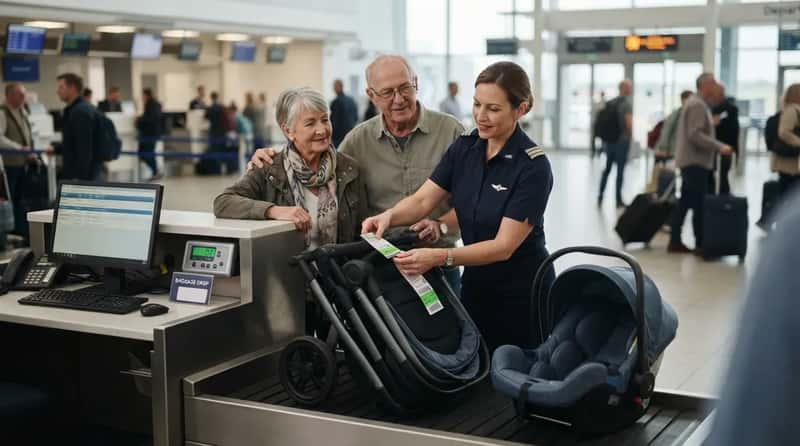
Many people over 65 fly to see grandchildren, and that comes with gear. A car seat or stroller can usually be checked at no additional charge when you’re traveling with children. That makes it one of the most widely used waivers in air travel.
Still, rules differ from airline to airline. Check your carrier’s page before you travel, and ask the agent to confirm at the desk if the tag looks wrong. A bag-fee charge on a toddler’s stroller is almost always a mistake. Meanwhile, a different group gets a bag break that has little to do with age, and it’s #7.
#7 – The Military Bag Break That Veterans Often Forget to Mention

Plenty of travelers over 65 served in the military, and some carriers have long recognized that. One travel blog reports that American, Delta and Alaska waive baggage fees for active or retired military members. That claim comes from a secondary source, so treat it as a lead, not a guarantee.
Eligibility varies. Some rules apply to active-duty members traveling on orders, while others cover more people. Check the airline’s military page, bring ID, and ask the agent directly. Retired status is exactly where policies differ, so the answer may depend on the carrier. The next two items work differently, because they’re built on status and plastic.
#6 – The Elite Status That Lets One Reservation Fly Bag-Free

Airline status isn’t tied to age, but many frequent-flying retirees have it. Elite tiers like Delta Medallion Silver, United Premier Silver, American AAdvantage Gold and Alaska MVP waive the first bag for the member plus companions on the same reservation. That’s where the “companion rule” comes from.
Quick Compare
- Delta Medallion Silver: first bag free for you plus up to 8 companions
- United Premier Silver and American AAdvantage Gold: the same up-to-8 companion rule
- Alaska MVP: first bag free for you plus up to 6 companions
Booking everyone together makes the difference. If your travel partner is on a separate ticket, the waiver may not apply. One reservation can cover a whole group of bags. That’s a smarter play than hoping for a senior break. Even without status, there’s another route, and it’s #5.
#5 – The Credit Card Perk Worth More Than Any Senior Discount

Here’s a take that may annoy some readers: for people who fly one airline often, a co-branded card can beat any age-based discount. Delta, United and American reserve free checked bags for loyal customers, and many co-branded cards give cardholders a free first checked bag on domestic flights. If you fly the same airline a couple of times a year, the math can work.
The perk can stretch further than expected. Alaska’s Visa Signature and newer Atmos Rewards cards generally include a free first checked bag for the cardholder and up to 6 additional passengers on the same reservation. The annual fee can pay for itself in a single family trip. Now we move outside the U.S., where age really does matter.
#4 – The Extra Baggage Allowance Air India Gives Older Passengers

This is one of the few cases where age itself earns something. Air India offers discounted senior fares to some passengers over 60, with savings of up to 25% on domestic routes for Indian passport holders. The baggage piece is separate from the fare piece.
That part isn’t limited by nationality. Additional benefits, such as a cost-free date change and an extra baggage allowance, are given to older passengers regardless of where they’re from. Check the exact allowance on Air India’s own site, because it can vary by route and fare. If you think that’s generous, the next one goes further.
#3 – The Mobility Device Payout That Ignores Normal Baggage Caps
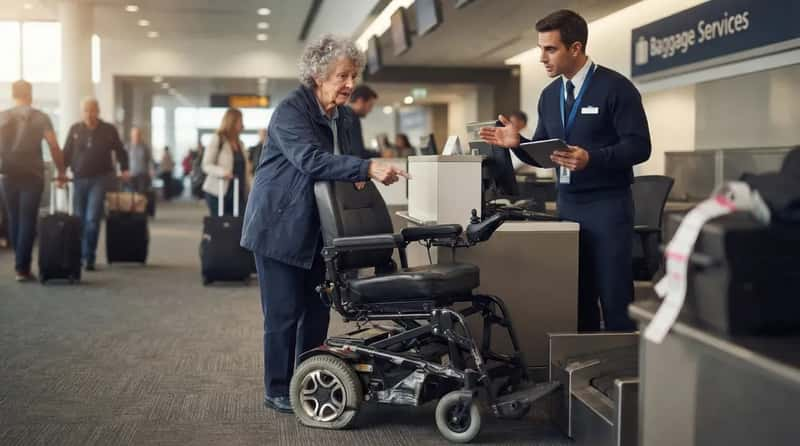
Ordinary lost luggage comes with strict compensation limits. A mobility aid doesn’t. The DOT says carriers must fully compensate passengers for loss or damage to wheelchairs or other assistive devices, without regard to rules limiting liability for lost or damaged baggage. That matters when a chair can cost thousands of dollars.
Delta describes it the same way. If a mobility aid is destroyed or lost, Delta says it will repair or replace it with a comparable model, and it doesn’t enforce the Montreal Convention liability limits for these devices. The cap that applies to your suitcase doesn’t apply to your wheelchair. But the only true age-triggered bag perk is next.
#2 – The €49 Pass That Gives Over-65s Free Checked Bags

If you want an actual age-based baggage perk, this is the clearest one. Air France’s Senior Pass offers flexible tickets, free checked baggage and discounts, and is available from age 65 for €49 a year.
Why It Stands Out
- Real age trigger: open to anyone 65 and older
- No nationality test: the pass isn’t limited to French or EU residents
- Price: €49 a year
- Perks: flexible tickets, free checked baggage and discounts
The pass isn’t automatic. You must provide a valid Senior Pass number when you book and be ready to present it at the airport. The discount applies only to flights operated by Air France or carrying an Air France flight number. This is the one genuine “over 65” bag perk here, and it’s a membership, not something you get just by asking. One more waiver remains, and it’s the strongest.
#1 – The Federal Rule That Makes the Medical-Device Bag Free

The most reliable way to drop a baggage charge isn’t being 65. It’s the law. The Air Carrier Access Act requires U.S. airlines to accommodate passengers with disabilities without penalizing them for the equipment their condition demands. The DOT defines an assistive device as any equipment that helps a passenger cope with the effects of a disability.
Airlines are getting stricter about what qualifies. Some passengers have asked for waivers on hospital beds, massage tables and wagons by calling them medical devices. American’s clarification to agents amounts to this: mobility aids and life-sustaining medical equipment get waivers. The waiver is real, but it isn’t a loophole for oversized gear. If you’re unsure, the DOT says to contact your airline’s disability or special assistance desk.
So being over 65 will not, by itself, erase a baggage fee at a U.S. airline. The charges that do get dropped come from medical-device rules, refund rights, status, cards, family gear and a few foreign senior programs like Air France’s.
The strongest waivers were never favors from the person behind the counter. They’re rights, and they only work for the people who know to name them.