Most people treat a resort fee like gravity: annoying, automatic, impossible to argue with. But hotels, golf courses and ski areas quietly bend on price for older guests, and sometimes for anyone who asks the right way.
We checked the real policies, and the picture is messier than the headline suggests. No source we found says a 60th birthday alone erases a bill, so we sorted what actually moves from what doesn’t. The most surprising answer is saved for the end.
#15 – The Full Standard Rate at Wyndham
The cheapest charge to shrink is the one most guests never question: the standard room rate.
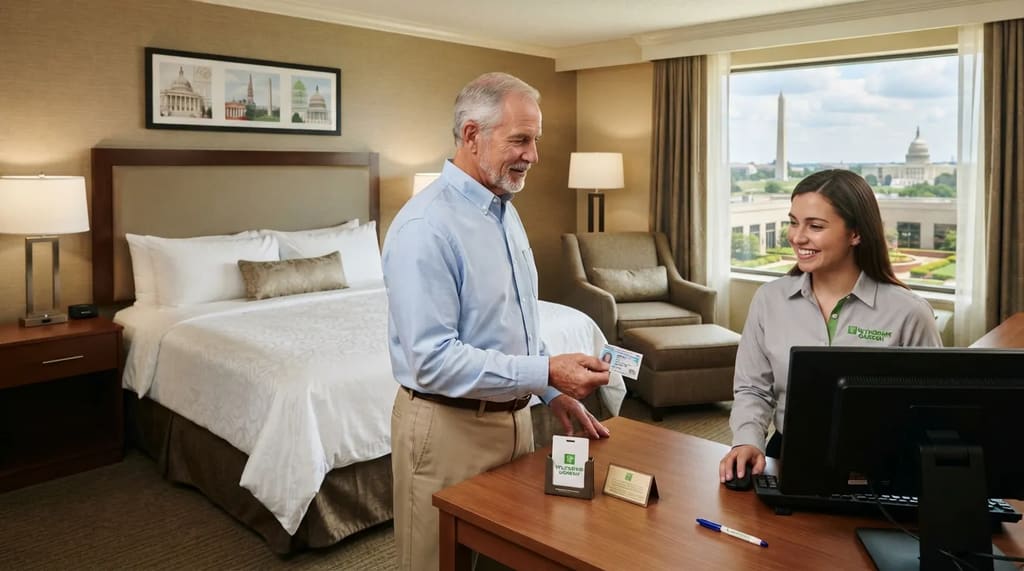
Wyndham says guests 60 and older get savings on the Standard Rate at participating locations, with valid ID at check-in.1 That makes 60 the magic number here.
One review site’s test search found a Wyndham Garden near Washington, D.C. listed at $139.40 standard versus $106.60 senior.2 That’s close to a quarter off for the same room.
Published percentages vary, and some lists say up to 10% or more. Results depend on the property.
But the next chain attaches a condition many guests miss…
#14 – The Choice Hotels Last-Minute Premium

Choice Hotels will cut its price for a 60-year-old, but only if you plan ahead.
Guests 60 and older can save up to 10% with advance reservations at participating properties.3 A same-day request may not qualify.
The discount also applies to AARP members. Booking ahead is the real price of the discount.
- Age requirement: 60 or older, or an AARP member
- Savings: up to 10%
Next comes a brand where the senior price isn’t always the cheapest option…
#13 – The Marriott Rack Rate

Marriott offers a senior rate, but it can lose to other prices on the same night.
Guests 62 and older can get senior rates at participating Marriott properties. That’s two years later than Wyndham’s cutoff.
Here’s the twist. Compare the senior price against loyalty, AAA, AARP and promotional rates, because one of those may be cheaper. Grabbing the senior label first can be a mistake.
Marriott also treats points differently from rivals. It does not waive resort fees on award stays.4
That raises a question about its biggest competitor, where the age limit is higher…
#12 – The Hilton Full Rate (If You’re 65)

Hilton’s senior discount is the one that shuts out most 60-year-olds.
Hilton offers up to 6% off the best available rate, for a maximum of two rooms, and you must be at least 65. One guide lists it differently, so confirm the age and percentage before you book.
There’s a workaround. AARP members can get up to 10% off the best available rate at Hilton.
But one chain makes you join something else first…
#11 – The IHG Rate You Can’t See Yet

IHG won’t show a 62-year-old a senior rate until they join its loyalty program.
You must sign up for IHG One Rewards, which is free, and be 62 or older.5 Without the login, the discount doesn’t appear.
The “ask” here is actually a checkbox. Most people never find it.
At a Glance
- Minimum age: 62
- Membership: free IHG One Rewards account
- Rate to select: Member Senior Discount
- Booking far ahead? Choose the advance-purchase version instead
The next brand has the widest gap between what’s advertised and what’s reported…
#10 – The Hyatt Standard Price

Hyatt’s senior discount is the hardest one to pin down.
Seniors 62 and older can get a discount at participating Hyatt properties. The size of the discount is where sources disagree.
One guide lists up to 15%. An older Kiplinger report cited discounts of up to 50% at participating hotels in the continental U.S. and Canada.
Treat the biggest number as a ceiling, not a promise.
Younger thresholds are hiding at some other brands, though…
#9 – The Rate That Opens Before You Turn 60

Some brands start the discount well before 60, so you may already be past the line.
Here’s how the starting ages stack up across the brands we checked.
Quick Compare
- 55: Best Western, Extended Stay America
- 59: Red Roof
- 60: Choice, Wyndham, Motel 6
- 62: Marriott, IHG, Hyatt
- 65: Hilton
On the budget end, Motel 6 lists a senior rate at 60. One list says up to 15%, while another says up to 10%.
Ask about the age cutoff before you assume you don’t qualify.
Hotels aren’t the only place where a 60-plus price list is hiding. The next one is outdoors…
#8 – The Full Greens Fee

Golf courses are one of the oldest places an age-based price cut lives.
Kiplinger notes that golf courses commonly discount greens fees for guests older than 55 or 60. That’s a broad pattern, not a rule.
Policies differ by course and sometimes by day or time. Ask when you book the tee time, not at the counter.
Don’t assume the resort’s rack rate is the final price. The discount may exist even when the booking page doesn’t show it.
Next, the slopes, where “senior” can mean three very different ages…
#7 – The Full-Price Lift Ticket

Ski resorts define “senior” however they like, and the age matters more than you’d think.
Some Utah resorts start senior pricing at 62, but others require 65 or 70. Free skiing at 60 or 65 practically doesn’t exist, according to one 2026/27 senior pass guide.
Almost every resort does offer a discounted senior ticket between 60 and 65. Size matters too, since most large ski resorts don’t discount for older adults while many smaller independents do.
The bigger savings come from how you buy, not the day ticket…
#6 – The Standard Season Pass

A senior season pass can quietly beat any day-ticket deal.
The Epic Pass offers a senior discount for ages 65 and up. At Sundance in Utah, a senior season pass starts at 65 and was listed at $359 for 2026/27.
Some places go further. Mount Hood Meadows lets guests 75 and older ski free.
Some free senior skiing carries a residency catch. New Hampshire’s Cannon Mountain, for example, requires state residency.
Now the charge everyone hates most. It isn’t about age at all…
#5 – The Unused-Amenity Charge

The resort fee is easiest to challenge when it bills you for things you never touched.
Resort fees are usually non-negotiable, even if you skip the services they cover. Some hotels will still waive it for a strong case, such as a short stay, an off-season booking or unused facilities.
The leverage is specific. If the fee covers the in-room safe or the gym and you didn’t use them, you can ask not to pay for them.
A precise complaint works better than a polite sigh.
There’s a sneakier version of this complaint, and it involves reading the fine print twice…
#4 – The Double-Billed Perk

Some fees charge you for perks the hotel also advertises as free.
If something like Wi-Fi is listed as a standard amenity and also sits inside the resort fee, you can call it double billing. That’s a fair question to put to the front desk.
Ask early about the extras, especially resort fees, parking and other possible hidden costs.
Getting one item removed is often easier than getting the whole fee waived. That advice comes from group-booking negotiations, so results for individual guests vary.
But the strongest argument isn’t about perks at all. It’s about what you were told before booking…
#3 – The Fee Nobody Told You About

If a mandatory fee wasn’t shown up front, you may have grounds to push back.
Related Stories From Travelbinger



The FTC’s Rule on Unfair or Deceptive Fees went into effect May 12, 2025. Hotels must disclose the total price, including mandatory resort fees, before you’re asked to pay.
The rule doesn’t ban resort fees. It also doesn’t restrict optional fees, as long as they’re disclosed.6
If the total price wasn’t clear, you can dispute it at check-out, contact customer service or file a chargeback with your card company.
One situation gives you more leverage than any rule, though…
#2 – The Fee After Things Went Wrong
A service failure is the most reliable reason to ask for a refund.
If something went wrong during your stay, ask to be compensated by having the resort fee waived. One Las Vegas guide mentions a delayed check-in or a long line as moments to ask politely.
- Name the specific problem
- Ask for a specific fix, such as removing the fee for the affected night
- Raise it before checkout, not after
Timing matters more than age here.
And that leads to the charge that tops the list, the one everyone wants gone…
#1 – The Resort Fee Itself
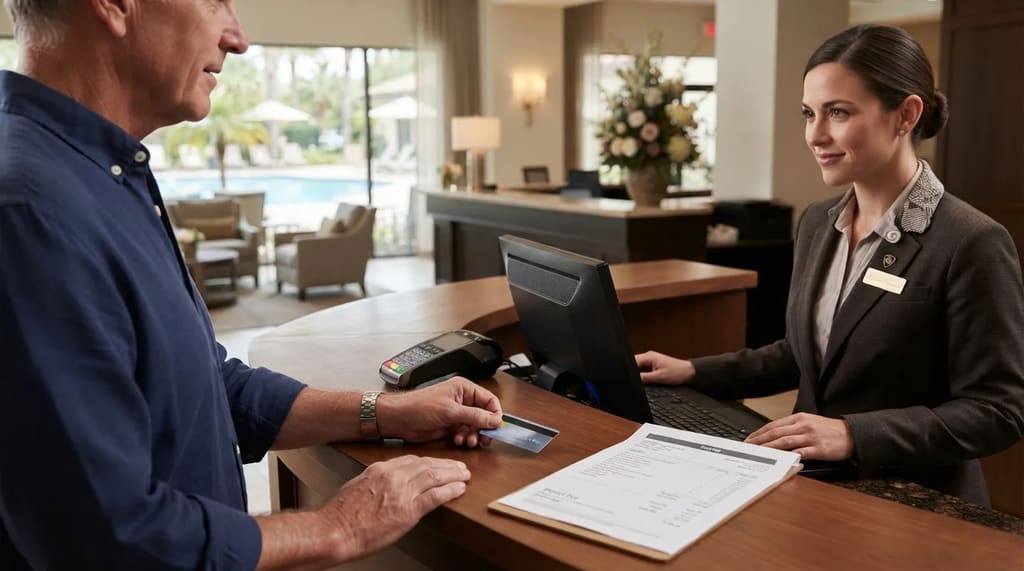
Yes, the resort fee can sometimes be waived, but it usually takes the right person and the right moment.
Call the front desk, not the central reservation line, and politely ask if the fee can be waived or reduced. A hotel may prioritize an occupied room over its fees.
Loyalty can also remove it. Hilton and Hyatt both waive resort fees on points bookings.4 6
Worth Knowing
- Front desk beats the central reservation line
- Hilton and Hyatt waive the fee on points bookings
- Marriott does not waive it on award stays4
- A waiver is a favor, not a guarantee
No source we found says age alone waives the fee. Waivers aren’t guaranteed, and a hotel can say no.
So the headline is a little too tidy. Resort fees are legal and usually mandatory, and what actually moves is senior room rates at Wyndham, Choice, Marriott, IHG and Hyatt, golf and ski discounts, and fees waived for unused perks or service failures.
Age thresholds run from 55 to 65, so check before you assume. For guests over 60, the senior rate and a polite, specific ask often work better together than either one alone.
Which of these have you actually tried at a front desk, and did the hotel say yes?
Bonus: The Paper-Trail Move Front Desks Respect

The best time to ask for a senior rate or a fee adjustment is before you arrive, and in writing. A request with a record behind it is much harder to brush off at 4 p.m. with a line behind you.
- Screenshot the booking page at the moment it shows your total price, including any mandatory resort fee. Save the confirmation email too.
- Contact the hotel’s front desk directly a few days before arrival, by phone or email. Ask whether the senior rate applies to your stay and whether the resort fee can be reduced or removed.
- Get it in writing. Ask for a reply by email, or note the agent’s name, the date and what was promised.
- Check the bill the night before you leave. Fixing a line item is easier while you’re still a guest than after you’ve left the property.
If the final bill doesn’t match what you were shown at booking, show the screenshots and ask politely for a correction. If that fails, you can still dispute the charge with your card issuer.
Be calm, be specific and keep your records. That combination beats any script.
- Wyndham Senior Discount: https://www.wyndhamhotels.com/hotel-deals/senior-discount
- Wealthup Senior Hotel Discounts: https://wealthup.com/senior-hotel-discounts/
- Choice Hotels Senior Rates: https://www.choicehotels.com/deals/senior-rates
- Points Guy Resort Fees: https://thepointsguy.com/travel/avoid-resort-fees/
- IHG Senior Discount: https://www.ihg.com/content/us/en/deals/hotel-offers/senior_discount
- Autopilot Resort Fee Guide: https://withautopilot.com/blog/hotel-resort-fee