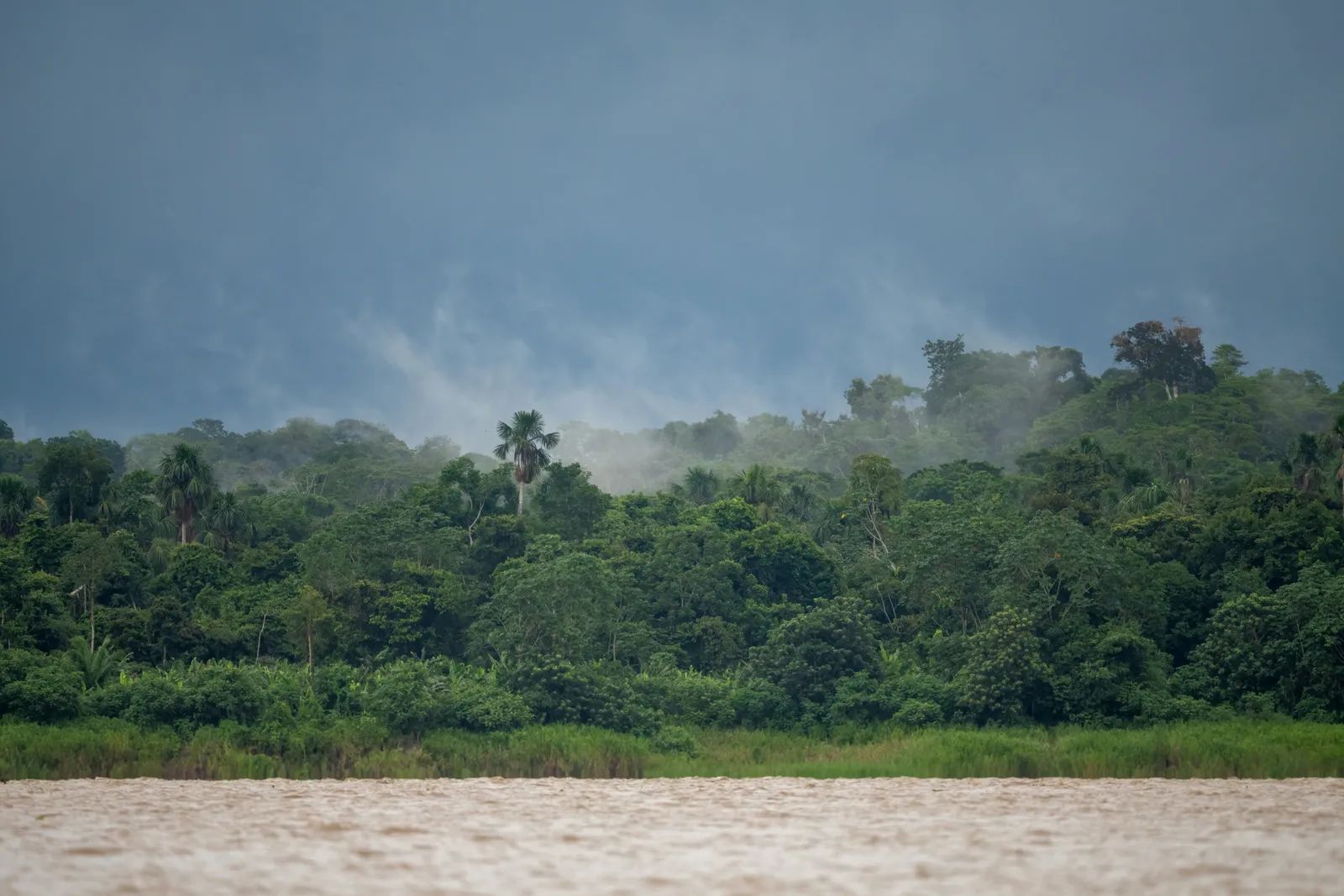
For years, climate research has focused on southern Amazonia as the region warming fastest. A newer study points to a different part of the basin, the central-north, as the place where extreme temperatures are rising most sharply. The shift matters for the rainforest’s future, and it began with a field team that found itself working inside the changing climate. ([1])
Working blind in the fire season
A small group of scientists was carrying out a forest census near Manaus, in northern Brazil, when the fire season began in October 2023. Some days the smoke was so dense that the team could barely see the forest around them. On other days the heat was too intense for ordinary masks, so Aretha Guimarães, a biologist with Brazil’s National Institute of Amazonian Research, and her colleagues wrapped wet bandages over their faces so they could breathe.
The smell reached them even through the bandages. Guimarães recalled that the odor of dead sloths was overpowering. “I’ve never seen such mortality,” she told Mongabay. “We were shocked.”
A forest where animals kept dying
Over the following months, the team recorded dead sloths in every section of the forest it studied. Some carcasses still hung from branches. The researchers assumed that many of the animals were too slow to reach water as temperatures climbed, though Guimarães has said she cannot fully explain what happened because she had never witnessed anything similar. The team’s account is an observation and a working assumption, not a confirmed cause of death.
The episode stands out because it occurred in a part of the Amazon that had received far less attention than the south. Guimarães’s experience gave researchers a human-scale picture of what a heat and smoke event can look like on the ground.
A hotspot that was not expected
Researchers have long said that average temperatures are rising faster in southern Amazonia, where deforestation and forest fires are widespread. A study published in September, however, points to the central-north basin as the front line of an alarming rise in extreme heat and dry conditions. Its authors analyzed satellite, aircraft and observation station records from 1981 to 2023. They found that extreme temperatures across Amazonia increased more than twice as quickly as annual mean temperatures.
The affected area is large. Researchers identified more than 700,000 square kilometers in the central-north where extreme dry-season temperatures have risen by at least 0.75 degrees Celsius per decade, according to a separate summary of the work. ([2])By comparison, average Amazon temperatures are rising about 0.21 degrees per decade, a pace that tracks the global average. ([2])
Mongabay described the research as published in Nature. The paper itself appears in Communications Earth & Environment, a Nature Portfolio journal, and was led by researchers at Lancaster University with WWF-UK and more than 50 scientists. ([3])
What the study does not settle
The central-north is not a region that most people associate with the worst deforestation. Mongabay noted that the area overlaps many protected areas and Indigenous territories in Brazil, and that it has seen the greatest increases in extreme temperatures and water deficit despite lying outside the arc of deforestation.
Related Stories From Travelbinger



| Point | What the research shows | What remains open |
|---|---|---|
| Extreme heat | Extreme temperatures rose faster than annual averages across Amazonia | How heat extremes will shape specific ecosystems over time |
| Central-north | The region shows the fastest growth in extreme dry-season temperatures | Why this part of the basin is changing so quickly |
| Possible drivers | Climate change is cited as the broad cause | Whether El Niño conditions and cloud patterns near the equator play a role |
The study’s authors say it remains unclear what is driving the rise in extreme climate events in the central-north. They suggest a mix of global climate patterns may be involved, including El Niño conditions and cloud cover concentrated around the equator. Until that picture sharpens, the findings describe where the stress is appearing more than why it is happening.
Why it matters beyond the research station
For travelers, the Amazon is often imagined as a remote and resilient landscape. The study does not suggest that visitors face new safety warnings, and the field experience described by Guimarães belongs to scientists working through a severe fire season. It does show that some of the forests people most associate with the Amazon are facing heat stress that was not widely anticipated.
The sloths that Guimarães’s team found may be the most immediate evidence of that stress. The broader lesson is that the Amazon’s climate risks are not confined to the places where they have been studied most. Future monitoring in the central-north will determine whether this pattern holds.