Most people assume train travel is so simple it needs zero preparation. They’re wrong – and first-time riders over 60 pay the steepest price for that assumption, often without realizing it until they’re already stuck on a platform.
The good news is that every mistake on this list is completely preventable once someone points it out. We’ll start small and build toward the one mistake that quietly undoes almost everyone’s first trip.
#16 – Not Arriving at the Station Early Enough

Most new train riders think, “It’s not a flight – I don’t need to be early.” That’s exactly the kind of thinking that strands people on platforms.
You don’t need two hours like at an airport. Give yourself at least 15 to 20 minutes to find your platform, compartment, and seat.
Platforms can change without notice, and connecting trains won’t wait for you. If luggage is weighing you down, give yourself extra minutes to catch your breath before boarding.
Large stations – think Chicago Union Station or London’s Euston – are genuinely labyrinthine. A first-timer over 60 carrying bags and reading signs for the first time can easily burn ten minutes just finding the right platform.
But arriving early is just step one. What you do before you even reach the station is where most people go wrong first – and that’s #15.
#15 – Skipping the Senior Discount

Paying full fare when a meaningful discount was sitting right there waiting is one of the most common – and quietly expensive – mistakes over-60 travelers make.
Amtrak travelers 65 and over are eligible for a 10% discount on most trains. It’s an easy way to make rail travel more affordable.
VIA Rail offers that same 10% discount starting at age 60, and the joint Amtrak/VIA cross-border service follows suit. Passengers aged 60 to 64 often don’t realize they already qualify, and they pay full price for a discount that was there the whole time.
From late September to early May, the Alaska Railroad offers half-price fares for people 65 and older, Medicare cardholders, and travelers with certain disabilities. That’s not a minor saving – that’s a completely different budget tier.
Discounts are great. But none of it matters if you book the wrong type of ticket entirely – which is exactly what #14 is about.
#14 – Confusing a Train Ticket With a Seat Reservation

This is one of the most misunderstood parts of rail travel, and it blindsides first-timers constantly.
On many routes – especially in Europe – a ticket only gets you on the train. It does not guarantee a specific seat, and you often have to pay for both separately.
Ignoring seat reservations can wreck a comfortable ride. One first-time traveler recalled standing for hours in the aisle, clutching luggage, because their ticket never came with an assigned seat.
The base fare gets you aboard – a specific seat, especially near accessibility features, often costs extra. Senior passengers who simply ask can frequently get these fees reduced or waived.
Standing for a two-hour trip is unpleasant. But the next mistake can make the whole journey feel physically draining before it even starts – see #13.
#13 – Packing a Suitcase That’s Too Heavy to Manage Alone
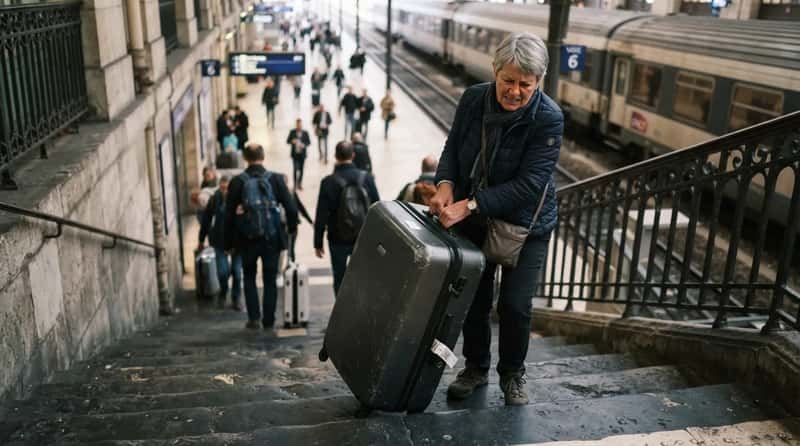
This sounds obvious until you’re standing at the top of a steep station staircase at 7 a.m. with a 28-inch hard-shell bag and no porter in sight.
Heavy luggage isn’t just inconvenient – it’s a genuine hazard on cobblestones, stairs, and crowded platforms. Plenty of older travelers have hurt themselves wrestling an overloaded bag that a lighter case would have handled easily.
If it’s been a while since your last trip, test whether you can still lift and manage your bag alone. A lightweight, wheeled case you can hoist onto a train yourself is always the smarter call.
Train aisles and overhead racks are narrow, and a massive hard-shell suitcase is a nightmare to navigate through them. A backpack or soft duffle bag is far easier to handle.
Luggage weight is one problem. Where you store that luggage once you’re on board is another – and #12 shows exactly how getting it wrong creates a ripple of problems.
#12 – Blocking the Aisle With Your Luggage
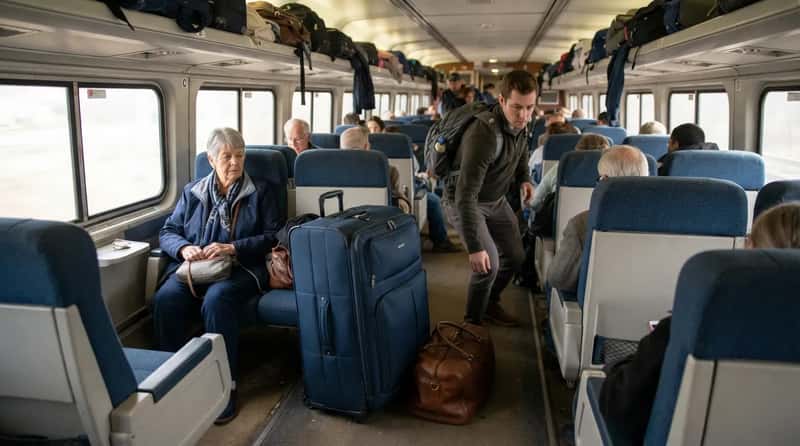
New train riders often drag large bags to their seat and prop them in the aisle or on the empty seat beside them. On a filling train, this creates friction fast.
Overhead racks and end-of-carriage luggage shelves fill up quickly on popular routes, and travelers with oversized suitcases often don’t plan for this. Blocking the aisle, or occupying a second seat with bags on a full train, is considered inconsiderate almost everywhere. Most operators expect large items on the racks near the doors, not at your seat.
Fast Facts
- Amtrak coach passengers can bring one free personal item (25 lbs) plus two free carry-on bags (up to 50 lbs each) – there’s rarely a real need to overpack the seat area.
- Where checked baggage service is offered, each passenger can check up to two bags free, with extra bags running about $20 each.
- End-of-car luggage racks are first-come, first-served, so early boarders get the easiest access to space.
- Overhead racks are sized for standard carry-ons, not full-size suitcases – big bags belong at the ends of the car, not overhead.
On busy trains, spreading your belongings over seats slows boarding and sparks awkward standoffs. It also leaves grime on the fabric, since bag bottoms touch sidewalks and platforms before someone else has to sit there.
The practical fix is simple: board early, head straight to the end-of-car luggage area, stow your main bag, then walk back to your seat with only a day bag. Almost nobody figures this out on their first trip.
But even with your luggage sorted, you may still be sitting in the wrong spot entirely – and that’s the trap in #11.
#11 – Sitting in the Wrong Seat Without Realizing It
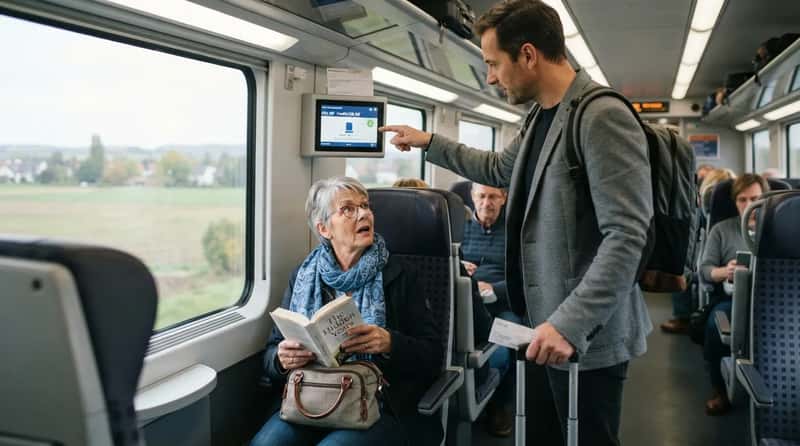
You find an empty seat, settle in, get your book out – and then someone arrives with a printed reservation for that exact spot. It’s awkward for everyone, and it’s completely avoidable.
The confusion often comes from partial reservations, where a seat is booked only for part of a longer journey. A traveler might board in Cologne and find a seat that’s free until Frankfurt, then off-limits after that stop.
If you’re on an unreserved ticket, check the reservation cards above seats before sitting down. Getting asked to move mid-journey is uncomfortable for everyone involved.
On Amtrak, a conductor assigns you a seat at boarding on some routes, but on others coach is open seating and first-come, first-served. Know which system your train uses before you board.
Seat confusion is stressful in the moment. But the next mistake causes stress that starts the night before your trip – and it’s almost entirely about assumptions. That’s #10.
#10 – Assuming the Dining Car Will Cover All Your Food Needs
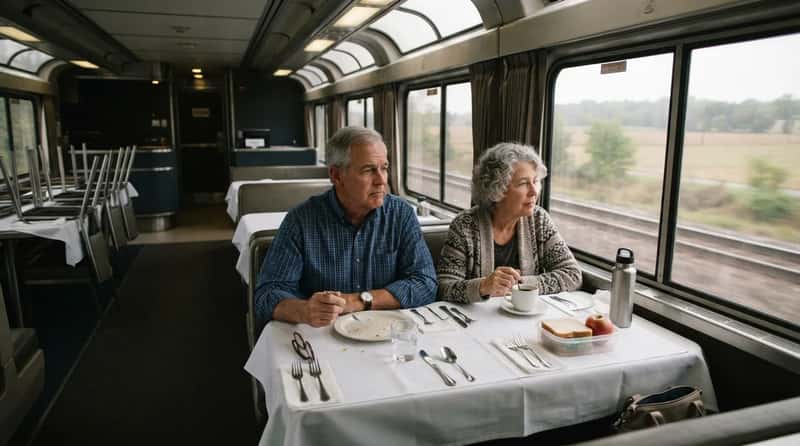
Many first-timers over 60 picture long-distance train travel as a moving restaurant. The reality is considerably patchier.
Overlooking meal stops can leave travelers hungry and grumpy fast. One rider recalled a long journey with no food at all, having simply assumed the train would feed them.
Dining cars are often overpriced and don’t always run for the full journey, and station food can be hit or miss between stops.
You can bring your own food and non-alcoholic drinks on most trains. It’s a simple way to save money and eat something you actually enjoy.
Food is manageable once you plan for it. But there’s a physical health mistake that’s even more consequential on a long rail journey – and most people over 60 never even think about it. That’s #9.
#9 – Staying Seated the Entire Journey

Unlike a plane, a train actively invites you to move around. Not taking advantage of that is a genuine health mistake, not just a comfort issue.
Passengers can get up and walk around while the train is moving, or spend time in the lounge and café cars. Beyond comfort, this simple habit can help prevent blood clots that form during long stretches of inactivity.
On longer journeys, take a walk through the train every hour or two. Many have observation cars with wide windows, dining cars, and snack bars worth exploring.
Deep vein thrombosis risk climbs with both age and prolonged sitting. Trains give you a wide aisle, no seatbelt sign, and often a full lounge car – use them, and set a timer if you have to.
Staying physically comfortable is critical. But there’s a category of mistake that can turn a minor delay into a major crisis – and it’s about what you packed, or didn’t pack. That’s #8.
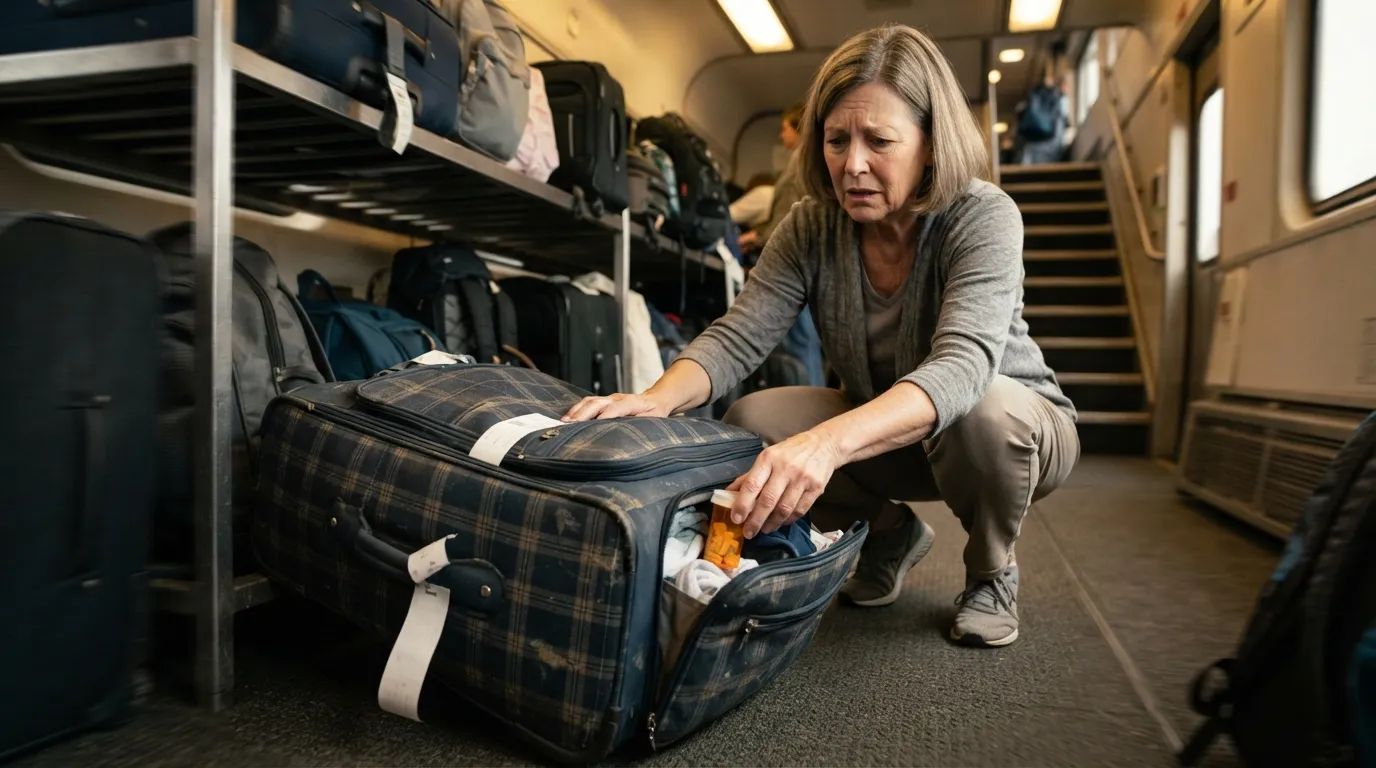
#8 – Packing Medication in Your Checked Bag
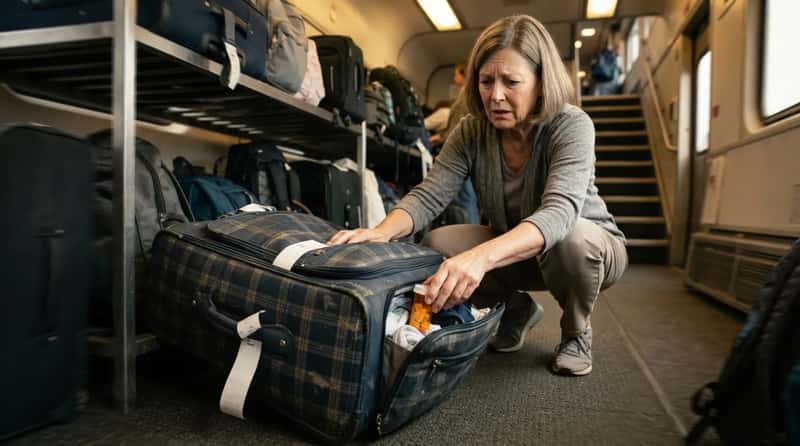
This is the mistake that can escalate from inconvenient to genuinely dangerous, and it happens more often than most people admit.
Checked bags get lost, delayed, or rerouted more often than travelers expect. Losing daily medication for even one day can spiral fast, so keep it in its original, labelled containers, packed with a few extra days’ supply.
Some medications allowed in one country are banned in another, especially those containing stimulants or codeine. When in doubt, check with the destination’s embassy before traveling.
On Amtrak, bags stowed in the lower luggage compartment on long-distance routes are only accessible at staffed stops. If your medication is down there and you need it between stations, you simply can’t reach it.
Medication is critical. But there’s another category of preparation first-timers almost universally neglect, and it shows up at the worst possible moment. See #7.
#7 – Not Saving Your Ticket Offline
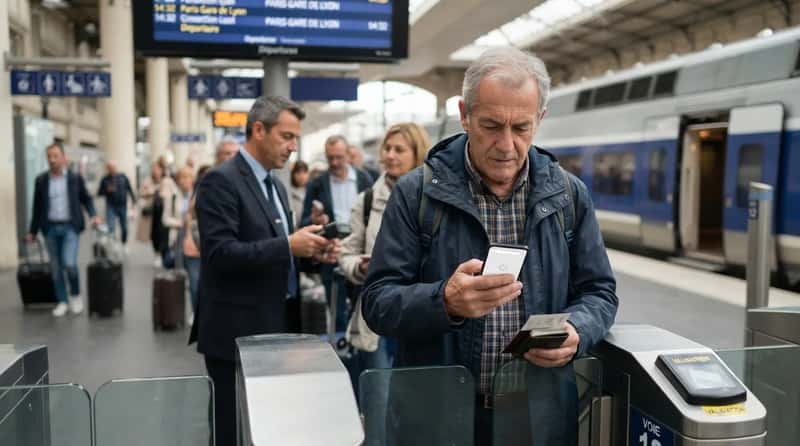
Experienced travelers know this one well. First-timers learn it the hard way, standing at the gate with no signal and a blank phone screen.
Many modern trains offer Wi-Fi, though it’s unreliable in rural areas. Download entertainment, maps, and important documents before boarding, not after.
Mobile signal drops in tunnels, mountains, and rural stretches. If your e-ticket only lives inside a web browser with no offline save, you could be in real trouble when the conductor comes around.
The fix is simple but non-obvious: screenshot your ticket and save it to your camera roll, then email it to yourself and print a paper backup. Conductors are used to paper, and they’ll never refuse it.
Tickets are fixable. The next mistake creates a problem that unfolds in slow motion across the entire journey, and it involves a number most people over 60 seriously underestimate. That’s #6.
#6 – Booking Connections That Are Too Tight

First-time train travelers often apply airport logic here – a 45-minute layover feels generous. On rail, especially at large stations with unpredictable schedules, it can be a disaster.
Train delays are more common than many first-timers expect. One traveler described missing a connection entirely because of a delay they never saw coming.
For travelers over 60, a missed connection with heavy luggage in an unfamiliar hub isn’t just annoying – it’s genuinely exhausting.
A good rule of thumb: allow at least 60 minutes between connections at large stations, and 90 minutes if mobility is a factor. It feels overly cautious until the day it saves your entire trip.
Tight connections are a timing mistake. But the next one is a planning mistake that locks in the problem months before you even board. That’s #5.
#5 – Waiting Too Long to Book

Train travel has a reputation for spontaneity – just show up and hop on. That’s true for short commuter routes. For long-distance and scenic journeys, it’s a myth that costs real money.
Mark Smith, founder of the rail travel blog The Man in Seat 61, has long advised booking ahead for the cheapest fares, just as you would for a flight. In Europe, booking windows range from 30 days to a full year, depending on the operator.
Amtrak’s schedule works a little differently. Fares are released 11 months before departure and often climb with demand.
Quick Compare
- Amtrak: Fares release up to 11 months ahead; prices tend to climb as departure gets closer.
- Most European operators: Booking windows run from about 30 days to a full year out, depending on the country.
- SNCF inOui senior fares: Refundable up to 7 days before departure, blending an early-bird price with real flexibility.
Early booking and flexibility aren’t mutually exclusive, either. Some senior fare classes, like SNCF’s inOui senior fares, allow refunds up to seven days before departure, so you can lock in a low price without losing the ability to change plans.
But booking early only helps if you’ve also thought carefully about what you’re booking, and whether your route actually suits your needs. That’s the trap waiting in #4.
#4 – Ignoring Accessibility at the Station
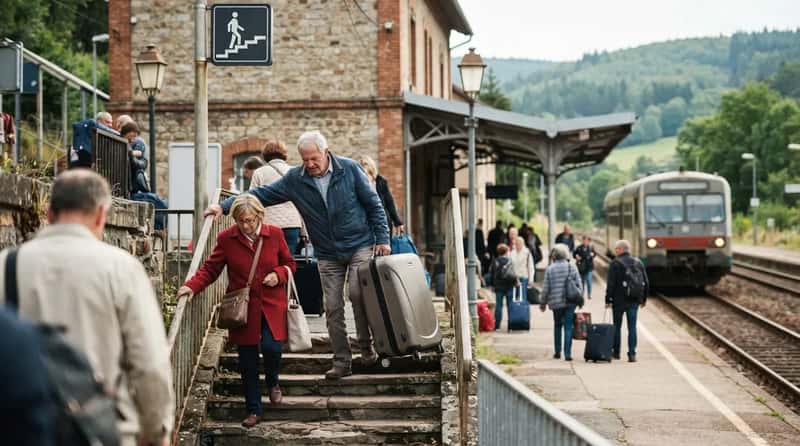
The train itself may be beautifully accessible. The station connecting you to it might be a completely different story, and first-timers rarely check until they’re already there.
Most major train stations in North America and Europe offer ramps, elevators, and accessible restrooms. Notify the operator of any mobility needs when booking, so staff can arrange assistance at both ends of your trip.
The keyword there is “major.” Smaller regional stations, often on the most scenic routes, may have limited or no elevator access, forcing passengers to carry luggage up stairs between platforms.
Call ahead. Most rail operators will pre-arrange staff to assist with boarding if you give notice, and it’s a free service built specifically for older passengers – one that almost nobody over 60 actually uses on their first trip.
Accessibility is about the physical environment. But there’s a personal health oversight that first-time older rail travelers make that can quietly undermine the whole trip. That’s #3.
#3 – Not Being Honest About Your Physical Limits

This is the one nobody wants to hear, but experienced senior travelers consistently say it’s the most important reset they ever made.
The goal is to neither overestimate nor underestimate your travel abilities. It’s easy to be honest about a chronic condition on paper and still quietly assume you’re younger and stronger than you actually are.
This matters most when choosing between a coach seat and a sleeper cabin on overnight routes, or between a one-transfer route and a simpler direct one. The “stretch yourself” instinct that served you well at 40 can genuinely backfire at 65.
Choosing comfort isn’t weakness. It’s the reason experienced senior travelers enjoy their trips far more than first-timers do.
Physical planning is deeply personal. But the #2 mistake on this list is almost universal, and it costs money, safety, and peace of mind in equal measure. You won’t believe how many people over 60 skip it entirely.
#2 – Not Buying Travel Insurance

Most first-time train travelers think insurance is only for international flights and cruises. It’s not, and skipping it on a domestic or European rail trip can turn a medical hiccup into a financial catastrophe.
It matters most when seniors are traveling far from home and family, in unfamiliar places where a small problem can get complicated fast.
A standard policy covers trip cancellation, trip interruption, emergency medical costs, and, critically for rail travelers, missed connection reimbursement. If a delay causes you to miss a non-refundable sleeper reservation, insurance pays for the replacement – without it, that cost lands entirely on you.
Buy it at the time of booking, not as an afterthought. Pre-existing condition coverage typically requires purchase within a set window of your first trip payment, so waiting can quietly disqualify you.
Insurance is critical. But it’s still only #2, because the single most consequential mistake on this entire list is one almost no first-timer over 60 even knows exists. That’s #1.
#1 – Not Telling the Operator You’re a First-Time Passenger
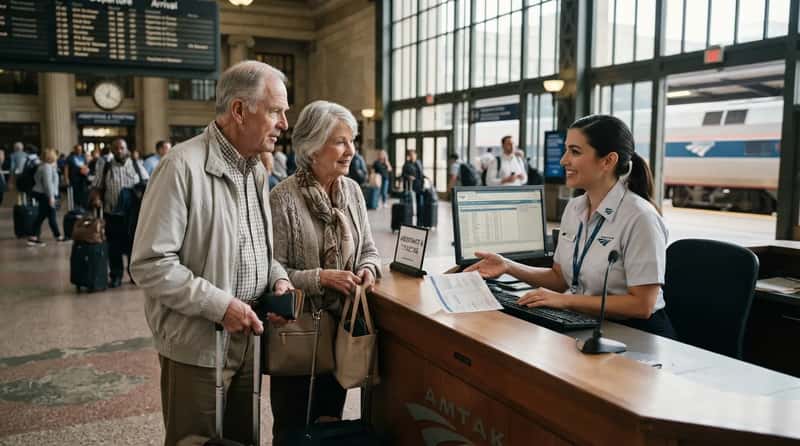
This sounds too simple to be the biggest mistake. It’s the one that would have prevented almost everything else on this list.
Rail operators, Amtrak included, run dedicated assistance programs for senior passengers and first-time riders. Staff can walk you through boarding, help with luggage, confirm your seat, explain the dining car schedule, and pre-arrange platform assistance at your destination.
None of this happens automatically. Seniors who mention accessibility needs or unfamiliarity with rail travel are frequently granted assistance and waivers at a staffed window, simply for asking.
The single biggest difference between first-timers who have a great trip and those who have a stressful one is whether they asked for help before they needed it. Every staff member at every major rail station has dealt with first-time senior travelers, and not one of them will judge you for asking.
Pick up the phone, call the rail line, and say, “I’m 65 and this is my first train trip – what do I need to know?” You’ll get more useful information in ten minutes than you’d find in an hour of googling.
The Bottom Line

Older adults make up a large and growing share of Amtrak’s ridership, which means the rail system is more senior-friendly than most first-timers realize. The mistakes on this list aren’t signs that train travel is hard – they’re signs that nobody bothered to warn you before you boarded.
At a Glance
- Senior discount: 10% off with Amtrak (65+) and VIA Rail (60+) – just ask for it.
- Connection buffer: at least 60 to 90 minutes at large stations.
- Medication: keep a 48-hour emergency supply in your carry-on, always.
- Biggest fix of all: tell the operator it’s your first trip – before you need help, not after.
Skip the senior discount and you lose money. Skip the seat reservation and you stand for hours. Skip the insurance and a single delay becomes a very expensive day.
But skip asking for help – that’s the one that makes everything harder than it needs to be.
Traveled by train and wish you’d known something sooner? Drop it in the comments – your experience could be the tip that saves someone else’s trip.