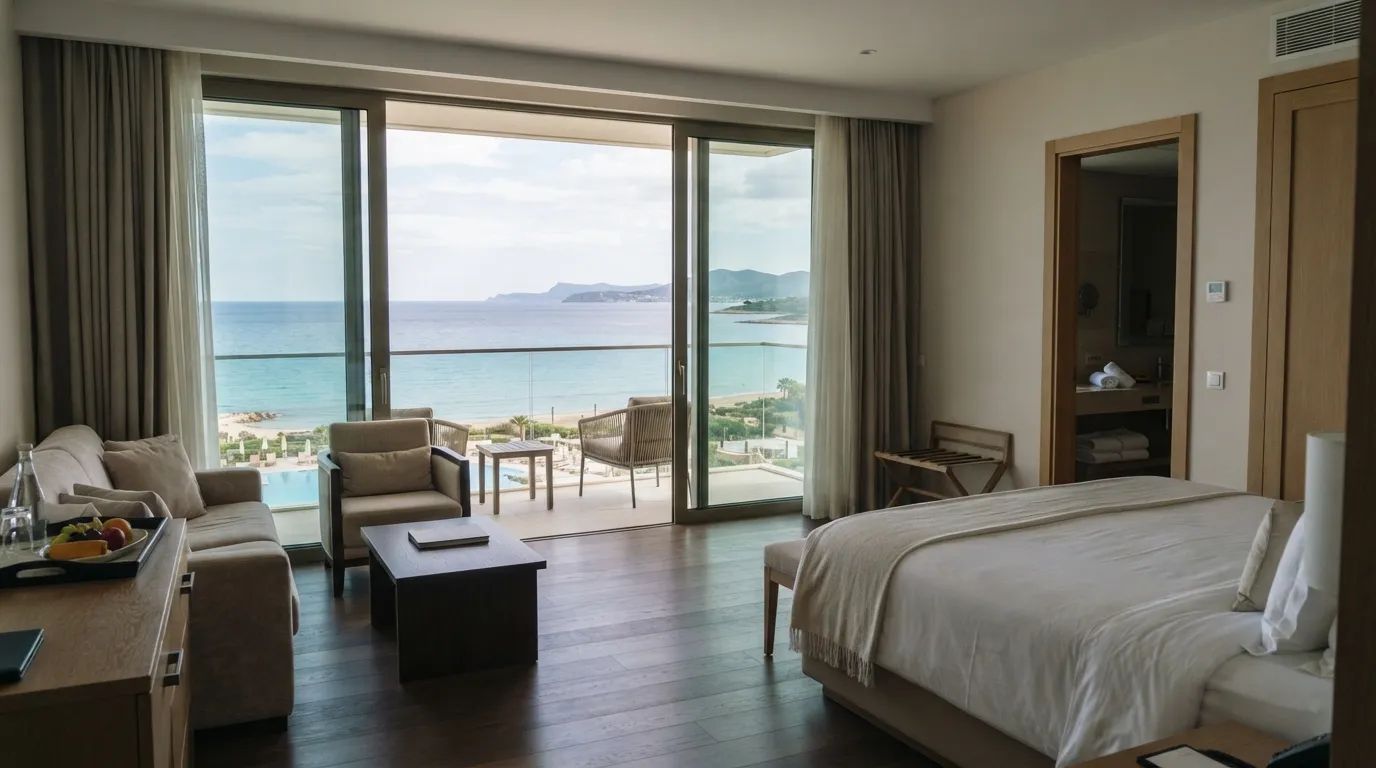
Most people assume the price on a resort’s booking screen is final. It isn’t.
Shoulder season puts resorts in a strange bind: rooms sit empty, but staff are trained never to admit it. The gap between what the front desk knows and what they volunteer can be worth hundreds of dollars per stay – and it starts with a number that was never real to begin with.
#16 – The “Rack Rate” on Screen Is Not a Real Price

Every resort sets a “rack rate” – the highest published price before any discount applies. It’s a ceiling, not something you’re expected to actually pay.
Behind the scenes, hotels quietly build tiers – maybe $250 at peak, $180 at shoulder, $120 off-season – and slide within them constantly. The number flashing on your screen only looks official.
That single fact changes how you read every price a resort ever quotes you. But the rack rate is just the opening move – #15 shows who’s really pulling the strings behind it.
#15 – OTA Commissions Are Secretly Your Leverage

Reception will never say this at check-in: booking through Expedia or Booking.com already drained the resort’s profit before you walked in. Hotels hand those platforms 25% to 30% of every booking as commission.
Skip the middleman and the resort suddenly has real room to negotiate. Direct-booking costs the property only about 4% to 5% – that gap between 30% and 5% is where your discount actually lives.
Quick Compare
- OTA commission (Expedia, Booking.com): roughly 15% to 30% per booking
- Direct booking cost to the resort: about 4% to 5%
- Your leverage: the wider that gap, the more room staff have to deal
Call the reservation desk directly; it costs nothing and can save far more than you’d expect. What happens on that call, in #14, makes the reasoning even clearer.
#14 – A Phone Call Can Do What No Website Will

Ask nicely and politely for a better rate over the phone, and many hotels will simply give you one. It’s not a fluke – it’s a known industry pattern.
You’ll likely get better service calling the front desk than booking online, because a real person can tailor an offer no website will ever generate. That human moment is worth more than any search filter.
A phone call bypasses every algorithm built to keep your price high. But there’s a specific window when that call hits hardest, and #13 is about timing it right.
#13 – The 4-8 Week Booking Window Is a Kept Secret

Most travelers assume booking early always wins. During shoulder season, that assumption can cost you real money.
Book too early and you lock in rates set before real demand exists. Book too late and the good rooms are already gone – the sweet spot sits at four to eight weeks out, a window resorts rarely advertise.
This is exactly when a resort finally learns how empty it’s going to be – and starts getting nervous. That nervousness, as #12 shows, creates a very specific kind of flexibility.
#12 – Front Desk Staff Have More Negotiating Room Than They Let On

During shoulder season, front desk teams often have quiet authority to upgrade rooms or add amenities at check-in. The key word is “often” – it happens only for guests who actually ask.
Hotel insiders describe managers stepping away for the night, deliberately leaving staff room to negotiate when guests push back on price. It’s a built-in release valve, not an accident.
The agent smiling at you may be sitting on a discount right now. There’s a right moment to ask for it, though, and #11 covers the timing mistake almost everyone makes.
#11 – Never Ask During the Check-In Rush

Skip the front desk during a busy check-in crunch; wait until it’s quiet. An agent juggling six guests has zero incentive to negotiate with you.
That same agent at 9 PM with an empty lobby is a completely different conversation. They have a target to hit and a manager who’d rather discount a room than report it empty.
Patience at check-in is one of the most underrated travel skills there is. But before you even walk in the door, reception is sitting on a secret about room categories – and #10 explains it.
#10 – Unsold Room Categories Get Quietly Discounted
Revenue managers exist for one reason: keep rooms from sitting empty. When demand dips midweek, prices quietly adjust downward to pull in last-minute bookers.
Suite and ocean-view categories suffer the most during shoulder season. Reception knows exactly which rooms are sitting dark – they just won’t say so unprompted.
Worth Knowing
- Suites and ocean-view rooms are usually first in line for quiet discounts
- A midweek demand dip can trigger a price adjustment within hours
- Reception rarely offers this rate unprompted – you need to ask by name
Ask specifically whether a higher category is available at a reduced rate, not whether there are “upgrades.” Precise language gets precise answers – and #9 explains why those answers can expire within hours.
#9 – Dynamic Pricing Means the Rate You See Has an Expiry Time

Dynamic pricing adjusts room rates in real time based on demand, booking behavior, and competitor rates. The price isn’t seasonal – it shifts daily, sometimes hourly.
If rooms aren’t filled within 48 hours of check-in, rates can drop 10% below standard to attract last-minute travelers. That drop is automated, and reception knows exactly when it’s coming.
Refreshing a rate page 24 to 48 hours before arrival isn’t paranoia during shoulder season – it’s strategy. But #8 reveals something that can undo that strategy overnight.
#8 – Local Events Can Spike Rates Inside Shoulder Season

A concert, a sporting event, a last-minute convention – any of these can override the seasonal discount instantly. Dynamic pricing tools react in minutes, not days.
Hotels build a calendar of local events 6 to 12 months in advance and quietly spike rates on those specific dates, even inside the “cheap” shoulder window. Shoulder season isn’t uniformly cheap – it’s cheap except when it isn’t.
Checking the local events calendar before locking in dates is a step reception counts on you skipping. And #7 exposes another calculation they never explain out loud.
#7 – Length-of-Stay Pricing Hides Significant Savings

Longer stays unlock better value, and resorts use that math to fill gaps between reservations. It’s especially aggressive during shoulder season and midweek stretches.
Adding just one extra night can unlock a rate tier that shaves 15% to 20% off every night in the whole stay. Most guests never ask if that math applies to them.
They just book the exact nights they need and walk away from real savings. And #6 is about something even sneakier – perks that never appear on any booking page at all.
#6 – Hidden Value Add-Ons Are Never Listed Publicly

Complimentary breakfast, $100 resort credits, priority spa bookings – these perks exist, but never on the public booking site. They live behind the front desk counter, waiting to be requested.
Resorts build these packages specifically to stand out from competitors without discounting the room rate itself. It’s value they’re happy to give away – if someone actually asks.
Fast Facts
- Typical hidden perks: free breakfast, resort credit, late checkout, spa priority
- None of it shows up on the booking page – it lives at the front desk
- Shoulder season stretches this bonus inventory the furthest
The motivation to hand it over is highest when the lobby is quietest. But #5 shows how loyalty programs quietly multiply all of it.
#5 – Loyalty Programs Pay Off Most in Shoulder Season, Not Peak

During peak season, every room sells itself, so loyalty perks stay cosmetic. During shoulder season, the property actually needs you – and suddenly those perks become real.
Signing up for a resort’s newsletter or loyalty program before booking can unlock exclusive rates most guests never see. Resorts simply don’t advertise when that value is highest.
Combine loyalty status with a direct call inside the 4-8 week window, and almost nobody else at check-in has stacked their odds that well. Then there’s #4 – something resorts really don’t want you timing correctly.
#4 – Shoulder Season Itself Is Shrinking – and Resorts Know It

More travelers are catching on, and that’s changing the math fast. Skyscanner’s 2025 Smarter Summer Report found one-third of Americans were already planning off-peak trips, with Gen Z leading the charge.
Workcations and “coolcation” trends – travelers chasing lower temperatures instead of peak-summer heat – are eating into the old shoulder-season discount. Destinations that were reliably cheap in September aren’t guaranteed anymore.
Reception knows the window where guests underestimate shoulder-season demand is closing fast. Knowing which destinations still hold real value – like #3 – is the actual edge left.
#3 – The Post-Labor Day Window Is the Last Reliable Sweet Spot

The weeks right after Labor Day remain some of the best travel weeks of the entire year. School is back in session, summer crowds have evaporated, and most pricing systems haven’t fully caught up yet.
Hotel rates during this window can drop 20% to 40%, attractions stay uncrowded, and weather in many U.S. resort markets is still excellent. It’s a rare stretch where all three benefits line up at once.
At a Glance
- Late August through the first week of September often ranks among the cheapest travel windows of the year
- Rate drops of 20% to 40% versus peak summer pricing are common in this stretch
- Crowd levels fall fast, but resort marketing teams are often slow to advertise the dip
This is the week resorts have the most empty rooms and the least aggressive marketing to fill them. Which means the moves in #2 work best right here.
#2 – The BAR Rate Is a Published Ceiling, Not a Floor

BAR – the Best Available Rate – is a published ceiling, not the actual bottom. Most guests assume BAR means they’ve already found the lowest number.
They haven’t. Rates slightly below BAR exist specifically to attract budget-conscious travelers while protecting the resort’s margins better than a deep off-season discount would.
Is there anything below this for my travel dates?
The question every guest should ask at check-in
Asking it signals to reception that you understand exactly how hotel pricing works. That signal alone changes the entire conversation – and everything on this list has been building toward #1.
#1 – Picking Up the Phone and Negotiating Directly Is Still the Single Most Effective Move

Hotel rates aren’t carved in stone, no matter how official they look on screen. A direct phone call can unlock lower rates, upgrades, and freebies that never appear anywhere online.
When business is slow, no property turns down a reasonable offer – and during shoulder season, business is slow almost everywhere. Ask about upgrades too; the only guests who miss them are the ones who never ask.
The entire pricing system is designed to make the screen’s number feel non-negotiable. It isn’t – one call, the right question, the right timing, and it’s been sitting there the whole time.
The Bottom Line

Resorts don’t lie to your face – they just never volunteer the truth. Rates during shoulder season can drop 20% to 40%, but only if you know exactly where to push.
The rack rate is theater. The BAR rate has a floor beneath it, and the OTA commission is your hidden leverage all along.
The agent greeting you at 9 PM with an empty lobby has more flexibility than any booking engine will ever show you. Book direct, call ahead, ask specifically, and land that 4-8 week window – the savings are real, but they have to be claimed, not offered.