You booked an all-inclusive resort because one price was supposed to cover everything, and mostly, it does.
Then you land, and somewhere between the airport shuttle and the mini-bar, a long list of expensive exceptions starts showing up that nobody mentioned in the brochure.
The all-inclusive model has been around since Club Med pioneered it in the 1950s, but the fine print has only gotten thicker since then.
Here are the 16 things resorts almost never tell you until you’ve already checked in, counting down to the one habit that quietly wastes an entire vacation.
#16 – “All-Inclusive” Is a Marketing Term, Not a Legal Standard

Most travelers assume the phrase “all-inclusive” carries some kind of official definition. It doesn’t.
It’s a marketing term, not a regulated standard, and resorts are legally allowed to exclude certain costs as long as those exclusions are disclosed somewhere – often buried deep in booking terms most travelers never read.
Resort executives readily admit that guests routinely assume every single thing is included, when that’s never actually the case, and the only real fix is figuring out what’s covered before you arrive rather than after.
The result is that guests frequently discover unexpected charges after arrival or at checkout, and consumer advocates describe these fees as legally permissible but ethically questionable.
But that’s nothing compared to what we found about #15…
#15 – Your Base Room Is Probably the Worst One on the Property

That stunning ocean-view balcony from the brochure almost certainly belongs to a room tier above the one you booked.
All-inclusive resorts love to showcase beachfront terraces and poolside balconies in their marketing, but the base room rate usually covers only the least desirable locations – even when better rooms sit empty.
Guests are frequently offered paid “upgrades” at check-in to escape a view of the parking lot, service entrance, or construction zone, and those upgrades can feel less like a luxury and more like a toll.
Using premium photos to sell an inferior default room creates a misleading expectation, and because location shapes the entire vacation experience, these charges often function as pressure-based add-ons rather than optional extras.
But that’s nothing compared to what we found about #14…
#14 – The Restaurants You Want Require Reservations (That Fill Up Fast)
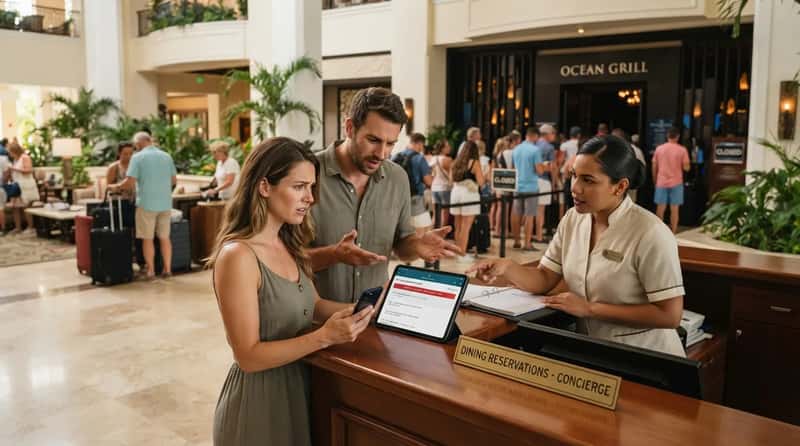
Many guests picture strolling into any restaurant, any night, no planning required. In reality, the best spots are often fully booked by noon on day one.
Most all-inclusive resorts now require advance reservations for their specialty restaurants, and some let you book weeks before you even arrive.
Whether you reserve before the trip or once you’re on property, the front desk or concierge is your best resource – many resorts now handle this through an app, while others still require an in-person request.
Guests often learn about the reservation system only after arrival, when the desk explains the limited complimentary slots or the surcharge attached to the fancier spots.
But that’s nothing compared to what we found about #13…
#13 – “Unlimited Drinks” Doesn’t Mean What You Think
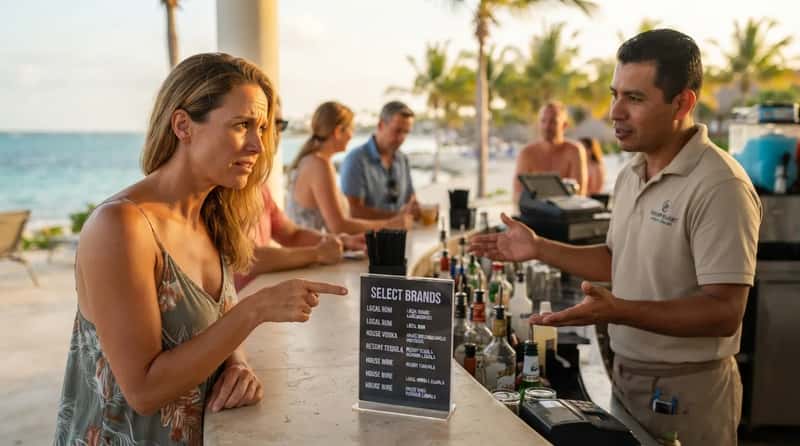
“Unlimited drinks” is one of the biggest selling points in all-inclusive marketing, and one of the most misunderstood.
The list of included brands is often shorter than guests expect, so if the label on your rum matters to you, it’s worth checking exactly what’s poured before you book.
Resorts defend the exclusions by narrowly defining “select beverages” in their terms, but consumer advocates argue it crosses into deceptive territory since most travelers reasonably assume unlimited means familiar, standard brands.
Some European all-inclusive properties have gone even further, capping the number of alcoholic drinks per day instead of offering truly unlimited pours.
But that’s nothing compared to what we found about #12…
#12 – The On-Site ATM Will Quietly Rob You
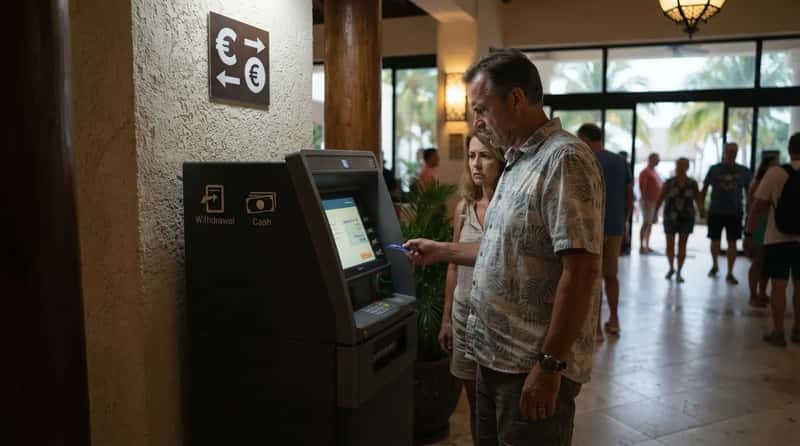
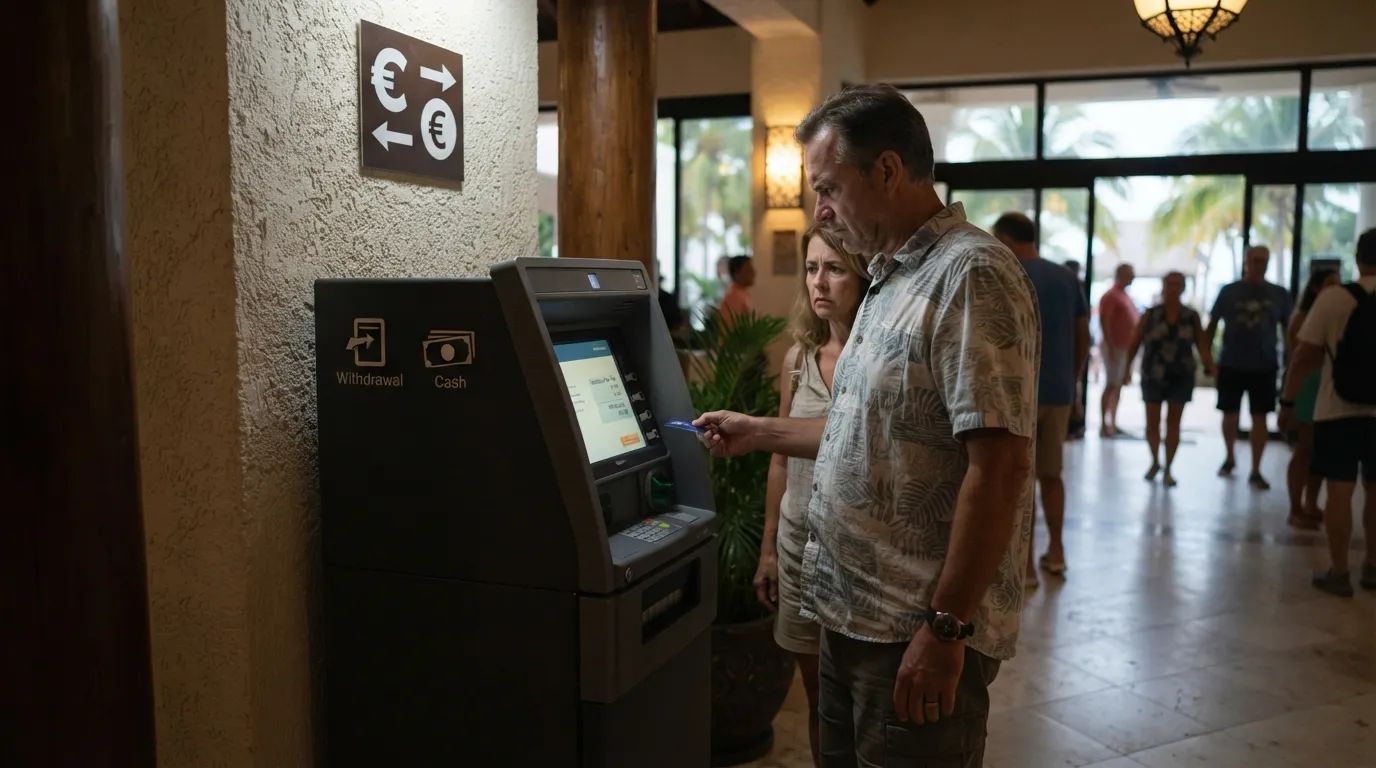
Running low on cash for tips or incidentals? The resort ATM is not your friend.
Your resort is probably outside the U.S., and while it will almost certainly have a currency exchange and an ATM on site, both know you’re a captive audience – the exchange rates are often terrible and the withdrawal fees can be astronomical.
The fix is simple: use a credit card with no foreign transaction fees, and pull cash from an ATM off the resort, ideally one affiliated with your own bank back home.
Local currency also goes further with staff than U.S. dollars, and small local bills are far more useful than large ones, since foreign coins usually can’t be redeemed at local banks anyway.
Fast Facts
- (cite index=”4-2″>Foreign transaction fee charges are generally 1%-3% of the transaction amount.
- (cite index=”8-6,8-7″>If you use an ATM that isn’t part of your bank’s network, your bank may charge an additional out-of-network fee, typically a flat amount per withdrawal, commonly $2 to $5.
- (cite index=”10-7″>Even where your bank does not have a specific ATM fee, you’ll usually pay an additional ‘conversion fee’ of between 1-3% of the transaction.
- Cards with no foreign transaction fees can wipe out most of these charges before you even land.
But that’s nothing compared to what we found about #11…
#11 – The Tipping Situation Is Genuinely Confusing

One of the most awkward moments at any all-inclusive is figuring out who to tip, when, and how much – because nobody actually tells you upfront.
Many properties fold staff gratuities into the base price and post a strict no-tipping policy, but plenty of others don’t, and it pays to learn the specific rules before you book rather than guessing on arrival.
Even resorts with an official “no tipping” policy often quietly expect gratuities for airport transport, spa treatments, and butler service – the sign in the lobby doesn’t always match reality at the front door.
Some brands, like Sandals Resorts, hold a genuinely strict no-tipping policy that covers everything except spa treatments and anything handled by a personal butler.
But that’s nothing compared to what we found about #10…
#10 – Airport Transfers Are Rarely Included by Default

Most guests assume the resort picks them up from the airport as part of the package. Most guests are wrong.
Transportation to and from the airport often isn’t included at all, and even when it is, it may only apply to certain room types or booking classes – something worth confirming long before your flight lands.
Skip that check and you could end up paying hundreds of dollars for a last-minute private car, especially at resort strips where taxis effectively set their own rates.
Alongside airport transfers, other commonly excluded items include premium drinks, excursions, taxis, spa services, laundry, and long-distance phone calls – none of which are typically folded into a standard all-inclusive rate.
At a Glance
- Airport transfers – often a separate fee unless your room tier says otherwise
- Off-resort excursions and tours – almost never included
- Laundry and long-distance calls – typically billed as extras
- Premium drinks and specialty spa services – usually carry a surcharge
But that’s nothing compared to what we found about #9…
#9 – Spa Access Almost Always Costs Extra – Even Just Walking In
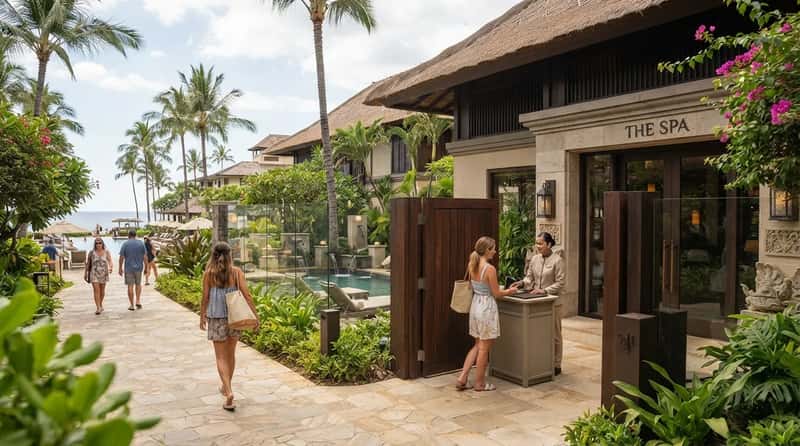
The spa is one of the most heavily marketed features at upscale all-inclusive resorts, and one of the most reliably extra-cost experiences on property.
Treatments almost always cost extra, and at some resorts, simply stepping into the spa facilities carries a day-use fee of its own.
Other activities that regularly come with an added charge include fitness classes, golf, theater shows, performance-based dinners like luaus, private beachfront meals, and kids’ camps or nanny services.
Resorts with a hydrotherapy circuit usually bundle the water journey into spa access, which can unlock private pools or decompression rooms most guests never even realize exist.
But that’s nothing compared to what we found about #8…
#8 – Motorized Water Sports Are Almost Never Included

Non-motorized water sports – kayaks, paddleboards, snorkel gear – are standard at most all-inclusive resorts. Anything with an engine is a different story entirely.
Jet Ski rentals, parasailing, and other motorized activities almost always cost extra, even at resorts that advertise a full water sports program.
Some properties even attach participation fees to activities they technically list as included, like snorkeling or fitness classes, once you ask about equipment rental or instruction.
With rare exception, guests are also on the hook for the full cost of any excursion or tour that leaves the resort property altogether.
Quick Compare
- Quiet inland lakes: (cite index=”15-6″>quieter inland lakes can dip to $75 per hour
- Standard coastal resorts: (cite index=”11-1″>jet ski rentals cost between $60 and $150 per hour, depending on location, model, and season
- Tourist hotspots: (cite index=”11-2″>high-demand areas like Hawaii or Miami often charge $120 or more per hour for premium models
- (cite index=”18-10″>Many providers discount multi-hour, half-day, and full-day rentals.
But that’s nothing compared to what we found about #7…
#7 – The Mini-Bar in Your Room Is a Trap

Grabbing a soda from the in-room mini-bar feels like the most natural thing in the world at an all-inclusive – until checkout.
Mini-bar usage often carries hidden fees despite the “included luxuries” framing, and resorts can charge inflated prices for drinks, snacks, and toiletries, betting most guests never check.
The key distinction is between what’s genuinely included in the package and what’s simply stocked as a convenience – many resorts do the latter and bill accordingly.
Ask the front desk directly whether your mini-bar is fully included or charged per item; it’s a question staff rarely volunteer an answer to unless you push for it.
But that’s nothing compared to what we found about #6…
#6 – Pool and Beach Cabanas Are Not Guaranteed – Or Free

Guests picture themselves lounging in a shaded cabana by the pool all day. That picture costs extra at plenty of resorts.
Cabanas and even premium sun loungers can run $50 to $150 a day at some properties, while identical setups are free at others just down the coast.
Other amenities that commonly carry an added fee include spa treatments, fitness classes, golf, theater shows, and kids’ camps or nanny services – it’s worth asking about all of them before you pack.
Even when loungers are technically free, the unspoken system is that towels claim them before 7 a.m., leaving late risers without shade at the exact moment they need it most.
But that’s nothing compared to what we found about #5…
#5 – The Food Quality Varies Enormously – By Price Tier

There’s a common assumption that all-inclusive food is roughly the same everywhere. Experienced resort-goers know that’s completely false.
At budget-level properties, the food quality ceiling is genuinely low, the drinks can be weak, and the whole experience feels mass-produced – fine for travelers who plan to live at the pool, less fine for anyone chasing a great meal.
At the top tiers, all-inclusive stops feeling like a compromise entirely; some luxury properties run restaurants that would hold their own as standalone destinations in a major city.
The mistake most people make is booking on price alone and then being surprised by the food – the tier you choose almost entirely determines the culinary experience, and no amount of complaining changes that mid-trip.
But that’s nothing compared to what we found about #4…
#4 – The Gift Shop Prices Are Wildly Inflated

Forgot sunscreen? Ran out of bug spray? The resort gift shop has you covered – at a price that will make your eyes water.
Basic items like sunblock or bug spray are routinely marked up at on-site shops and pharmacies, and you may be nowhere near the nearest real store.
That’s by design: resorts know guests rarely want a 20-minute taxi ride to a pharmacy in an unfamiliar destination, so the in-house shop becomes a monopoly charging three or four times retail.
Pack everything you rely on from home – medication, sunscreen, after-sun lotion, your usual toiletries – the extra suitcase weight is nothing compared to the markup waiting at the lobby shop.
Worth Knowing
- Sunscreen, aloe, and bug spray are consistently the most marked-up items at resort shops.
- A single on-site pharmacy option means built-in pricing power with no competition.
- A small “just in case” kit packed from home usually pays for itself on day one.
- Ask the front desk about the nearest off-site pharmacy before you need it in an emergency.
But that’s nothing compared to what we found about #3…
#3 – Being Nice to Staff Is the Single Most Valuable Hack

This sounds obvious. Almost no one actually does it consistently – and the guests who do have a measurably different trip.
These are hardworking locals who genuinely can make or break a vacation, and a real conversation with your concierge, bartender, or server can unlock insider tips about the destination no guidebook will ever mention.
One of the simplest, most overlooked moves at any all-inclusive is talking to the people who actually run the property – not just handing over a room number, but asking a real question on day one.
Staff remember guests who treat them with genuine respect, and they quietly go out of their way for those people – better table placement, faster drink service, earlier reservation slots, even the occasional room upgrade, all flowing naturally from one good relationship.
But that’s nothing compared to what we found about #2…
#2 – The Best Perks Are Hidden Behind Upgrades Nobody Mentions at Booking

Upgraded room tiers at all-inclusive resorts don’t just buy a better view – they often unlock an entirely different resort experience that feels like a separate property altogether.
Upgrading can open up quieter pools, private lounges, premium drink lists, and priority restaurant bookings, which during busy seasons is often the only real escape from the crowds that make a standard all-inclusive feel exhausting.
Elite hotel status can layer on even more – club lounge access, room upgrades, better restaurants and pools, private butlers, or resort credit – all without paying full price à la carte for every extra.
The problem is resorts rarely explain the full scope of an upgrade during booking. Ask directly what you actually lose by staying at the standard tier, and you’ll almost always get a clearer answer – sometimes clear enough to convince you the upgrade is worth every cent.
But that’s nothing compared to what we found about #1…
#1 – Most People Never Leave the Resort – And Completely Miss the Destination

This is the one nobody wants to hear, and it’s the one that changes how you think about the entire all-inclusive concept.
The model is brilliantly designed to keep you on property – every meal, every drink, every activity is right there, and every hour spent off-resort feels like an hour of “value” you’re not getting back.
So most guests never leave. They spend a week in Mexico or the Caribbean and see the inside of a gated compound, nothing more.
Exploring the surrounding area – a market, a fishing village, a street food stall – can transform the entire trip; the resort delivers comfort, the destination delivers experience, and most all-inclusive guests only ever get one of the two.
The Bottom Line

All-inclusive resorts can deliver exactly what they promise – a stress-free, value-packed vacation – but only for guests who arrive already knowing what the fine print says.
The hidden fees are real. The room-location trap is real. The gap between “unlimited drinks” and the drinks you actually wanted is real.
And the irony that most guests never leave the property to see the destination they flew hours to reach? That’s the most expensive oversight of all.
Read the inclusions list before you book, confirm reservations on day one, tip in local currency, and make at least one real trip beyond the resort gates – guests who do just those four things consistently describe a completely different, and far better, vacation.
Which of these caught you off guard? Drop it in the comments – and let us know if there’s a resort secret we missed.
Bonus: The Pre-Arrival Move That Can Unlock a Free Upgrade

Skip the third-party booking site the next time you reserve and instead book directly through the resort’s own website or call center after joining its free loyalty program first.
Direct, loyalty-linked bookings are the ones front desk staff can actually adjust – room location, early check-in, and complimentary upgrades are far easier for them to grant when your reservation lives in their own system, not a middleman’s.
Then send one short email to the resort’s guest services address 3-5 days before arrival with your confirmation number, arrival time, and any occasion worth mentioning.
- Join the resort’s or hotel group’s free loyalty program before you book, even if you’re only staying once
- Book the room directly on the resort or brand website, not through an OTA
- Email guest services 3-5 days out with your confirmation number and a specific, polite request (quiet floor, away from elevators, close to the main pool)
- Repeat the same request verbally at check-in – staff who see it twice, in writing and in person, are far more likely to act on it
This single habit costs nothing and takes ten minutes, but it consistently produces the upgrades, late checkouts, and welcome extras that guests who book through third-party sites almost never see offered.