You land, drag your bags to the bed, type in the Wi-Fi password, and flop down for a quick nap. Feels productive, right?
Veteran travellers – the ones who’ve logged hundreds of nights in hundreds of rooms across dozens of countries – would tell you that’s already three mistakes in a row. What they do instead in those first ten minutes looks almost too small to matter, until you see why it does.
#16 – They Screenshot the Room Number the Second They Get Their Key
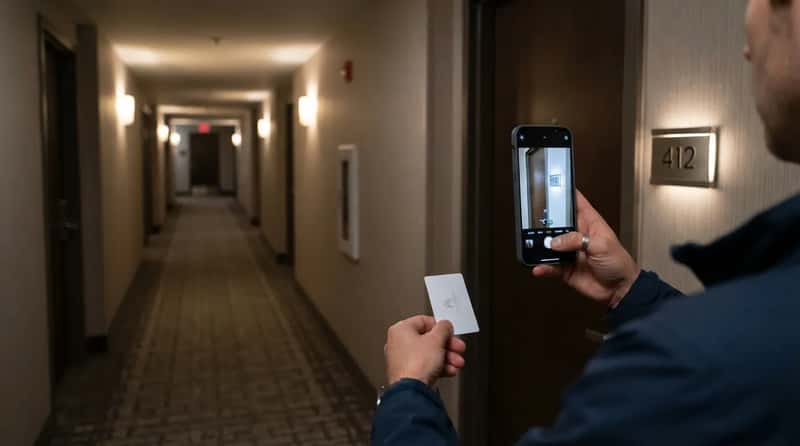
Most guests trust their jet-lagged brain to remember the room number. Veteran travellers don’t trust anyone’s memory, especially not their own after a long flight.
They screenshot the room number and hotel address the moment they’re handed a key. Long identical hallways and jet lag make it shockingly easy to forget which door is yours after a late dinner.
It also saves you if you get separated from a travel companion, or need to give a delivery driver exact directions. Your phone becomes the backup system – not your memory.
It sounds almost insultingly simple. That’s exactly why most people never bother, right up until they’re standing in a corridor at midnight, key card in hand, completely lost.
But that’s nothing compared to what happens the second they walk into the room.
#15 – They Pull the Curtains Open Immediately
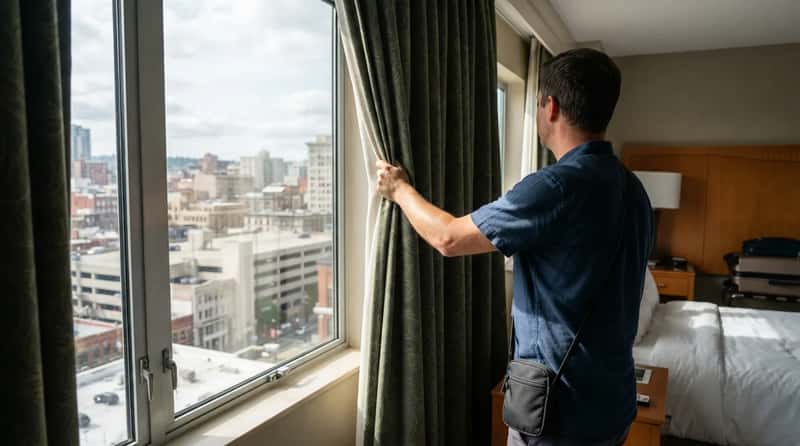
They’re not doing it for the view. They’re doing it to verify the view.
Room photos on booking sites are notoriously optimistic, and “city view” can quietly mean a parking garage or the top of an air conditioning unit. Experienced travellers open the curtains within minutes to see exactly what they’re actually paying for.
If it doesn’t match what was promised, they raise it with the front desk immediately instead of stewing over it for the whole trip. Wait even a single day, and the complaint loses almost all its weight.
Hotels have limited room inventory, and the moment you’ve “settled in,” you’ve silently agreed to whatever you got. The window check takes ten seconds – the leverage it buys only works if you move fast.
#14 – They Photograph Every Scuff, Stain, and Scratch
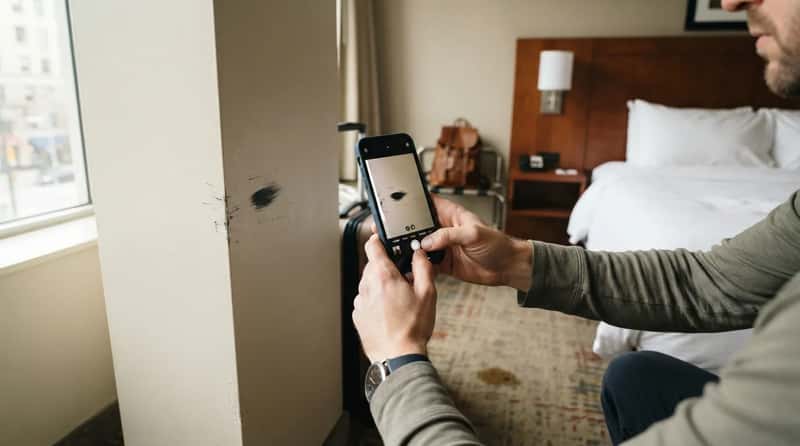
This is the habit most travellers only learn after being charged for damage they didn’t cause.
Scuffed walls, a stained carpet, a hairline crack in the mirror – experienced travellers photograph all of it before a toothbrush comes out of the bag. It’s a defensive move, and a simple one.
Damage-fee disputes are common enough that consumer protection guides routinely recommend documenting a room’s condition on arrival. It takes seconds and creates a timestamped record that ends any argument before it starts.
A photo taken before your bags hit the floor is almost impossible to dispute. A complaint filed at checkout, with no evidence, rarely goes anywhere.
#13 – They Check the Smoke Detector
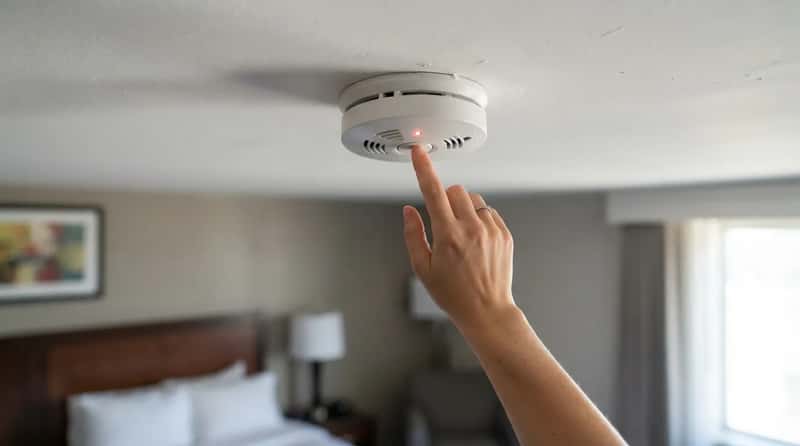
Not a glance. A proper check.
Before anything touches the sheets, savvy guests look at the smoke detector and sometimes give it a light tap to confirm the indicator light is active. It ties directly into basic fire safety advice that keeps getting repeated for a reason.
Smoke detectors are occasionally disguised as camera housings in privacy scares, so this quick check does double duty. You confirm the safety equipment works, and you scan for anything that shouldn’t be there.
It takes five seconds. Most travellers have never done it once in their lives – that’s not a criticism, it’s just the gap between casual and experienced.
#12 – They Look for a Carbon Monoxide Detector

This is the habit that tends to genuinely rattle people, because it exposes a gap most travellers never knew existed.
Carbon monoxide is a silent, colorless, odorless threat, and not every property has an in-room detector. Seasoned travellers check within the first few minutes, and some pack a portable one for older buildings.
Unlike smoke, carbon monoxide gives you zero warning. No smell, no visible sign – just a growing headache most people blame on jet lag, right up until it isn’t jet lag at all.
Fast Facts
- Only 14 U.S. states legally require carbon monoxide detectors in hotels and motels.
- Carbon monoxide has no smell, no color, and no taste – there’s no natural warning sign.
- Most hotel rooms still skip a detector unless local law forces the issue.
- A portable CO detector is small, battery-powered, and easy to pack for older buildings.
Regulations vary wildly by country and even by city, so nothing can be assumed. This is the one check veteran travellers say they’d never skip, even at a five-star property.
#11 – They Read the Evacuation Plan on the Back of the Door
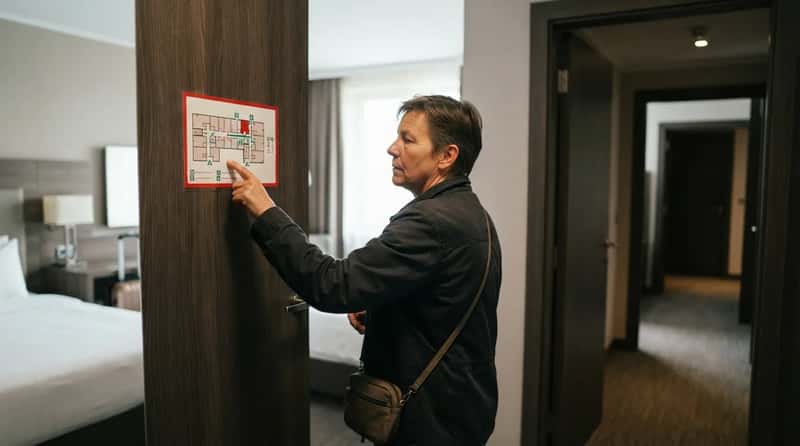
Most guests treat it as wallpaper. Experienced travellers actually read it.
The American Red Cross recommends reading the evacuation plan, locating the two nearest exits, and counting the doors between the room and those exits. Seasoned travellers treat this as a normal arrival ritual, because a map you’ve never looked at is useless the moment the power cuts out.
Hotel fires move fast, and smoke fills corridors within minutes. The guests who know which direction to walk in total darkness are the ones who already ran this exercise on arrival.
It costs sixty seconds. Veterans insist it’s the most important sixty seconds of any check-in.
#10 – They Fold Back the Comforter Immediately

This one makes people uncomfortable – which is exactly why it matters.
Comforters are notoriously the least-cleaned item in a hotel room, washed far less often than the sheets underneath. Seasoned guests fold it back immediately, check what’s actually touching their skin, and sometimes set the whole thing aside for the rest of the stay.
It isn’t drama. It’s just knowing what housekeeping realistically has time to do during a fifteen-minute room turnover.
Some veteran travellers simply request an extra blanket from housekeeping and use that instead. Small swap, very practical reasoning.
#9 – They Check the Bed Seams Before Anything Touches the Sheets
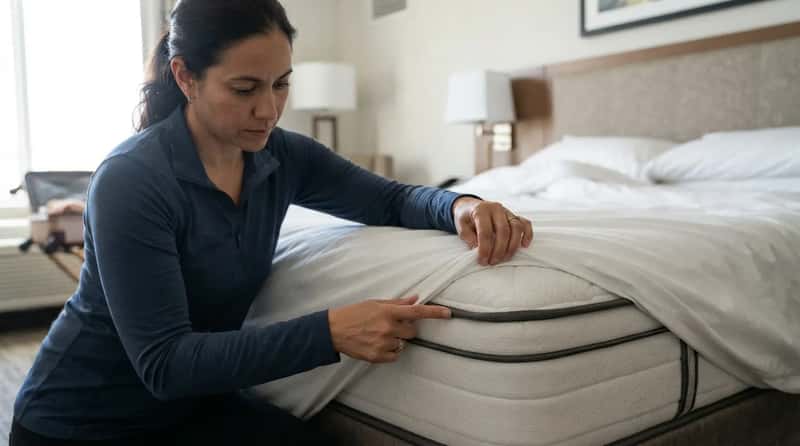
Veteran travellers aren’t paranoid – they’re pattern-aware.
Before anything else touches the bed, seasoned travellers pull back the corners of the mattress and check the seams, headboard, and box spring for signs of bed bugs. A single missed infestation can follow your luggage home and cost hundreds to eradicate.
Hotels of every price point have reported incidents – this is not a budget-hotel problem. The check takes under two minutes, and if anything looks off, experienced travellers request a room change before unpacking a single item.
Worth Knowing
- Hotels spend an average of $6,383 per bed bug incident, covering treatment, replacement, and lost bookings.
- Add litigation, and a single incident can run as high as $23,560 all in.
- Almost half of hotels dealing with bed bugs have faced a guest lawsuit over it.
- Luxury offers no immunity – bed bugs travel in on guests, not on a hotel’s star rating.
The golden rule: luggage never touches the bed until the check is done. Bags go on the rack or in the bathroom first, always.
#8 – They Ask About Late Checkout at Check-In, Not at Checkout

Timing is everything, and most travellers get it completely backwards.
Most guests wait until the morning they’re leaving to ask for extra time – which is exactly why they usually get told no. Experienced guests ask the moment they arrive, when the front desk still has flexibility and no competing requests stacked up yet.
Asking early also signals someone who plans ahead rather than someone scrambling. It rarely guarantees anything, but it shifts the odds meaningfully compared to a last-minute plea at 10:58 a.m.
One question, asked at the right moment, can buy you two extra hours of sleep on departure day. Veterans call it one of the easiest wins in travel – hiding in plain sight.
#7 – They Have Everything Ready Before Reaching the Front Desk
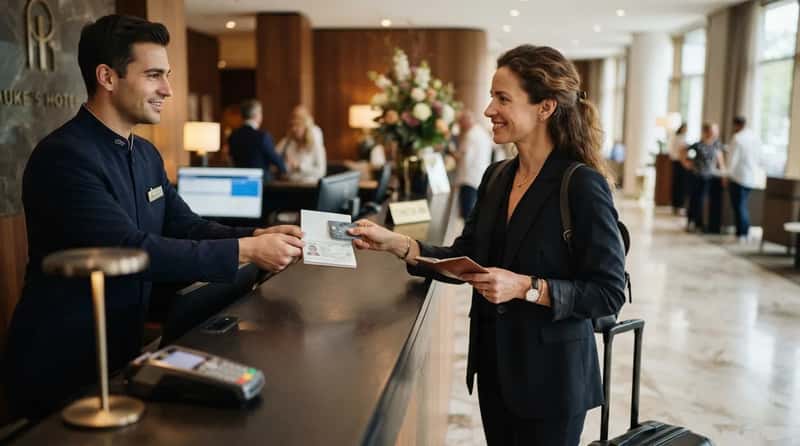
This one separates the experienced from the first-timers in under thirty seconds.
Veteran travellers have ID and card ready before reaching the counter, and never dig for a confirmation number buried in a week-old email. That frictionless handoff signals experience instantly.
Front desk agents sort a guest’s travel comfort level almost without thinking. Hand over a printed or screenshotted confirmation, and you’re filed into the “easy” pile in under a minute.
Being the easy guest matters more than most people realize. Staff remember it, and it tends to translate into better room assignments and more goodwill later in the stay.
#6 – They Verify the Room Assignment Wasn’t a Mistake
Roughly 70% of American travellers now check in using an app or kiosk instead of a front desk, which means fewer humans double-checking room assignments in real time. Veteran travellers know this, and verify their own room details on arrival.
They cross-check the floor, the bed type, the view category, and any special requests against what they actually booked. A misassigned room caught in the first five minutes is easy to fix – caught later, it’s a fight.
This habit also flags the room next to the ice machine, near the service elevator, or directly above the bar. No algorithm is going to catch that for you.
#5 – They Unpack the Essentials Within Ten Minutes
Most people live out of a suitcase for the entire trip. Veteran travellers call this one of the biggest daily time-wasters in travel.
The organised camp moves clothes into drawers, hangs up anything wrinkle-prone, and lines up shoes by the door – all within the first ten minutes. It sounds like overkill for a two-night stay, but it kills the mental clutter of digging through a bag every single morning.
It also makes it far less likely something gets left behind at checkout. Almost everything forgotten in a hotel room was buried at the bottom of a suitcase that never got properly unpacked.
#4 – They Silence Jet Lag by Refusing to Nap
This is the most divisive habit on the list – and the one with the most evidence behind it.
The strategy veteran travellers swear by is forcing themselves to stay awake as late as possible on arrival, so the body clock realigns to local time fast. A nap in the first few hours feels like relief, but it functions more like a delay, shoving your internal clock further out of sync.
Sleep researchers broadly agree that anchoring to local time on day one is the fastest route out of jet lag. Veteran travellers treat the first afternoon as a battle to win, not a rest to indulge in.
Quick Compare
- Napping on arrival: feels great for an hour, but pushes your body clock further out of sync.
- Staying awake to local bedtime: rough for one afternoon, resets the clock far faster.
- Westbound flights: the body adapts at roughly 1.5 hours per time zone, per day.
- Eastbound flights: adaptation slows to about 1 hour per time zone, per day.
The payoff is a full, functional day two – instead of two or three days spent foggy and half-present.
#3 – They Learn Two or Three Words of the Local Language Before the First Conversation
This isn’t about being impressive. It’s about being effective.
Experienced travellers quietly research basic etiquette before arriving – appropriate dress at religious sites, tipping norms, greeting customs – not to perform respect, but because they’ve seen how much smoother interactions go when locals feel it.
Knowing how to say “thank you” correctly, or greet someone properly, opens doors that a guidebook clutched in your hand will permanently close. Nearly every seasoned traveller has one slightly mortifying story about getting this wrong early in their travels.
That memory sticks. It shapes behaviour far more than any guidebook warning ever could.
#2 – They Get a Physical Map or Hotel Business Card Immediately
In 2026, this looks like an old habit. It’s actually a survival strategy.
Veteran travellers grab a local map from the airport information desk or hotel reception the moment they arrive, because a physical map often surfaces local highlights and insider tips that digital search simply doesn’t prioritise.
They also always pick up a hotel business card with the address printed on it. The moment your phone battery dies, roaming fails, or you’re in a taxi with a driver who doesn’t speak your language, that card is the single most valuable object in your pocket.
The travellers who end up stranded are almost always the ones who assumed their phone would never let them down. Veterans plan for the moment it does – on day one.
But the single most important thing veteran travellers do in those first ten minutes? Almost nobody talks about it.
#1 – They Do a Full, Systematic Room Sweep Before Touching Anything
Every other habit on this list is a piece of the picture. This one is the whole picture.
Experienced travellers take a quick photo or video sweep of the entire room – walls, furniture, carpet – within the first few minutes. It’s not paranoia, it’s pattern recognition built from hundreds of nights in hundreds of rooms.
In one pass, they confirm the room matches the booking, there’s no pre-existing damage to dispute, the smoke and carbon monoxide detectors are present, the bed is clean, and the exits are located.
At a Glance
- Room matches the booking – floor, view, bed type
- No pre-existing damage left undocumented
- Smoke and carbon monoxide detectors present and active
- Bed and linens actually clean
- Nearest exits located and counted
What takes a first-time traveller three days to notice, a veteran resolves in five minutes. The sweep isn’t dramatic – it’s calm, quiet, and methodical, and it’s the clearest sign there is that someone has done this before.
The Bottom Line
The gap between a first-time traveller and a veteran was never about passport stamps. It’s the first ten minutes.
Photographing damage, verifying the room, refusing the nap, reading the evacuation map, checking for carbon monoxide – none of it is complicated. It’s just invisible until someone points it out.
The travellers who do this consistently sleep better, dispute less, and leave fewer things behind. The ones who skip it are the ones telling the horror story at dinner next year.