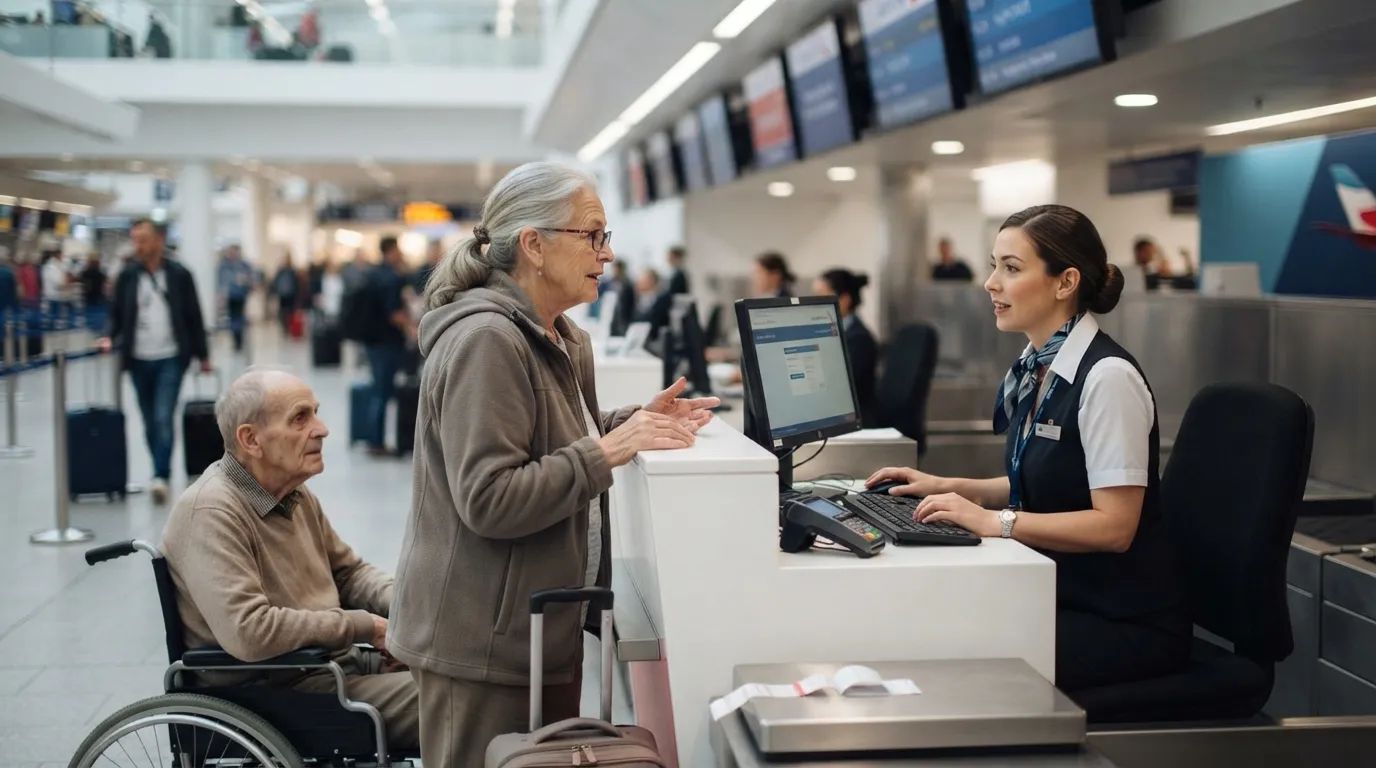
Here’s the honest version: almost no fee disappears just because you turned 65. The ones that do vanish because of a federal rule, a quiet program, or a question most agents will never raise on their own.
Some of these are legal rights that airlines rarely mention. Some are senior fares that never show up on a booking page. And one is a published program so cheap it makes the American system look stingy, but you’ll have to reach #1 to see it.
#17 – The Phone Booking Fee When the Website Fails You

If an airline’s website doesn’t work with your screen reader, or a disability keeps you from finishing a booking online, the airline must waive its telephone reservation fee. That isn’t a courtesy. It comes from the Air Carrier Access Act.
So if you ever paid a service charge to book by phone because the site beat you, that charge shouldn’t have been collected.
Carriers can still charge the fee if the site works fine and you just like talking to a person. So state clearly why you’re calling.
That fee is small, though. The next one involves a much bigger number.
#16 – Your Own Walker or Wheelchair in the Cargo Hold
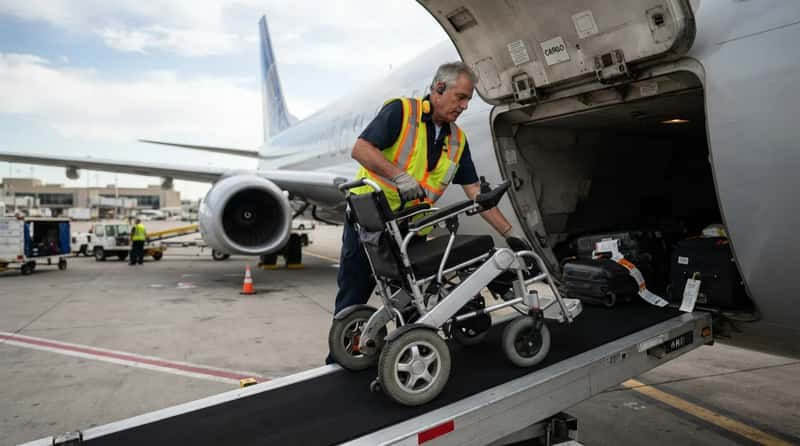
Checking your personal wheelchair, scooter, or walker at the ticket counter costs nothing. These devices count as baggage, but the standard baggage liability cap doesn’t apply to them on domestic flights.
The Department of Transportation says the airline’s liability for a lost or damaged assistive device is its original purchase price. If an airline destroys a $20,000 chair on a domestic flight, it owes you $20,000.
If a gate agent pushes back on the zero fee, ask for the airline’s Complaint Resolution Official. Every major U.S. carrier must make one available.
But what happens when that expensive chair comes off the plane broken?
#15 – The Loaner Wheelchair Fee When Yours Is Damaged

When an airline damages your wheelchair, it owes you a loaner at no charge while yours is repaired or replaced. Under DOT rules, the loaner must fit your functional needs and cost you nothing.1
If the airline can’t provide a suitable one, it must reimburse you for getting one yourself.2 The protection covers scooters as well as manual and power chairs.
The airline also bears the cost of repair or replacement, and you can choose your own repair vendor. These protections come from the DOT’s 2024 wheelchair rule, and some enforcement pieces were phased in through 2025.3
The same rule also covers the scarier scenario, where your chair never makes the flight at all.
#14 – The Rebooking Fee When Your Wheelchair Misses the Plane
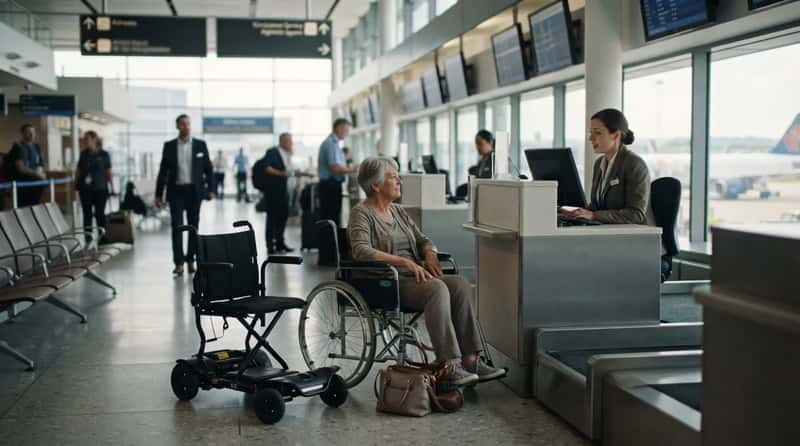
The 2024 rule requires airlines to offer free rebooking on the next available flight if your wheelchair or scooter isn’t loaded or doesn’t fit on your scheduled flight.1 3 No fee, no fare difference, no argument.
Airlines must also reimburse transportation costs to or from the airport that you incur because they delayed your equipment.1 If you had to take a cab or rideshare because of their mistake, submit the receipt.
Fast Facts
- Rebooking on the next available flight should cost you nothing.
- You shouldn’t owe any fare difference for the new flight.
- Cab or rideshare costs caused by the delay are reimbursable.
- Your receipts are the proof, so save every one.
Keep every receipt from the moment the problem starts. Next, a waiver that hides inside a single sentence at the counter.
#13 – Medically Necessary Equipment That Never Should Have Been Charged

Airlines shouldn’t charge you a fee for medically necessary equipment. CPAP machines and portable oxygen concentrators are the classic examples, and most carriers ask for little or no paperwork.
If you paid a bag fee for medical gear on a past trip, that charge can be disputed.
For the many travelers over 65 who manage a chronic condition, this one matters. Pack medical gear in its own clearly labeled bag and the counter conversation gets much shorter.
#12 – Priority Boarding That Goes to Anyone Who Asks for Assistance
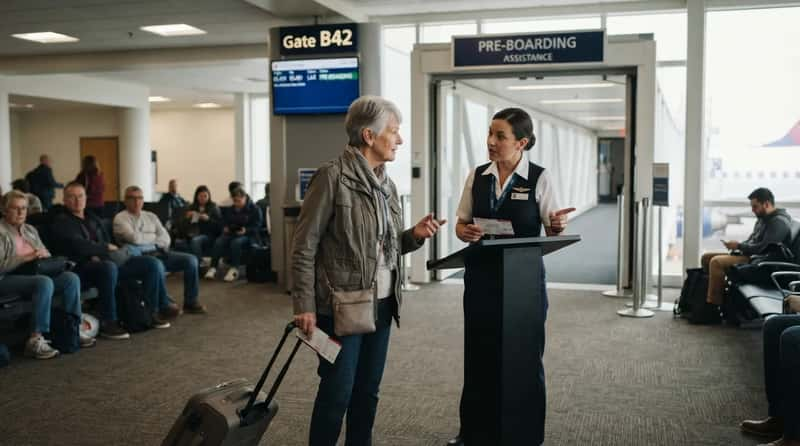
Paid early boarding is one of the most common upsells at the gate. But a passenger who tells the agent they need extra time or help to board, stow equipment, or get seated is entitled to board before everyone else.
That’s not a favor. It’s a right under the Air Carrier Access Act.
Ask for “pre-boarding assistance due to mobility needs,” and you typically get on ahead of first class. You don’t need a wheelchair, because trouble with stairs, joint pain, or stowing a carry-on carefully can all qualify.
Worth Knowing
- Ask the gate agent in person, not a kiosk or app.
- Use the phrase “pre-boarding assistance due to mobility needs.”
- Stairs, joint pain, and lifting a carry-on can all count.
- You can skip the paid priority-boarding upsell.
Say it to the gate agent, not a kiosk. Now for a fee that only opens up when the worst news arrives.
#11 – Delta’s Bereavement Fee Waiver Available Only by Phone

Delta’s bereavement policy gives you flexibility on the best published fare for your trip. Tickets are still subject to availability and there’s no extra discount, but service fees are waived on both the outbound and return flights.4
It applies at any age, but it can matter a lot when a family loss forces a last-minute trip.
- Bookings go through a Delta phone agent, not the website.
- The person booking must hold a SkyMiles number.
- Service fees are waived on both outbound and return legs.
The waiver is narrow and doesn’t cut the base fare. On a last-minute ticket, though, the service charge alone can be a meaningful sum.
#10 – The Delayed Baggage Fee the Airline Owes You Back

If an airline fails to deliver your checked bag within a reasonable window after you land, you can claim a refund of the bag fee. Under a 2024 DOT rule, that window is 12 hours on domestic flights.5
That refund is separate from any reimbursement for expenses caused by the delay. They’re two different claims, and you can make both.
File both claims in writing as soon as the delay is confirmed, and keep copies. Treat them as two separate requests so neither gets lost.
#9 – The Overnight Hotel Bill When the Airline Strands You

If your flight is canceled or badly delayed for a reason the airline controls, such as a mechanical problem or crew shortage, you shouldn’t be paying for the hotel. No single federal law guarantees it, but many major U.S. airlines’ own customer service plans promise a room for overnight controllable disruptions.
Meals and ground transportation to the hotel are often part of the package too.
The key phrase at the desk is “this was a controllable delay.” Agents often move faster when they can tell you know the difference, so check your airline’s customer service plan before you fly.
Those are the rights. Now come the discounts you won’t find on any booking page.
#8 – American’s Unpublished Senior Fare on Select Routes
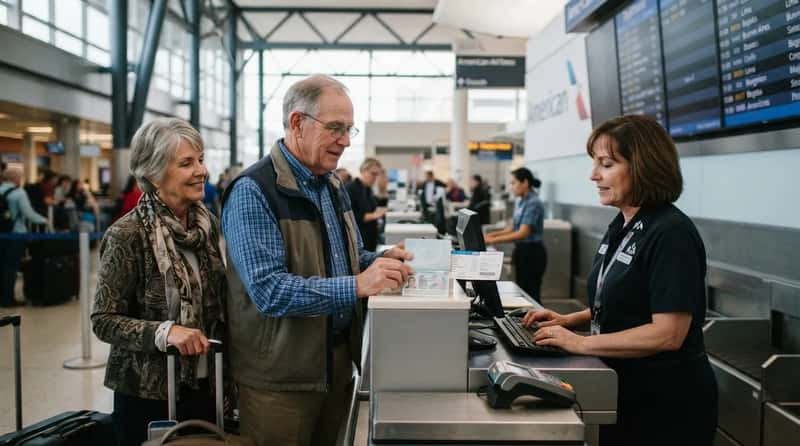
American’s booking engine can offer a “Senior (65+)” passenger type on some routes, but the airline doesn’t promote it. Bring government ID showing your age to the airport.
Reported discounts run about 10% to 15% off the base fare, mostly on international routes to Latin America. The fare applies only to the senior traveler, not everyone on the reservation, which is easy to miss when booking as a couple.
Check the public fare online first, then call and ask whether a senior fare beats it.
#7 – Delta’s Senior Fare Hidden Behind a Phone Call

Delta offers senior discounts on certain domestic markets for passengers 65 and older. They aren’t displayed on delta.com, so you have to call reservations and ask.
Delta’s own fares-and-discounts page says certain discounts “are not available at delta.com.”
Few airlines spell out what these discounts are worth or which flights carry them. The fare may beat the published price or it may not, so look up the public fare first and then call to compare.
Quick Compare
- American: Senior (65+) fare on select routes, reported at 10% to 15% off, mostly international.
- Delta: Select domestic markets, 65 and older, phone booking only.
- United: Senior (65+) option on united.com, 5 to 25 percent off by one recent guide, Basic Economy excluded.
#6 – United’s Senior Fare and the Basic Economy Trap

United has offered a senior discount on select routes for passengers 65 and older, with a catch. Basic Economy fares are excluded, and no amount of asking at the counter will change that.
On united.com you can choose “Senior (65+)” from a dropdown, and one recent guide puts the discounts at 5 to 25 percent. The range is wide because it depends on route and fare class.
The online process is simpler than calling, but the Basic Economy exclusion removes the discount from the tickets budget travelers buy most. A senior ticket also doesn’t automatically include a seat assignment.
#5 – The Seat-Selection Fee When You Need a Caregiver Beside You

Federal regulation requires airlines to seat a passenger with a disability next to a traveling companion who provides personal care during the flight. The advance seat-selection fee shouldn’t apply in that situation.
You have to ask an agent directly, because the automated seat map won’t apply the exemption on its own.
If you’re denied adjacent seating, ask for the Complaint Resolution Official. That request alone tends to speed things up.
#4 – The Fare Difference When the Plane Can’t Fit Your Mobility Equipment
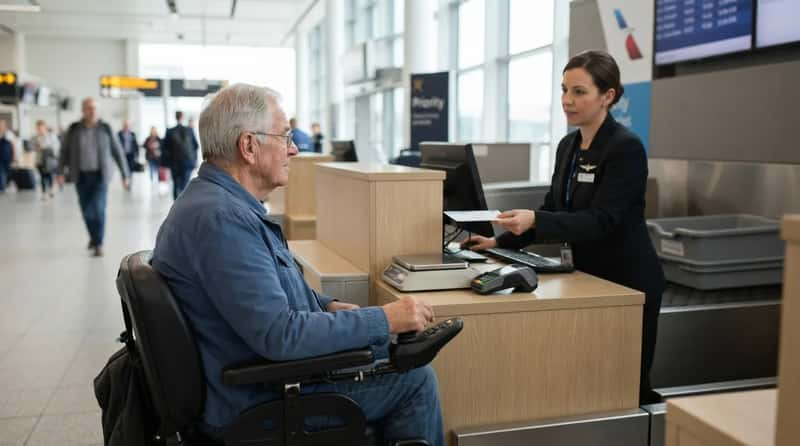
Some planes simply can’t carry certain wheelchairs or scooters. Under the DOT’s 2024 wheelchair rule, you shouldn’t be stuck paying extra if that forces you onto a pricier flight, and you can ask the airline to refund the difference.2
Almost no agent will mention it unless you bring it up.
Picture a nonstop on a regional jet that can’t take your power chair, so you’re rerouted onto a costlier connecting itinerary. That fare gap belongs to the airline, not you.
Document the original itinerary and the reason for the change before you leave the counter.
#3 – Southwest’s No-Change-Fee Rule That Needs No Age Check

Southwest ended its senior fare program in 2019, so there’s nothing age-specific to ask for. There are no loyalty-based exceptions to track either.
What Southwest does offer every passenger, including those over 65, is a no-change-fee policy. That makes it genuinely flexible for travelers whose plans shift.
At a Glance
- Senior fare program: ended in 2019.
- Change fees: none for any passenger, any age.
- “Bags Fly Free”: ended May 28, 2025.
- Age check at the counter: not needed.
The old “Bags Fly Free” perk ended on May 28, 2025, which changed the math. If you fly Southwest often with a bag, compare a year of bag fees against a co-branded card’s annual fee, and confirm what your specific fare includes before you book.
#2 – Air India’s Published 10% Off for Passengers Over 60

Air India gives passengers 60 and older a flat 10% off base fares on international flights booked at airindia.com or in its app. You opt in to the senior citizen discount while booking and show date-of-birth ID at check-in.6 7
Taxes and fees are charged in full.
It’s published, it’s verifiable, and it doesn’t require a phone call or a negotiation. Beyond it, the programs that still exist in writing include Frontier’s on-again, off-again 55% promotion and Air France’s Senior Pass for travel within Europe.
Compare that clarity with the unpublished, unquantified fares at the big U.S. carriers, and it says a lot about who takes this group seriously. One program does even better.
#1 – The Air France Senior Pass That Cuts Up to 30% Off European Fares

Air France sells a Senior Pass to travelers 65 and older for 49 euros a year. It offers up to 30% off Standard fares within Europe.7 8
The pass also includes flexible tickets and free checked baggage.8 That’s three separate benefits from one annual fee.
At the full 30% discount, the pass earns back its price after roughly 165 euros in eligible tickets, and smaller discounts take longer. That’s a low breakeven for anyone flying within Europe more than once a year.
It isn’t the most dramatic waiver on this list. It’s the one that’s documented, repeatable, and almost invisible to the American travelers who could use it.
Look back over all 17, and the pattern is clear: the fee doesn’t vanish because you’re over 65. It vanishes because you know what you’re owed and say so, at the right moment, to the right person.
Federal rules protect your mobility equipment, your bag fee, and your seat beside a caregiver. Senior fares at American, Delta, and United are real but easy to miss, while Air France and Air India publish theirs in plain sight.
Before you pay any airline charge, ask whether it applies to your situation. If the first answer is no, politely ask for a supervisor.
What’s one fee you’ve paid at an airport that, looking back, you’re not sure you actually owed?
#18 – The Bonus Tip Nobody Shares: Settle It Before You Reach the Airport

Every waiver above gets easier when it’s already on your reservation. The trick is to make one call days before you fly, not to argue at the counter.
Here’s the exact sequence:
- Call the airline’s special assistance or accessibility line at least 48 hours before departure. Airlines can require that much notice for some services, such as certain wheelchair and oxygen arrangements.
- Have them note your needs on the booking: pre-boarding assistance, your mobility device’s make, model, and dimensions, and any caregiver seated beside you. Ask for the agent’s name and a reference number.
- Call TSA Cares at 855-787-2227 at least 72 hours ahead. It’s a free TSA helpline that can arrange checkpoint assistance for travelers with disabilities or medical conditions.
- Save the DOT’s aviation disability hotline, 800-778-4838, in your phone. If an agent disputes a right, you can call it from the gate.
Why it works: a documented note changes the conversation from “please” to “it’s already on file.” If something goes wrong, you also have a written trail, which is what a complaint or claim needs.
Print or screenshot the confirmation and carry it with your ID.
- DOT Wheelchair Rule Announcement: https://www.transportation.gov/briefing-room/secretary-buttigieg-announces-sweeping-protections-airline-passengers-disabilities
- Federal Register Wheelchair Rule: https://www.federalregister.gov/documents/2024/12/17/2024-29731/ensuring-safe-accommodations-for-air-travelers-with-disabilities-using-wheelchairs
- Regulations.gov Passenger Rights Notice: https://www.regulations.gov/document/DOT-OST-2024-0062-0362
- U.S. News Bereavement Fares: https://travel.usnews.com/features/bereavement-flights
- DOT Automatic Refund Rule: https://www.transportation.gov/briefing-room/biden-harris-administration-announces-final-rule-requiring-automatic-refunds-airline
- Air India Senior Citizen Offer: https://www.airindia.com/in/en/book/exclusive-deals/senior-citizen-flight-offer.html
- Senior Airline Discounts Guide: https://seniorsite.org/savings/13-best-discount-airline-tickets-for-seniors-verified-deals
- Air France Senior Pass: https://wwws.airfrance.fr/en/information/offres/cartes-de-reduction/carte-senior