You probably picture the ship’s kitchen as a big restaurant kitchen that happens to float. It’s actually closer to a small food factory that can never, ever run out of anything, and the numbers behind it are wild.
Your dinner roll, your midnight pizza and your morning coffee all come out of a machine that never really sleeps. Some of what happens in there is jaw-dropping. A few details are harder to swallow than the food itself, and the strangest rule of all comes right at the end.
#17 – The Kitchen That Never Clocks Out
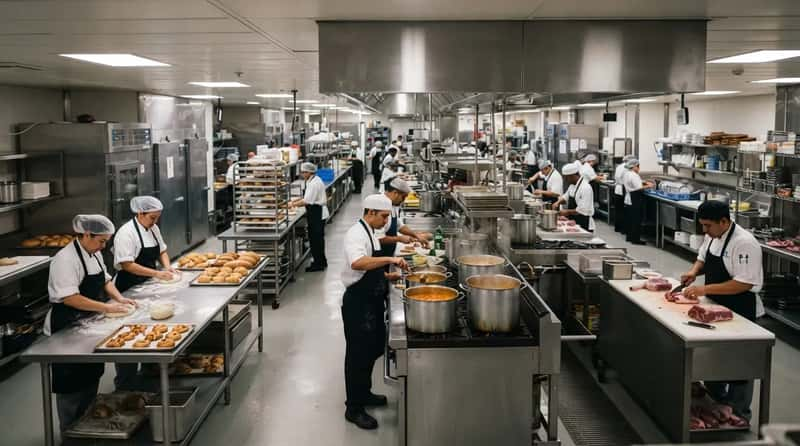
The galley doesn’t go dark when the late-night buffet closes. While passengers sleep, bakers prepare fresh pastries and breads for the morning, and butchers portion meats for the next day. Sauces and stocks simmer slowly overnight while the whole space gets scrubbed and restocked.
That takes a lot of people. On one Princess Cruises vessel, the galley team numbers 253 people working shifts that cover breakfast, lunch, dinner, late-night service and room service. So the hush at 3 a.m. is only quiet from the passenger side.
Keeping all those people busy takes a shocking amount of groceries, starting at #16…
#16 – A Single Week’s Groceries Can Top 300,000 Pounds
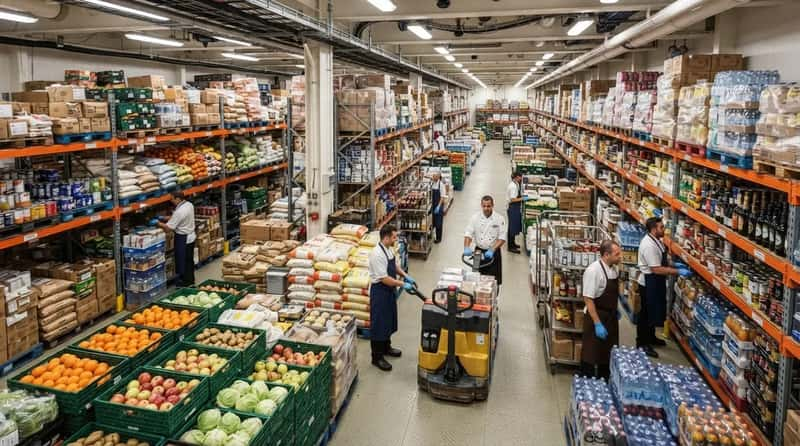
Nobody pops out to a supermarket in the middle of the ocean. On Princess’ largest ship, about 180 tons of food and alcohol, equal to over 300,000 pounds, come aboard every 7 days. That’s a bigger delivery than most small-town grocery stores ever see.
Here’s the part most people miss. The order includes a deliberate buffer in case of delays at sea. That extra food is a safety net, and the whole voyage leans on it.
All those groceries have to become something, and the first stop is the bakery at #15…
#15 – The Bakery Burns Through 1,300 Pounds of Flour a Day
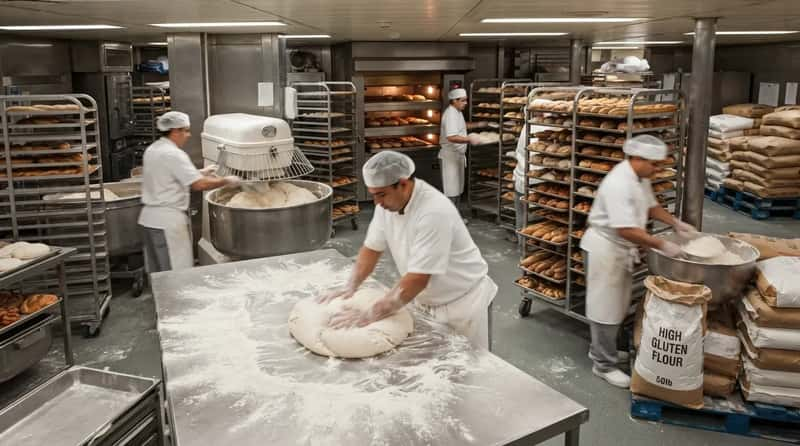
Bread on a cruise ship is a heavy-industry job. Flour is the base for cakes, cookies, pastries and bread, and that same Princess galley goes through over 1,300 pounds of it daily. The ovens are working long before you’ve even thought about breakfast.
Older figures show how big these bakeries can get. On a ship toured years ago, eight bakery employees used an average of 1,700 pounds of flour each day. That’s one ship’s snapshot, but it tells you what the early shift is up against.
Fast Facts
- Princess galley: over 1,300 pounds of flour every day
- Older ship tour: 8 bakers, about 1,700 pounds daily
- That works out to roughly 212 pounds of flour per baker
- Everything from breakfast rolls to cakes starts here
Now zoom out to the full meal count, because #14 is where the scale really hits…
#14 – Up to 45,000 Meals on a Single Sea Day
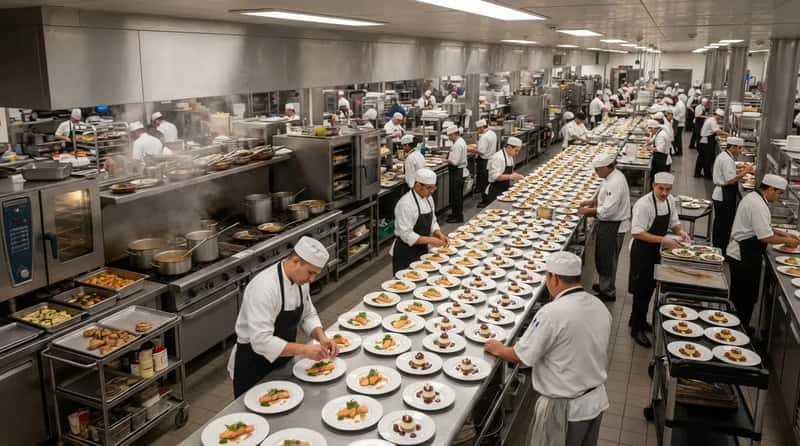
“Three meals a day” is the wrong way to count. One guide estimates a megaship makes 25,000 to 40,000 meals per day, counting snacks, room service, late-night pizza and specialty dining. The biggest ships go higher still.
Carnival Celebration, serving around 6,500 passengers, turns out up to 45,000 meals on a sea day, including breakfast, lunch, dinner and snacks. That’s the food output of a small city, produced on a moving ship.
Some of those meals are far fancier than a snack, like the one at #13…
#13 – 4,000 Lobster Tails in One Night
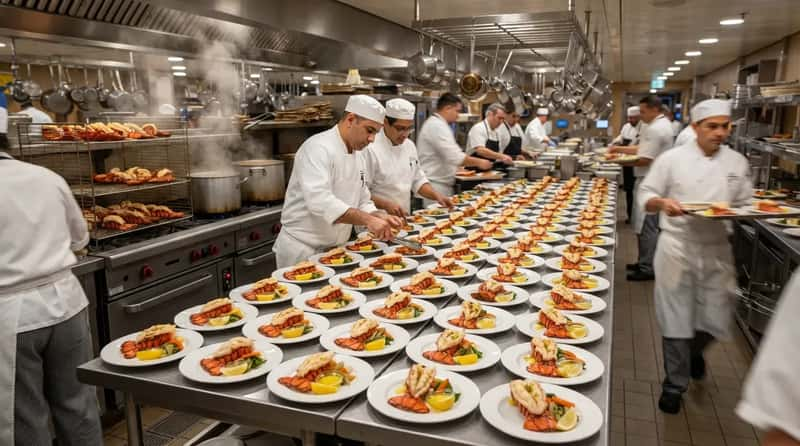
Lobster night looks effortless from the dining room. On Carnival Celebration, the kitchen dishes out 4,000 lobster tails in a single night. Every one has to reach a plate at exactly the right moment.
That’s a timing problem as much as a cooking problem. Overcook a tail and it turns rubbery, so the kitchen has to coordinate thousands of orders across a packed dining room. Next time you crack one open, picture the thousands of others landing on tables at the same time.
Pulling that off takes a crew bigger than you’d think, and #12 puts a number on it…
#12 – 186 Crew Members to Feed About 2,600 Guests
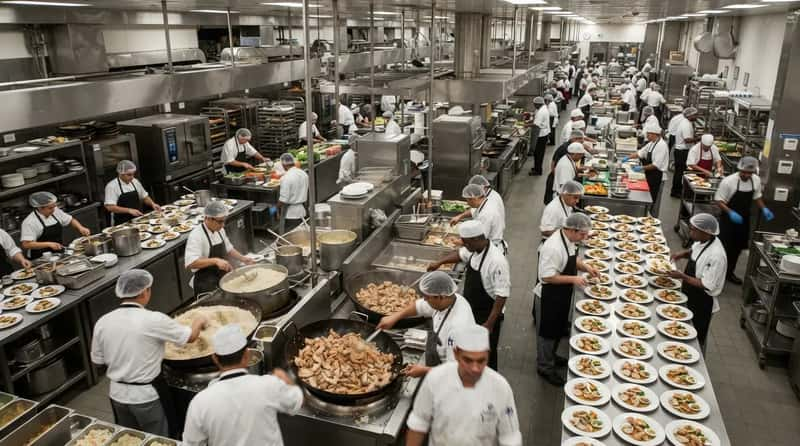
On Holland America’s Koningsdam, which carries around 2,600 guests, the kitchen staff includes 186 crew members. That’s a kitchen team bigger than the whole staff of most restaurants you’ll ever eat in. And they’re not just stirring pots.
That team prepares approximately 500 pounds of chicken and 300 pounds of rice each day. Those are only two items on a menu with hundreds of dishes. Every plate you see has a long chain of hands behind it.
At a Glance
- Ship: Holland America’s Koningsdam
- Guests on board: around 2,600
- Galley crew: 186
- Daily chicken and rice: about 500 and 300 pounds
- Rough ratio: about 14 guests for every galley crew member
Now brace yourself for what happens after the plates come back, at #11…
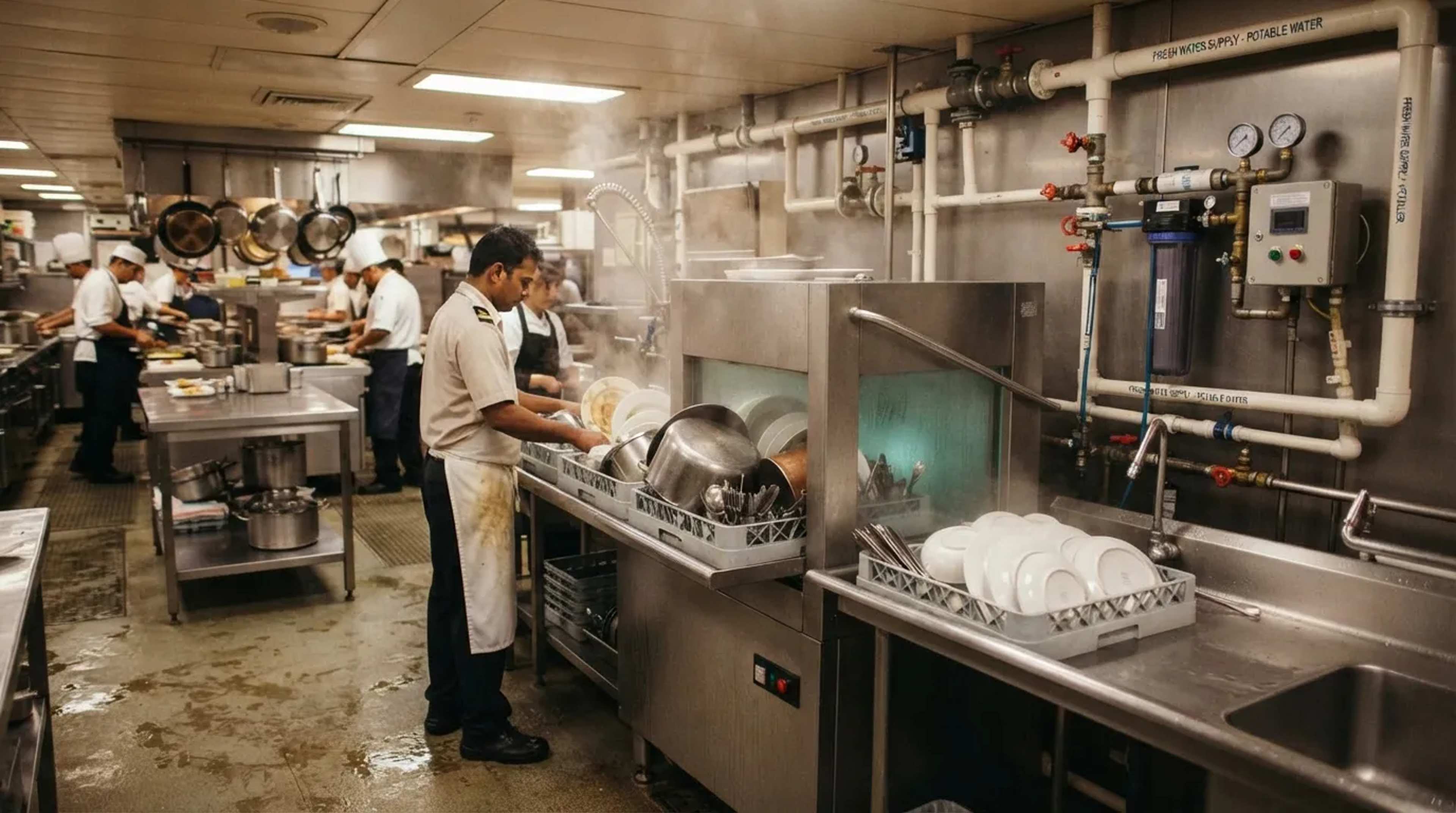
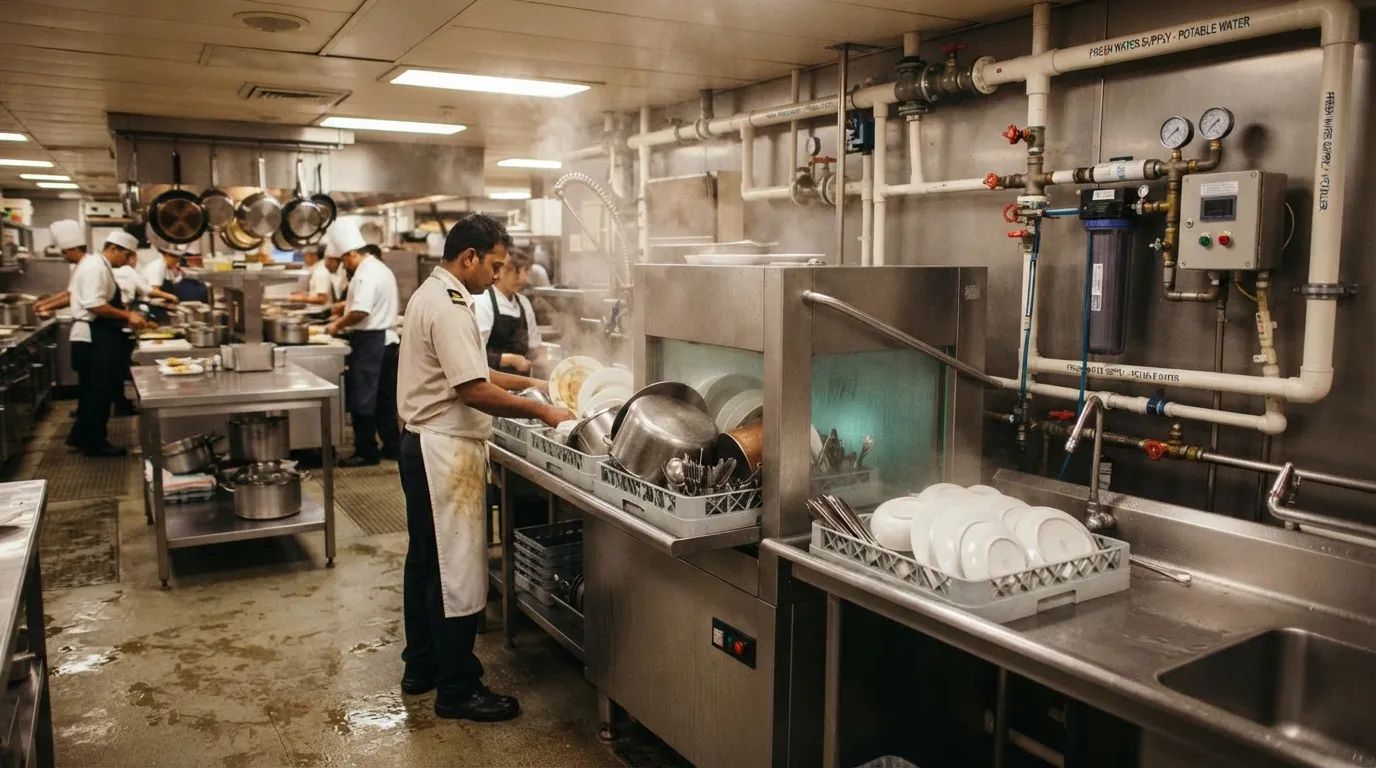
#11 – The Dish Room Handles 70,000 Plates a Day
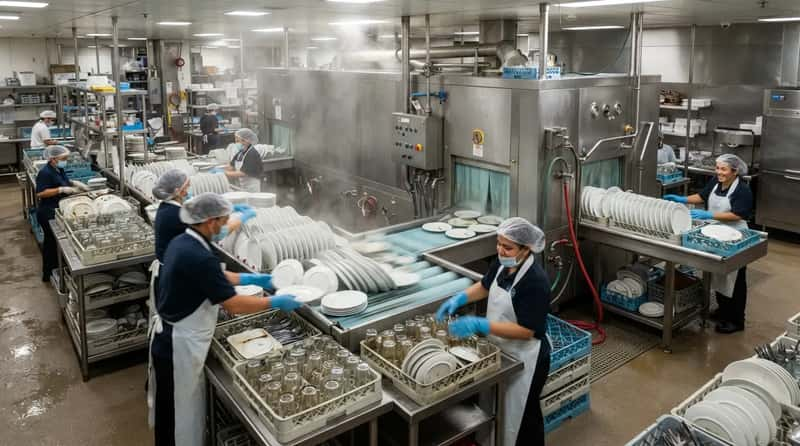
The least glamorous job on board may be the most important. On one ship’s tour, 52 people washed about 70,000 dishes and 21,500 glasses a day, using 58 gallons of detergent. That’s an older, single-ship account, so treat it as a snapshot.
In the sculleries, nine other people scrubbed and polished the giant pots and pans. Reports on galley sanitation also describe large automatic dishwashers, plus crew who must wear gloves and wash their hands often. The dish room is the galley’s quiet engine.
Meanwhile, somewhere on that ship, a lot of people are waiting on caffeine, as #10 shows…
#10 – 470 Gallons of Coffee Disappear Daily
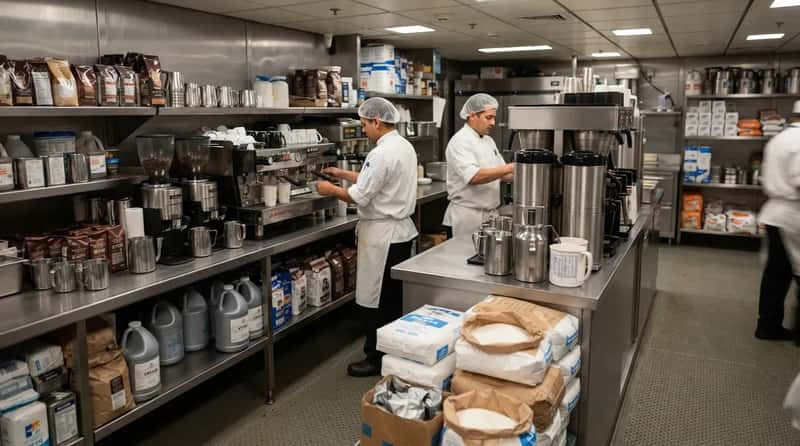
Cruise ships run on caffeine. On that same older tour, roughly 470 gallons of coffee, 62 gallons of coffee cream and 400 pounds of sugar were consumed daily. That’s a lot of early mornings.
Surprisingly, the team behind it was tiny. Just four people were responsible for keeping the coffee and espresso machines working. Modern ships have different setups, but the point stands: coffee is serious infrastructure at sea.
And the sweet side of the galley is even wilder at #9…
#9 – Thousands of Pastries, Gallons of Ice Cream, Pounds of Butter

The pastry shop is secretly one of the busiest corners of the galley. On that tour, 16 people prepared an average of 6,000 assorted pastries, 300 cakes and pies, and 90 gallons of ice cream every day. It all happens before most guests have finished breakfast.
The supporting cast is just as big. Average daily fresh fruit served was 7,000 pounds, and butter use was 500 pounds. Even mayonnaise hit about 28 gallons a day.
Then there’s the meal math that makes it all add up, at #8…
#8 – Ships Budget for Nearly Four Meals Per Person Per Day
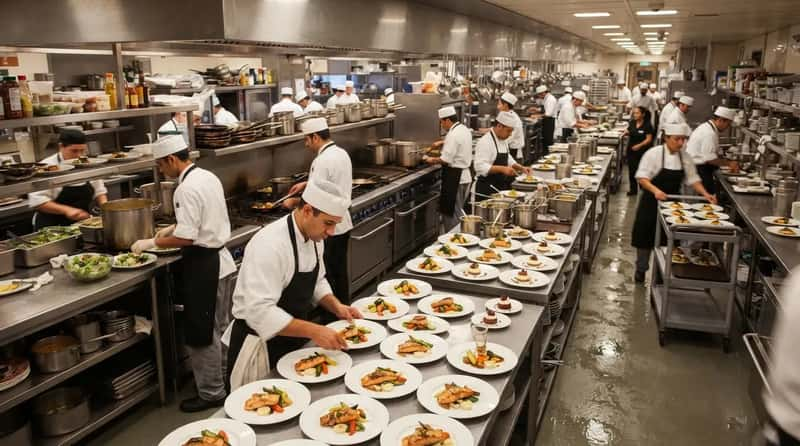
You think you eat three meals. The ship plans for more. In an older EPA filing for a cruise with 1,300 passengers and 520 crew, passengers and crew averaged 3.5 to 4 meals per day, including late-night snacks and bar food.
That ship budgeted for 5,500 to 6,000 meals per day, crew included. Galley schedules shifted on port days, but the ship served basically the same number of meals as on ocean days. Port day or not, the kitchen never gets a break.
And all of it happens on a floor that won’t hold still, which brings us to #7…
#7 – The Kitchen Is Built to Handle a Rolling Ship
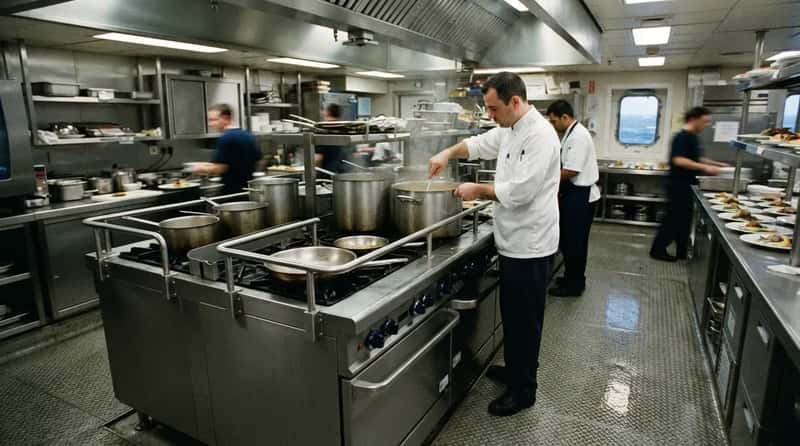
Cooking on land is one thing. Cooking on a moving ship is a different sport. Galley equipment is typically secured in place so heavy pots and machinery don’t slide when the vessel rolls, and floors and work areas are designed with motion in mind.
Most guests never see this, because a smooth voyage hides it. But when the sea gets lively, the crew still has to plate thousands of meals on schedule. That’s a skill land-based chefs rarely need.
Worth Knowing
- Heavy equipment is usually fixed in place rather than freestanding
- Raised edges on stoves and counters are a common marine touch to keep pots put
- Calm seas hide all of this from guests
- Rough seas don’t change the schedule, only the difficulty
Next up is the one resource the galley can’t run without, at #6…
#6 – The Galley Depends on Water the Ship Makes Itself
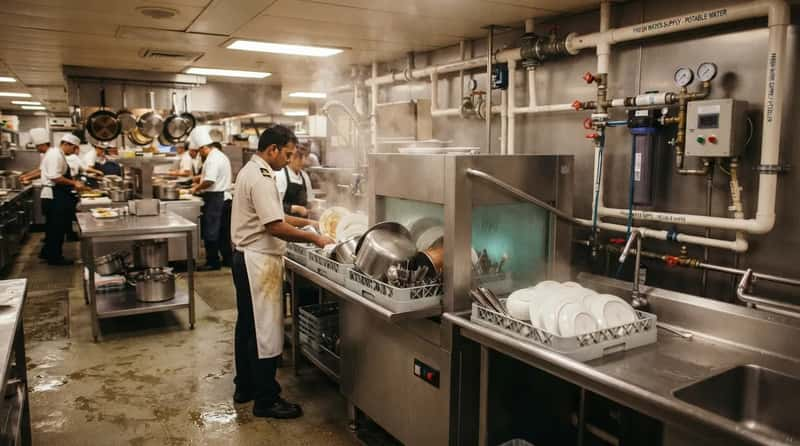
Every pot, dish and ice cube needs fresh water. Many large cruise ships produce fresh water onboard from seawater, rather than carrying all of it from shore. Without it, the galley couldn’t run for long.
That matters because cooking and dishwashing use huge amounts of it. Guests rarely think about it when they turn on a tap or pour a drink. The kitchen is quietly one of the thirstiest parts of the vessel.
Not every galley is a giant, though, and the smallest one at #5 might be the most impressive…
#5 – On a Research Ship, Three People Feed Everyone
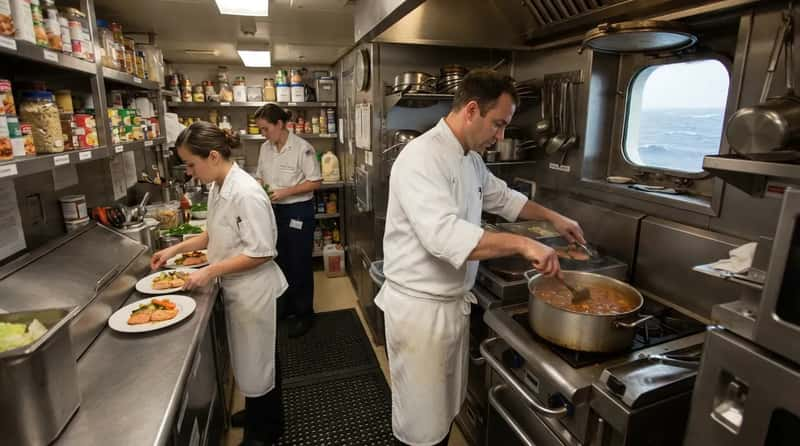
Running the galley on the R/V Neil Armstrong takes approximately 35 person-hours per day, typically split among three people: a steward, a cook and a mess attendant. Together they keep a whole scientific crew fed, far from any grocery store.
Planning is everything out there. Food is planned and bought based on each chef’s preferences and how long items will last between ports. Initial dry stores like rice, pasta and cereals last approximately three to three and a half months.
Now for the part that stings, because what goes uneaten tells its own story at #4…
#4 – Passengers Leave More Behind Than Crew
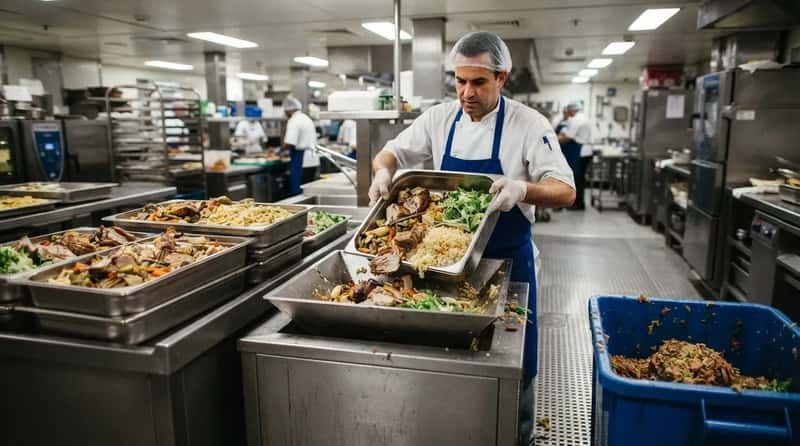
A large cruise ship wastes about 1.4 to 1.7 kg (3 to 3.7 lb) of food per person per day. Passengers sit at the higher end, at about 1.7 kg, while crew waste less.
The biggest culprit isn’t leftover plates. It’s overproduction, with the kitchen making more than anyone ends up eating. Cruise-industry write-ups credit better inventory tracking and less over-preparation with a 24% waste reduction, though reports differ on which line achieved it.
Quick Compare
- Whole ship, per person per day: about 1.4 to 1.7 kg (3 to 3.7 lb)
- Passengers: about 1.7 kg, the top of that range
- Crew: lower than passengers
Multiply that by everyone on board and the total gets uncomfortable at #3…
#3 – Four Tons of Food Waste, Every Single Day
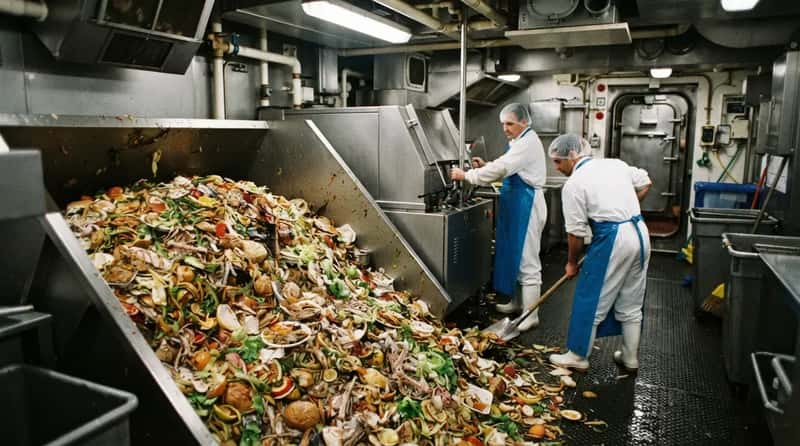
Scale that per-person number up and the picture changes fast. A ship with 3,000 guests and crew throws away around 4 metric tons of food every day, or nearly 29 tons over a seven-day sailing. That’s a heavy pile for a single day.
Some argue the all-you-can-eat model is the real problem. Others say the buffet is what guests love most, and cutting it would spark a revolt. Either way, the galley is stuck between abundance and waste.
So where does all that food go? Some ships have a startling answer at #2…
#2 – Machines That Shrink 10 Kilos of Food to 10 Grams
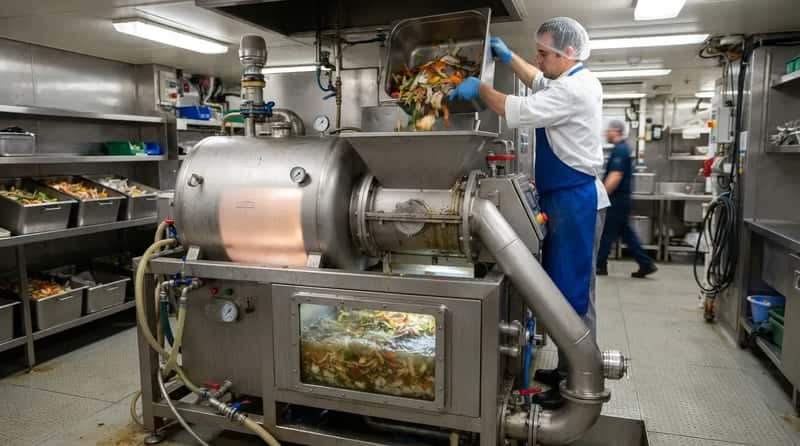
Many ships now rely on biodigesters. These machines break down food waste using natural enzymes, and a single machine can reduce 10 kilos of food waste to just 10 grams. The scale of the equipment is striking.
Sun Princess has 26 biodigesters placed in areas like garbage rooms and galleys, and they can process 6,000 kilograms of food waste a day. Carnival Corporation has installed nearly 600 units across its fleet.
But the detail crew bring up most has nothing to do with machines, and it’s waiting at #1…
#1 – Once Food Leaves the Galley, Crew Can’t Touch It
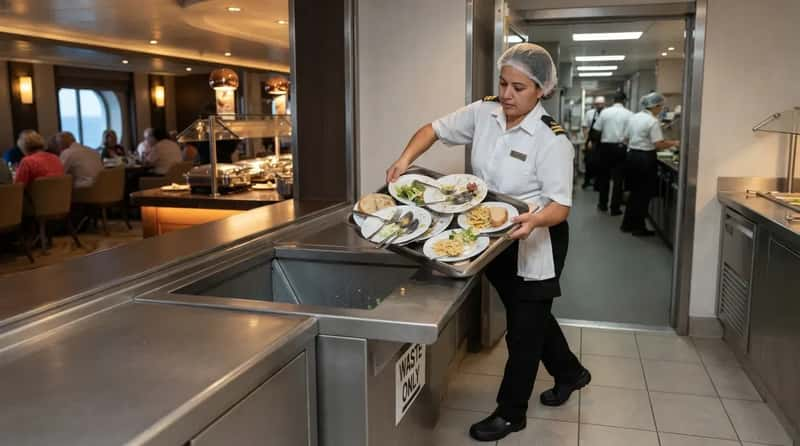
This is the detail that stays with people. According to crew accounts on one travel site, cruise lines don’t allow crew to touch food once it has left the galley. One former server said food that hits a passenger area is considered trash if it isn’t consumed.
Policies differ by ship. Another report says leftover prepared food that meets safety standards may be repurposed for crew meals or next-day buffet items, depending on the ship’s internal protocols. Some crew describe systems like MAGS (Micro Auto Gasification System) destroying leftovers from tables an hour earlier. These are crew voices, not an official policy statement, but they show how hard the line between galley and guest can be.
The galley at sea runs on scale, timing and planning that most guests never glimpse. From 180 tons of weekly groceries to 45,000 meals on a sea day, the numbers are bigger than almost anyone expects. The most surprising part isn’t what goes in, but how much comes back out.
Next time you walk past the buffet, remember there’s a whole floating factory behind every plate.