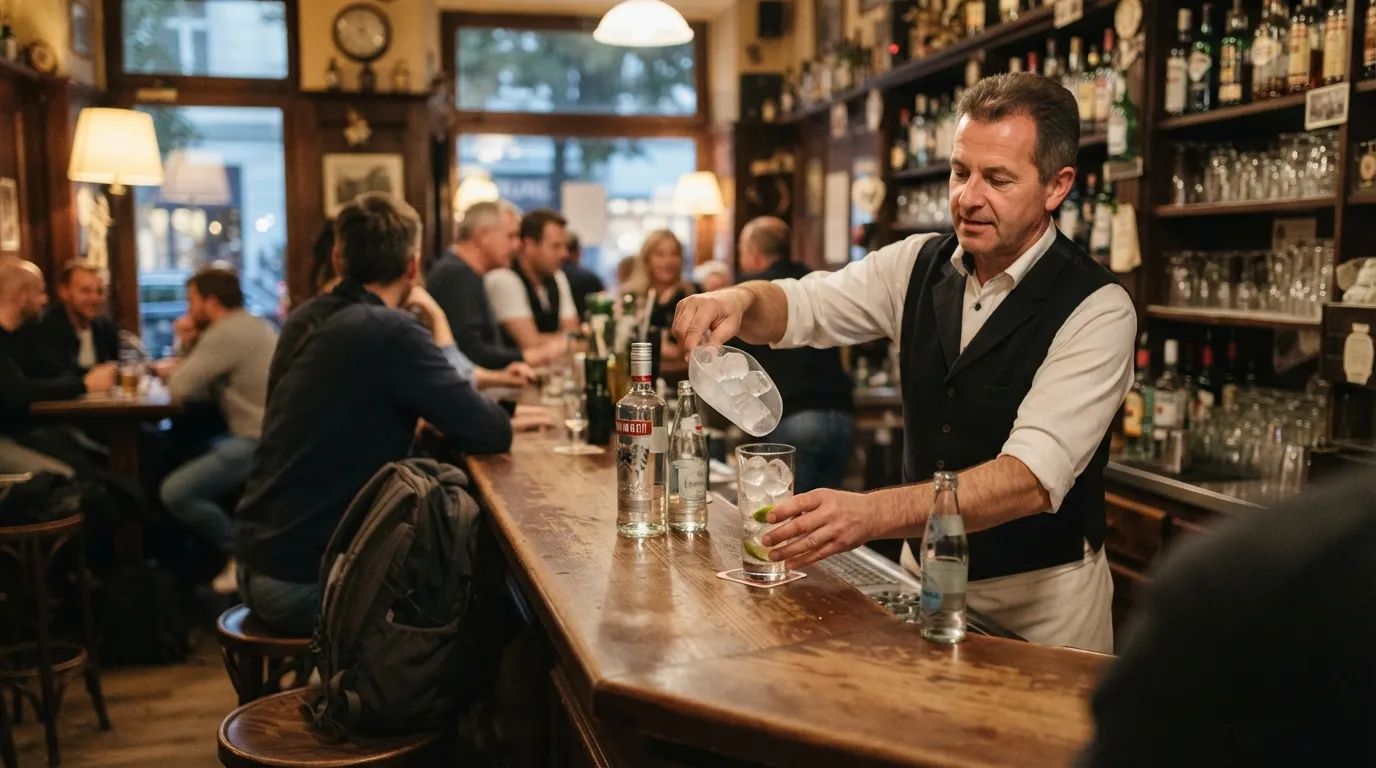
You probably think you blend in the second you sit down at a bar. You don’t.
Bartenders in hotel lounges, cruise ships, and tourist-heavy neighborhoods have watched the same patterns play out thousands of times, and they can often peg your nationality, your budget, and your tipping habits before you’ve said a single word. That’s not a lucky guess – it’s pattern recognition built shift after shift.
Some of these tells are obvious. Others are so subtle you’ll never notice them happening to you again once you know what to look for.
#17 – How You Walk Through the Door
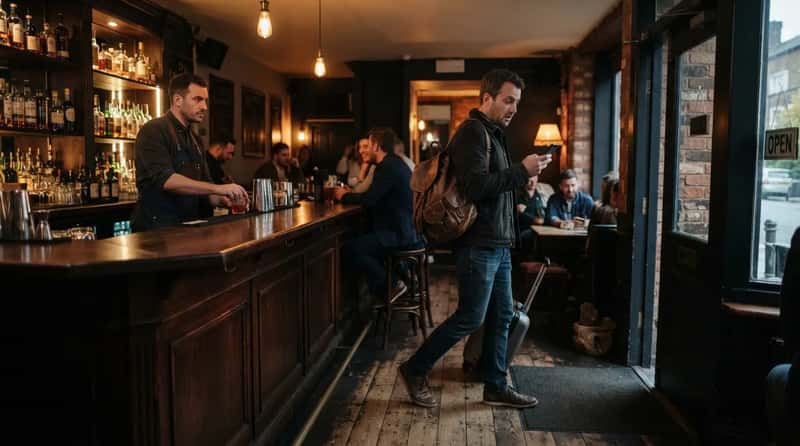
Your entrance is the first tell, and bartenders clock it instantly.
Bartender Miner says sobriety is the first thing he scans for. If someone looks disheveled or slurs their words, he’ll quietly offer water instead of pouring alcohol.
It’s not only about drinking, either. Your posture shows whether you already know what you want, or whether you’re about to need a suggestion.
Travellers who barrel in scanning their phones are the easiest to spot. They look confused, not curious – and that reads as “tourist” louder than any accent.
But your walk is only the opening move. Wait until you see what #16 gives away.
#16 – Whether You Linger or Commit
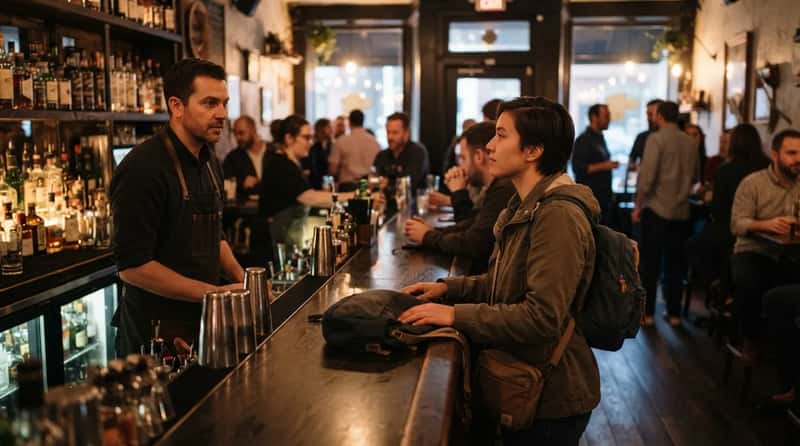
There’s a split-second decision every new customer makes at the bar, and bartenders catch it every single time.
Walk up with your card already out, and the bartender reads you as ready to order – they’ll keep things moving. Linger near the door scanning the room, and they’ll assume you’re waiting for someone, or just soaking in the vibe.
Travellers almost always linger. Locals rarely do. Locals know exactly where they’re headed; tourists scan. That ten-second read tells the bartender how much hand-holding the next twenty minutes will require.
Think that’s a lot to learn from one moment? #15 gets a lot more personal.
#15 – The Stress You’re Carrying
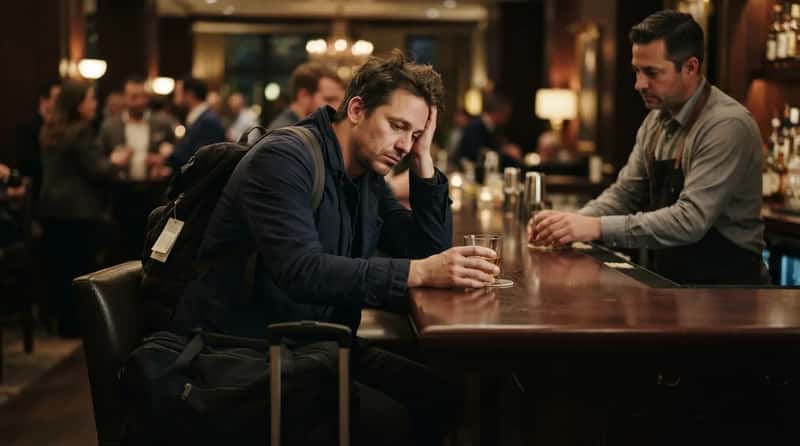
Experienced hotel bartenders don’t just pour drinks. They absorb your arrival energy.
People come straight off flights carrying visible weight – a delayed connection, lost luggage, a long day of travel. Good bartenders notice it the second you sit down.
The tell is in the shoulders. A stressed traveller gets a lighter approach: quicker pours, less small talk, room to decompress.
Stress is readable. But #14 reveals what your group dynamic gives away.
#14 – Who’s Actually in Charge of the Group
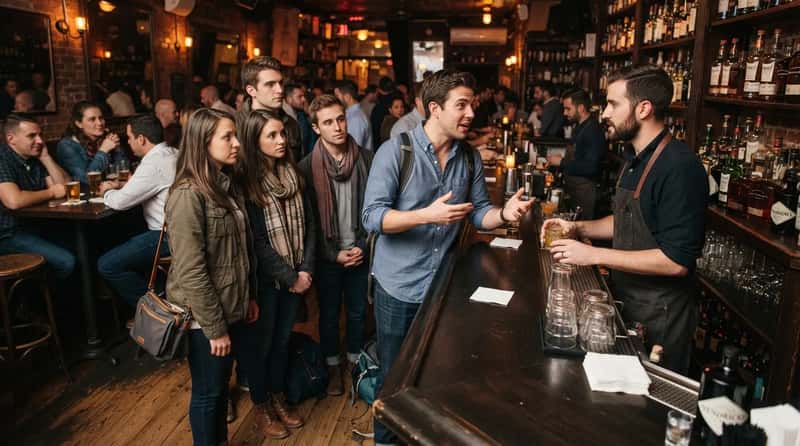
Walk in with four friends, and within seconds a bartender knows exactly who’s running the show.
Antonio Hernandez, a bartender at a Manhattan speakeasy, says solo, date, and group orders all hand over different intel. Someone on a date tends to order something impressive; a group with one loud spokesperson tends to run hot all night.
The “spokesperson” traveller is one of the most common patterns bartenders see. One person talks while the others stand awkwardly – a dead giveaway that nobody in the group knows the local bar culture. Locals almost always order for themselves.
The group dynamic is revealing. But #13 is where your actual nationality starts to leak out.
#13 – Your Nationality, Before You Say a Word
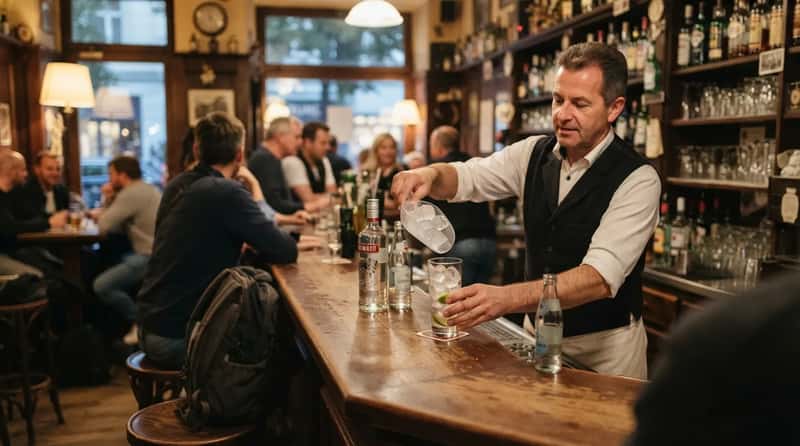
Walk into almost any bar in Lisbon, Prague, or Bangkok, and staff can often guess your nationality before you speak. It usually comes down to the order itself, or a habit locals simply don’t share.
For Americans, it’s rarely loudness that gives them away. It’s the specific requests – habits that feel completely normal back home and stand out everywhere else.
Ordering a vodka soda in Vienna or a frozen margarita in Croatia is a flashing neon sign. Bartenders in those cities see it almost exclusively from American tourists – and they remember.
Fast Facts
- Americans often ask for extra ice, no matter the drink.
- British travellers tend to order “a pint” without specifying the beer.
- Australians commonly request a “schooner” – a size most bartenders outside Australia have never heard of.
- German tourists usually order beer by brand, not by style.
Speaking of orders – #12 is the one habit that instantly marks you as out of your depth.
#12 – Whether You Actually Know What You’re Ordering
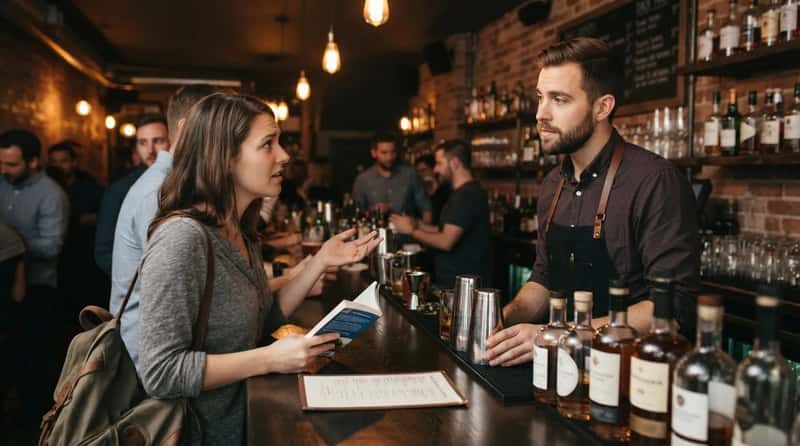
Ordering confidently is a skill, and plenty of travellers skip it entirely.
If a bartender looks blank at your request, the fix is simple: describe what’s in it. Not every bartender knows your favorite niche cocktail – and that’s fine, as long as you help them out.
Every so often, someone confidently requests a deep-cut drink last seen on a menu in 1974. Bartenders have a polished way of handling it, but they absolutely notice.
The traveller who orders something hyper-regional from back home, in a foreign bar, is the most common version of this mistake. It signals you haven’t thought about where you actually are. Locals order what the bar does well; tourists order what they already know.
That’s your order exposed. But #11 is about the moment you try to get their attention.
#11 – How You Try to Get Served
This might be the most universally despised traveller habit in the entire industry.
Your bartender is not a dog. Snapping or whistling won’t get their attention – at least, not in a good way.
Guests who click their fingers or interrupt while someone else is being served tend to keep that behavior going all night.
Snapping or waving is the number one behaviour that marks an inexperienced traveller. The correct move – catching their eye and giving a small nod – is something locals pick up fast. Tourists rarely do.
Think your manners are fine? Wait until #10 reveals what your first words actually say about you.
#10 – Your Opening Line
The first sentence out of your mouth tells a bartender almost everything.
One bartender put it simply: better service starts with empathy – yet ask someone “Hey, how are you doing?” and half the time the answer is just “Vodka soda.”
A quick smile and a simple “Hi, how’s it going?” sets a friendly tone without demanding anything. Skip straight to the order, and you’re quietly deprioritized.
Hotel bartenders say tourists almost never open with a greeting. Regulars always do. That one social habit is enough to classify you instantly.
Your words matter. But #9 is about something far more subconscious.
#9 – Your Body Language at the Bar
Bartenders aren’t just listening. They’re watching everything happening below the chin.
Repetition trains the eye – thousands of shifts of watching the same patterns unfold from the first “hey” to last call.
Psychologists call these snap judgments “thin slices” – quick reads based on a brief moment of behavior. In a busy bar, those brief observations turn out to be surprisingly accurate.
Worth Knowing
- Nalini Ambady and Robert Rosenthal coined the term “thin slices” to refer to such instantaneous non-verbal cues.
- Thin-slicing refers to the ability to make accurate judgments about people or situations based on very limited information, often within a few seconds or minutes.
- Author Malcolm Gladwell later referred extensively to this research in his book Blink: The Power of Thinking Without Thinking.
- Bartenders run a version of this experiment every single shift – just with cocktails instead of clipboards.
Travellers who sit rigidly, avoid eye contact, or constantly check their phones get read as disengaged – and often get slower service as a result. It’s not personal. It’s pattern recognition built over thousands of shifts.
Body language is the invisible signal. But #8 really separates the savvy traveller from the rest.
#8 – Whether You Treat Staff Like People
This is the one bartenders talk about most – and most travellers completely underestimate it.
Bartenders spot difficult guests early simply by watching how they treat staff, especially during a rush.
Small phrases carry weight. “Whenever you have a second” tells someone you see the workload, and bartenders remember that kind of courtesy.
The traveller who talks to bar staff like a vending machine is one of the most common – and most remembered – sights in tourist-heavy bars. Not fondly. Bartenders talk to each other, and word travels faster than you’d think.
Respect matters more than you realize. And #7 shows the tipping read starts even earlier than you’d expect.
#7 – Whether You’re Going to Tip, Before You’ve Paid
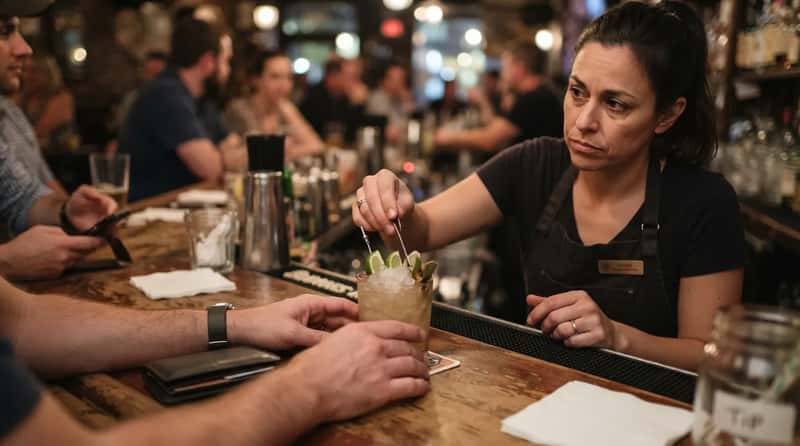
Experienced bartenders develop an almost eerie ability to predict tipping behavior long before the bill arrives.
It’s not a foolproof science – it’s pattern recognition built after thousands of nights on sore feet. But what you order is often the very first clue.
The traveller who over-modifies a cheap drink – extra lime, light ice, a specific glass, go easy on the soda – is a consistent red flag. Maximum demands on a minimum-cost order is one of the clearest tip-prediction signals in the trade.
The tip read is real. But #6 reveals the cultural gap no guidebook warns you about.
#6 – Whether You Understand Local Tipping Culture
This is where travellers from different countries reveal themselves most starkly – and where the quiet friction happens.
Tipping in bars simply isn’t customary in the UK, yet it’s expected in the US – a gap that genuinely shocks visitors who don’t know the norm. American bartenders generally expect around 20%, whether the order comes from a table or straight from the bar.
Quick Compare
- What’s standard in New York can look unusual in London, and what works in London can look miserly in Tokyo.
- United States: tipping at bars isn’t just polite, it’s structural – many bartenders are paid a lower base wage on the assumption that tips make up the difference.
- France & Germany: rounding up to the nearest euro is appreciated but not required – and in Germany, it’s simply the dominant habit.
- Japan: tipping is generally considered unusual, and in some contexts even inappropriate.
International travellers who leave nothing – not out of cheapness, but because tipping isn’t the custom at home – are one of the most common misunderstandings in any tourist bar. Bartenders usually know the difference between cultural ignorance and deliberate stinginess. That doesn’t mean it goes unnoticed.
Tipping culture is loaded. But #5 exposes what your drink choice broadcasts about you.
#5 – Your Drink Choice as a Travel Experience Signal
What you order doesn’t just reveal your taste. It reveals how much of the world you’ve actually seen.
Classic cocktails suggest certainty, vacation drinks suggest leisure, and unusual orders can even prompt an age check.
One head bartender put it bluntly: order mezcal a certain way, and it’s clearly “someone who probably went to Oaxaca and can’t shut up about it.” Bartenders find it amusing, not flattering.
The traveller who orders the most “exotic” thing on the menu to prove a point is one of the most recognizable archetypes in bars worldwide. Confident drinkers order what they enjoy; performative travellers order what they think makes them look experienced. Bartenders see through it every single time.
Your drink is a window. But #4 is where it gets really interesting – this is what bartenders never say out loud.
#4 – Whether You’ve Been Told a White Lie
Here’s something most travellers never find out: if a bartender tells you that you “look like a local,” there’s a good chance it isn’t true.
It’s a common kindness in tourist cities – tell them you’re visiting, and you might just hear you blend right in. Nice gesture. Rarely accurate.
A small pause while they work out what gave them away, then they stand up a bit straighter.
Phil Forbes, owner of The Exchange, Warsaw
The white lie is designed to be kind – and it works every time. But it also confirms exactly what the bartender already knew.
Sweet lies aside, #3 reveals what solo travellers broadcast without realizing it.
#3 – The Specific Loneliness of the Solo Traveller
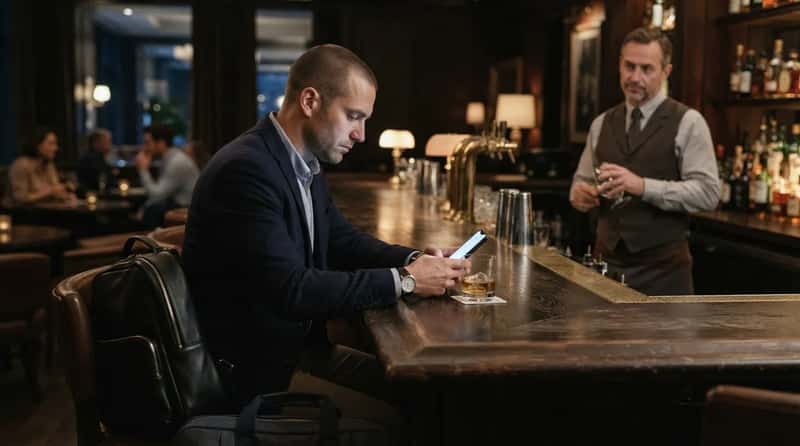
Solo travellers think they’re invisible at a bar. They’re actually the most closely watched customers in the room.
Some business travellers spend more than half the year on the road, far from family and the people they can just be themselves around.
Sometimes a person sits down carrying visible weight, and good bartenders notice immediately. Figuring out what they enjoy drinking – or what escape even means to them – is the real job.
The solo traveller who nurses one drink and stares at their phone is the most common, and saddest, sight in any hotel bar. The good bartenders do something about it. That quiet “long day?” isn’t random – it’s intentional.
Solo travel tells a story. But #2 might be the most underestimated signal of all.
#2 – How You Handle Waiting
Patience is one of the clearest markers separating frequent travellers from first-timers, and bartenders rank it among their most reliable reads.
Guests who click their fingers or grow impatient during a rush tend to keep that energy all night. Guests who smile, make eye contact, and wait their turn are the easiest to serve – and often get the better end of it.
Timing matters, too. Say “excuse me” five times mid-pour and it feels like pressure; catch their eye and lift a finger, and it reads as patient.
At a Glance
- Impatient tell: finger-snapping, sighing, repeating “excuse me.”
- Patient tell: eye contact, a small nod, an easy smile.
- The payoff: patient travellers get faster pours and better recommendations.
The traveller who respects the queue, especially in a packed tourist bar, is noticed and rewarded. The one who doesn’t is remembered for all the wrong reasons. Bartenders have long memories and short shifts.
But none of this compares to the #1 thing bartenders notice – the detail that, once you know it, you’ll never unsee.
#1 – Whether You’re Actually Present, or Just Passing Through
This is the one bartenders talk about most when they’re being honest – and the one no travel guide ever mentions.
Bartenders arguably have the most intimate, in-depth interactions with travellers of anyone in the hospitality industry. Their view offers a remarkably clear window into how visitors actually engage with a place.
A great bartender is the heartbeat of a hotel bar – warmth, discretion, rhythm, and memory rolled into one. They’re far more than a drink maker; they’re the storyteller, confidant, and emotional anchor of the room.
The traveller who treats the bar as a pitstop – eyes on the phone, drink downed, gone – is the most forgettable person in the room. The one who looks up, asks a question, and actually engages with the person behind the bar? That traveller gets remembered, recommended, and quietly taken care of. Every single time.
Put it all together and the pattern is obvious: bartenders are reading you from the second you walk in – your posture, your opening line, your order, your patience, your tip.
The travellers who get the best treatment aren’t the biggest spenders. They’re the ones who show up as actual people – eye contact, a hello, a fair tip, five minutes without a phone in hand.
It costs nothing. And once you know what bartenders are actually watching for, you’ll never walk into a bar the same way again.