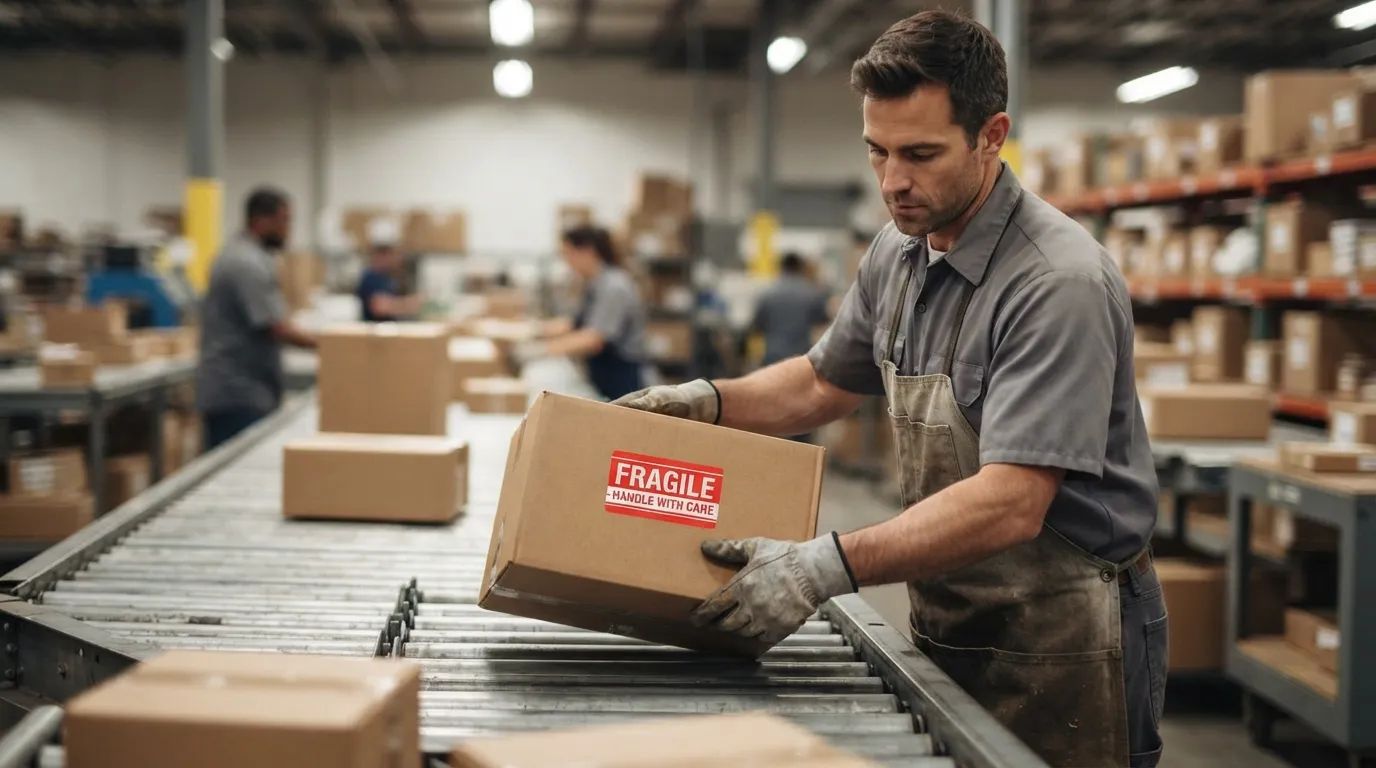
Most people slap a “Fragile” sticker on a box and sleep soundly, convinced their precious cargo is protected. Turns out, that little red label may be doing far less than you think.
Shipping insiders know a gap between what fragile labels promise and what actually happens in transit, and it’s bigger than most senders realize. From automated sorting belts to overworked overnight crews, your package travels through a gauntlet you’ve probably never pictured, and handlers are finally ready to explain why.
#17 – The Label Is a Request, Not a Command
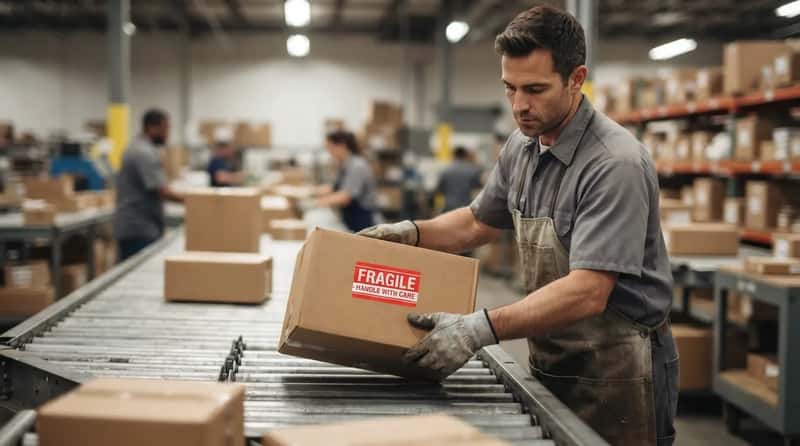
Handlers see your fragile label, but they’re not legally bound by it. Writing “fragile” on a package, in most cases, does not cause it to be handled with special care.
Paid special handling services exist, but a self-applied fragile label doesn’t automatically trigger them. Think of it as a polite note, not a guarantee.
Without purchasing a specific service, that sticker is purely a visual cue, nothing more. This is the foundational truth handlers wish every shipper understood before sealing a box.
But the reasons your label gets ignored are more complicated than you’d guess, and #16 is where it starts to unravel.
#16 – Volume Kills Attention

Handlers in large facilities process hundreds, sometimes thousands, of packages per shift. It’s a blur of unloading trailers, sorting, loading trucks, and scanning barcodes on a brutal schedule.
In that kind of high-volume environment, fragile labels can get ignored entirely. When you’re moving that fast, every box starts to look the same.
Fast Facts
- Large hubs process hundreds to thousands of packages per shift.
- A fragile sticker alone doesn’t legally require special handling.
- Only paid special-handling services guarantee extra care.
- Automated sorters read barcodes, not printed warnings.
The label that stands out in a quiet room disappears in a warehouse at midnight. The speed problem is real, and it leads straight into a psychological trick handlers rarely admit to.
#15 is where it gets uncomfortable.
#15 – Handlers Go “Label Blind”
Repetition destroys attention. When handlers see the same red “Fragile” sticker on box after box, the brain simply stops registering it as a warning.
Overuse desensitizes handlers to the label’s importance. The more people use it, the less power it has – a cruel irony that makes it almost self-defeating at scale.
Shipping professionals actually recommend switching up label style and wording just to fight this exact problem. Desensitization is only one layer, though.
There’s a purely mechanical reason your label gets ignored too, and #14 exposes it.
#14 – Automated Sorters Don’t Read “Fragile”
Modern shipping hubs run on conveyor belts and automated sorting systems, and those machines cannot read your sticker. They scan barcodes and routing data, not handling instructions.
Multi-side labeling across the top and two adjacent sides is critical for automated carrier sorting. Obscured or non-line-of-sight labels fail the machine’s routing, and that failure shifts liability onto you.
A label facing the belt floor might as well not exist. This is where placement becomes everything, and most shippers are getting it completely wrong.
#13 shows exactly how.
#13 – One Label on One Side Is Almost Useless
Most people stick one label on top and call it done. Handlers know that’s a rookie mistake.
Professional handling labels go on at least two adjacent sides, avoiding seams and tape, so the warning stays visible no matter how the box gets stacked. Once a box is loaded on a pallet or crammed into a truck, only what’s visible from the outside matters.
One hidden label is functionally zero labels. Placement is critical, but the surface you choose matters just as much.
#12 gets specific about the one spot that actually works.
#12 – The Largest Surface Is Your Best Real Estate
Not all placement is equal, and most shippers have the hierarchy backwards. Fragile indicators belong on the package’s largest surface, where the first human who picks up your box will see them immediately.
The largest surface is where handler eyes naturally land first – it’s the broadest visual target in a fast-moving room. A label tucked onto a narrow edge gets missed every single time.
Once the label is in the right spot, its color and design matter more than you’d think. #11 breaks down the visibility science.
#11 – Color Is a Weapon – Use It Right
Not all fragile labels are created equal. Color and contrast determine whether a label registers subconsciously or just vanishes into the cardboard.
High-visibility fluorescent labels are far more effective in busy sorting environments. Use fluorescent paper for fast indoor parcel streams, and weather-resistant vinyl for long-haul or outdoor freight.
Bright orange and neon yellow outperform plain red in high-speed visual scans. The generic white-on-red sticker from the office supply drawer is the worst option you could pick.
Material matters too, and weather destroys cheap labels before your package even arrives. #10 explains what happens next.
#10 – Cheap Labels Fall Off in Transit
A fragile label that peels off in a damp loading dock is worse than no label at all, because now the handler never even gets the visual nudge. Dusty or humid environments compromise adhesive fast.
Handlers regularly see boxes where labels have slid, bubbled, or detached entirely by the time the package reaches them. Pressure-sensitive labels built for logistics are a completely different product from the decorative stickers most people buy in a pack of fifty.
The label’s job is to survive the journey, not just the kitchen table. Surviving the journey means more than adhesive, though.
What’s inside the box matters enormously, and #9 exposes the gap most shippers never close.
#9 – A Label Cannot Fix Bad Packaging
Handlers see broken items constantly, and they know the label was never the problem. Outer labels cannot compensate for internal failures.
Carriers mandate 2-3 inches of internal cushioning and double-boxing for heavy or fragile items just to validate damage claims. Paired with structured inserts or molded pulp protection, fragile stickers may lower damage rates by up to 25%.
The label is the last line of defense, not the first. Shippers who rely on the sticker alone, with no cushioning inside, are basically hoping for luck.
That’s the truth handlers wish senders understood before they even pick up a marker. But there’s a legal angle to the label most people never consider, and #8 could save you real money.
#8 – The Label Is Evidence in a Damage Claim
Handlers know something insurers will never advertise out loud: your fragile label is documentation. Standard labels don’t guarantee special handling, but compliant labeling counts as evidence of “shipper diligence” when a claim gets denied.
Proper labeling can serve as proof if there’s a dispute over damaged goods. Without a label, you hand the carrier a ready-made excuse to deny your claim.
With one, you establish that you did your part as a responsible shipper. That difference alone can be worth hundreds of dollars.
The claims angle is powerful, but so is the psychological effect the label has on the last human in the chain. #7 breaks that down.
#7 – The Label’s Real Power Is at the Last Mile
Here’s the truth handlers rarely say out loud: fragile labels matter most not in the warehouse, but at the very end of the delivery chain. A machine doesn’t care about orientation, but the person loading the final delivery truck certainly does.
At these manual touchpoints, a clear visual warning can change how a package is lifted, stacked, or set down. The delivery driver is the most important audience for your label, not the sorting machine.
That one person, making one decision in a truck, is where the sticker actually earns its keep. That human moment connects directly to something handlers almost never admit.
#6 is the one insiders rarely share.
#6 – “Handle With Care” Outperforms “Fragile” Alone
Most shippers default to the word “FRAGILE,” but handlers actually respond differently to varied wording. “Handle with care” gets used for glassware, artwork, and electronics for a reason – it reads as a caution, not just a label.
Quick Compare
- “Fragile” alone: often ignored after repeated exposure.
- “Handle With Care”: reads as an active caution, not a routine label.
- “Heavy”: cuts down on lifting injuries and rough handling.
- “This Side Up”: stops upside-down stacking on sight.
Combining label types sends a clearer, more urgent signal than one repeated word. “Fragile / Glass / Handle With Care” alerts handlers at final delivery, “Heavy” prevents workplace accidents, and “This Side Up” arrows stop upside-down mishandling.
A layered labeling strategy signals a professional shipper – and handlers subconsciously treat professional-looking packages better. There’s one label type, though, that genuinely changes handler behavior in a way you’ve probably never heard of.
#5 reveals it.
#5 – Shock Indicator Labels Actually Change Behavior
Forget the standard sticker for a second. The label that truly grabs a handler’s attention is one that tells them they’re being watched.
Shock indicator labels trigger a visible change when a G-force impact hits the package, so any handler can instantly tell if it’s been dropped or slammed. It shows them, in real time, that the goods inside are being monitored.
The accountability effect is real – a package that visually signals monitoring gets treated with measurably more care. It’s not magic, it’s just human nature.
Monitoring tools are powerful, but even the standard fragile label carries a hidden benefit for international shippers. #4 covers the blind spot almost nobody catches.
#4 – Text-Only Labels Fail Internationally
Sending a package overseas? A label that reads “FRAGILE” in English may mean absolutely nothing to a handler in another country.
ISO 780, the international packaging standard, recommends universal symbols like the Broken Wine Glass instead. A single internationally recognized symbol can do more work than any word.
That broken wine glass icon is understood across dozens of languages and logistics systems, without a single word being read. International shippers ignore this almost universally, and domestic shippers make their own version of the same mistake.
#3 reveals it.
#3 – Where You Place the Label on the Box Can Void Your Insurance
Most people don’t realize label placement isn’t just a visibility issue, it’s a compliance issue. Obscured or non-line-of-sight labels fail automated routing, and that failure shifts liability straight onto the shipper.
Some courier companies only reimburse losses if proper packaging and labeling were present on the box. A label on the bottom, covered by tape, or facing inward can legally disqualify your damage claim.
Worth Knowing
- Labels hidden by tape or seams can throw off automated routing.
- A label facing the truck floor counts as no label at all.
- Some carriers deny claims outright without visible, compliant labeling.
- Most placement mistakes surface only after a claim is denied.
Handlers know this cold. Most shippers only find out after the claim has already been denied.
The stakes here are higher than anyone tells you upfront, and #2 reveals the one thing handlers see that no shipper ever accounts for.
#2 – The Damage Often Happens Before Your Handler Even Sees the Label
Here’s the part that stings most: fragile labels alone often don’t change handling practices at all, because the damage already happened somewhere upstream.
By the time I start loading my truck, I can already hear the rattle of broken glass and ceramics.
Shipping industry worker, via Reddit
The breakage often happens upstream, in sorting hubs your label never properly reached. By the time a conscientious final-mile handler sees your sticker, the internal damage is already done.
The label protected nothing, because the real danger zone had no one reading it. This is the hardest truth in the entire fragile label conversation.
And it leads directly to the single most important thing handlers want you to know.
#1 – The Label Only Works as Part of a System
Ask any handler honestly, and they’ll tell you the same thing: the fragile label is the weakest link, not the solution. Paired with structured inserts or molded pulp protection, visible fragile stickers may lower damage rates by up to 25%.
That’s why experts push fragile stickers as part of a complete shipping system, not a standalone fix. Studies indicate 22% of fragile items still suffer damage from improper handling, label or no label.
The label, the packaging, the cushioning, and the carrier service all have to work together. Fail on any one of them and the label is just theater.
Handlers aren’t the enemy here. They’re the last line of a system most senders never actually build.
The Bottom Line
Most people treat a fragile label as a magic shield. Handlers know it’s barely a suggestion.
Fragile labels are the voice of your package when you’re not there to speak for it, but that voice gets drowned out by automated sorters, label blindness, poor placement, and cheap adhesive. It only works when it’s fluorescent, multi-sided, backed by real internal packaging, and paired with the right carrier service.
Done right, damage rates drop significantly. Done wrong, it’s just a sticker on a prayer – so which one have you been shipping?
#18 – The Insider Trick Handlers Never Tell Shippers
Handlers won’t say this out loud, but the single most useful habit for protecting a claim is a 90-second routine you do before the box ever leaves your hands.
Photograph the sealed box, on all visible sides, right before drop-off or pickup – with the fragile label, tape, and any “This Side Up” arrows clearly readable in frame.
- Take one photo showing the full box with the label centered and legible.
- Take a second photo of the shipping label with the tracking barcode visible in the same shot.
- Keep both photos with a timestamp until the package is confirmed delivered intact.
- If damage occurs, submit these photos immediately with your claim – they prove the label was present, visible, and compliant before the carrier ever touched it.
This one habit closes the exact loophole carriers use to deny claims over “missing or obscured” labeling. It costs nothing, takes under two minutes, and it’s the one thing handlers wish every single shipper already did.