Most people assume that once you’re past 60, a crowded museum in peak season is something to just survive – shuffle past the exhibits, dodge the tour groups, get out before your knees give up. That assumption is dead wrong.
Museum staff quietly arrange a long list of accommodations for older visitors during busy season, and almost nobody ever thinks to ask for them. Here are the 17 real arrangements insiders actually offer, starting with the one most visitors miss before they even walk through the door.
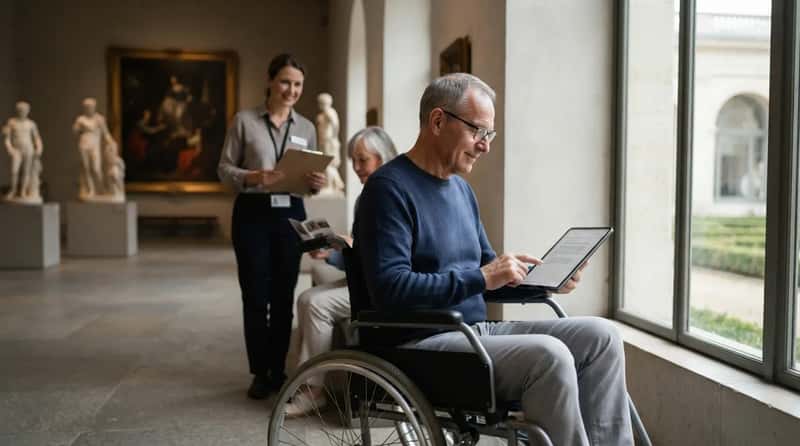
#17 – Reserved Wheelchair Loans (Before You Even Arrive)
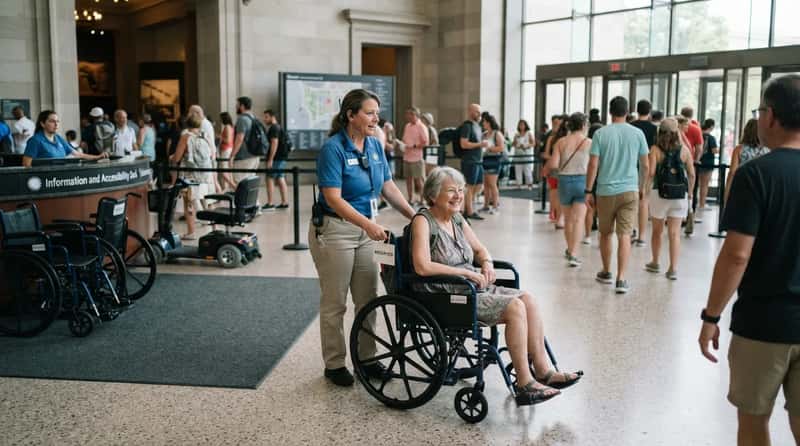
Free manual wheelchair loans exist at Smithsonian museums and the zoo, first-come first-served. During busy season, they vanish within the first hour.
Call the accessibility coordinator or visitor line 2–3 days ahead, not day-of. Ask specifically for a wheelchair reservation – most visitors don’t realize staff can flag it in advance so a chair is waiting at the door.
Motorized scooters are also available for rent, and they help enormously on big floor plans. They also disappear faster than manual chairs in summer, so reserve early.
Fast Facts
- Manual wheelchairs at Smithsonian museums and the zoo are free and first-come, first-served.
- During busy season, chairs can be gone within the first hour of opening.
- Motorized scooters are rentable but book out even faster in summer.
- A call 2–3 days ahead is often enough to get one held at the door.
But the wheelchair is only the opening move. What staff do once you’re inside is where this gets interesting, and #16 is where the real strategy starts.
#16 – Quiet-Hours Scheduling (The Time Slot Staff Use Themselves)
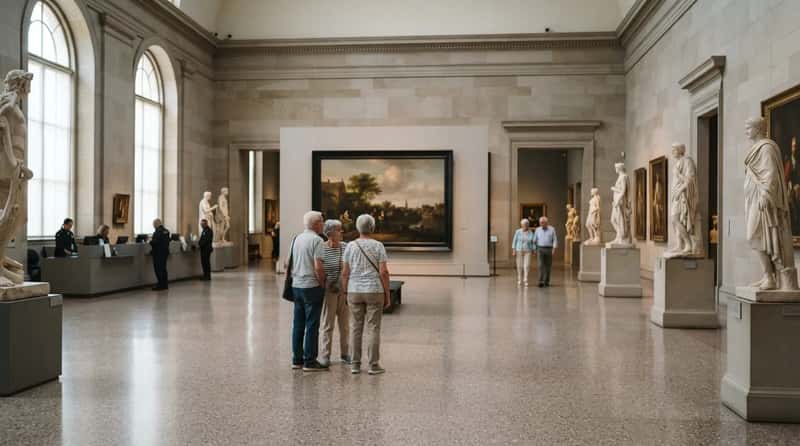
The first 90 minutes after opening are the quietest stretch of any museum day. Security lines are short and the marquee exhibits are actually walkable.
Front-desk staff know exactly when the crowds surge and when they thin – they just rarely get asked. Many institutions now run dedicated senior hours with lower noise and extra staff on hand.
The mistake most visitors over 60 make is walking in at 11 a.m., right as school groups and tour buses arrive. Ask staff for the quiet window instead.
Speaking of exclusive time slots, #15 takes this idea even further with something that’s not even on the main booking calendar.
#15 – Dedicated Senior-Only Sessions
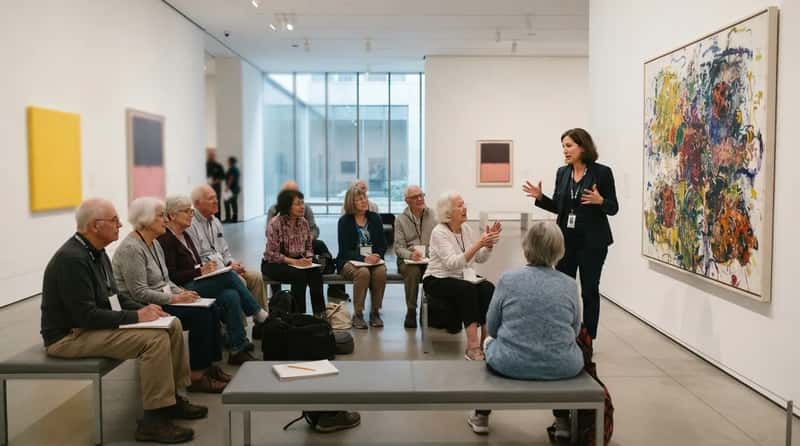
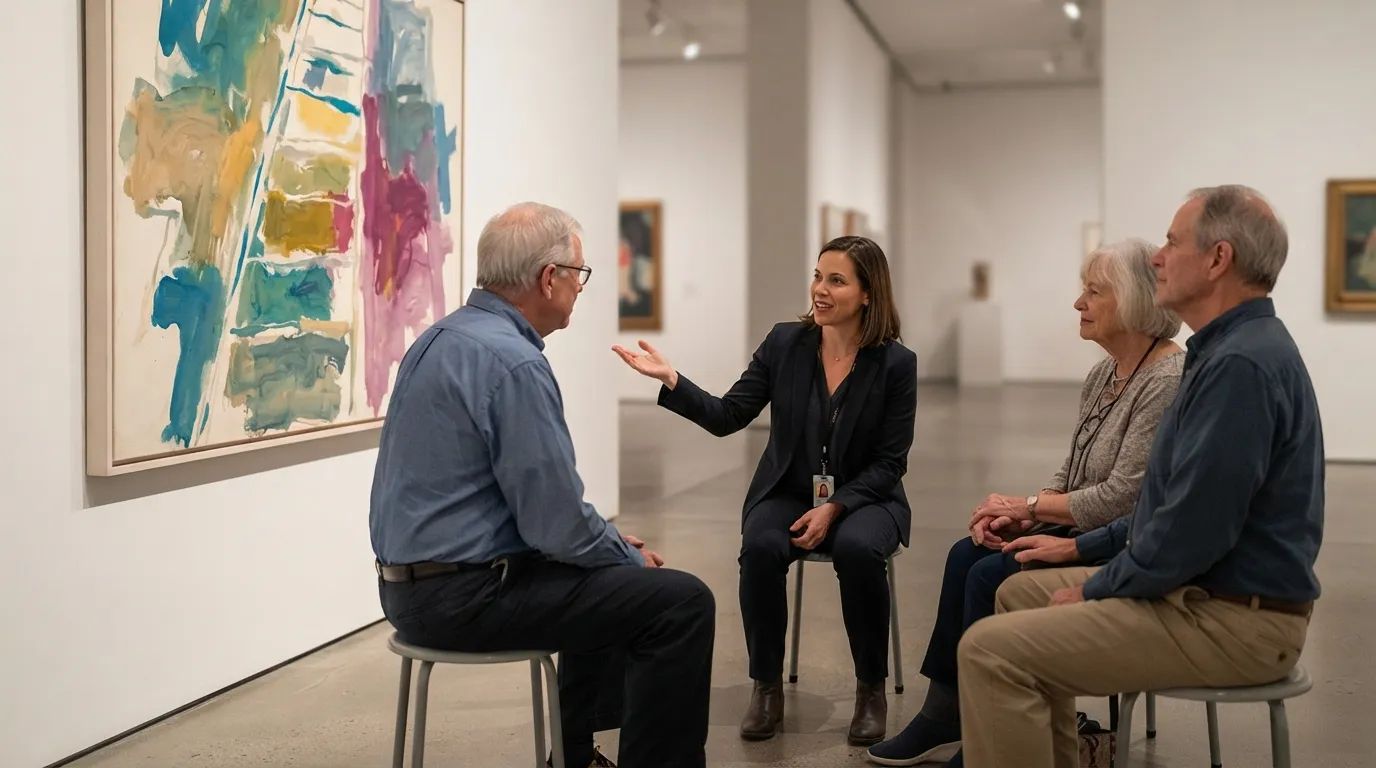
MoMA runs “Prime Time” sessions exclusively for visitors 65+, with guided discussions and creative activities in a deliberately uncrowded room. It’s not listed on the main ticketing page.
The Phillips Collection offers similar creative-aging programming – mindful looking, informal discussion, and hands-on art-making with trained educators. Attendees explore works, share ideas, and build real connections.
Worth Knowing
- MoMA’s Prime Time days include free admission for visitors 65 and over.
- A typical Prime Time day features gallery conversations, art-making activities, and a film screening.
- Registration for the smaller sessions runs on a first-come, first-served basis.
- None of it shows up on the museum’s main ticketing page.
These sessions are built for small groups and a slow pace, and they fill up weeks before a busy-season weekend. You have to dig into the accessibility or programs calendar to even find them.
What’s waiting inside #14 is something even fewer visitors know they can request.
#14 – Slow Art Tours Built for Older Adults
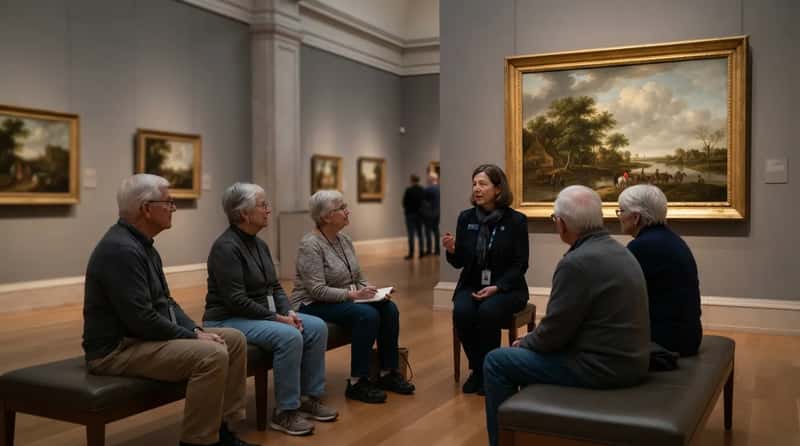
Forget the standard 45-minute sprint through 200 exhibits. Some museums run “Slow Art” tours built specifically for older adults that encourage quiet, unhurried observation.
The National Gallery of Art offers Accessibility Tours with shortened routes, frequent seating breaks, and docents trained in senior-friendly communication. Small group sizes make it easier to connect with both the art and the other visitors.
These tours routinely sell out before general admission tickets during busy season. Book the moment your travel dates are confirmed.
Up next: the mobility tool most visitors don’t realize they can pair with their tour.
#13 – Portable Stools and In-Gallery Seating Setups
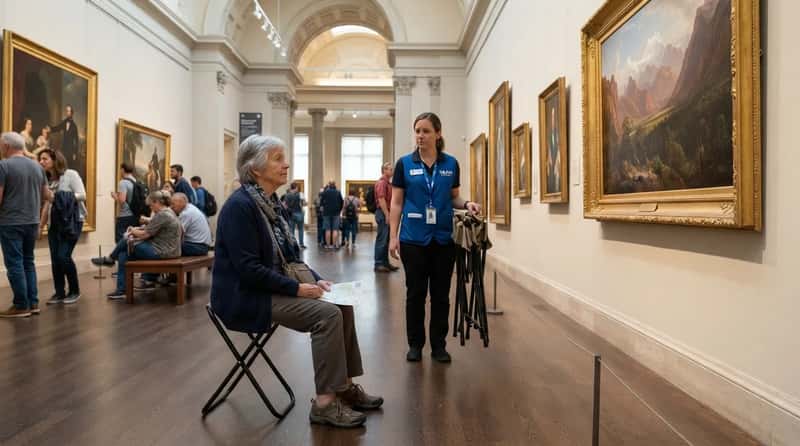
The Smithsonian American Art Museum runs “Mobility Assistance Tours” with elevator-accessible routes and portable stools carried by staff for rest breaks. You just have to request the tour.
Traditional museum design is notoriously age-hostile – little seating, harsh lighting, long stretches between benches. Many institutions have quietly fixed this, but only for visitors who know to ask.
A stool placed at the right moment during a 90-minute tour can be the difference between a great afternoon and a painful one. Ask at the accessibility desk, not general admissions.
The next arrangement is one almost nobody over 60 tries, and it’s about how you hear the art, not just see it.
#12 – Hearing Loops at Admissions Desks and in Galleries
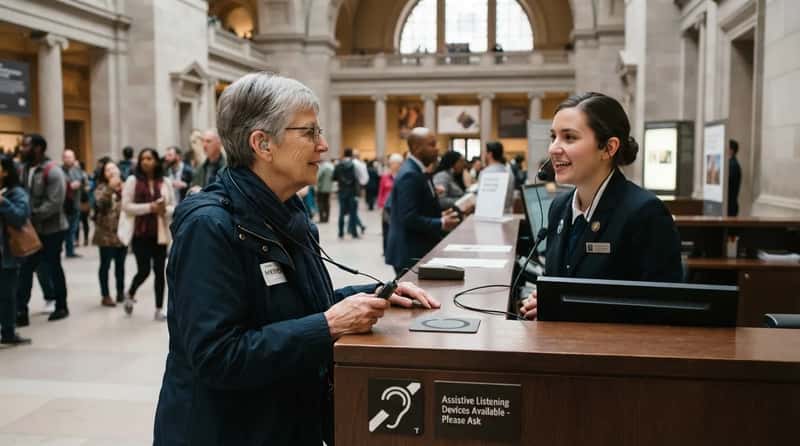
The Met’s accessibility services include hearing loops, assistive listening devices, large-print maps, and audio-described tours. Headsets and neck loops are free at select desks.
Most visitors with hearing aids don’t realize they can switch to T-coil mode and pick up the loop signal directly, no headset required. Hearing loops are becoming standard equipment at major institutions for exactly this reason.
During busy season, background noise turns a gallery into a wall of sound. A hearing loop slices right through it.
What #11 arranges is something completely different, and arguably more personal.
#11 – Personalized Accessibility Maps (Not the One on the Brochure Rack)
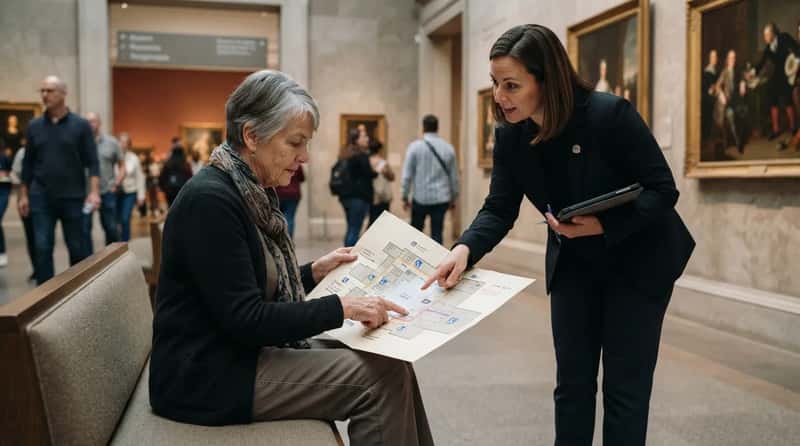
A personalized accessibility map lays out wheelchair parking, stair counts, ramps, grab bars, and restrooms specific to your visit, not the generic folded map at the front desk. Staff can build one on request.
Ask for the low-traffic route staff use internally, plus the exact senior admission price, in the same call. That internal route is real: staff move through buildings differently, with shorter paths and fewer stairs.
Requesting the staff route before busy season is one of the most underused moves an older visitor can make.
What comes next has actually been studied formally by the American Alliance of Museums, and the findings are surprising.
#10 – Proactive Staff Check-Ins During Peak Hours
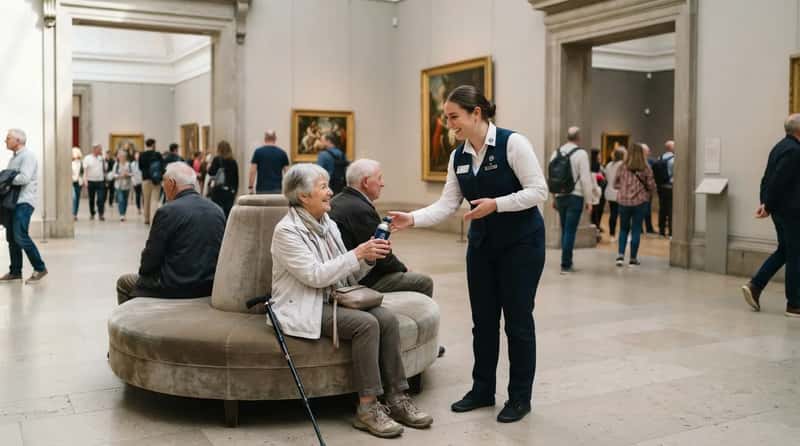
Most museum staff will help if you ask. The better institutions don’t wait to be asked at all.
Museum programming can accidentally segregate older visitors if staff assume what they want instead of checking in. The best institutions train staff to proactively offer seating, routes, and water during peak hours.
Some larger museums formally assign a visitor services staff member to the accessibility desk specifically for busy-season weekends. Ask on arrival if a designated accessibility contact is on duty.
What’s happening behind the scenes in #9 is even more deliberate.
#9 – Large-Print Guides Reserved on Request
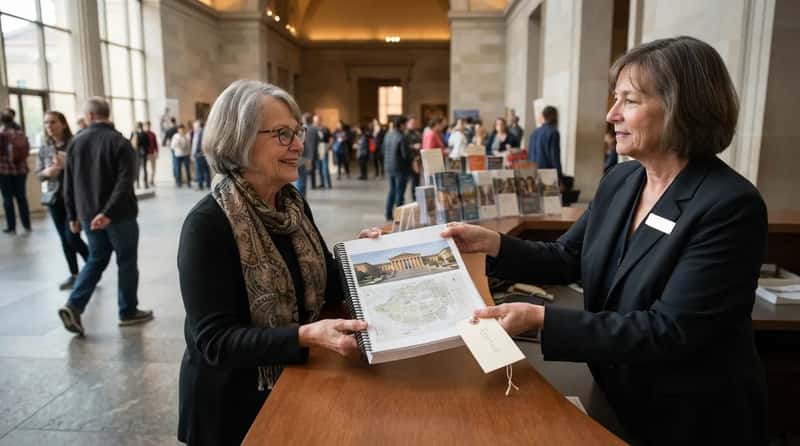
Leading museums offer audio description, large-print guides, and tactile tours. What they don’t advertise is how fast those guides disappear in high season.
Staff can reserve a large-print copy if you call ahead, a fact almost nobody knows to ask about. The Philadelphia Museum of Art asks visitors to request large-print materials by email three weeks in advance.
Quick Compare
- Walk-in request: guides may already be gone by midday during busy season.
- Advance request: staff hold a copy with your name attached.
- Philadelphia Museum of Art: asks for large-print requests by email three weeks out.
Three weeks. That’s how tight the supply runs.
If you show up and ask same-day, you may be out of luck. Call ahead and get a name attached to your reservation.
What #8 arranges is a completely different kind of support, and it surprises most people.
#8 – Captioned and Audio-Described Exhibition Videos
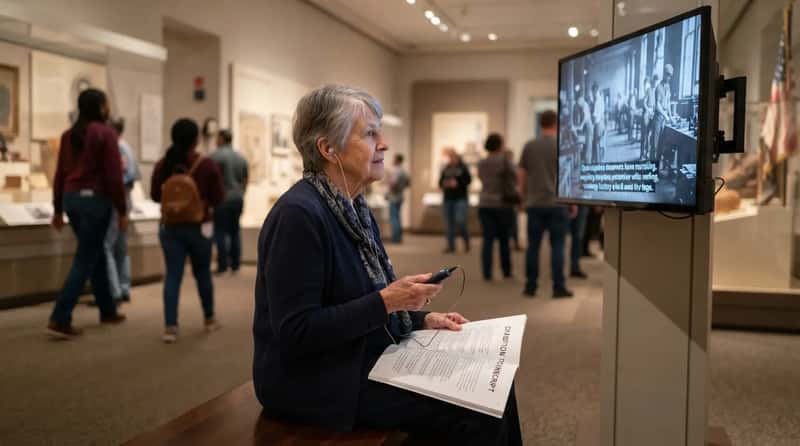
Smithsonian museums build open captioning and audio description directly into exhibition videos, a standard more institutions are quietly adopting. It’s becoming the norm rather than the exception.
Audio guide content is streamable on your own device for thousands of artworks, with large-print transcripts available for every audio program. Most visitors over 60 never realize that large-print transcript version exists.
Following a transcript at your own pace is a genuine game-changer in a noisy, crowded gallery.
The arrangement in #7 goes even deeper into sensory support, and it’s rarely listed publicly anywhere.
#7 – Sensory-Friendly Sessions With Noise-Reduction Tools
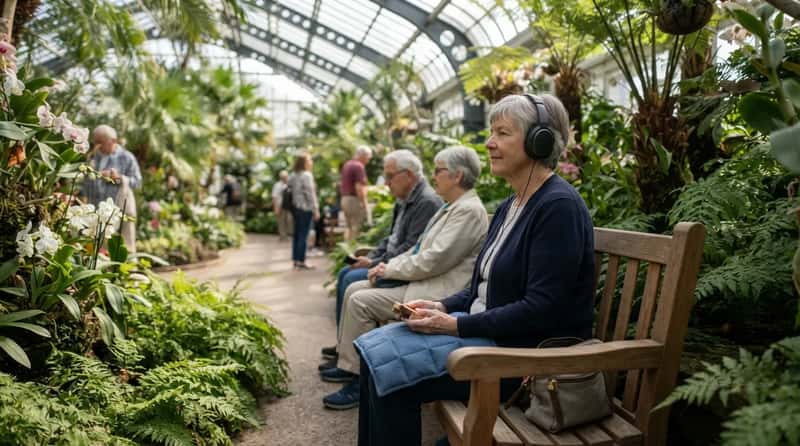
Noise-reducing headphones, weighted lap blankets, and fidget tools are available at public programs, including at the U.S. Botanic Garden. These resources exist specifically to ease sensory overload.
Sensory-friendly sessions run at the Natural History Museum London, the British Museum, the Rijksmuseum, and all Smithsonian museums. During busy season, these sessions are often the only genuinely quiet space in the entire building.
At a Glance
- U.S. Botanic Garden: noise-reducing headphones, weighted lap blankets, fidget tools.
- All Smithsonian museums: dedicated sensory-friendly sessions.
- Natural History Museum London & The British Museum: quiet-hours programming.
- Rijksmuseum: “Silent Sunday,” with crowd noise actively managed.
The Rijksmuseum’s “Silent Sunday,” where crowd noise is actively managed, is one of the most practical senior-friendly arrangements any major museum runs.
These sessions live on accessibility calendars, not the main events page. #6 reveals something formally organized but even more rarely discussed.
#6 – Dementia-Friendly Art Programs
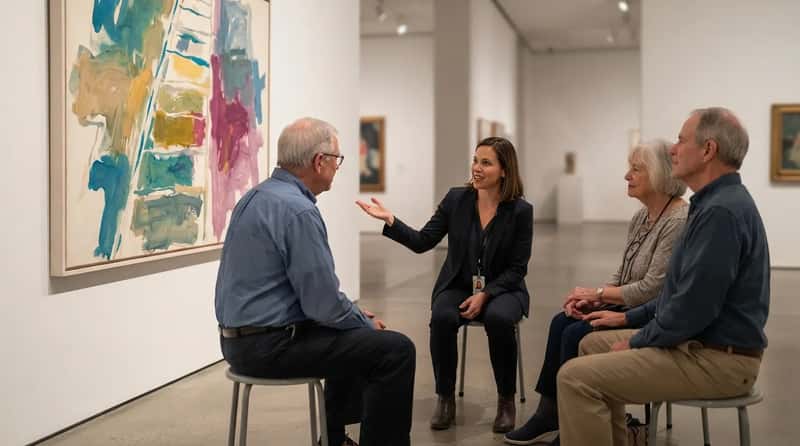
“Meet Me at MoMA” is a public program for visitors with Alzheimer’s or other dementia and their care partners, built around dialogue through looking at art. Specially trained educators guide the conversation through the galleries.
The High Museum’s “Musing Together” runs monthly for people with early-stage dementia and their care partners, built around a 90-minute conversation on three or four artworks. The Museum of Fine Arts Houston runs a near-identical program on the second Monday of each month.
These programs exist at far more institutions than most families realize. They’re specifically designed so the experience never feels overwhelming.
What #5 arranges quietly requires no diagnosis at all, just a request.
#5 – Touch Tours for Tactile Engagement
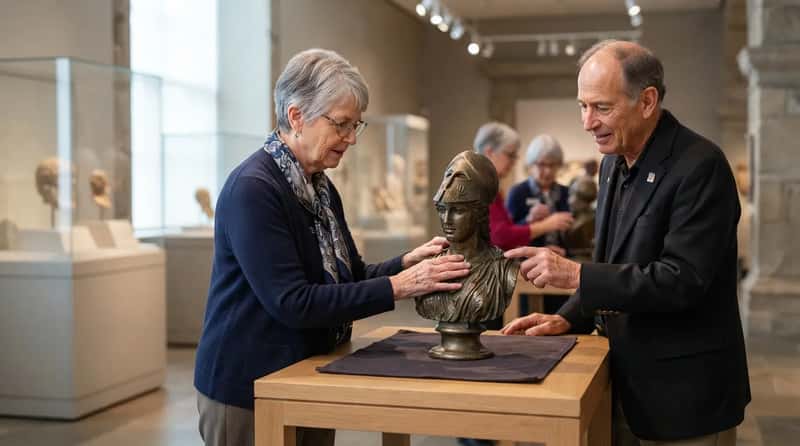
Many museums now offer touch collections for tactile engagement alongside complimentary wheelchairs and slower-paced docent tours. Ask directly whether a Touch Tour is running that week, since it’s rarely listed on the main calendar.
Touch Tours let visitors handle reproductions or select collection objects, turning the museum from a purely visual experience into something genuinely multi-sensory. For visitors with vision changes, this can make an entire exhibition meaningful instead of frustrating.
Advance booking through the access team is required, since general admissions usually can’t set it up.
What #4 arranges is now formally documented in museum research, and it changes the pricing picture significantly.
#4 – Unlisted Senior Pricing (Lower Than What the Website Shows)
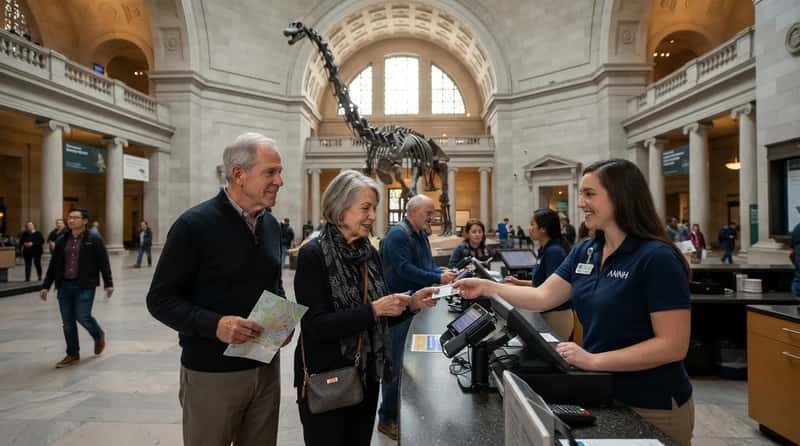
The American Museum of Natural History lists a lower admission rate for visitors 60 and over than standard adult pricing. That’s public, but it’s not the full story.
Fast Facts
- At the American Museum of Natural History, the suggested donation for general admission runs around $25 for adults and $20 for seniors 60 and up.
- Valid ID showing your age is required at the register to receive the senior rate.
- Out-of-state visitors typically see a fixed senior price set a few dollars below standard adult admission.
Phone staff will often quote an even lower rate than the website shows, once you identify yourself as a senior visitor on the call. The website rate and the phone rate are sometimes genuinely different, and the phone rate is almost always the better one.
Ask for the internal low-traffic route and the exact senior price in the same phone call. You’re stacking two insider advantages into a single five-minute conversation.
The arrangement at #3 is free, takes 30 seconds to request, and almost nobody does it.
#3 – Companion and Caregiver Free Admission
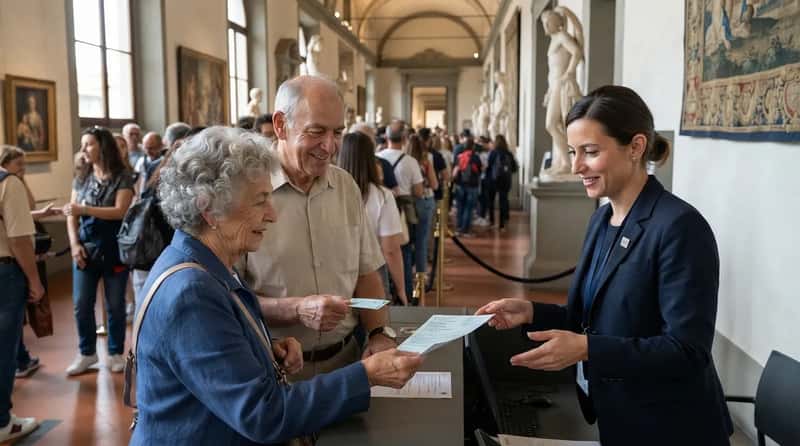
The Philadelphia Museum of Art gives free admission to one personal attendant per visitor with a disability. Dozens of major institutions across the US and internationally run some version of this policy.
At the Uffizi Gallery in Florence, presenting a disability certificate gets you and a companion in free, with no queue and no reservation required. During peak season, skipping the line with a companion pass is worth more than the ticket price itself.
Ask the accessibility desk specifically, since general admissions staff don’t always know the policy exists.
What #2 arranges goes beyond cost and comfort entirely. It’s a formal engagement experience built specifically for older adults.
#2 – Reminiscence and Creative Aging Programs
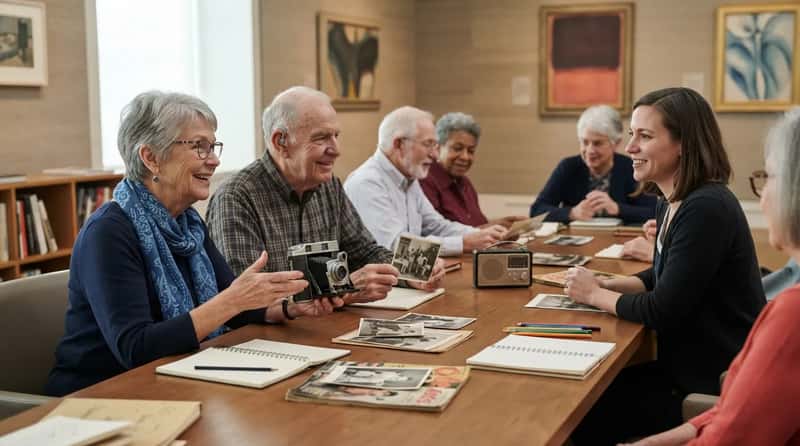
Reminiscence therapy invites older adults to actively recall past experiences, often triggered by objects and images from earlier decades. It’s vivid, engaging, and built around sharing those memories with a listener.
Programs like this are designed for seniors, nursing homes, and organized groups in a relaxed, comfortable setting. The Phillips Collection runs a similar structured format built around mindful looking and expressive making.
These programs are deliberately scheduled during off-peak hours to keep the room calm. That makes them one of the few museum experiences engineered to be the exact opposite of busy-season chaos.
What comes next at #1 is the one arrangement that unlocks nearly everything else on this list in a single phone call.
#1 – The Advance Accessibility Call That Activates Every Perk at Once
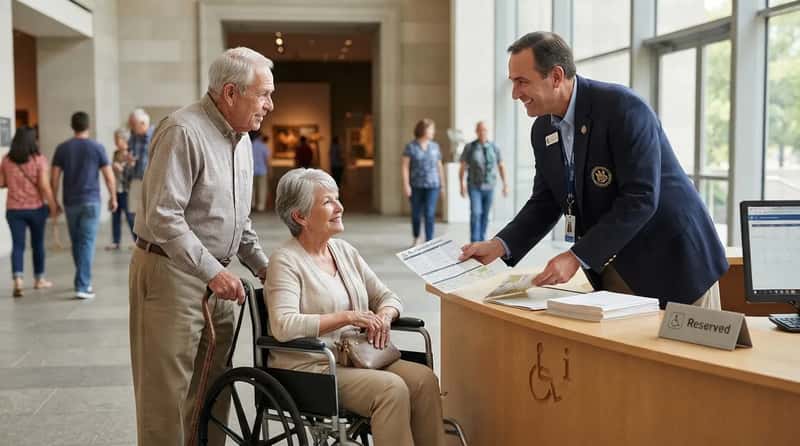
Calling ahead before a busy-season visit is one of the most underused tools older visitors have. It’s also the one that multiplies every other arrangement on this list at once.
Call the accessibility coordinator or main visitor line 2–3 days before your visit, and ask for guest services specifically, not general ticketing. Say this exactly: “I’m visiting on [date] and I’m over 60 – can you note a wheelchair reservation, a rest-seating map, and any slower-paced tour or audio option available that day?”
One call turns six or seven separate insider perks into a single confirmed plan waiting for you at the door. It costs nothing, takes about five minutes, and almost no visitor over 60 has ever tried it.
This is the single highest-leverage move any older museum visitor can make before a busy-season trip, and it’s completely free.
The Bottom Line
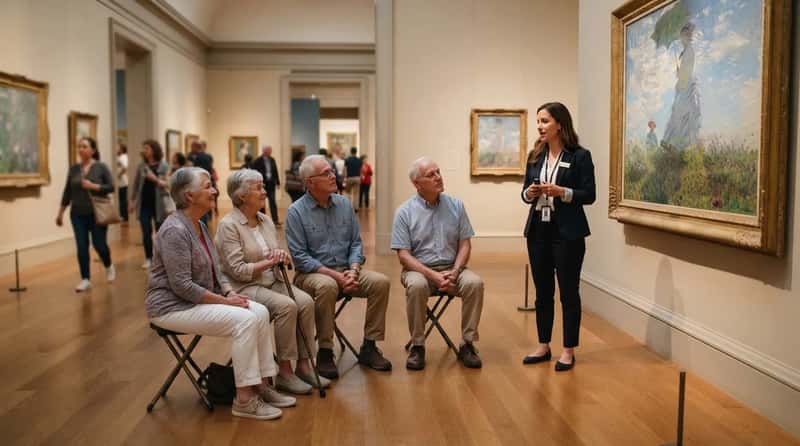
Museums are doing far more for visitors over 60 during busy season than most people ever realize. Quiet hours, Slow Art tours, hidden senior pricing, proactive staff check-ins – the tools already exist at institutions across the US and beyond.
The critical mistake is assuming you have to navigate peak-season chaos exactly like everyone else. You don’t, and the staff around you are often waiting to prove it.
Most of these arrangements go completely unused simply because nobody ever told visitors to ask. The museum experience for visitors over 60 usually comes down to one thing: whether that phone call got made before the visit began.
Which of these arrangements surprised you most? Drop it in the comments.
Bonus: The One Email That Locks In Everything Before You Even Leave Home
A phone call works, but a written request to the museum’s dedicated access or accessibility email address works even better, because it creates a record staff can act on before you arrive.
Send it 10 to 14 days before your visit, not the night before, and put every request in one message so nothing gets missed.
- Find the “Accessibility” or “Access Services” contact under the museum’s Visit or Plan Your Visit page – not the general info@ address.
- State your exact visit date and that you’re a visitor over 60.
- Request all of the following together: a wheelchair or scooter hold, a personalized low-traffic route map, any Touch Tour, Slow Art tour, or sensory-friendly session running that date, and companion admission if you’re bringing someone.
- Ask them to reply with a confirmation name or number you can reference at the accessibility desk on arrival.
A written confirmation beats a verbal promise every time. Staff rotate shifts during busy season, but an email with your name and date attached follows you to whoever is working the desk that day.