You spent months planning the trip, and the flight home got about ten minutes of thought. That’s exactly where the quiet damage happens: a surprise duty bill, a confiscated snack, a pocketful of coins nobody will exchange and a body clock stuck three days behind. People who fly constantly treat the trip home as its own mission, and these 24 habits show how.
The strange part is that the costliest mistakes look harmless when you make them. One is hiding in a snack bag. One is a single button on a card terminal. And one starts at a shop register days before you ever see an airport. Keep scrolling, because the sneakiest one isn’t where you’d expect.
#24 – They Grab the Boarding Pass the Minute Check-In Opens

Most major airlines open online check-in about 24 hours before departure. Seasoned travelers set a phone alarm for it. Their boarding pass is saved to their phone wallet before most passengers have even thought about packing. It’s also a free preview of how the day will go.
Screenshots are the backup plan. Airport Wi-Fi fails and apps freeze at the worst moment, but a saved image still opens at the gate. The airline app has an even more useful trick, and it’s coming up at #23…
#23 – They Trust the Airline App Over the Departure Board

By the time a delay hits the airport screens, the app has often pinged them already. Many airlines now let you rebook right in the app. That means seasoned travelers are choosing a new flight while everyone else queues at the desk. The best seats on the backup flight can vanish in minutes.
They also know their rights. A 2024 U.S. Department of Transportation rule requires automatic refunds when an airline cancels or significantly changes a flight to, from or within the U.S. and you decline the alternative. Fine print still applies, so they screenshot every notice. None of that helps if your suitcase is a mess, though, and #22 is the simplest fix there is…
#22 – They Pack a “Dirty Laundry” Bag on Day One

Pros pack the return suitcase in layers, not in a panic. One dedicated bag collects worn clothes from the first day. Clean items stay separate, and nothing smells like a gym locker when you open the case at home.
The real payoff is speed. Packing the last morning takes minutes when the sorting is already done. The biggest return-day stress is often the 20 minutes you spend sitting on a stuffed suitcase. Speaking of stuffed suitcases, the next habit decides how much you pay at the counter…
#21 – They Weigh the Bag Before It Ever Reaches the Airport

Souvenirs are heavy, and nobody believes it until the scale says so. Many airlines cap standard economy checked bags at 50 pounds (23 kg) on international routes. Overweight fees add up fast, which is why a cheap handheld luggage scale is a quiet favorite among frequent flyers.
Worth Knowing
- Some international carriers set a lower economy limit, such as 20 kg (about 44 pounds), so check your return airline specifically.
- Many major airlines also cap checked bag size at 62 total inches (158 cm) for length, width and height combined.
- Overweight fees on major U.S. carriers often start around $100 per bag and climb for heavier ones.
- A large hard-shell suitcase can weigh 10 pounds or more empty, which eats into your allowance before you pack a thing.
Some travelers swear by going carry-on only for the trip home and shipping or leaving behind the extras. Others call that a fantasy for anyone buying real gifts. Either way, the scale decides, not your opinion. And one rule about the carry-on can doom a prized bottle, as #20 explains…
#20 – They Know Exactly Which Bottles Won’t Survive Security

The TSA’s 3-1-1 rule still governs most checkpoints. Liquids, gels and aerosols in a carry-on must be in containers of 3.4 ounces or less, and they all go in one quart-size bag. That means the olive oil, hot sauce and local spirits belong in checked luggage.
Seasoned travelers wrap bottles in clothes and seal them in a zip bag. One leaking bottle can ruin an entire suitcase of souvenirs. Duty-free purchases on connecting flights add their own wrinkles. But the biggest money trap isn’t liquids at all, it’s what comes next at #19…
#19 – They Declare Everything, Even When It’s Under the Limit
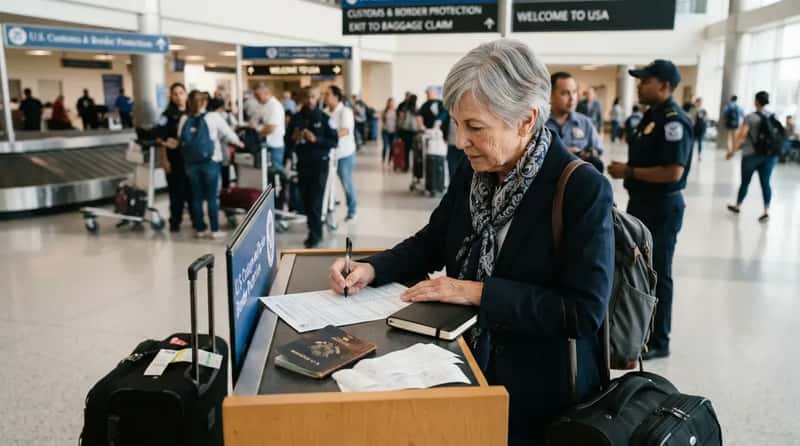
Here’s the mistake that costs travelers real money. The $800 duty-free exemption does not mean you can skip listing your purchases. Seasoned returners declare every item they acquired abroad, including gifts and things they’re wearing.
Going over the exemption isn’t itself a violation. You may simply owe duty on the extra. The real trouble starts when something goes undeclared. Keeping proof of what you paid makes everything smoother, which brings us to #18…
#18 – They Keep Every Receipt in One Folder

A pile of crumpled receipts in five pockets is a headache in the customs line. Pros keep them in one envelope or snap photos as they go. The CBP declaration asks for values in U.S. dollars, and for gifts you list the retail value. That’s hard to do from memory.
Foreign prices and exchange rates blur fast after two weeks. A traveler who bought a watch in a market with no receipt is guessing at a number an officer may question. A quick photo of each tag or receipt takes seconds. Receipts are only half the story, though, because what’s in your snack bag matters even more at #17…
#17 – They Never Gamble on the Sandwich in Their Bag

Customs isn’t only about money. Agriculture rules exist to keep pests and animal diseases out, and fresh fruit, many meats and some plant products are restricted. Seasoned travelers check CBP’s guidance before packing food. An apple left over from the plane can turn into a penalty if you don’t declare it.
Packaged, shelf-stable treats are often fine, but the rule is simple: if you’re unsure, say so on the form. Officers see this every day. Food is one surprise, but cash brings a rule most travelers have never heard of at #16…
#16 – They Know the $10,000 Cash Rule Before They Need It

Carrying large amounts of cash isn’t illegal. Failing to report it is. Anyone bringing $10,000 or more in currency or monetary instruments into or out of the U.S. must report it to CBP, and the customs form itself references the requirement.
At a Glance
- The trigger: $10,000 or more in U.S. or foreign currency, or the equivalent combined total.
- What counts: cash, traveler’s checks, money orders and other negotiable instruments.
- The paperwork: a FinCEN Form 105 report, which a CBP officer can help you complete.
- The risk: money that isn’t reported can be seized, even if it was legally earned.
That includes combined amounts for a family traveling together. Most people don’t realize the rule covers more than paper bills. Checks and money orders count too. Seasoned travelers rarely carry that much anyway, because cards are safer. Speaking of skipping the paperwork, #15 is the biggest time saver on this list…
#15 – They Skip the Paper Form and Use the Free App

CBP’s free Mobile Passport Control app lets eligible travelers submit passport details, a photo and customs answers electronically before they reach an officer. Seasoned returners have it ready the moment they land, if the airport supports it. Frequent international travelers also use Global Entry kiosks.
Eligibility and airport availability vary, so they check CBP’s site before the trip. The real time-saver is doing the setup at home, not in the arrivals hall. But your bag may hold a bottle that changes the math, as #14 shows…
#14 – They Count Their Bottles Before Buying Them

Bringing back a bottle is allowed. The catch is the limit. CBP guidance says no more than one liter of alcohol per adult aged 21 or older can be included in the duty-free exemption. Anything above that is still admissible, but it’s subject to duty and federal excise tax.
State laws can be stricter than federal rules, so special exceptions exist and so do extra restrictions. That “bargain” wine case can cost more than the shop price once taxes land. Seasoned travelers often pick one great bottle, not six. Once you’re past customs, though, your body is the next problem, and #13 explains why…
#13 – They Plan Around Which Direction They’re Flying

Jet lag isn’t equal in both directions. Most sleep experts say flying east tends to feel harder than flying west, because it asks your body to fall asleep earlier than it wants to. Seasoned travelers know which way they’re headed and plan for it.
Many start nudging bedtime a day or two before flying and get outside soon after landing. No hack removes jet lag completely. It can only shorten it. And one of the smartest fixes has nothing to do with sleep, as #12 shows…
#12 – They Never Book the Return for Sunday Night

This is the quietly controversial rule. Many frequent travelers insist that landing the night before work is the biggest mistake of all. You arrive tired, the fridge is empty and your inbox is full. Monday becomes a write-off.
Their fix is a buffer day. They land a day early, even if it costs a bit more, and use it for laundry, groceries and mail. Not everyone agrees, and some travelers would rather squeeze in one more vacation day. Still, travelers who try the buffer day tend to keep doing it. There’s one more thing that keeps your body happy in the air at #11…
#11 – They Treat the Aisle Like a Walking Track

Long flights aren’t just tiring, they’re physically demanding. The CDC notes that sitting still on trips of four hours or more raises the risk of blood clots. So seasoned flyers get up, walk and stretch on long hauls.
Many pick an aisle seat for exactly this reason. It’s less about comfort than about not feeling like a stranger in your own legs on landing. Next up is a tech habit that saves more trips than you’d think, at #10…
#10 – They Charge Everything and Download Before Leaving

A dead phone at arrival can mean no boarding pass, no ride app and no map. Seasoned travelers top up every device at the gate. They also download shows, playlists and offline maps before the flight, since in-flight Wi-Fi is hit or miss.
Power banks follow a firm rule. The FAA says spare lithium batteries and power banks must travel in the cabin, not in checked bags. A power bank in a checked suitcase is a safety violation, not just a bad idea.
Fast Facts
- Spare lithium batteries of 100 watt-hours (Wh) or less are generally fine in a carry-on.
- Batteries from 101 to 160 Wh need airline approval, and you’re limited to two.
- No Wh on the label? Multiply amp-hours by volts. A 20,000 mAh bank at 3.7 volts comes to about 74 Wh.
- Loose batteries should have their terminals covered or be kept in their own cases or pouches.
Another habit protects your most important item, and #9 spells it out…
#9 – They Give Their Passport a Permanent Pocket

The same pocket, every time. That’s the habit. Seasoned travelers keep the passport and boarding pass in one spot and never in a checked bag. They don’t dig through a backpack in the immigration line.
They also keep a pen handy for forms, since someone always asks to borrow one. Plenty of travelers have spent the last minutes of a trip tearing apart a bag for a passport that was in their jacket. And if the bag itself goes missing, #8 has the answer…
#8 – They Pack a “Landing Kit” in Their Carry-On

Checked bags do get delayed, and frequent flyers plan for it. The carry-on holds a change of clothes, medications, a charger, a toothbrush and the essentials. If the suitcase goes missing, life continues.
Many also slip a tracker tag into the checked bag so they can see where it is. Some travelers watch their bag’s location on their phone from the plane. It doesn’t prevent a delay, but it turns a mystery into information. Timing matters just as much as packing, as #7 shows…
#7 – They Arrive Early for the Flight Home, Even When It Feels Excessive

Airlines commonly recommend arriving about three hours before an international departure. Some frequent flyers call that overkill at small airports. Others have missed flights because of one slow security line in a busy hub. The unfamiliar airport is the wildcard.
Seasoned travelers use the extra time to eat, charge devices and sit still. The wait isn’t wasted, it’s insurance. One leftover item in your wallet is the next trap, and #6 covers it…
#6 – They Burn Through Leftover Foreign Coins at the Airport

Foreign coins are the money you can’t get rid of. Many exchange counters and banks back home only accept paper bills. Seasoned travelers spend their last coins on water, snacks or a final souvenir before departure.
Airport duty-free is another story. It’s often marketed as a bargain, but many frequent travelers argue it’s overhyped, and they check prices first. A “duty-free” label doesn’t guarantee a low price. Paying the wrong way abroad is a bigger drain, as #5 shows…
#5 – They Say No to “Pay in Dollars” One Last Time

Card terminals abroad often offer to charge you in U.S. dollars. It sounds convenient, but this “dynamic currency conversion” typically comes with a worse exchange rate. Consumer guidance commonly advises choosing the local currency. Seasoned travelers decline every time, including at the final hotel checkout.
Quick Compare
- Pay in local currency: your card network does the conversion, and the only extra cost is any fee your own card charges.
- Pay in dollars: the merchant’s terminal or provider sets the rate, and a markup is usually built in.
- The tell: a screen that asks “dollars or local currency?” is the cue to choose local.
They also scan card statements after getting home. Hotel holds, duplicate charges and foreign transaction fees can all slip in. A pending charge that never drops off is surprisingly common. They screenshot receipts to dispute it if needed. Your phone plan may be quietly draining too, as #4 explains…
#4 – They Shut Off the Roaming Plan Before It Bills Them Again

A trip-only plan can outlive the trip. Seasoned travelers check their carrier account on the way home. They cancel temporary travel passes and delete eSIM plans they no longer need.
They also switch roaming settings back and turn Wi-Fi calling off if needed. Plenty of travelers only notice a leftover plan when the charge appears weeks later. Now for a refund most people leave on the table, at #3…
#3 – They Get Their Tax Refund Stamped Before Checking a Bag

Many countries, including those in Europe, offer VAT refunds on purchases by visitors. Seasoned shoppers know the catch. Goods often need a customs stamp before the bag goes into the hold. Miss that step and the refund is usually gone.
Minimum purchase amounts and store rules differ everywhere. The refund process starts at the shop, not the airport. Savvy shoppers ask for the form at the register. The final two habits aren’t about money at all, starting with #2…
#2 – They Back Up Their Photos Before Leaving the Hotel

Losing a phone is the nightmare scenario. Seasoned travelers back up photos to the cloud or a drive before the trip home. They use hotel Wi-Fi on the last night, not airport Wi-Fi. If the phone vanishes, the memories survive.
Many also delete blurry duplicates on the flight. A thousand unsorted photos is usually where good memories go to be forgotten. One more habit costs nothing and may matter most, and it’s #1…
#1 – They Write the Trip Down Before the Plane Lands

Details fade fast once real life returns. Seasoned travelers open a notes app on the flight home. They jot down the meal they’d order again, the street name, the strange conversation and the small moments no photo caught.
It takes ten minutes, and it’s often what they reread years later. The notes tend to outlast the souvenirs. Many also write down one thing they want to do on the next trip. That turns the end of a journey into the start of the next one.
The trip home isn’t dead time. It’s where seasoned travelers protect their money, their health and their memories. The big adventure gets the photos, but the small habits decide what you actually carry back.
Which of these have you learned the hard way?