For millions of retirees, Social Security is not just a supplement to retirement income, it is the primary source of it. With the average monthly benefit sitting at just over two thousand dollars after this year’s cost-of-living adjustment, where you choose to live can make an enormous difference in how comfortably that check covers your bills.
In January 2026, the Social Security Administration enacted a cost-of-living adjustment for benefit recipients, boosting payouts by 2.8%, increasing the average retiree payment by about $56 per month, from roughly $2,015 to $2,071. Still, that extra bump doesn’t mean much if you’re living somewhere with sky-high housing costs and a state government that taxes your benefits on top of everything else. The states below stand out because they combine low everyday expenses with tax policies that leave Social Security income untouched, letting retirees keep more of what they’ve earned.
1. Mississippi

Mississippi has the absolute lowest cost of living in the United States, with housing coming in as the cheapest in the country and groceries, utilities, and transportation all falling well below national averages. That combination alone would make it a strong contender, but the tax picture makes it even better for retirees relying on fixed monthly checks.
Social Security is fully exempt from state taxes in Mississippi. Some rankings have even placed the state surprisingly high on overall retirement quality lists once affordability and tax treatment are weighed together, since when you factor in affordability, tax treatment, and climate, the math tends to favor Mississippi more than people expect. For retirees who prioritize stretching every dollar, it’s hard to beat.
2. Alabama

Alabama consistently ranks as one of the cheapest states in the country for retirees, with extremely low housing costs, including many areas offering homes under $150,000 that would cost three or four times that in coastal states. That kind of housing affordability alone can free up hundreds of dollars a month that would otherwise go toward a mortgage or rent payment.
The tax situation is just as favorable. Social Security is fully exempt from state tax in Alabama. Retirees looking for coastal living without the premium price tag often find it here, since the Gulf Coast offers beach living at a fraction of what you’d pay in Florida, with Mobile and the Baldwin County area becoming popular retirement destinations for people who want coastal access without the price tag.
3. Arkansas
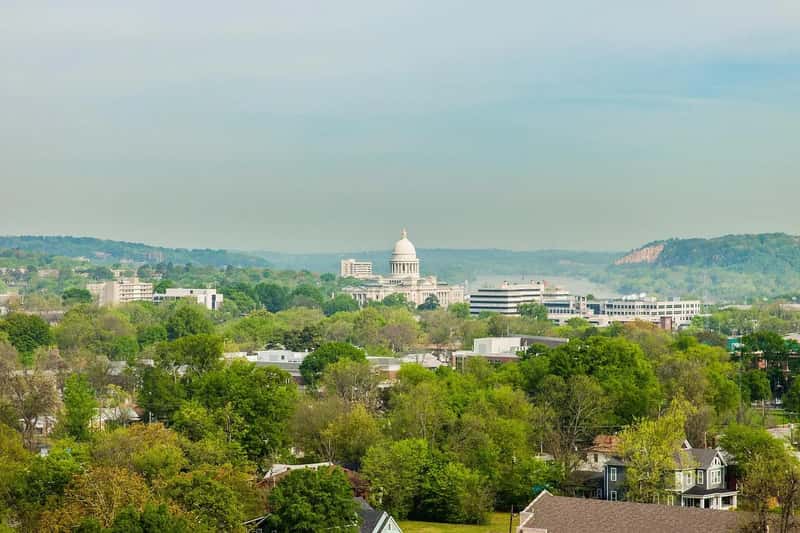
Arkansas rarely gets the spotlight compared to flashier retirement destinations, but its low cost of living quietly does a lot of heavy lifting for retirees on fixed incomes. Places like Arkansas, Mississippi and South Dakota are perennial standouts for stretching fixed income. Housing, groceries, and everyday services all tend to run below the national average, which matters enormously when your monthly income doesn’t fluctuate.
Arkansas also falls into the large group of states that leave Social Security benefits alone at tax time. Combined with modest property taxes in many counties, this gives retirees more breathing room in their monthly budget. For those who want a quieter, more affordable pace of life without giving up access to healthcare and basic amenities, Arkansas continues to be an underrated option.
4. Oklahoma

Oklahoma pairs a genuinely low cost of living with straightforward tax treatment of retirement income. Housing costs in most parts of the state remain well below national averages, and that gap tends to widen even further outside the major metro areas of Oklahoma City and Tulsa. Mississippi, Alabama, and Oklahoma are the cheapest by a significant margin among states commonly evaluated for retirement affordability.
Oklahoma does not tax Social Security benefits, which means retirees can count on keeping their full monthly check regardless of income level. Utilities and grocery costs also tend to run lower than in many neighboring states, helping fixed incomes cover more ground. For retirees who want proximity to larger cities without paying big-city prices, Oklahoma offers a practical middle ground.
5. Kentucky

Kentucky is one of the most underrated retirement states in the country, with a cost of living that runs well below average. Housing in particular tends to be affordable across most of the state, and that affordability extends to everyday expenses like groceries and utilities as well.
Kentucky and Tennessee offer the best balance of low cost and livability among states frequently compared for retirement affordability. Kentucky exempts Social Security from state income tax, and it offers additional exclusions for other forms of retirement income, which helps retirees who also draw from pensions or retirement accounts. That layered approach to tax relief makes it a smart pick for anyone trying to make a modest fixed income go further.
6. West Virginia

West Virginia has spent the past few years phasing out its tax on Social Security benefits, and as of this year that process is complete. West Virginia entirely phased out its tax on benefits in 2026. That change puts it firmly in the same tax-friendly category as most of the country, joining the large majority of states that leave retirees’ Social Security checks untouched.
Beyond the tax change, West Virginia fully eliminated its state tax on Social Security benefits as of January 1, 2026, with all recipients exempt regardless of income level, completing a three-year phase-out. Combined with historically low housing costs across much of the state, particularly in rural and small-town areas, West Virginia has quietly become a more attractive option for retirees than it was just a few years ago.
Choosing where to retire is rarely just about the weather or the scenery, even though those things matter too. The states above show that low housing costs, modest grocery and utility bills, and a tax code that doesn’t touch Social Security benefits can add up to real, measurable savings every single month. None of this means you have to uproot your life and move across the country. Still, if stretching a fixed income is a priority, it’s worth taking a hard look at how much of a difference geography alone can make.