Huế is positioned exactly where it is to impress—and it worked on me immediately. I arrived at the edge of the city at night, when the gates of the Citadel appeared like thresholds to a secret world I couldn’t yet see, only imagine. I walked the entire perimeter in the dark, circling the walls, wondering what was hidden inside, swallowed by shadows. I felt oddly like a subject locked out of a royal domain, close enough to sense its importance, not yet allowed in.
The next morning confirmed every expectation. Entering Huế gave me the unmistakable sensation of stepping into an important, regal residence—one designed to communicate authority, hierarchy, and permanence. And for good reason: for more than a century, this was where the Nguyen emperors lived, ruled, and staged power. Huế sets the tone immediately, through scale, symmetry, and an imperial gravity that still defines the city today. But let’s take this in order, because Huế is best understood in two acts: a night walk outside the walls, and a full day inside the Citadel. Together, these moments reveal not only the city’s history, but its surprisingly contemporary life. And before starting, there’s something essential to know.
A City Nearly Erased

To fully understand Huế, you have to acknowledge what happened here in 1968. During the Vietnam War, the city became the center of one of the longest and most destructive urban battles of the conflict. For nearly a month, fighting raged through the streets and inside the Citadel itself.
Much of what once stood was destroyed. Entire neighborhoods disappeared. Thousands of civilians were killed. What you walk through today is not a perfectly preserved imperial capital, but a city that had to rebuild itself—carefully, selectively, and often painfully. The empty spaces inside the Citadel, the uneven restorations, and the gaps between structures all speak clearly of that rupture. Knowing this history subtly but decisively changes the way you see Huế.
Nightfall: Around the Walls

I first experienced Huế at night. Outside the Citadel, a wide moat encircles the walls, separating the square fortress from the surrounding city. On each side of this square plan stands a monumental gate, each connected to the land by a bridge crossing the water. As darkness falls, the gates light up one by one, their reflections stretching across the still moat. The effect is quietly beautiful. Walking the perimeter at night is one of Huế’s most enjoyable experiences. Locals stroll, couples linger, children ride bikes. The massive gates—designed to intimidate during the day—soften under the lights. They stop feeling defensive and start feeling architectural, almost elegant.
Seen from the outside, each gate has its own personality. The lighting reveals proportions and details that daylight often flattens. It’s a unique way of understanding the Citadel—not as a seat of power, but as part of the city’s everyday life. And throughout that walk, there’s a growing sense of anticipation that is, in itself, a kind of pleasure.
Daytime: Inside the Imperial City

In the morning, I finally passed through one of those monumental gates and entered the heart of Huế: the Imperial City, a vast walled complex built in the early 19th century as the political and ceremonial center of the Nguyen Dynasty. The layout is deliberate and symbolic. Gates, courtyards, palaces, temples, and gardens unfold with almost ritual precision. By day, the Citadel feels expansive and calm. Even when there are many visitors, the scale absorbs them easily. You’re encouraged to walk slowly, to notice alignments, thresholds, and framed views. Some buildings are beautifully restored; others still carry visible scars from time and war. That contrast gives the place depth. It doesn’t feel staged or overly polished—it feels earned.
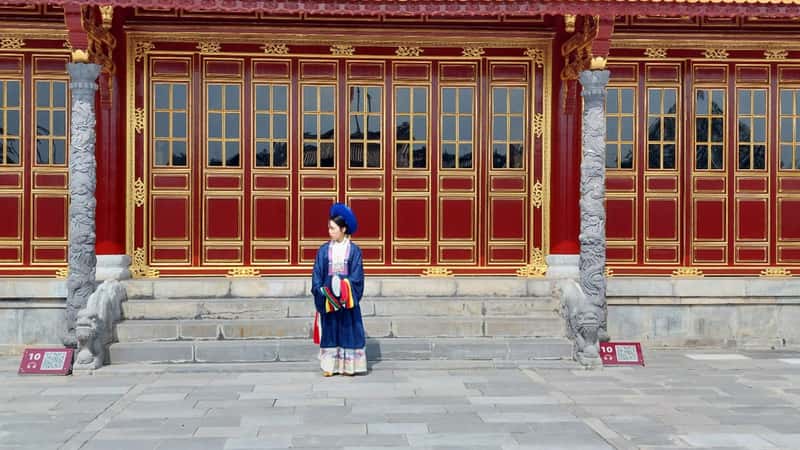
One of the most striking aspects is how actively the architecture is used today. Throughout the complex, you see people—especially young women—wearing traditional áo dài, moving gracefully through gates and corridors, spending long stretches of time being photographed. This isn’t casual sightseeing. It’s deliberate, aesthetic, and almost performative in the best sense. The Citadel has become a living backdrop where history, identity, and self-expression overlap. Rather than resisting this, the elegance of the architecture seems to invite it.
Gardens and Shops

Beyond the palaces and ceremonial spaces, Huế surprises you with its gardens. They are spacious, green, and carefully composed, offering real moments of calm. Trees provide shade, ponds mirror the surrounding buildings, and paths encourage wandering rather than direct movement. These gardens soften the formality of the architecture and make the Citadel feel inhabitable, not just monumental.
Inside the Citadel, there are also shops that are genuinely worth slowing down for. Beautifully curated and focused on traditional crafts and design objects, they go well beyond standard souvenirs. Among many things, they sell lacquered trays decorated with classic Vietnamese motifs—and they are extraordinary. Deep colors, intricate patterns, impeccable finishes: the kind of objects that make immediate sense both culturally and aesthetically, and that you can imagine living with long after the trip ends.
How to Get There
Huế is located in central Vietnam and is well connected by air, train, and road. The city is served by Phu Bai International Airport, about 9–10 miles south of the city center. From the airport, a taxi or hotel-arranged transfer takes roughly 25–30 minutes and is the easiest way to reach town. Huế is also a key stop on Vietnam’s north–south railway line. Trains from Hanoi and Ho Chi Minh City stop here, with travel times varying widely depending on the service (overnight trains are a popular option). If you’re coming from Da Nang, the train journey over the Hai Van Pass is particularly scenic and takes about 2.5–3 hours.
Once in Huế, getting around is simple. The Citadel is centrally located and easy to reach by taxi, bicycle, or even on foot if you’re staying nearby. Taxis are inexpensive and widely available, making it easy to combine daytime visits inside the Citadel with an evening walk around the moat and illuminated gates without any logistical stress.
Why Huế Works
Huế doesn’t rely on spectacle. It relies on structure, memory, and balance. A day inside the Citadel gives you political, architectural, and historical context. An evening outside the walls gives you perspective, showing how that history coexists with modern life. Seen this way—first from the outside, then from within—Huế feels complete.