The trailhead is dark at 4 AM.
Your pack weighs thirty-eight pounds. You chose that.
There is an easier path. You know this. You chose the other one.
And somewhere between the first switchback and the last shred of cell service, you stop pretending it’s about the view.
Here is the Identity Gap that lives inside every extreme trekker: the distance between the person who signs up for the brutal route and the child who once learned that comfort had to be earned through pain. Between the adult who craves the summit and the kid who was never allowed to simply rest. Between who you became on the outside – capable, driven, ironclad – and who you still are on the inside: someone quietly seeking permission to exhale.
The Weight You Chose
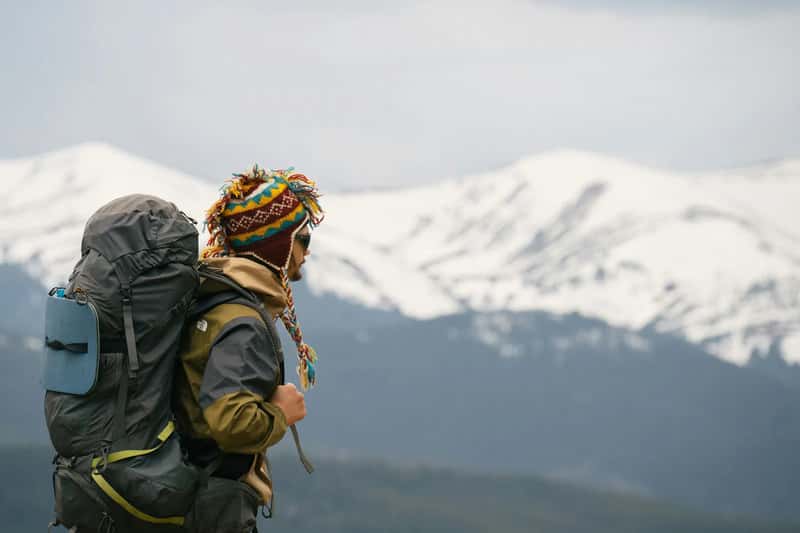
Nobody makes you carry a heavier pack than necessary.
Nobody puts a gun to your head and says: take the forty-mile ridge route instead of the twenty-mile valley walk.
You chose it. You always choose it.
The psychology of voluntary suffering in extreme hiking is not random. Research points to something called sensation-seeking – a personality trait characterised by the pursuit of novel and intense experiences, even at the risk of physical harm – and finds that individuals with high sensation-seeking tendencies are more inclined toward adventurous activities and perceive risks differently than those without these traits. But sensation-seeking is only the surface reading. Beneath it, for many, lives something older. Something learned young. The weight in your pack is not just gear. It is a translated memory – the subconscious belief that arriving at peace requires first arriving at the edge of yourself. Every blister on your heel is a negotiation with a rule you inherited before you were old enough to question it.
The Childhood Contract
Some of us were handed a contract before we could read.
It said: you must suffer first.
Then – and only then – you may rest.
Complex trauma can arise from experiencing repeated or multiple traumatic events from which there is no possibility of escape, and the sense of being trapped is a defining feature of the experience. For the child living inside that contract, the world becomes a transaction. Joy has a price. Peace has a price. Simply existing without justification – that costs the most of all. Trauma alters three main cognitive patterns: thoughts about self, the world, and the future – leading individuals to see themselves as incompetent or damaged, to see others and the world as unsafe and unpredictable, and to see the future as a place where personal suffering will continue. The mountain, decades later, is just a cleaner version of that original contract. Exhaustion is the currency. The summit is the receipt. The proof of payment. And you’ve been paying the same debt since childhood.
The Body as Courtroom
The body keeps meticulous records.
It does not forget what the mind has edited.
Every time you push past a reasonable stopping point, your body is being used as a courtroom in which you argue your worthiness.
Childhood trauma causes extreme stress on the body – when you experience stress, your body releases certain hormones like cortisol and adrenaline, which help you adjust to the situation. But long-term stress causes those hormones to remain in constant use – a state called toxic stress – which can target the brain and change how it grows and functions. What this means, practically, is that the child who grew up braced for impact becomes the adult who seeks out the impact deliberately. The nervous system doesn’t distinguish between childhood chaos and a Category 4 mountain route. Both feel, in their own way, like home. The courtroom never fully closes. You just change the venue.
The Sensation of Legibility
Out there, on the brutal trail, you finally make sense to yourself.
The pain is legible. The goal is legible. The rules are simple: move forward or don’t.
Normal life doesn’t offer that kind of clarity.
A study published in the Journal of Sports Sciences found that mental fatigue, not physical exhaustion, was a more accurate predictor of whether an endurance athlete would quit or push through. That finding holds a secret. For those whose inner lives are turbulent, unresolved, and hard to name – the physical struggle becomes a translation. The external pain gives language to the internal one. The solitary moments on a hike provide an opportunity for introspection, and many hikers describe these moments as meditative, where they can introspect, evaluate, and find clarity on personal matters. For the trauma-shaped trekker, clarity isn’t just a nice byproduct. It is the entire point. The mountain gives them a sentence structure for feelings that have never had syntax.
The Proof-Of-Toughness Identity
I remember the first time I picked the harder route not because I wanted to.
But because I needed the other version of myself – the one who had suffered enough – to finally show up.
I was twenty-six. Standing at a fork in a trail in the highlands of northern Scotland. The easier path was clearly marked. The other one barely was. I took the unmarked one, limping by hour three, triumphant by hour seven. And for approximately forty minutes at the top, I felt like I had paid something off.
Then the feeling dissolved. And I started looking for the next trail.
A trauma therapist suggested that childhood experiences could play a part in driving people on – prompting an unease with vulnerability and a need to prove themselves tough and capable. That need to prove toughness is not ambition. It is archaeology. Each brutal route is an excavation – a dig through old terrain looking for the moment when you finally become enough.
The Stillness Problem
Here is the real issue. The terrifying one.
What happens when you stop?
The trail is a controlled form of noise. When the body is screaming, the mind goes quiet. But stillness – actual stillness, in a living room, with no agenda – that is where the old contract resurfaces and demands renewal.
Living in defense mode and ever-vigilant to the possibility of threat, people may experience ongoing problems with sleep or physical pain and feel a diminished sense of self-worth. For the earned-rest trekker, the sofa is not safe. Safety, paradoxically, feels more dangerous than the sheer face of a mountain. Without treatment, repeated childhood exposure to traumatic events can affect the brain and nervous system and increase engagement in high-risk activities. The extreme route, then, becomes a form of self-regulation. A way to manufacture the kind of exhaustion that justifies rest, without having to believe you deserve it for free. The stillness problem is not solved by more hiking. It is solved by confronting why stillness was ever made to feel like a crime.
The Summit as Transaction
You reach the top. You take the photo. You feel it.
That flood. That wave. That thirty-second window of pure, uncomplicated peace.
And then you immediately start thinking about the descent.
In the hardest stretches of long-distance hiking, many people don’t suffer so much physically as they lose motivation – but on the other side of that anguish, it feels genuinely good to be proud of oneself. That pride is real. That moment is real. But for the earned-rest personality, the transaction is never complete. The summit clears the debt temporarily. By morning, the ledger resets. Trauma shakes up our world and forces us to take another look at our cherished goals and dreams – we tend to rely on a particular set of beliefs, and traumatic events typically shatter that worldview, leaving us to rebuild ourselves. The trekker rebuilds themselves again and again on the mountain, not realizing the architecture they keep returning to was designed by someone else, a long time ago, in a house they no longer live in.
The Dopamine of Difficulty
Difficulty has a chemical signature.
Your brain knows this. It has been banking on it for years.
The underlying neurological causes are poorly understood, but are widely held to include low levels of dopamine – a neurotransmitter linked to emotional regulation and mental stimulation. For those raised in chaotic or neglectful environments, the baseline dopamine system is recalibrated toward high-stimulus environments. Flat, peaceful days feel like withdrawal. Physical activity may facilitate post-traumatic growth by interacting with cognitive, affective, and social processes following a traumatic event – providing opportunities to develop a sense of control and self-empowerment, and relieve emotional distress. The difficult trail is not irrational from a neurological standpoint. It is, in fact, deeply logical given the brain it was issued to. The problem is not the dopamine. The problem is the belief that it can only arrive through punishment.
The Identity You Leave at the Trailhead
There is a version of you that only exists on hard routes.
Capable. Singular. Unambiguous.
That version doesn’t have to explain itself. It doesn’t have to justify its existence. It just has to keep moving.
An event may be considered traumatic when it alters in a negative way the identity definition of the subject, leading to an impaired ability to cope – to put “the right distance” between oneself and the things around them. The hard trail offers a corrective identity – one that is built in real time, through visible, measurable effort. It is not the identity you were given. It is the one you built with your own suffering. Childhood trauma survivors often construct a false self-image to cope, and early onset of trauma may contrive a low self-esteem where depression and anxiety surface due to feelings of inadequacy. The trail-built identity is not false, exactly. But it is also not complete. It is the most convincing costume in the closet. The one you wear so well that even you forget it’s a costume.
The Permission You Keep Refusing
There is one thing the hardest routes in the world cannot give you.
They cannot give you permission to rest without earning it first.
That permission doesn’t live on any summit. It was never buried under any miles.
Post-traumatic growth may feature positive changes in self-perception, interpersonal relationships and philosophy of life – leading to increased self-awareness and self-confidence, a more open attitude towards others, a greater appreciation of life, and the discovering of new possibilities. That growth is real. That transformation is real. But it requires something the brutal trail alone cannot provide: the radical act of deciding that you were already enough before the first step.
The assumptions people have made about their identity, life path, and the predictability of their world are shattered by traumatic events – and the intrusive rumination that follows may be harnessed into a more deliberate reflection on core beliefs, and a reconstruction that can lead to genuine post-traumatic growth. That reconstruction, when it happens on the mountain, is borrowed from the landscape. Durable growth – the kind that survives the return home – requires reconstructing the internal one. The one that says you had to hurt before you were allowed to heal.
The trail doesn’t ask why you came. It just receives you. Mud, blisters, ancient grief and all. And there is something sacred in that – the mountain’s complete indifference to your history. It does not care what you were told as a child. It does not reinforce the old contract. It simply sits there, asking only for your next step.
The cruelest part of the earned-rest psychology is that it is invisible from the outside. To the world, you look like a person who loves adventure. Who chases difficulty for sport. Who has an enviable relationship with their own limits. Nobody sees the internal accountant furiously calculating whether you’ve suffered enough yet to justify sitting down. Nobody sees the child behind the trekking poles, still waiting for someone to say: that’s enough now. You can stop. You’ve done enough.
Maybe the most radical trail you could ever walk is the short one. The flat one. The one you take on a Tuesday for no reason, at no particular pace, toward no particular summit – carrying nothing heavier than the quiet, revolutionary idea that rest was always yours to take.