Chesil Beach is the heart of the Jurassic Coast, and without question my favorite place in this extraordinary corner of southern England. Here, the sea meets some of the oldest exposed landscapes in Europe, rich with fossils and layered geology. The terrain is constantly shifting, shaped by wind and water, and it reflects the slow, ongoing transformations of our planet—telling an ancient, multicolored story that unfolds step by step along the shore.
We are in Dorset, about 135 miles southwest of London. Chesil Beach runs northwest to southeast for roughly 18 miles, forming a long, narrow barrier that links the Isle of Portland to the mainland and stretches toward West Bay. No matter where you access it, the experience will feel different every time. The beach is a landscape in motion, one that reflects the slow, relentless transformations of the planet itself. It changes step by step: textures shift, stones grow finer, and if you were to walk its entire length, it would feel less like a single beach and more like a sequence of countless, distinct shores.
A Beach that Changes Step by Step
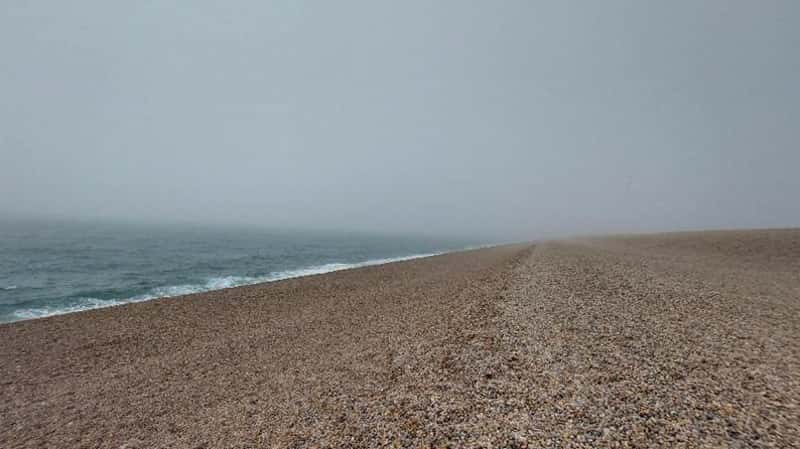
Because its formation is constantly shifting, Chesil Beach is best understood on foot. Near the Portland end, the shore is composed of large, smooth pebbles—heavy, rounded stones that clatter loudly as waves pull them back toward the sea. Here the beach feels raw, almost hostile, and conveys a sense of primordial force: the sea doesn’t gently lap the shore, it actively carves it.

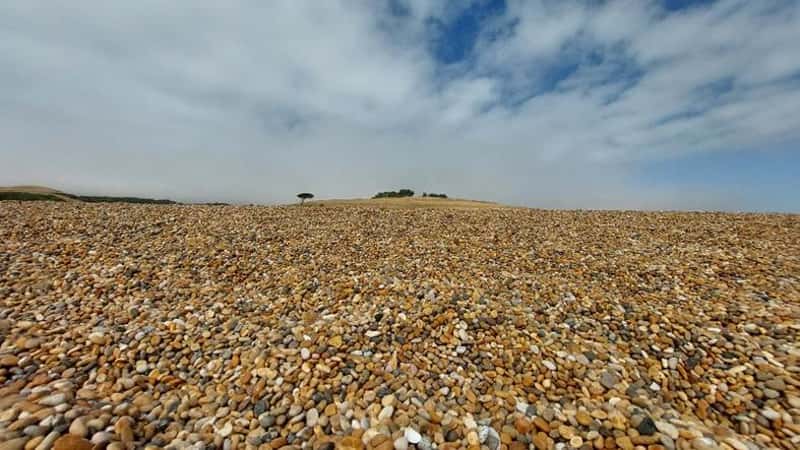
Moving northwest along the beach, the pebbles gradually decrease in size, almost imperceptibly at first. Step after step, the surface softens. Stones become smaller, then mix with gravel, eventually giving way to finer material closer to West Bay. The color shifts as well: the initial cold gray slowly warms into pale gold toward the center of the beach, then deepens into coppery, reddish tones in its northwestern stretch. This graded transition is one of Chesil’s most fascinating features—a natural sorting process shaped by wave energy and prevailing winds.
Between Open Sea, Still Water and Cliffs

Another defining characteristic of Chesil Beach is what lies behind—and alongside—it. On the landward side stretches the Fleet Lagoon, divided into East and West Fleet, a long, narrow body of brackish water running parallel to the shore. Separated from the English Channel by the shingle barrier, the Fleet creates a rare dual landscape: restless open sea on one side, calm and reflective water on the other. For a broader perspective, do like I did: follow the path up to St Catherine’s Chapel, perched above the lagoon. From there, the view stretches across water, fields, and stone, offering one of the most balanced and quietly spectacular panoramas in the area.
If time allows, there are two notable stops just a short distance away. The Abbotsbury Swannery is home to the world’s only managed colony of free-roaming mute swans, a centuries-old tradition set within a protected lagoon environment. Nearby, the Abbotsbury Subtropical Gardens take advantage of the mild coastal microclimate to host an unexpected collection of exotic and subtropical plants, layered along sheltered paths with views toward the sea.
A Deeply Narrative Coastline
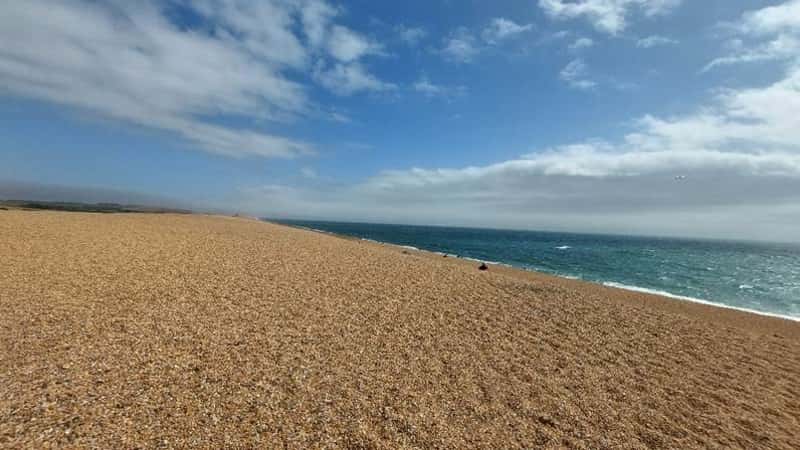
Chesil Beach carries a strong emotional charge. It is wide, ever-changing, in some stretches it’s not inviting, raw and severe, in some other it’s charming, almost exotic. The scale of the shoreline, the constant wind, and the muted palette of stone and sea create an atmosphere that feels introspective. I even had an emotional episode at West Bexington: the sun, the wind, the space were just too much. It’s the kind of place that doesn’t offer comfort, but instead amplifies thought.
It’s no coincidence that this stretch of the Dorset coast – namely the Cliffs of West Bay – became part of the visual identity of the television series Broadchurch. The bleak, wind-swept settings mirror the show’s layered storytelling, where truth is gradual, fragmented, and often uncomfortable.
How to Experience Chesil Beach
Chesil is not at all a classic beach-day destination. Swimming can be dangerous due to steep drop-offs and strong currents, and services are limited along much of its length. This is a place for walking, observing, and listening rather than lounging. Sturdy shoes are essential, especially near the pebble-heavy Portland end, and weather conditions matter: wind can be strong, and the beach is fully exposed.
You can easily spend a full day here, but Chesil also rewards longer stays if you choose to base yourself nearby for several days—there’s no risk of boredom. Access points vary, with easier entry near places like Abbotsbury and Portland. Plan your walk based on energy and conditions rather than distance alone; even a short stretch can feel physically demanding. Bring water, layers, and time—this is a landscape that asks you to move slowly and stay present.
How to Get There and Around
Chesil Beach is best reached by car. The journey takes roughly 3 to 3.5 hours from London, depending on traffic, and offers an easy transition from urban England to a much wilder coastline. The most common access points are near Portland, Abbotsbury, and West Bay, each offering a different perspective on the beach. Traveling by train is also possible: regular services run from London Waterloo to Weymouth in about 2.5 to 3 hours, followed by a short bus ride or taxi to reach the shoreline.
Food options depend largely on where you choose to access the beach. Chesil itself is largely undeveloped, which is part of its appeal, so it’s best to plan meals in nearby towns. Weymouth and Portland offer casual seaside cafés, pubs, and fish-and-chips shops, while Abbotsbury has a few well-regarded pubs and tearooms that work well after a long walk. Packing water and snacks is essential if you plan to spend several hours on the beach, as there are long stretches with no services at all.
Why it Stays with You

Chesil Beach left me with an accumulation of sensations: the shift of color and sound, the constant change in texture underfoot, the quiet presence of deep time. It’s a landscape that refuses to be reduced to a postcard or a single viewpoint. My advice is to experience it in solitude and walk alongside it for as long as you can. And if possible, return under different weather conditions—each visit will reveal a new mood, a different state of mind.