Every night for years, Yosemite staff shoved a blazing pile of bark off a cliff while crowds cheered, and Yellowstone built wooden bleachers so visitors could watch bears feed at the dump. Both were official park attractions, and both are gone.
Most people assume park rules only get stricter because visitors behave badly. The records tell a stranger story, and the biggest twist is saved for last.
#20 – The Tree You Could Drive Through
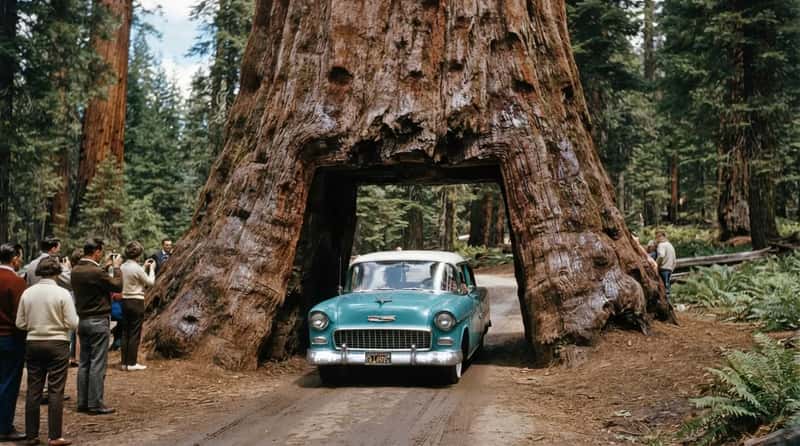
You could once steer a car straight through a living giant sequoia.
The Wawona Tunnel Tree in Yosemite’s Mariposa Grove had a passage cut through its trunk in 1881. Photos of cars in that opening became some of the most famous images of American road-trip culture.
The tree stood for nearly 90 more years, then fell in the winter of 1969 under heavy snow. Nobody in the Park Service is proposing new tunnels today.
The next rule change involved a bridge, and a very hungry fish.
#19 – Fishing From Fishing Bridge
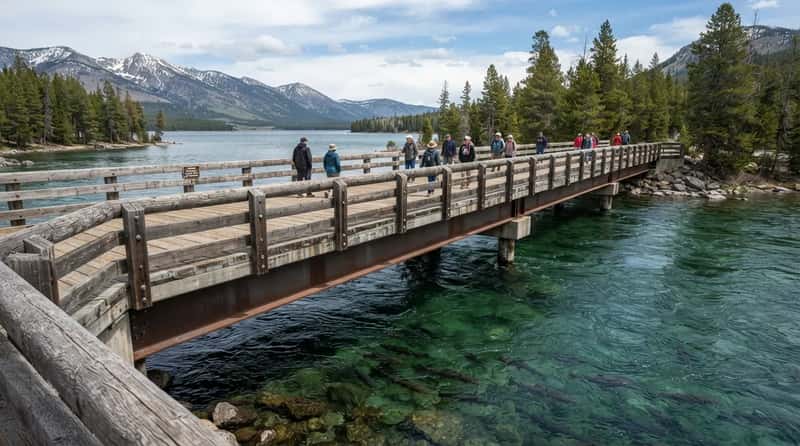
There is a bridge in Yellowstone named for fishing where fishing is not allowed.
Fishing Bridge spans the Yellowstone River where it leaves Yellowstone Lake. Anglers once lined the railings and dropped lines straight into the water below.
Fishing from the bridge has been banned since 1973. The spot is a natural gathering point for native cutthroat trout, a fish that bears and other wildlife depend on.
The cutthroat had other troubles too. Lake trout, illegally introduced into the lake and discovered in 1994, have threatened them ever since.
Fast Facts
- Location: where the Yellowstone River leaves Yellowstone Lake
- Fishing ban from the bridge: since 1973
- Fish at the center of it: native cutthroat trout
- Invader discovered in the lake: lake trout, in 1994
Some rules protect the visitor. This one protects the food chain, and the next one protects the whole forest.
#18 – Fireworks and Unlimited Campfires
That Fourth of July fireworks show in a national park? Not without special permission.
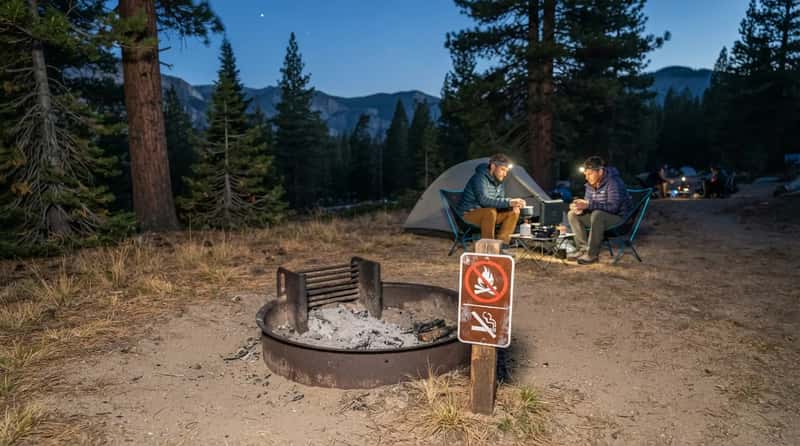
Federal park rules prohibit fireworks unless a permit is issued. Dry grass, dead timber, and one stray spark are a bad mix.
Campfire rules have tightened too. Yosemite bans campfires above 9,600 feet, and many parks restrict fires entirely during dry spells.
Now for something that roars across the water.
#17 – Jet Skis on Park Waters
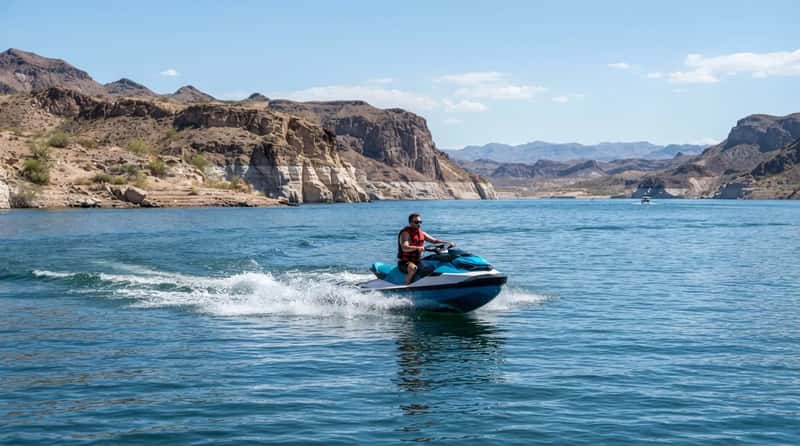
Personal watercraft quietly disappeared from most national parks.
The Park Service moved in the early 2000s to prohibit them across most units. A small number of lake and seashore areas kept access under park-specific rules.
Noise, fuel emissions, and disturbance to wildlife and other visitors drove the change. Older two-stroke engines were a big part of the concern, because they discharged unburned fuel into the water.
Lake Mead and Glen Canyon are among the places where they are still allowed.
The rules on the water were about noise. The rules in the sky were about something even bigger.
#16 – Free-for-All Air Tours
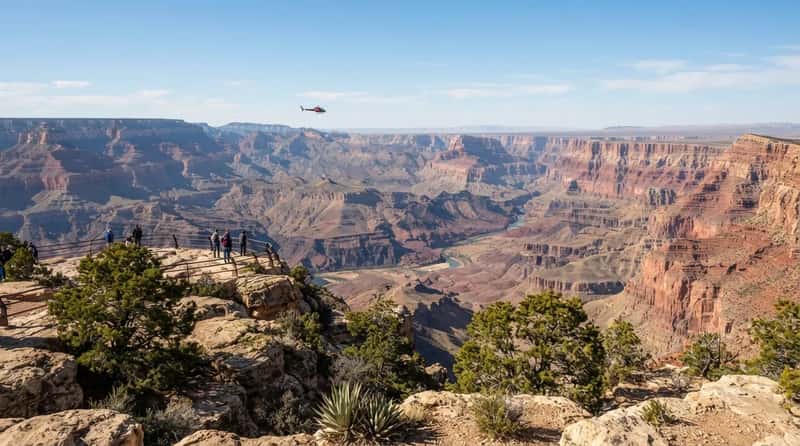
The sky above the Grand Canyon used to belong to whoever could afford a helicopter.
Congress stepped in with a 1987 law aimed at restoring natural quiet at the canyon. It set up flight-free zones and limits on sightseeing aircraft.
A later law extended air-tour management to other parks. Congress wrote quiet into federal law in 1987.
Next, a road that most visitors don’t realize they’ve lost.
#15 – Driving Your Own Car Into Zion Canyon
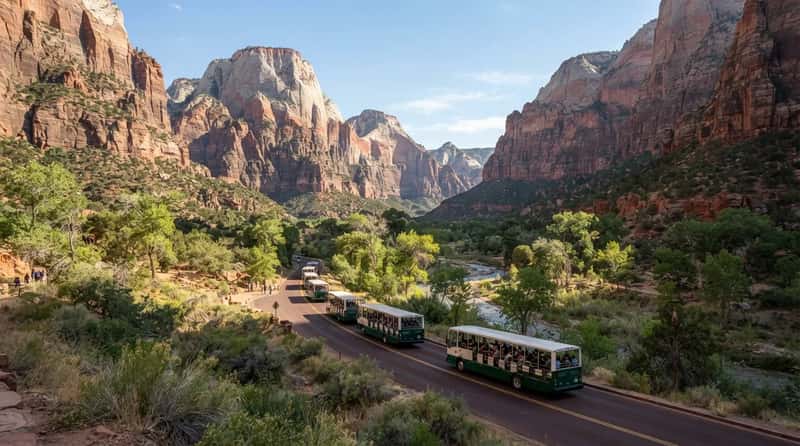
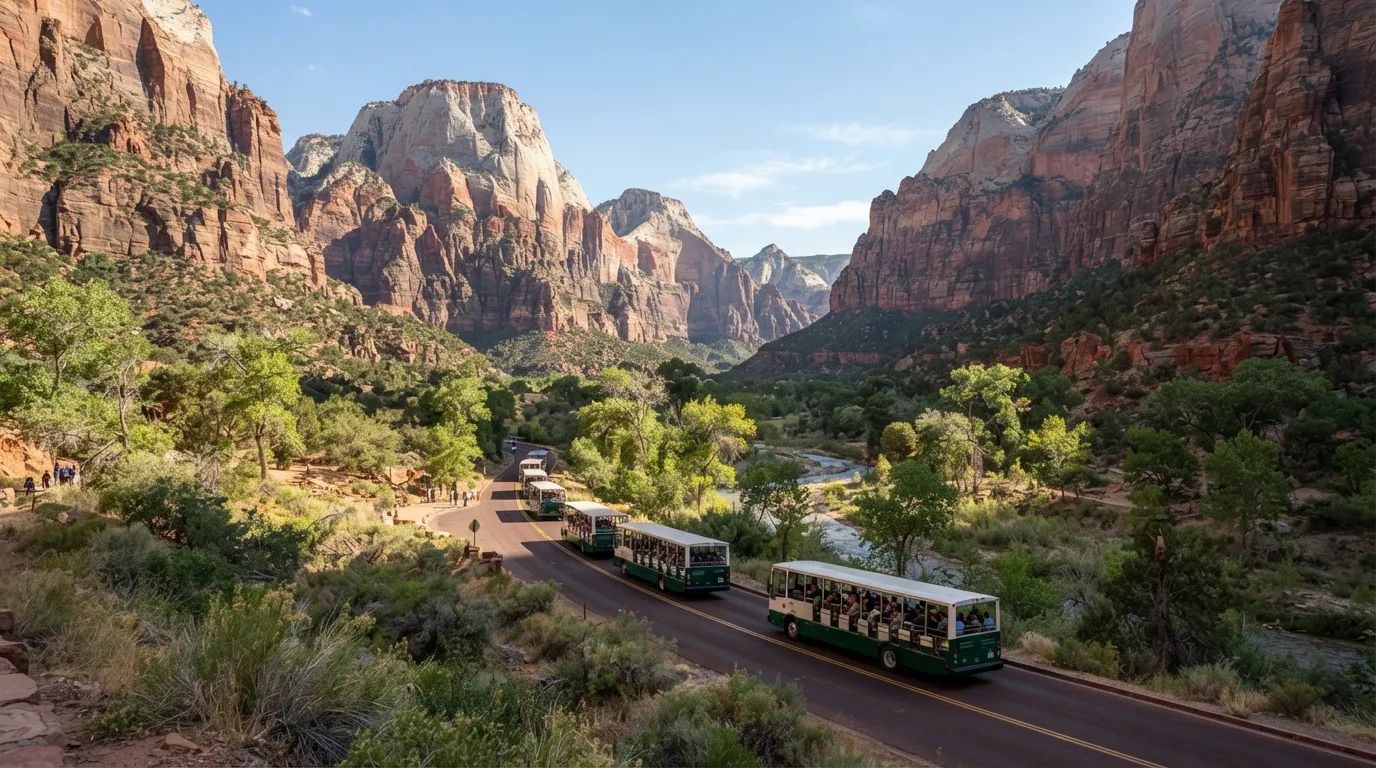
Zion Canyon looks like a scenic drive, but private cars are largely shut out.
A shuttle system started in 2000 to fix traffic that clogged the canyon road. During the busy season, visitors ride the shuttle instead of parking at trailheads.
Fans say the canyon finally feels quiet. Critics say waiting in line is a poor trade.
The parking lots inside the canyon were never going to fit the crowds.
The next ban starts with something you probably packed in your trunk.
#14 – Hauling Firewood From Home
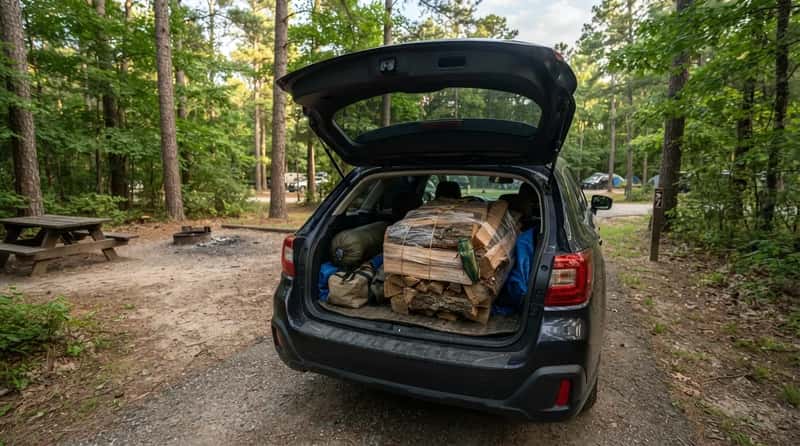
That bundle of firewood from your driveway can be a smuggler.
Invasive insects, like the emerald ash borer, can hitch rides inside cut wood. That beetle has killed tens of millions of ash trees across the country.
Many parks and states now tell campers to buy firewood near where they’ll burn it. Rules vary by park and by state.
One bundle can carry pests that kill trees for miles.
Even innocent souvenirs come with a catch.
#13 – Taking Home a Rock
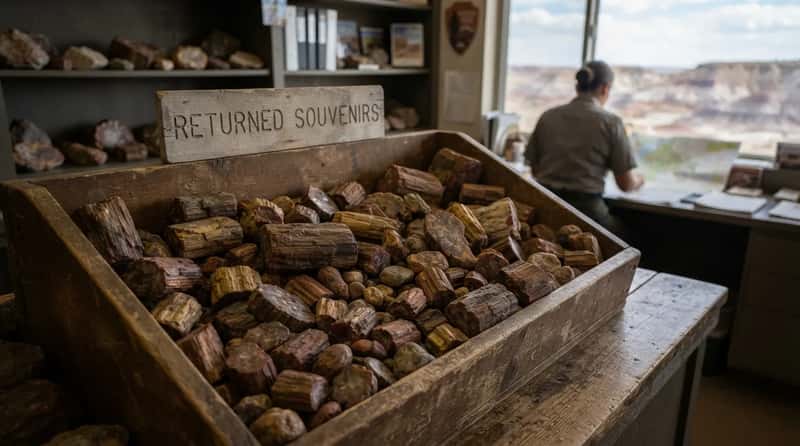
That harmless pocket souvenir is a federal problem.
Park regulations generally prohibit removing natural objects, including rocks, petrified wood, antlers, and fossils. It matters because millions of visitors each taking one rock adds up.
Places like Petrified Forest have long received pieces mailed back by visitors who felt guilty. Some of those packages arrive with letters of apology.
Rangers usually can’t tell where a returned piece came from, so it can’t simply go back to its spot. The damage is done even when the regret is real.
Guilt is one thing. The next rule is about who gets in at all.
#12 – Showing Up Without a Reservation
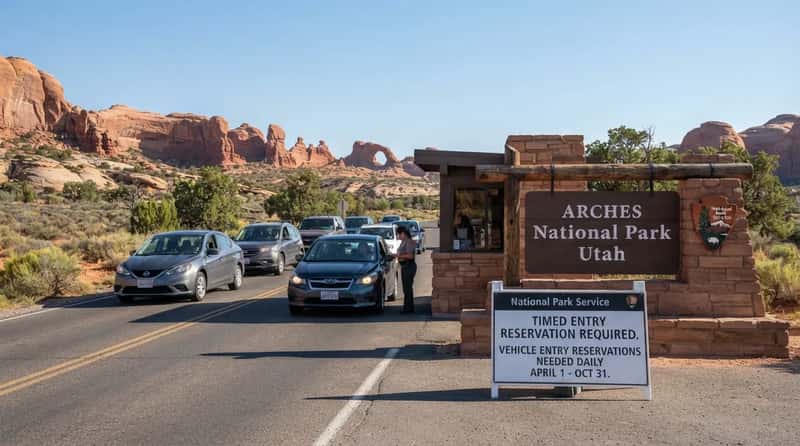
At some parks, spontaneous arrival is no longer guaranteed to work.
Several popular parks have tried timed-entry systems in recent years, including Arches, Rocky Mountain, and Yosemite at various times. The goal was to spread out crowds and cut gridlock at the gate.
Supporters say it ends hours-long lines. Critics say it shuts out road-trippers who plan nothing.
Some parks turned a drive-up visit into a booking.
The next rule affects one very loyal member of your travel party.
#11 – Dogs on the Trail
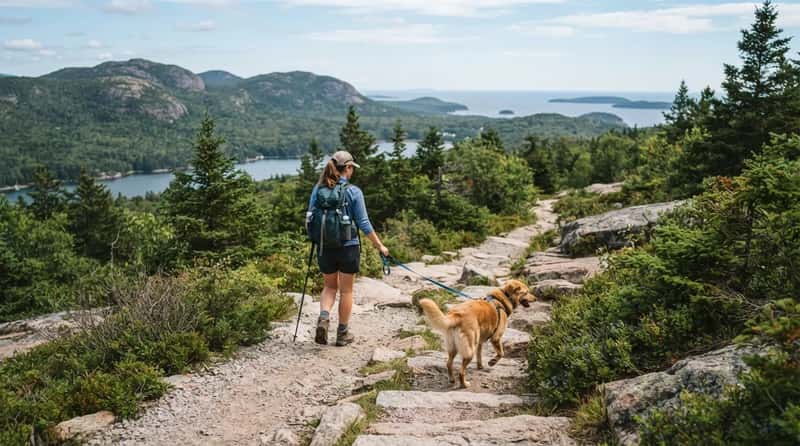
Your dog is welcome in a national park, just not on most trails.
Pets must generally be on a leash no longer than six feet. They are usually restricted to roads, parking areas, and campgrounds, with service animals as the exception.
Scent and noise can change how wildlife behaves, even when the dog is leashed. To many animals, a dog looks like a predator.
There are exceptions, though. Acadia, for one, allows leashed dogs on most of its trails.
Quick Compare
- Most parks: leash of six feet or less, with pets kept to roads, parking areas, and campgrounds
- Acadia: leashed dogs allowed on most trails
- Service animals: the standard exception to the pet limits
Wildlife rules get even tighter when you’re holding a phone.
#10 – Getting Close for the Selfie
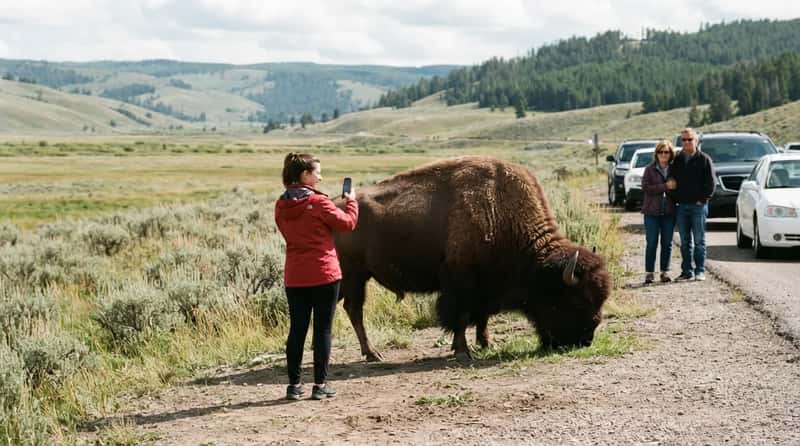
The perfect photo is now a citable offense if you get too close.
Yellowstone requires at least 25 yards from most wildlife, such as bison and elk. For bears and wolves, the distance is 100 yards.
A hundred yards is about the length of a football field. Yellowstone says bison have injured more people in the park than bears have.
Some visitors have left their mark in far more permanent ways.
#9 – Carving Your Name Into Things
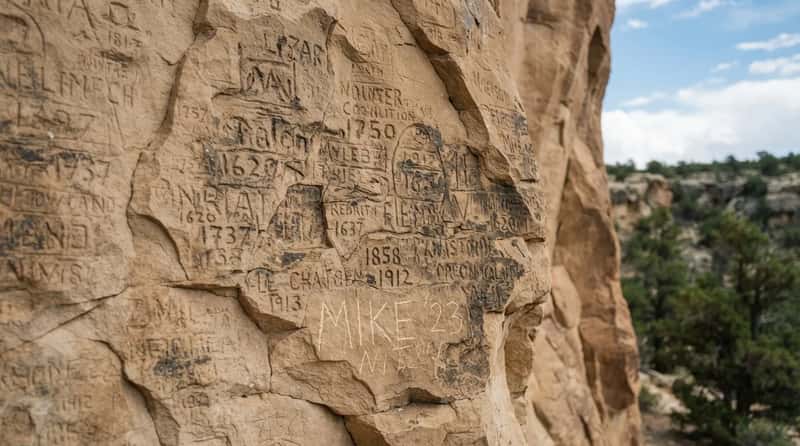
Signing your name into rock or bark used to be a tradition.
At El Morro National Monument in New Mexico, travelers carved names into Inscription Rock for centuries, some dating to 1605. Those old inscriptions are now protected as history.
Fresh ones are treated as vandalism. The same act can be a historic record or a crime, depending on the century.
Removing graffiti is costly and can damage the surface underneath.
The next rule is about what happens when you step off the boardwalk.
#8 – Swimming in Thermal Pools
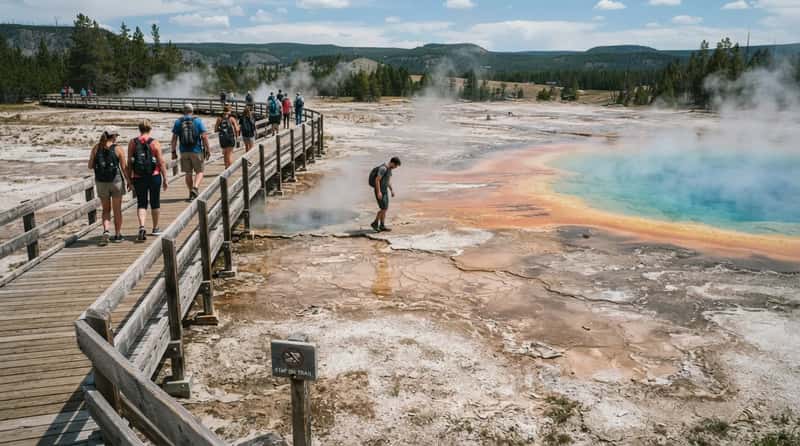
Yellowstone’s colorful pools are not swimming holes.
Park rules prohibit soaking or swimming in thermal features. Swimming is allowed only in a few designated cool-water spots.
The ground around some pools is a thin crust over scalding water. People have died after leaving the boardwalk.
The next one involves gravity and a parachute.
#7 – Jumping Off Cliffs With a Parachute
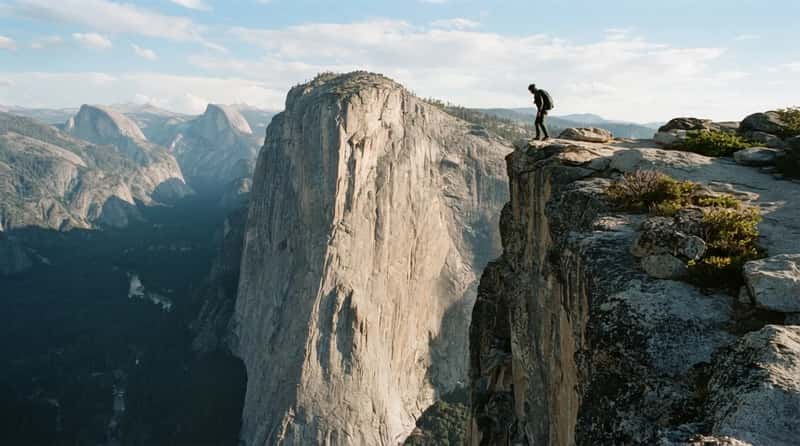
Standing on El Capitan’s edge with a parachute is against federal rules.
Some of the earliest modern BASE jumps happened off that very cliff in the 1960s. Today, park regulations prohibit delivering a person by parachute or other airborne means, except in emergencies.
Rare permitted events, like New River Gorge’s Bridge Day, are the exception. Everywhere else, it’s a citation.
Some visitors chase a different kind of thrill: buried treasure.
#6 – Treasure Hunting With a Metal Detector
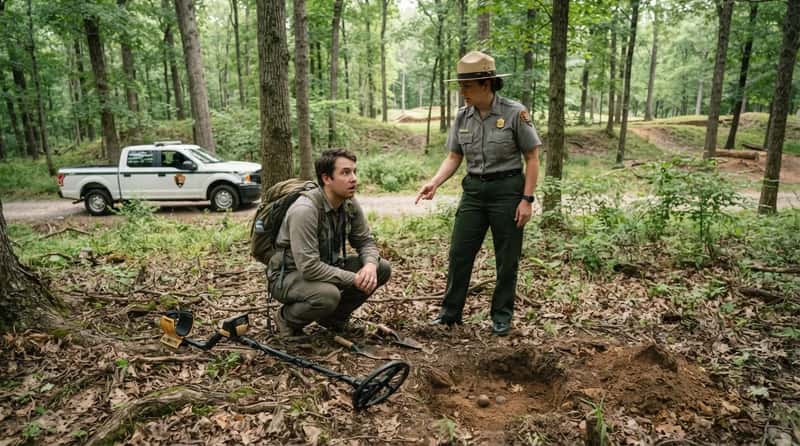
Hunting for buried relics is off the table in most park units.
Federal law, including the Archaeological Resources Protection Act of 1979, protects artifacts on public lands. That includes many battlefields managed by the Park Service.
Even picking up a single bullet at a Civil War battlefield can be a violation. Digging erases the story that the ground tells.
The next ban once looked like harmless fun, and the park itself encouraged it.
#5 – Feeding the Animals
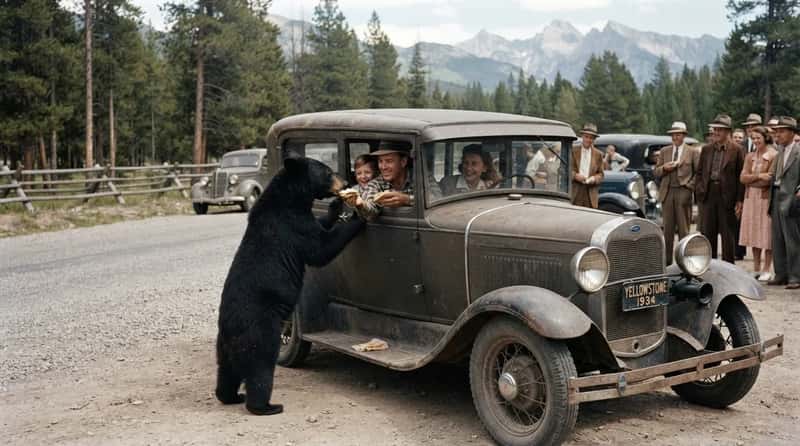
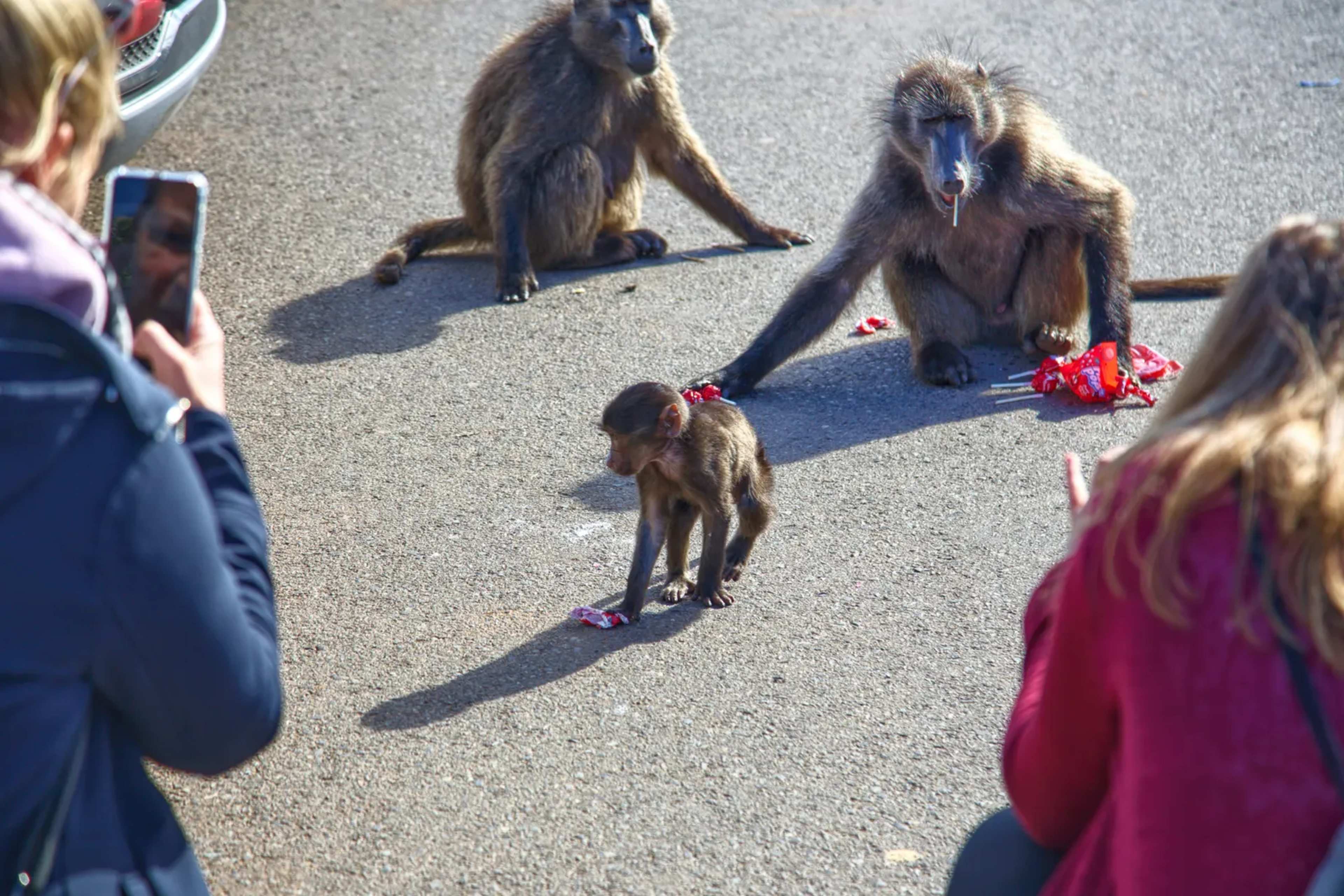
Park staff and visitors once fed wildlife as entertainment.
Yellowstone tacitly encouraged black bears that roamed the roads and “held up” cars for food. In the 1920s, the park even had a small zoo at Mammoth where visitors could meet a bear.
Bears that learned to expect handouts caused property damage and injuries, and many were killed for it. Rangers have a saying for the result: a fed bear is a dead bear.
Today, feeding wildlife is prohibited. Fed animals lose their fear of people, and that often ends badly for the animal.
Worth Knowing
- Roadside “holdups” by black bears were tolerated for years
- A small bear zoo operated at Mammoth in the 1920s
- Handouts taught bears to expect food from people
- Feeding wildlife is now prohibited in national parks
But the rulebook can also go backward, as this next one shows.
#4 – Plastic Bottle Bans (and the Twist)
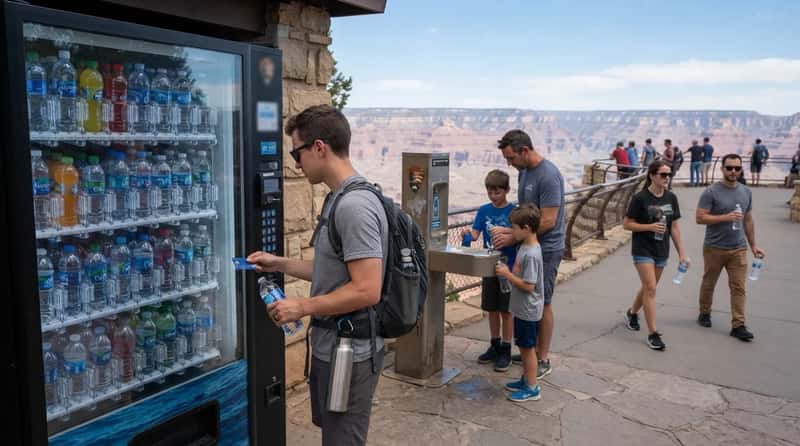
This one is different, because the ban was lifted.
A 2022 order set out to phase out single-use plastic products across the Interior Department by 2032. In May 2025, a new order rescinded it.
Interior’s rescission cited operational and logistical challenges for visitor services and procurement. A 2017 policy had already ended the park-level bottle-sale bans that a few parks, including Grand Canyon, had adopted.
Plastic is only the start. The next rule is about what’s in the sky.
#3 – Flying a Drone
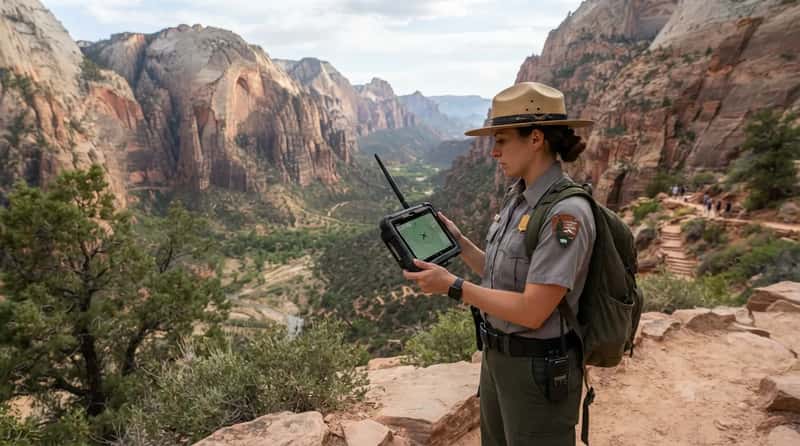
Drones went from a hobby to a federal offense in one memo.
Policy Memorandum 14-05, released in June 2014, directed superintendents to prohibit launching, landing, or operating unmanned aircraft. It followed noise complaints, safety concerns, and incidents of wildlife harassment.
At Zion, volunteers watched a drone disturb bighorn sheep, reportedly separating adults from young. One pilot who crashed a drone into Grand Prismatic Spring was reportedly ordered to pay $3,200.
Violators face fines of up to $5,000 and up to six months in jail. Launching from outside the park and flying over park land still violates the rules.
The last two bans were beloved by millions. The next one was a nightly spectacle.
#2 – The Yosemite Firefall
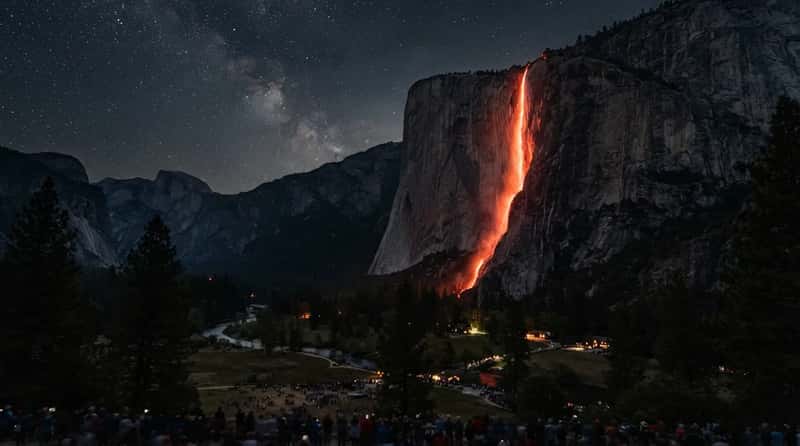
For nearly a century, Yosemite lit a fire and shoved it off a cliff on purpose.
Each night at 9 p.m., glowing embers rained down from Glacier Point. The fuel was red fir bark, chosen because it made the best embers.
In January 1968, Park Service director George Hartzog ordered it stopped because crowds trampled meadows and it was not a natural event. The last one was held without public notice, to avoid a flood of nostalgic visitors.
Even bigger changes were happening in the bear world.
#1 – Bear Shows at the Garbage Dump
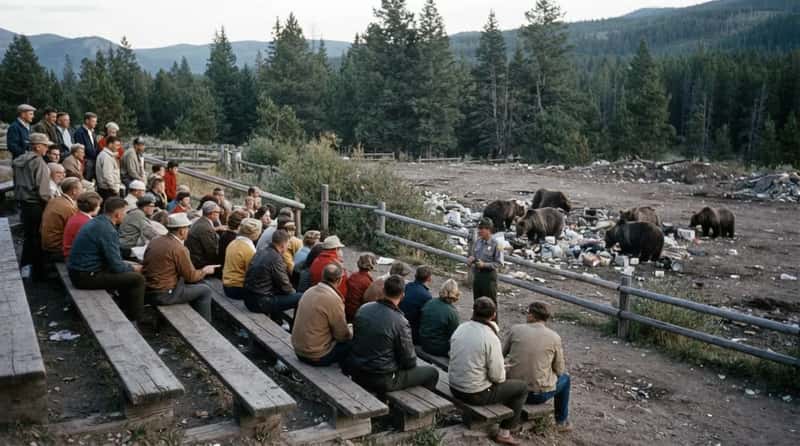
The ban that changed park management the most involved grizzlies, bleachers, and trash.
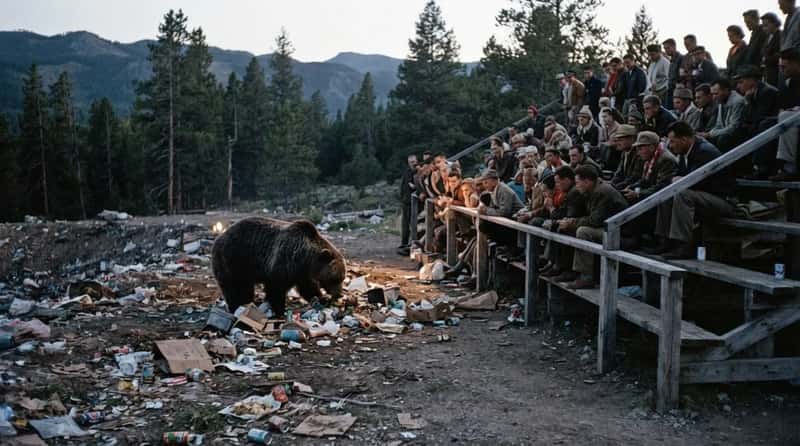
At Yellowstone’s dumps, visitors sat on wooden bleachers to watch bears feed. Rangers gave talks on bear biology while the animals ate.
Yellowstone, Yosemite, and Sequoia all had dumps or feeding grounds within walking distance of hotels and campsites. The last Yellowstone dump, Trout Creek, closed around 1970.
Park staff chose to close the dumps abruptly, while some researchers wanted a gradual phase-out. Between 1967 and 1972, at least 229 Yellowstone-area grizzlies died.
The controversy led to the formation of the Interagency Grizzly Bear Study Team in 1973. Was the abrupt closure a hard but necessary call? Scientists still debate it.
The Bottom Line
National parks didn’t stop these things at random. A new conservation ethic, growing alongside the 1964 Wilderness Act, backed away from spectacle.
Some bans, like drones, came after real incidents. Others, like the Firefall and the bear dumps, came from a change in philosophy.
The plastic rule shows that some bans can be lifted again. The most shocking one is the bear dump, where a hard decision may have cost at least 229 grizzlies.
Which of these surprised you most, and which ban would you bring back?