
Kyrgyzstan is often described as the land of mountains and yurts, an untouched landscape of dramatic mountain ranges and open pastures for horseback riding adventures. And while it is all of these things, it is also a place deeply rooted in cultural traditions and history dating back millennia. During my time there, I sought out to understand the cultural elements that make this country so unique, from the food to its nomadic practices and traditions.
Situated at the crossroads of the Silk Road, the country, alongside its fellow “Stans,” has long stood as the meeting point between East and West. It has been shaped by waves of Turkic migrations, Mongol invasions, Russian imperial rule, Soviet governance, and its cultural proximity to China.
Visiting a Museum Dedicated to the Dungan People
As I walked towards the museum in this small village in Eastern Kyrgyzstan, the building stood out immediately. It was an eclectic mix of Kyrgyz, Soviet, and Chinese architecture. Waiting outside in a large woven hat and a red embroidered silk shirt was a smiling man who greeted us with an ear-to-ear smile. On his name tag, it read: Luke Lee, museum keeper.

Inside, the modest museum told the story of the Dungan people, Chinese Muslims who were forced to flee the Qing Dynasty in the 19th century. The exhibits were simple: images of previous generations, paintings of the past heroes of the Dungan people, Russian-language texts, and family heirlooms.
They were a people caught between empires, with the borders of the Russian Empire, the Chinese Nation, the Soviet Union, and modern-day Kyrgyzstan shifting around them for centuries. He then pulled my little brother up to the front of the group, handing him symbols to play while he performed a warrior dance with a large stick as a weapon. Twirling it around, I was struck by how passionate he was about keeping his people’s stories and traditions alive.
A Dungan Meal
Standing on the dirt street outside the museum, a small child ran up to our group, waving us towards a house down the street. Our guide then explained that this was our next stop on the tour for a traditional Dungan meal. Walking into the inner courtyard, a friendly couple greeted us, and a long table filled with food awaited us. Bowls of hand-pulled noodles sat on display, accompanied by dishes of spicy broths, meats, vegetables, dumplings, and fruits.
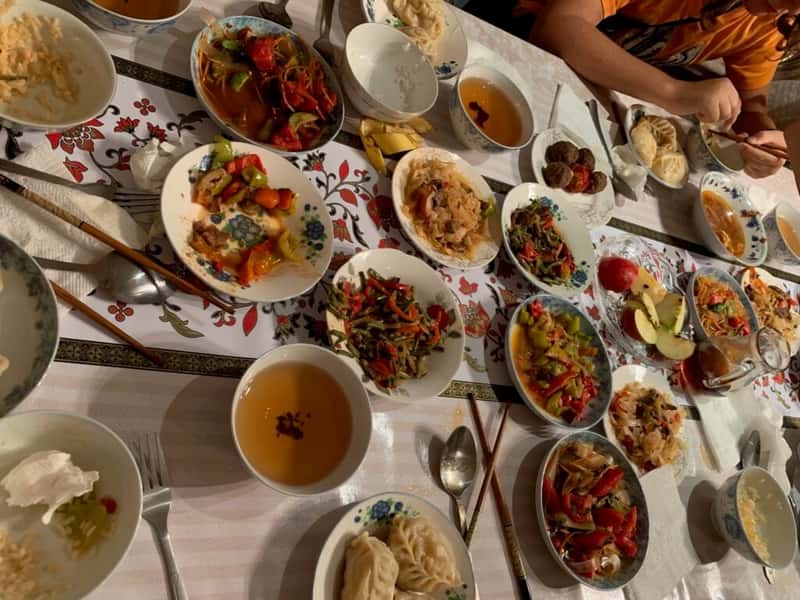
Translating for our kind hostess, our guide explained that the main dish in front of us was Ashlan Fu, a traditional Dungan dish now adopted by many across the country. Each person manually made their own bowl, selecting from the large quantity of optional ingredients. With wooden chopsticks and lots of food ahead of us, we dove into the spicy, extremely flavorful dishes. As each bowl was finished, another was brought, and our guide said, “It is customary to eat everything on the table.”
Looking around at the visitors and the host family happily communicating through hand signals, I saw a small glimpse of the lessons that travel provides and why we do what we do in the first place. Before coming to Kyrgyzstan, I couldn’t have imagined that I would be sitting in a small home in a mountain village, enjoying a meal with a group of strangers, yet here I was.
Traditional Bread Workshop
In Osh, our mission was to try as much food as possible. With numerous food tours taking place every day, we were excited to discover new flavors. Our first stop was an Uzbek bakery, where a friendly baker, with many teeth missing, waited for us. Since Osh is on the border between the two countries, many are ethnically Uzbek, a cross-cultural phenomenon seen in many nations of this region after Russia divided the countries not based on ethnic lines but on arbitrary borders.

Looking into the tandyr, the clay oven, loaves of lepeshka, the traditional bread of the area, stuck to all sides, slowly rising. One by one, we rolled the dough balls, ready to bake, learning to make slits along the sides and to create circular patterns.
Then, grabbing the palette used to place the bread in the oven and sticking it to the sides, we tried to put the bread in, with many of them falling. Though our loaves didn’t come close to the baker’s perfection, we gladly tried the delicious, doughy bread.
Pilaf Cooking Class
Our next stop in Osh was a cooking class in a traditional home, hosted by a kind family ready to show us how to make pilaf. This dish is known throughout Central Asia and Eastern Europe by various names, but its primary ingredients remain the same: fried rice, meats, nuts, and dried fruits. Watching and copying each step, we peeled potatoes, cooked the rice, and ended up creating a delicious meal rich in flavors I had never tried before.
Conclusion
While Central Asia is an ideal location for outdoor adventures, one-of-a-kind experiences await on cultural tours. These provide a new perspective on daily life in Kyrgyzstan and its surrounding countries, and, more specifically, on the delicious regional dishes worth a try.