
One of my favorite activities here in Chile is hiking, and there’s no shortage of incredible treks in the iconic Andes mountain range. When a dear friend invited me to go on a group hike in central Chile’s Maule Region, near the city of Talca, I couldn’t resist.
The plan was to make the long, four-hour car ride from Santiago in the early morning, hike a well-known trail, and then return in the evening. We were in for a physically and mentally demanding Saturday, but when I accepted the invitation, I knew it’d be worth it.
Arriving at Parque Nacional Altos de Lircay
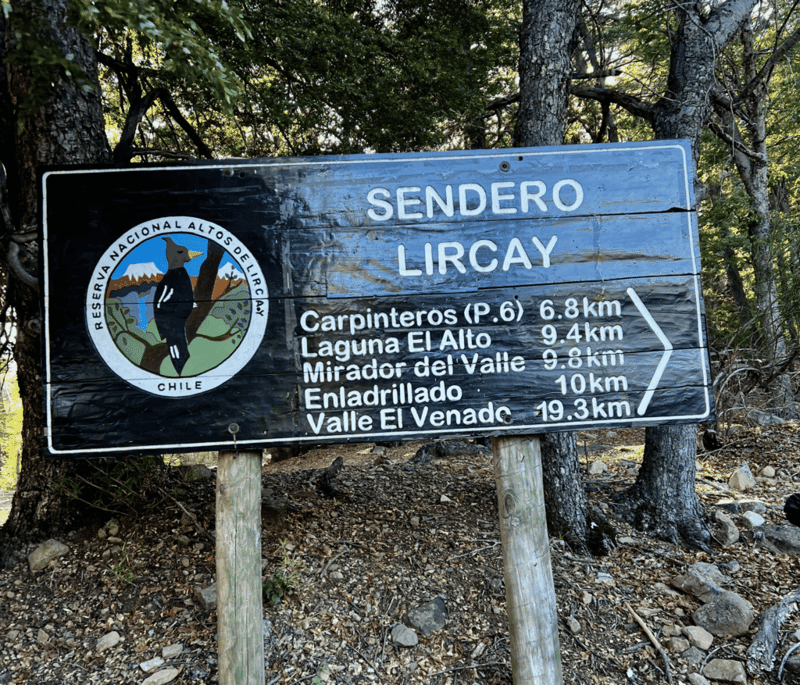
As we left in the dark and early morning hours that Saturday, I missed nearly all of the scenery between Santiago and Talca. The sun was just rising as we made it to the trailhead a bit after 7:00 a.m. I gobbled down a protein bar, put on my hiking boots, and made sure the laces were tightly tied ahead of this 22-kilometer (13.6-mile) hike that could take up to 10 hours.
And why exactly did my friend insist on going this particular weekend? Well, it was the first weekend in April, which is the beginning of the autumn season in Chile. That means all the leaves were starting to change colors—from bright green to orange and red. And apparently, the famous Enladrillado trek inside Reserva Nacional Altos de Lircay is especially stunning around that time of year.
Armed with our trekking poles, laced-up boots, and light layers, the four of us said a final goodbye to the car and went to the entrance gate. We’d secured tickets in advance, so the check-in process with the park ranger was simple. Though we were all a bit sleepy from the night of driving, starting the trail gave us a renewed sense of energy.
Walking Through the Forested Trail
As we walked through the first few kilometers of the trail, tall, thin trees stretched up into the sky around us. Walking under the forest canopy was calm and grounding, especially after another chaotic week in the huge city of Santiago. Leaves crunched beneath our boots, and birds chirped all around us. We stopped within the first hour to replace our beanies with sunhats, apply sunscreen, and don our sunglasses. Though it was technically fall, the sun felt as strong and bright as in the summer.
To my slight disappointment, most of the trees were still lime green, with only a portion already changed to yellow, bright orange, or deep red. I made a mental note to try to return to central Chile the following year for a hike in the mid or late stages of the fall, when all the leaves would be painted fall colors. But even without autumn’s full effect, the forest was magical and incredibly scenic. I gazed out at distant, oddly shaped mountain tops in the background.
As we slowly climbed in elevation, the forest thinned out, the trees shortened, and we started seeing more higher-altitude foliage. The trail isn’t particularly high in elevation; the highest point is only at about 2,200 meters (7,200 feet). Nor is the trail steep. It’s the length that gives it a moderate or high difficulty rating. And as we approached the fourth hour of hiking, we could feel the need to rest creeping in, but we pressed on.

The Plateau and Volcanic Views
Spotting occasional green lizards and giant mushrooms on the trees we passed kept us on our toes, but as we approached the last couple of kilometers of the hike, all those sights disappeared. The trail transformed into only low shrubbery and rocky surroundings, and I was sweating profusely under the high afternoon sun without any shade. Fascinating, huge volcanic rock formations sat on either side of the trail, looking almost otherworldly. And, at last, the trail flattened out into a plateau.

This broad plateau marked the finish line of our Enladrillado trek. Worn out from the lengthy trek up, we set up a little picnic on the plateau’s edge, and I enjoyed a couple of mashed ham-and-cheese sandwiches. In the distance, we could see snow-capped volcanoes, making the scenery simply breathtaking. Spread out around us on this massive field of a plateau were other friend groups and solo hikers enjoying a well-deserved lunch.
While we enjoyed our break on the plateau, my friend’s husband explained a bit about this area. The plateau, as I learned, is a natural volcanic feature formed by ancient lava flows. When I asked about the odd, rectangular stones in our surroundings, I discovered that the meaning of Enladrillado is “laid with bricks.” I thought the linear cracks in these rocks looked almost as if they’d been intentionally created by human machinery… and I heard that some people believe they’re remnants of a structure built by extraterrestrials.
Exiting the Park
Our plateau picnic had to come to an end so we could begin the descent back down to the parking lot. For another 10 kilometers (6.2 miles), we hiked and hiked. The trek down was mostly quiet, and the sun was dipping lower toward the horizon. I heard the leaves of the lenga trees rustling in a gentle breeze, and besides that, the only sounds were our feet and occasional chatter from other passing hikers.

Including the picnic, we spent a total of nearly 12 hours on the trail. By the time we reached the car, poles dragging and feet sore, it was about 8:00 p.m. It was another four hours back to Santiago, and luckily, we had a pitstop to fuel up and grab some much-needed snacks. I gingerly peeled off my sweaty wool hiking socks, revealing pink blisters beneath, and let them breathe on the long drive back while the other car passengers dozed off.
Enladrillado: Completely Worth the Blisters
All in all, this trek was among my top three day hikes in Chile so far. What made it so magical for me was the unique Andean terrain, unlike that of the areas surrounding Santiago. It would be an excellent choice for any moderately-experienced hiker in the fall or spring, when the weather is mild. And although it’s an incredibly long day, for me, the aching muscles and tender feet were entirely worth it to be able to experience the stunning volcanic views at the top.