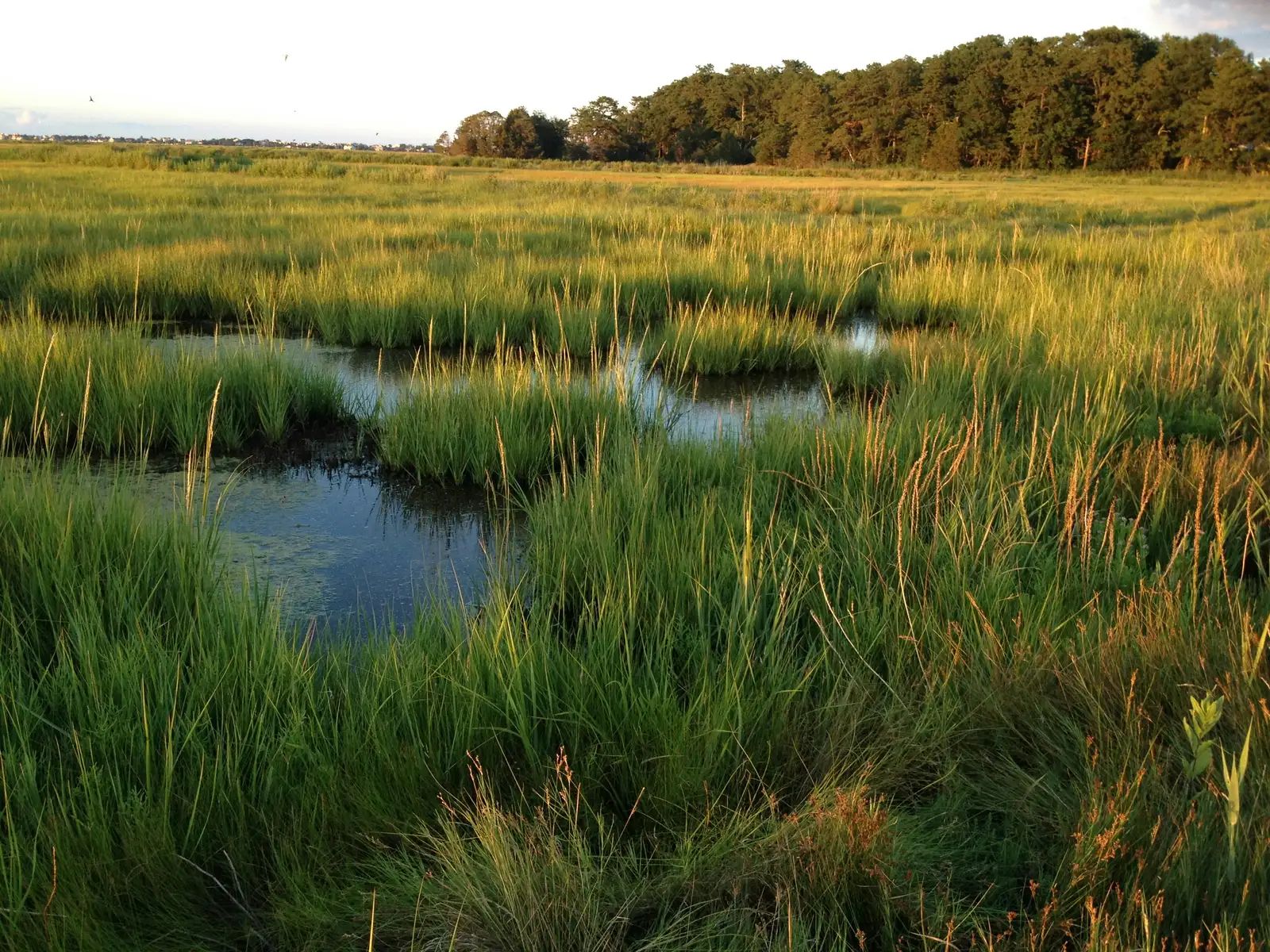
Researchers moved an entire section of living salt marsh into one of the world’s largest wave tanks to see how the ecosystem would fare under conditions that mimic the most powerful coastal storms. The experiment, detailed in a new study published in Nature, offers fresh evidence that these coastal wetlands can continue to reduce wave energy even when waves grow unusually large. The work also highlights clear limits to that protection once vegetation begins to break down. ([1])
Replicating Super-Storm Conditions at Full Scale
The team transplanted roughly 306 square meters of intact salt marsh, complete with its soil and plants, from a site in the Netherlands into the Delta Flume at Deltares. Inside the 300-meter-long facility, the marsh faced waves reaching up to two meters high and water depths of four meters – levels comparable to design conditions for major coastal defenses. The exposure lasted more than 20 hours across multiple test runs, allowing scientists to track both wave behavior and changes to the vegetation over time.
Previous laboratory studies had examined smaller waves, typically below one meter. This full-scale test pushed the system into the range of rare but damaging events with return periods of 100 or 1,000 years. By measuring wave heights before and after the marsh, the researchers could isolate how much additional reduction came from the plants themselves rather than from the elevated marsh platform alone.
Vegetation Damage and Wave Attenuation Trade-Off
At the start of each run, the marsh reduced incoming wave heights by 15 to 20 percent when waves stayed near or below one meter. As the tests continued, stems broke and biomass dropped sharply – by as much as three-quarters in some cases – causing the degree of wave damping to decline. Even so, the plants still provided measurable extra attenuation beyond what the marsh surface alone could achieve, particularly on lower-energy coasts where incoming waves remained modest.
Global modeling based on the flume data suggests that on coasts where significant wave heights stay below one meter during extreme events, vegetation can cut wave energy by 10 to 50 percent for 100-year storms. On higher-energy shores, the contribution falls below 10 percent once damage accumulates. The marsh platform itself proved remarkably stable, with almost no measurable erosion of the soil surface despite the prolonged pounding.
Implications for Coastal Planning Worldwide
The findings strengthen the case for preserving and restoring salt marshes as part of hybrid coastal defense strategies. While hard structures such as dikes remain essential, the natural damping provided by marshes could reduce the height and force of waves reaching those structures, potentially lowering maintenance costs over time. The study also underscores that protection is not uniform: benefits are greatest where wave energy is already moderate and diminish rapidly once vegetation is heavily damaged.
Lead author Pim Willemsen noted that the marsh bed held up far better than expected, with negligible surface lowering even after hours of extreme conditions. The results point to the value of maintaining healthy marsh vegetation ahead of storms, since intact plants deliver the strongest initial wave reduction. Further work is needed to understand how marshes recover between events and how restoration projects can maximize long-term resilience.