
The snowstorm that had surprised our small expedition group the previous afternoon had left a blanket of snow on the mountain that glistened in the morning sunlight.
Above us, a trail along a ridge climbed up from our camp, past a glacier, and connected to the highest camp, which would be our last stop on this journey. With some determination and luck, we’d attempt the summit the following morning. But in this section of the Andes, and at high altitude, we had no guarantee of the outcome. All we could do in that moment was establish our plan and try our best to stick to it.
Leaving Camp at 3,500 Meters
We’d left our backpacks sheltered beneath pack covers, some underneath the fly of our shared tent. Mine was a bit damp from some snow that had melted from the strong morning sun, but otherwise fine. We repacked all of our belongings, leaving behind a few unnecessary items to avoid carrying too much weight with us to the highest camp. After brushing snow off the tents, we worked together to take them down and distributed the tent components amongst ourselves.
Volcán San José, as our guides explained, is a stratovolcano, meaning there are various layers to the volcanic structure. We could see the broad upper slopes rising toward the summit plateau, but we couldn’t see the highest point of the volcano from this camp—we wouldn’t be able to see it from the high camp, either. If we made it to the top at 5,856 meters (19,213 feet), we’d have a glorious view of the surrounding mountains, including some mountaintops in Argentina, since we were so close to the Chile-Argentina border. Well-informed about what lay above us, we headed off with our heavy backpacks to the high camp.
Climbing Toward High Camp
Hiking up to the high camp, which awaited us at about 4,500 meters (14,764 feet), we trekked in our heavy double boots over snow and rocks. One steep section had just a thin layer of snow, and underneath was nothing but loose dirt and scree. Navigating this section was the trickiest part; it required a great deal of patience as each step would slide halfway back down in the scree. At one point, I made no progress for several steps due to sliding back down. The increased effort on that terrain, combined with the heavy pack and the increasing altitude, made it challenging, to say the least.
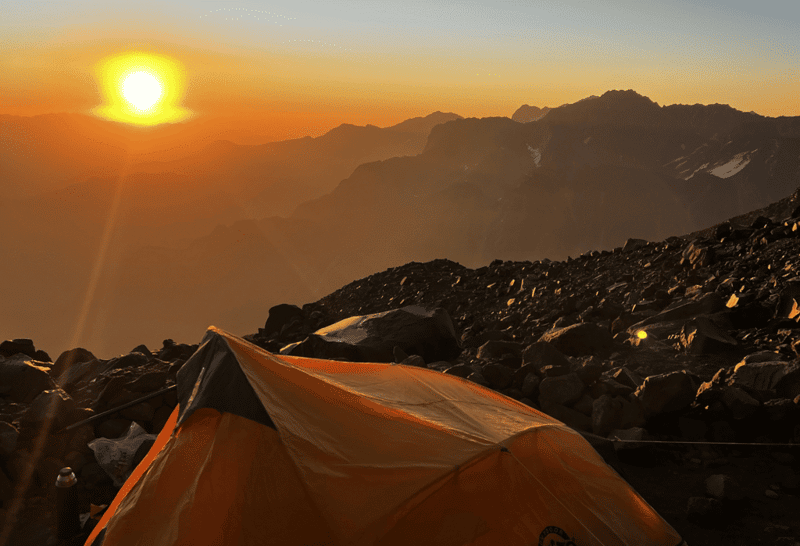
After hours of struggling and slowly climbing 1,000 meters, we finally arrived at the high camp. Fortunately, the weather had been stable so far today. There was only a slight breeze and a steady, albeit cold, temperature, and the sun continued shining brightly. After a short rest at the rocky campsite, we began unpacking and setting up our tents for the evening.
High Camp, Wind & Sleet on Summit Day
As I knew all too well before this expedition, summit days are long and require very early morning starts. A normal summit day on Volcán San José could be ten hours: about seven hours up, and three down. To avoid getting caught in afternoon storms, we had to start at around 4:00 am, which would put us back at camp at around 2:00 or 3:00 pm.
We’d eaten dinner extremely early the night before, around 6:00 pm, and tried to sleep by 8:30 pm. I had a difficult night of tossing and turning, thanks to the high altitude and the noisy wind outside. Waking up at 3:00 am was difficult and cold. We’d kept our double boots inside the tent so they didn’t freeze, although the temperature outside was a relatively warm 12°C (10°F). I’d pre-packed my backpack so it was easier to get ready in the early morning. And after a hot cup of tea (thanks to our guide) and a small breakfast, we started into the freezing night under the light of a nearly full moon and stars.
But only a couple of hours into the trek, the weather began to take a turn for the worse. First, we felt it in the wind speed. The breeze transformed into a rough wind that pushed us harder and harder, until one wind gust nearly knocked us all over. Then the precipitation started; intermittent pellets of ice at first, then a relentless onslaught of sleet that burned the thin stretch of exposed skin on my face between my goggles and buff. Our guides stopped us for a group huddle, informing us that it was too dangerous to continue the ascent. In that moment, freezing and feeling the exhaustion from the altitude, I had no energy to protest. Shuffling our feet, we turned back, starting the descent back down to our tents.
Exploring Glaciar La Engorda
The mood was a bit solemn when we reached the high camp, which was now coated in a thin layer of icy precipitation. We crawled inside our shared tent, shedding our outer layers, and started to boil some water to make tea and warm up. The disappointment among our group was obvious, but we agreed that it was always better to be safe than to continue in a high-risk situation.
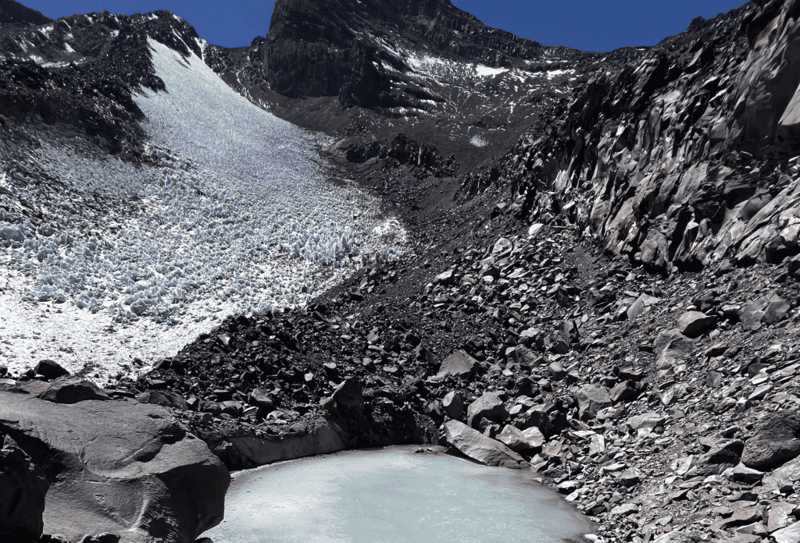
It was only about 7:30 am. We napped, and by about 11:00 am, the weather had once again cleared up, though we saw dark storm clouds on the volcano high above us. After a second breakfast, we decided to go explore the nearby glacier to make the most out of the rest of the day. And what we found was gorgeous, perhaps more rewarding than the summit would’ve been.
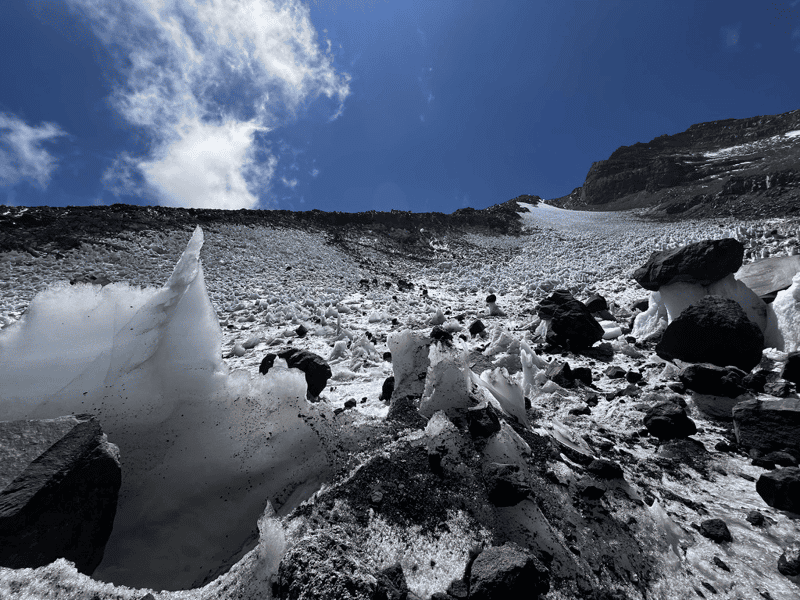
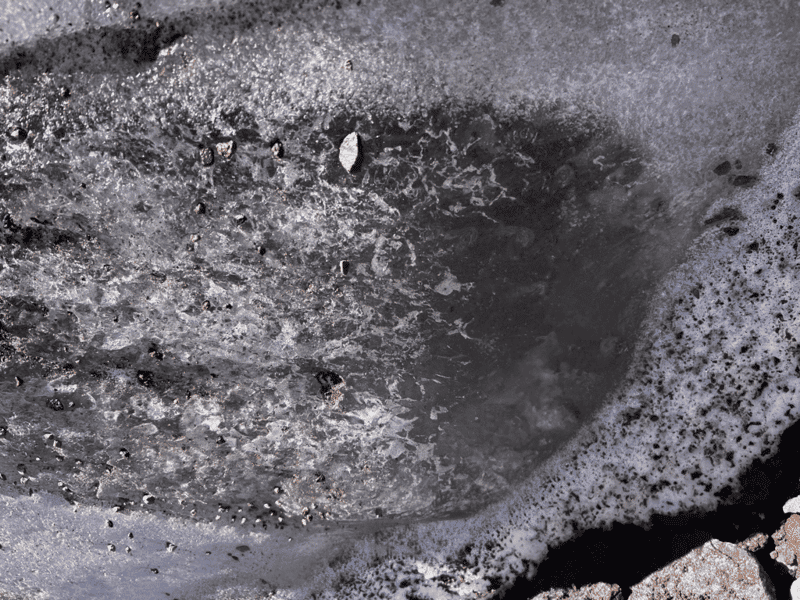
Exploring Glaciar La Engorda turned out to be the highlight of this expedition; massive boulders were held up by ice columns, and strange ice formations surrounded small glacial lakes. The glacial river running down the center of Glaciar La Engorda twinkled in the sunlight, and the sound of running water was relaxing. We filled up water bottles with this glacial water, careful not to lose our bottles in the current. After a couple of hours of admiring the breathtaking artwork of ice on the glacier, we headed back to camp for our final night before the descent the following day.
A Summit for Another Day
In the unpredictable high altitude climate of the Andes, all we can ever do is show up prepared for the best or worst. On this expedition, we came with high hopes that fizzled out in the icy, windy weather on summit day. But we walked away with peace knowing that we gave it our all, and that we still got to experience some of the profound beauty that the volcano had to offer.
Perhaps I’ll be able to attempt this iconic volcano another day, but if not, I’ve chosen to be content with how far we made it as a team on that late-summer expedition.