If I had to choose an island in the Gulf of Naples, Italy —already a concentrated display of beauty—I would choose Procida. Not because it is the most famous, nor the most spectacular in an absolute sense, but because it gave me something rare: the feeling of a place that does not stage itself to please national or international tourism.
Procida is quite small (I walked the entire island, every area of it), and its points of interest could be described as modest. It doesn’t have major museums or grand collections, and compared to Capri or Ischia—where luxury tourism is part of the landscape—it feels more contained, more understated. But that is precisely its strength. Procida is more relaxed, less crowded, free from the urgency to impress, and almost indifferent to outside visitors. And yet it has the power to surprise and enchant, through a beauty made of soft colors, dark-sand beaches, quiet views, and stories passed down through generations.
What stays with you after a few days on Procida are, above all, the stories of the people you’re lucky enough to meet. Forget the stereotypical Italy of Hollywood films: the history of Procida’s inhabitants is often a harsh and complex one. Even today, many people leave this beautiful island to pursue careers in Italy and abroad—only to return later, in most cases, to the place they still call home. It’s a story of resilience and determination that surprised me, even as an Italian, and one that genuinely moved me.
The Colors of the Marina
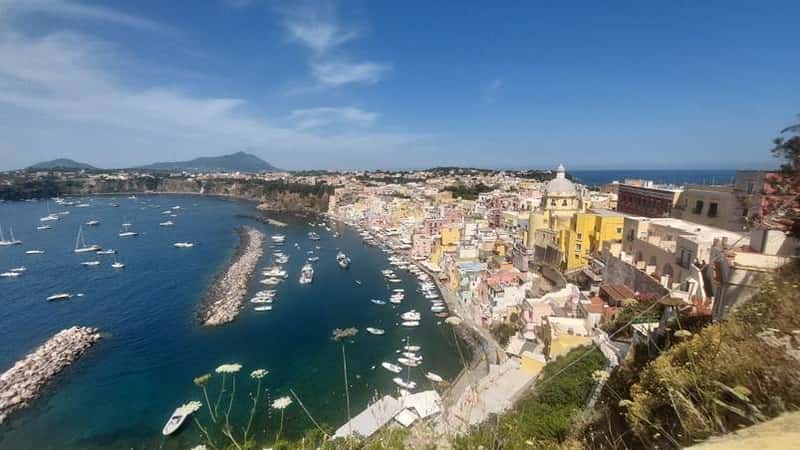
You arrive in Procida by sea, by ferry from Naples or from one of the other islands in the Gulf, and dock at the Marina. There’s no transition zone or neutral buffer: from the very first glimpse, the island strikes you with its pastel-colored houses, warm and luminous tones stacked closely together, shifting in intensity with the changing light of the day—dusty pinks, deep yellows, pale greens, salt-worn blues. Everything seems calibrated to exist in dialogue with the sea.
It took just a few steps onto the pier for me to already inside the island. To my great pleasure, Procida welcomed me by essentially ignoring me—or better absorbing me into its gentle rhythm without pressure, without sales pitches, without invitation. Along the main landing point, used daily by residents, shop owners, and commuters, you’ll find a number of restaurants and small shops that feel pleasantly calm and unforced.
The Slow Pace of Marina Corricella

I walked a lot during my three days on Procida. The roads are narrow, sidewalks slim, and small vehicles move quickly, but with a bit of attention it’s a pleasure to follow the island’s main routes on foot, reaching beaches and viewpoints along the way.
My first destination was Marina Corricella, the island’s oldest harbor and the source of its most iconic view—one that alone justifies the trip. The fortress of Terramurata, glowing at sunset, creates a sense of warmth and beauty that feels almost like an embrace. Stunning at any hour of the day, Corricella is an ancient but still fully alive neighborhood, where colorful houses sit just above the waterline, separated from the sea by a wide pier. Here you’ll see fishermen’s workshops (with real fishermen repairing nets), children playing soccer on the stone pavement, boats pulled ashore, and modern cafés and restaurants. It feels like another era, yet nothing about it is staged or artificial.
The Slow Time of Chiaia Beach
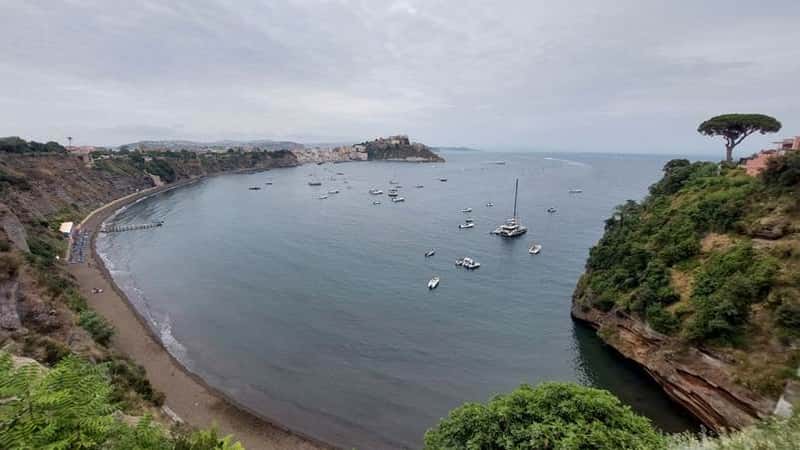
Just south of Marina Corricella, only a few minutes away on foot, lies Chiaia Beach, one of the island’s main beaches. It’s a long stretch of dark sand, protected by a rocky ridge behind it.
I walked its full length, then doubled back up to the road to reach the Elsa Morante viewpoint at the southern end. From here, the view is expansive and deeply evocative—especially for anyone familiar with the great Italian writer who lived on Procida and set one of her masterpieces, Arturo’s Island, right here.
An Open View Above Terramurata
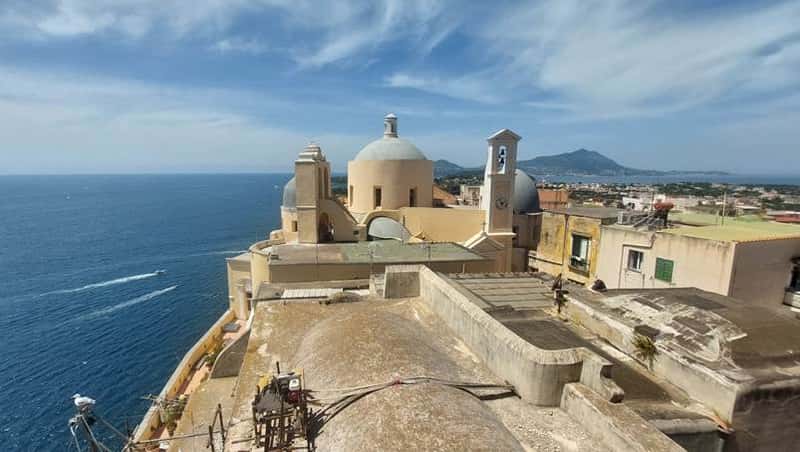
A climb up to Terramurata is essential. This ascent leads into the island’s oldest and most austere heart, where Procida reveals its historical depth. From the spectacular viewpoint, your gaze stretches across the colorful houses below and out toward the open sea, while the wind sometimes carries the sound of bells from the Abbey of San Michele Arcangelo, which dominates the village.
Nearby stands the imposing Palazzo d’Avalos, originally a noble residence, strategically positioned above the sea and the island. Today it houses a museum that recounts its transformation into a prison—one of the harshest in Italy—until its closure in 1988. For generations, the palace represented separation and confinement, leaving a deep mark on the island’s collective memory.
Crossing Toward the Green
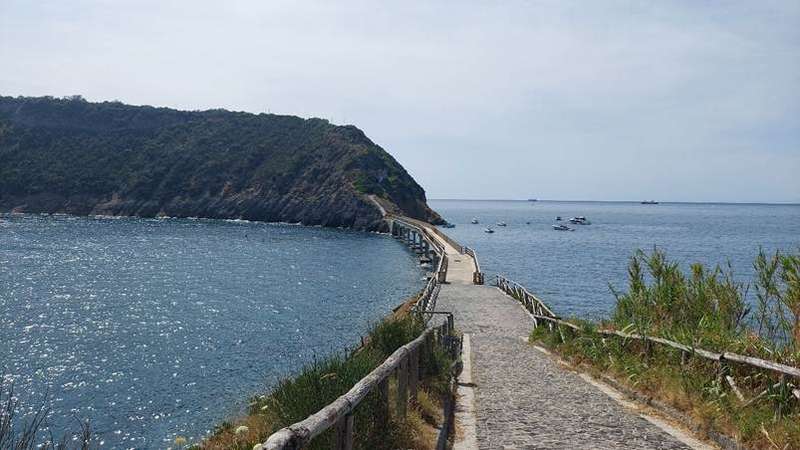
If you feel like reaching Procida’s southernmost edge, you’ll encounter its most untamed nature. The island’s southern tip leads to Vivara, a small islet designated as a protected nature reserve, connected to Procida by a narrow bridge that feels like a genuine threshold. The reserve shelters protected plant and animal species and can be visited daily by booking through the official website.
Just north of Vivara lies Chiaiolella Beach, the longest on the island—wide, bright, and more energetic than Procida’s many secluded coves.
The Sound of the Waves of Cala del Pozzo Vecchio
The place I loved most was Cala del Pozzo Vecchio, known as Postman’s Beach after scenes filmed here for the 1994 movie Il Postino (The Postman). Small and intimate, with dark sand, the beach feels deeply contained and peaceful.
What makes it truly special, however, is what lies just above it: the island’s cemetery, perched along the cliff overlooking the sea. It’s one of the most striking graveyards I’ve ever seen. Walking its paths in silence, you hear only the gentle sound of waves below and the wind moving through the trees. Few places invite respect and quiet as naturally as this one.
Why Procida Is Not a Postcard, but a Lived Place
During my days on Procida, I never once felt like tourism was the dominant force shaping the island. Instead, I felt genuinely welcomed and often invited—by locals themselves—to learn about the places I was passing through. I stopped to talk with people I met by chance: someone working in an orchard, someone opening a church, someone sitting in the shade along the road. I had imagined they had never left, and instead I heard stories of youth spent on the island, followed by years in Milan, Zurich, New York, in search of opportunity—with the intention, almost always, of returning.
Procida was named Italian Capital of Culture in 2022, bringing new attention and visibility. And yet, the island has managed to preserve its identity without losing itself. In a place like the Gulf of Naples, where excess is always a risk, that sense of balance may be Procida’s greatest achievement.