The boarding gate closes in ten minutes.
You are already online.
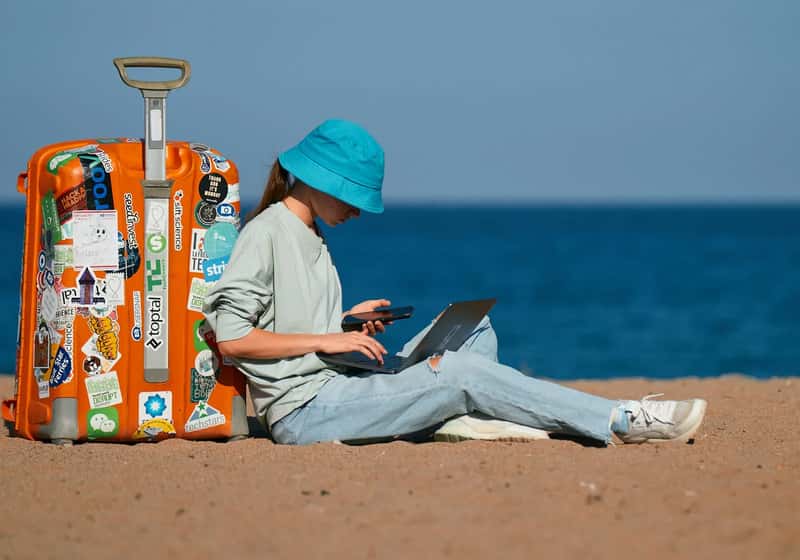
Somewhere over the Atlantic, you will answer emails.
The market in Marrakech will blur past you like a screensaver. The temples in Kyoto will become the background of a Zoom call you forgot to reschedule.
There is a word for what you are doing. It is not called freedom. It is called displacement with Wi-Fi.
The Identity Gap is the chasm between the traveler you perform on Instagram and the employee you remain at 11 PM in a rented apartment in Lisbon, still answering Slack messages, still unable to put the machine down. You packed a bag. You did not leave your job. You did not leave yourself. You simply relocated your desk to somewhere with better light.
1. The Cage Has No Lock – And That’s the Point
The cruelest prisons are the ones you choose.
One of the biggest challenges for digital nomads is that the freedom that attracted you to the lifestyle can become overwhelming without proper structures.
Without walls, you build invisible ones. The laptop becomes the perimeter. The inbox becomes the warden. You move every three weeks, but your obligations follow with perfect fidelity.
The cage is not the job. The cage is the belief that being somewhere else will eventually feel like being somewhere real.
You keep adding stamps to your passport like evidence. Evidence of what, exactly? That you were there? Or that you were trying to arrive somewhere you cannot yet name?
Location independence without clear personal or professional goals can lead to aimless wandering and existential anxiety.
The lock was never on the door. It was always on the question you refused to ask: Why can’t I put this down?
2. The Temporary Identity
Every new city offers you a clean slate. A new version of yourself. The one who wakes up early and writes. The one who learns Portuguese. The one who finally, finally, meditates.
But you bring the same browser tabs with you.
The burden of constant self-creation – having to decide who you want to be in each new place – can be liberating but also exhausting.
Identity needs friction to form. It needs the same coffee shop, the same argument with the same neighbor, the same Tuesday. Without repetition, there is no self – only performance. And performance is exhausting when there is no audience that knows your name for longer than a week.
Identity shifts happen when your sense of self isn’t anchored to a specific place, community, or routine, leading to existential questioning and confusion.
You are not becoming someone new in every city. You are becoming thinner. A version of yourself stretched across too many time zones to hold a coherent shape.
3. The Exit Strategy
Here is what nobody posts about: the laptop was the plan B that became plan A.
Most people who travel with laptops did not leave for adventure. They left for escape. Heavy financial commitments, combined with the high cost of living in western cities and the boredom associated with a 9-to-5 job, appear as obstacles that can only be overcome through a radical life change.
But a radical life change is not a flight to Bali with a carry-on and a Notion account.
The exit strategy was always about leaving something behind. The problem is you packed it. You packed the anxiety. You packed the need to be productive at all times. You packed the fear that stillness means failure.
The very freedom that attracts people to nomadic life often undermines the structures that typically support good mental health.
You didn’t escape the thing that was suffocating you. You just gave it a window seat.
4. The Always-on Frequency
There is a particular type of exhaustion that has no name in most languages.
It lives in the body of someone who has watched a sunset over the Aegean Sea while answering a Slack message marked “urgent.” It sounds like the hum of a laptop fan in a hammock. It feels like being physically present and spiritually elsewhere – simultaneously in paradise and in a conference call.
Constant connectivity means your brain never truly shifts into recovery mode. It does not matter that recovery mode now comes with a sea view.
Business travelers – and by extension, remote workers – always feel “on” when they’re traveling for work. The lines between work and personal time are blurry at best.
The frequency never changes. The scenery does. And after a while, even the scenery stops registering, because your nervous system has learned to treat every beautiful place as a backdrop, not a destination.
As you keep moving, the buzz you get from travelling to a new place starts to fade, but travel-induced stress does not.
5. The Anecdote You Recognize
I know this because I have been in a temple in Chiang Mai, photographing it for the first ten seconds and working for the next forty minutes, crouched on a stone step with bad posture and good Wi-Fi.
I convinced myself I was “integrating” work and life. What I was actually doing was allowing work to colonize every quiet moment that might have taught me something about myself.
The temple did not care. The monks did not notice. But my body noticed. My sleep noticed. The quality of my thoughts noticed – thinner, faster, more transactional.
The biggest hidden burnout trap is never fully disconnecting. Remote workers who travel sustainably set boundaries: no laptop at dinner, no email in bed, and no “quick task” during a hike.
I had no such boundaries. I had a laptop and the noble story that I was “living differently.” I was. Just not in the direction I thought.
6. The Loneliness Algorithm
You will be surrounded by people and profoundly alone. This is not a paradox. This is the math of always-moving.
Building meaningful relationships requires time and consistency. Always being the “new person” can become emotionally exhausting and prevent deep connections from forming.
The laptop fills the silence. You tell yourself it is productivity. But at 9 PM in a co-working space in Medellín, surrounded by other people behind glowing screens, what you are actually doing is avoiding the particular silence that asks: Who would call me if I disappeared for a week?
Recent surveys of digital nomads reveal that over 65% report periods of significant loneliness, while 43% have experienced depression symptoms that they attribute to their lifestyle choices.
The algorithm of loneliness is simple: the more you move, the harder it is to be known. And humans do not just need connection. They need the specific intimacy of being known over time, across moods, through ordinary Wednesdays.
7. The Nervous System That Never Lands
Your nervous system does not know it is on vacation.
Humans are wired for attachment to people and places. Constant movement can trigger anxiety in your nervous system, even when the movement is voluntary and exciting.
Every new airport is a mild threat. Every new neighborhood is an unknown variable. Every unfamiliar pillow, every different power socket, every “where is the nearest pharmacy” moment – these are small stressors that accumulate like compound interest.
Your brain finds safety in routine. When everything is constantly changing, your nervous system may remain in a subtle state of alert, contributing to anxiety and sleep issues.
And into all of this unresolved tension, you open the laptop. Because the laptop is the one constant. The one thing that behaves exactly the same in Tbilisi as it does in Tallinn. The screen doesn’t change. So you return to it like a touchstone. Like home.
That should give you pause.
8. The Productivity Theater
The laptop is a prop in a story you tell about yourself.
The story goes: I am not just traveling. I am building something. I am working. I am purposeful. I am not running away. I have a Notion board that proves it.
The blurred lines between work and personal life are a significant concern. Digital nomads need to establish clear boundaries to prevent burnout.
But productivity theater is exhausting in a way that actual rest is not. It requires constant maintenance. The appearance of output. The performance of hustle. The open tab. The visible effort.
For many people, the laptop that hosts morning meetings is the same device used for evening entertainment, creating an unbroken cycle of digital engagement that leaves little room for genuine mental rest.
You are not building something. You are managing the appearance of building something, from increasingly beautiful locations, with increasingly diminishing returns on your actual joy.
9. The Things You Leave Behind
Here is what the lifestyle influencers do not mention.
You will miss the ordinary. Not the landmarks – the ordinary. The particular way your grandmother makes coffee. The sound of your city during a rainstorm in October. The friend who knows, without explanation, that you are not okay.
If you spend a few years on the road, sooner or later you’ll start to detach from old friends and lose the familiarity and certainty of home. Basically, you can turn any place into your home, but at some point you won’t feel at home anywhere.
The laptop is not the problem. The laptop is the symptom. The problem is the belief that elsewhere is better than here. That the present moment is just a loading screen for the next destination.
Constantly being on the move, adapting to unfamiliar environments, and feeling the pressure to make the most of every destination can eventually lead to burnout.
What you leave behind is not a city. It is continuity. And continuity is the soil in which a self actually grows.
10. The Question That Changes Everything
There is only one question that matters, and it is not “where should I go next?”
It is: What am I afraid would happen if I stopped moving?
Many feel they have no right to struggle when living what others perceive as a dream lifestyle. So they don’t stop. They book another flight. They open another tab. They post another photo of another view from another rented apartment, and they call it living.
Many nomads are driven by internal resistance to corporate life, seeking to reclaim control over how and where they work. That is a noble impulse. But reclaiming control does not mean being perpetually in motion. Sometimes, reclaiming control looks like sitting still long enough for your own thoughts to catch up to your body.
The best lifestyle is the one that aligns with your values and aspirations, not the one that simply looks glamorous online.
The golden cage is not the laptop. It is the story that you need the laptop to be interesting. To be valuable. To be enough. The cage is built from that one silent fear: that without the work, without the movement, without the performance of productivity in an exotic location – there is nothing particularly remarkable about you.
There is.
But you will only find it in the moments you are too busy to check your email.
Somewhere right now, someone is watching a sunset over water – really watching it. No notifications. No open tabs. No urgent responses pending. They look slightly bored by the metrics of productivity culture, and they are the most present person within a hundred miles. They are not building a personal brand. They are building a memory. They are building, quietly and without documentation, a version of themselves that does not require an audience.
The laptop will always be there when you get back. The sunset will not. Neither will the version of you that is capable of being changed by it.
Put it down. Just once. Not to be more productive tomorrow. Not to reset and return stronger. Not as a strategy. Just to see what it feels like when the world outside the screen has your full, undivided, unmonetized attention – and whether, in that silence, you still recognize yourself.