The cabin door seals.
The signal dies.
Your screen goes dark – not by choice, but by architecture.
And then, quietly, inexplicably, you open your laptop and you work.
Not the performative kind of working you do at home, glancing sideways at your phone every four minutes. Not the shallow, scattered kind you do in coffee shops, one eye always on who just walked in. Real work. The kind that has texture and weight. The kind you forgot you were capable of.
1. The Forced Browser Reset
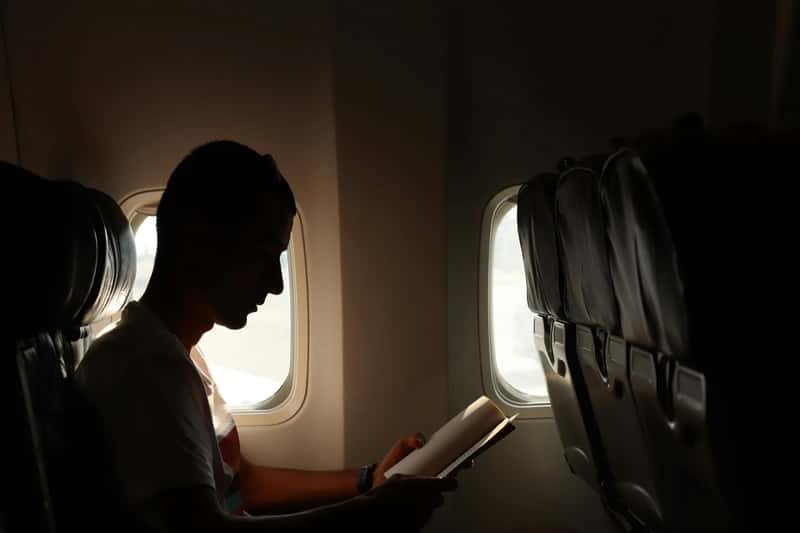
The plane is not a productivity hack. It is a forced browser reset.
When that cabin door seals, the tabs close. Not because you chose to close them. Because the environment simply will not load them.
This is the distinction that matters. Willpower didn’t do this. Architecture did.
Every productivity framework you’ve ever tried – every app, every timer, every dopamine-hack system – has asked you to resist the pull of distraction using sheer human resolve. The flight doesn’t bother asking. It simply removes the option. The infrastructure of connection, the cellular grid, the social scaffolding that holds your scattered attention in place – all of it suspends the moment you leave the ground.
What you’re left with is the raw version of yourself. No notifications to perform responsiveness for. No timelines to scroll out of social anxiety. Just the hum of the engines and the particular silence of a mind that has, for the first time in days, nowhere else to be.
That silence is not emptiness. It is capacity, suddenly available.
2. The FOMO Tax
Fear of Missing Out is not a personality flaw. It is a rational response to an irrational information environment.
Every notification is a small invoice. You pay it with a fragment of focus.
The invoices stack. Invisibly. Relentlessly.
People with greater FOMO may be more vigilant towards notifications, and because some of their attentional resources are occupied, this may result in more distractions and poorer concentration. You are not simply distracted when you glance at your phone. You are taxed. A cognitive levy is extracted from your working capital each time. And the receipts don’t show up until you land somewhere quiet enough to notice just how broke you’ve become.
In the brain, FOMO triggers the amygdala, activating a stress response when individuals feel excluded. The body treats missing out the same way it treats physical threat. You are, neurologically speaking, in a mild but chronic state of alarm when you are perpetually connected. The flight doesn’t just silence FOMO. It deactivates the alarm.
At 35,000 feet, the currency is suspended. The tax office is closed. And what remains – stripped of the levy – is pure cognitive capital, suddenly liquid and yours to spend.
3. The Open Loop Problem
Your brain is running too many tabs.
Not metaphorically. Literally. Your brain treats unfinished tasks as active obligations, keeping them partially loaded in working memory even when you’re doing something else. Every open loop – unfinished task, unmade decision, unprocessed information – creates a background drain: open loops occupy mental slots, attention fragmentation occurs as your brain periodically checks on incomplete tasks, and stress accumulates as multiple open loops create chronic low-level anxiety.
This is the Zeigarnik Effect in its darkest application. In psychology, the Zeigarnik effect postulates that people remember unfinished or interrupted tasks better than completed tasks. The practical translation: your unfinished life is shouting at you constantly. The email you meant to send. The conversation you haven’t had. The project half-started on a Tuesday afternoon three weeks ago. The constant mental “nag” of open loops uses up cognitive load – less mental space for what matters: creativity, focus, decision-making, enjoying life.
The flight doesn’t complete those tasks. Your unfinished life is shouting at you constantly. The flight silences it – not by completing the tasks, but by removing your ability to tend to them. That is a profound distinction. You are not more organized at altitude. You are simply sealed off from the noise long enough to hear yourself think.
4. The Architecture of Constraint
The most powerful productivity tool ever invented is a locked door.
The “closed loop” of the aircraft – bounded, signal-stripped, physically contained – does what no app, no timer, no motivational framework ever could. It removes the possibility of distraction at the source. Not willpower. Architecture.
The environment is doing the heavy lifting that your psychology has been failing to do for years. The bounded physical space of the cabin – the narrow seat, the fixed tray table, the total absence of exit options – creates what behavioral economists call a “commitment device.” You are, for the duration of the flight, committed. Not by choice, but by containment. The irony is stunning: the most constrained space you occupy in modern life is also the one where your mind is most free.
The average knowledge worker switches tasks every three minutes. Research shows that it takes an average of 23 minutes and 15 seconds to fully get back on track after being interrupted – a staggering cognitive tax compounded across every working day. The plane eliminates this entirely. No task-switching. No reorientation. Just the sustained depth of a mind that has, finally, been given permission to go long.
5. The Temporary Identity
I remember a flight from London to Tokyo. Fourteen hours. I had been stuck on a project for three weeks – not for lack of ideas, but for lack of mental space to let them breathe. Every time I sat down to work on the ground, something pulled me sideways. A thread. A message. A creeping sense that the world was happening somewhere I wasn’t.
Somewhere over Siberia, I wrote twelve pages without stopping.
Not because I was suddenly smarter. Not because the airplane seat was ergonomically superior to my desk. But because the version of me that exists on the ground – the one who is always half-available, always partially elsewhere – had nowhere to go. The flight had, without asking my permission, created a temporary identity. A self who existed only here. Only now. Only in this narrow aluminum tube moving through the dark at 600 miles per hour.
That self was quieter. More focused. Less afraid of what he was missing, because there was, by design, nothing to miss. That self felt, strangely, more like the person I wanted to be every day. And that recognition, sitting above the clouds with my document open and the world below moving on without me, was one of the more disorienting moments of psychological clarity I have ever experienced.
6. The Passive Scroll Tax
On the ground, you are not just distracted. You are being managed.
Passive consumption – characterized by scrolling through others’ content without interaction – has been consistently linked to greater FOMO, increased social comparison, and psychological distress.
FOMO preys on low self-esteem, loneliness, and fear of social exclusion, and it can lead to feelings of anxiety and depression. It is thought to trigger two processes: the feeling or perception that one is missing out and a compulsive desire to continually track what others are doing.
The scroll is not neutral. It is not rest. It is a form of labor – the labor of constant social comparison, of relentlessly sizing up your life against the curated highlight reels of others. The pervasive nature of digital platforms means that it’s easy to feel like everyone else is experiencing something exciting or important without you. Every swipe is a small act of self-abandonment. You leave yourself, briefly, to go inhabit the imagined life of someone else. You return slightly diminished. The plane removes this entirely. The scroll is gone. The comparison engine goes offline. And in the quiet that follows, you remember – dimly, cautiously – that you are actually here.
7. The Cognitive Unpacking
Something neurological happens when FOMO is removed from the equation.
FOMO has been associated with distractibility and reduced productivity, possibly due to the ongoing cognitive load of monitoring alternative experiences and outcomes. When that monitoring stops – when the system responsible for scanning the horizon for better options simply has no horizon to scan – the cognitive resources it was consuming are redistributed. Suddenly available for thought. For creation. For the kind of deep, slow, expensive cognitive work that produces something worth producing.
Working memory is shockingly limited. While early research suggested we can hold around 7 items in working memory, more recent research indicates the true capacity is closer to three to five chunks of information. This is the cognitive bottleneck through which all learning and complex thinking must pass.
The flight doesn’t expand your working memory. It stops stuffing it with noise. The bandwidth that was previously consumed by the low-grade anxiety of perpetual connectivity is quietly reassigned. Your mind, freed from surveillance duty, begins doing what it was actually designed to do: think clearly, connect ideas, solve problems, create.
8. The Permission Structure
Nobody texts you at 35,000 feet to ask if you saw their post.
Nobody expects you to respond.
And this – this absence of social obligation – is doing something profound. FOMO is characterized by the apprehension that others may be having more rewarding experiences and a desire to stay continually connected, with significant implications for mental health. When the mechanism that enforces that desire is removed – structurally, architecturally, without asking for your cooperation – the social anxiety that fuels your distraction has nothing to grip. It dissolves. Not because you worked through it. Because it simply has no purchase in this environment.
The plane gives you permission to be unreachable. And more than that – it gives you the excuse. There is something revealing in the fact that many people need an excuse to be unavailable. That being on a flight is a socially acceptable reason to disappear, in a way that choosing to disappear on the ground is not. The flight removes the guilt of absence. You are not ignoring anyone. You are simply in the sky. And in that guiltless space, you finally show up for yourself.
9. The Identity Alignment
There are two versions of you.
The one who lives on the ground, fractured and half-present. And the one who emerges somewhere over the Atlantic, coherent and whole.
You are not being more productive because you are on a plane. You are being more productive because you are, briefly, being more yourself.
This is the uncomfortable truth at the center of the flight-productivity phenomenon. Participants experienced FOMO as involving feelings of exclusion, disconnection, and inadequacy. However, FOMO was also perceived as an important signal of unmet needs, prompting reflection on the misalignment between one’s actual life and desired life. The flight, by silencing FOMO, also silences the signal that something in your on-ground life is misaligned. For the duration of the journey, that gap closes. You are who you want to be. Focused. Capable. Present. The dissonance disappears – not because the misalignment is resolved, but because the altitude has temporarily suspended your awareness of it.
Identity travel. The most honest kind. No destination required.
10. The Heaviest Question
The flight does not make you extraordinary. It removes the conditions that make you ordinary.
Sit with that for a moment.
The constant mental juggling not only diminishes our ability to perform effectively but also impacts our sense of satisfaction and accomplishment. Without a system to manage these loops, we run the risk of perpetually acting reactively, caught in a cycle of addressing the most immediate demands at the expense of our important goals.
The version of you who exists at altitude is not a fantasy. They are not a productivity-retreat version. They are not the “best self” of motivational posters. They are simply the version of you that emerges when the noise stops. When the ambient anxiety of infinite option and constant comparison is removed. When the architecture of your environment finally matches the architecture of your actual needs. That person wrote twelve pages. That person finished the chapter. That person sat quietly and felt, for once, like enough.
The question the flight leaves behind – the one that hums quieter than the engines but longer after you’ve landed – is not how to build yourself a faraday cage at home, or how to simulate 35,000 feet in a studio apartment. Those are fine questions, practical questions, the kind this essay has been circling. But they are not the heaviest question.
The heaviest question is this: the question the flight leaves unanswered – the one that hums quieter than the engines but longer after you’ve landed – is not how to replicate the closed-loop environment. It’s why you need a sealed cabin at 35,000 feet to feel like you have permission to be the person you actually are.
You already know who you are when the signal drops. You’ve met them. You sat next to them in a window seat over a dark ocean and watched them work with a quiet, unhurried certainty that felt, in the low blue light of the cabin, like coming home. The turbulence, when it came, didn’t bother them. They were already somewhere the noise couldn’t reach.
The landing is always the hardest part.