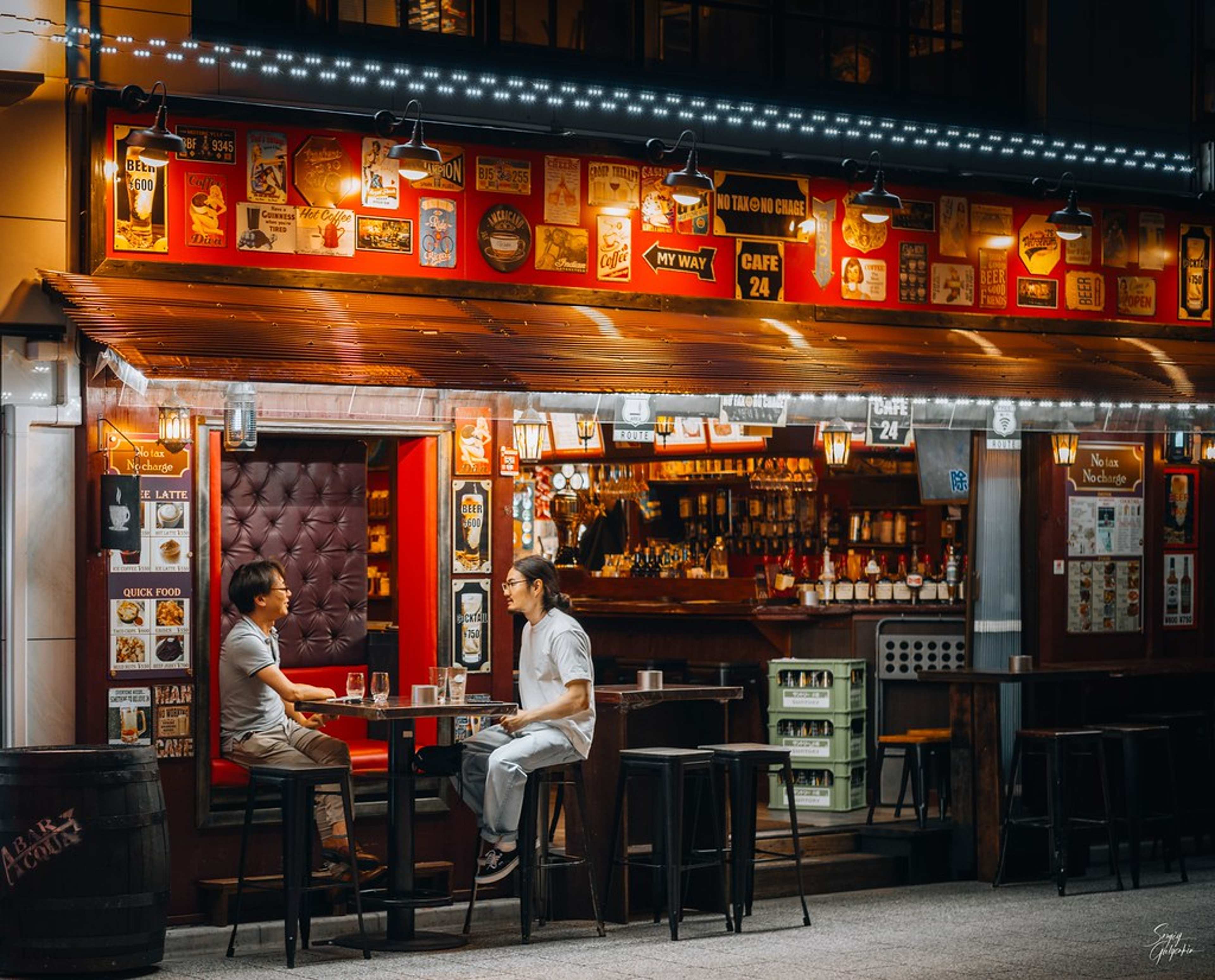
You land at 11 PM.
The city doesn’t know your name.
By midnight, you’re already researching which alley has the best noodles.
By morning, you have a list. Not for the food. For something else entirely.
There is a gap – a quiet, persistent one – between the person you perform when you travel and the person who stares at the ceiling at home not knowing who they are. The traveler is confident, informed, fluent in the local grammar of place. The person at home is uncertain, soft-edged, without a narrative to hand someone at a dinner party. Travel fills that gap, temporarily. The knowledge you hoard from every city is not about the city. It is about you. It is about the unbearable feeling of being ordinary in a place that has no record of you being otherwise.
The Knowledge Collector

You know the name of the bakery that doesn’t have a sign.
You know which metro line the locals actually use.
You know that the famous square is “only for tourists” and you would never.
This is not curiosity. Curiosity is warm and open and directionless. Research into social exchange behavior has found that knowledge and information function as a primary form of social currency – a way of facilitating conversation and, more revealingly, a way of facilitating belonging. The collector doesn’t gather facts about a place because the facts are inherently beautiful. The collector gathers them as proof of proximity. As evidence that they are not just passing through.
Every piece of insider knowledge is a small coin dropped into a jar labeled I am not a tourist. The jar is never full. It can’t be. Because the problem was never a lack of information. The problem is a persistent, gnawing suspicion that no matter how much you know, the place still doesn’t know you back.
The Outsider Doctrine
There is a long, uncomfortable tradition in how we think about who gets to know a place.
Sociologists have studied it for decades.
As groups become more self-conscious and solidary, their members tend to claim unique or privileged access to certain kinds of knowledge – and this insider doctrine carries with it the correlative claim that the outsider has a structurally imposed incapacity for access to such knowledge. The traveler on the hunt for local secrets has internalized this doctrine completely. They know, on some level, that they are the outsider. That the knowledge they are acquiring is not truly theirs. That they will always be observing the ritual from the doorway rather than standing inside the fire. And so they gather more.
A better restaurant. A more obscure market. A phrase in the local dialect spoken with just enough confidence to make someone pause. The performance is constant. The audience is themselves. And the performance, no matter how polished, doesn’t resolve the underlying question: do I actually belong anywhere?
The Social Capital Transaction
Every “did you know” is a bid.
Every “I found this place off the main street” is a negotiation.
The concept of social currency derives from Pierre Bourdieu’s social capital theory and relates to increasing one’s sense of community, granting access to information and knowledge, helping to form one’s identity, and providing status and recognition. When you deploy your carefully accumulated local knowledge at a dinner table – the name of the chef, the neighborhood nobody talks about, the festival that isn’t in any guidebook – you are not sharing. You are spending. You are cashing in a chip you earned by spending three days feeling invisible in a foreign city.
Within social groups, individuals want to feel valued and significant, and people who share information do so to get recognition from others in that group, giving themselves a feeling of significance. The transaction is clean on the surface. Underneath it is a quiet desperation. Underneath it is the question you’ve been carrying since before the flight: do these people think I am interesting enough?
The Performance of the Non-Tourist
The greatest irony of the compulsive local-knowledge seeker is this:
The harder they try not to look like a tourist, the more tourist-like they become.
Tourism, in its oldest and most honest form, is about being elsewhere. Being elsewhere means being unfamiliar. Being unfamiliar is not a flaw; it is the entire point. Meaningful travel is a psycho-social contract, shifting the traveler’s role from temporary consumer to temporary resident who seeks to understand the existing local flow. But the knowledge-as-currency traveler doesn’t want to understand the flow.
They want to be mistaken for the flow. They want someone local to look at them and see a neighbor. That will not happen. Not because they’re not interesting or intelligent or observant. But because belonging is not a credential you earn by studying for it. It is something that accumulates slowly, over years, through ordinary unremarkable days spent in the same air as other people. A week of hidden restaurants cannot replicate that. Neither can two weeks. Neither can a year of weekends.
The Anxiety Underneath the Itinerary
I remember sitting in a café in Lisbon with a notebook full of addresses.
I had the name of a tile shop in Alfama that a woman on a blog had mentioned in passing three years prior. I had a hand-drawn map to a viewpoint that wasn’t on Google. I had the exact time to arrive at a certain bakery to catch the second batch of pastéis de nata before they sold out.
I was exhausted before I left the hotel.
The notebook wasn’t a travel journal. It was a script. And the moment I lost the script – a closed café, a wrong turn – I felt a flash of something close to panic. That panic wasn’t about the café. It was about identity. Without the itinerary, I was just a person sitting in a foreign city, unremarkable, unlabeled, with no proof of sophistication on hand.
Imposter syndrome often runs as a loop: anxiety rises, the mind predicts exposure, then we do something to reduce the fear. That strategy helps short term, yet it often strengthens the belief long term. The notebook was my short-term strategy. The belief it strengthened was that I could only belong somewhere if I could prove, to a silent jury of strangers, that I had earned my presence there.
The Insider Status We Were Never Offered
Something happened to many of us at some point.
We were made to feel that we didn’t belong where we were.
Maybe it was a city we grew up in that never quite fit. Maybe it was a family that spoke a language of expectation we could never fully master. Maybe it was a series of rooms – school rooms, office rooms, living rooms – where we sat slightly to the side of the real conversation. Competence becomes identity, so the idea of slipping up feels like losing your place in the world. Travel offers a reset. A clean geography. A place where no one has the evidence of your previous ordinariness.
And so we study the new place with an intensity that is not about the place at all. We are trying to build, in a city that doesn’t know our name, the insider status that was never fully ours in the places that do. The local secrets are not secrets about the city. They are secrets we are trying to keep about ourselves.
The Hierarchy of the “Real” Traveler
There is a quiet cruelty in the travel world’s caste system.
At the bottom: the tourist. Flash photos. Guidebook restaurants. Visible confusion.
At the top: the traveler who passes.
According to tourism psychology, knowledge is the basis of changes in attitude, and the degree of knowledge mastery affects the consistency of attitude and behavior – but this “knowledge” is not objective knowledge; rather, it is an abstracted perception of knowledge that directly affects tourists’ psychology and decision-making practices. The hierarchy is built on this abstracted perception – a feeling of being more knowing, more attuned, more real than the person at the souvenir stand. But the hierarchy is a hall of mirrors.
The person at the souvenir stand is having a genuine experience. They are not trying to pass as anything. They have, in their complete absence of performance anxiety, achieved something the knowledge-collector is still chasing. They are simply there. Present. Undefended. Allowing themselves to be a stranger without making that strangeness into a wound that must be managed.
The Compulsion Loop
The research list grows before the plane lands.
Then it grows in-flight.
Then it grows in the cab from the airport.
The “Expert” type of imposter feels they need to know everything before they can act or speak with authority. The bar for “knowing enough” never quite arrives. This is the compulsion loop in its purest form, translated from the boardroom to the cobblestone street. The traveler doesn’t feel like an expert yet. Not with six restaurant names. Maybe with twelve. Maybe with the exact name of the neighborhood sub-district. Maybe if they speak a few words of the language with confidence.
The loop tightens with every new piece of information because the information is not the real target – the feeling of being enough is the real target, and the high-achievement paradox means success can reinforce rather than diminish imposter feelings, creating a cycle where achievement increases rather than decreases self-doubt. Each new address in the notebook raises the bar. You now need to know more to feel the same temporary relief you felt last time.
The City That Doesn’t Owe You Belonging
This is the hardest one to sit with.
The city does not know you are there.
The city does not care how many of its tiles you can name, which of its hills you have climbed before sunrise, or whether you bought your coffee at the place that the people who actually live there go to. Local knowledge experience can stimulate curiosity, association, and nostalgia, which may translate into place identification and attachment – enhancing a tourist’s sense of belonging and safety. But notice what that says: a sense of belonging. A feeling of belonging. Not belonging itself.
The city is not conferring citizenship upon you because you skipped the popular square. The warmth you feel in the off-the-map café is real. But it is warmth you brought with you. The city simply gave it a surface to project onto. Research suggests that a deeply authentic, self-altering experience in a foreign culture can permanently alter an individual’s self-concept, integrating a new identity into their core values. But the alteration requires authenticity. And authenticity requires dropping the performance. The performance and the transformation cannot happen simultaneously.
The Exit That Was Never About the City
At some point, most compulsive knowledge-collectors sense it.
A quiet exhaustion behind the research.
A moment – usually on a Tuesday, in a city they’ve been in long enough for the novelty to thin – when the notebook feels heavy and the café feels like every other café and the question returns, stripped of its foreign-language disguise: who am I when I am not performing being somewhere interesting?
Imposter syndrome is a psychological experience marked by persistent self-doubt, fear of being exposed as a fraud, and difficulty internalizing success – despite objective competence or achievement. Replace “success” with “presence” and you have the traveler in that café on that Tuesday. Despite objectively being somewhere remarkable. Despite having a notebook full of evidence.
Despite having ordered the coffee the right way and found the right square and earned the right to sit here. There is still a suspicion that it doesn’t count. That it will never quite count. That the counting mechanism is broken and no number of cities will fix it.
The exit, when it comes, is not dramatic. It doesn’t arrive like a revelation over a scenic overlook. It comes quietly, usually when you are too tired to perform. When you leave the notebook in the hotel room and just walk. When you eat somewhere ordinary because your feet are tired. When you sit with the discomfort of being a stranger without trying to cure it.
When you let the city be foreign and let yourself be foreign within it, two strangers sitting together in the afternoon light, neither one requiring the other to prove anything. That is the closest thing to belonging that travel can offer. Not the collected knowledge. Not the insider vocabulary. Just the willingness to be unknown, fully and without apology, in a place that owes you nothing.
Perhaps that is where the real journey was always headed – not toward knowing the city, but toward tolerating the person you are when no one, not even the city, is keeping score.