The restaurant is loud in a language you don’t own.
The plate disappears before you’re done.
Your chest tightens. Your jaw follows.
And the strangest part? You weren’t even hungry anymore.
This isn’t about food. It never was. It’s about who you are when the ground keeps shifting – when the customs are foreign, the rhythms are wrong, and every small gesture by a stranger feels like a verdict on your place in the world. The traveler who panics when the plate is cleared too soon isn’t reacting to the plate. They’re reacting to the oldest signal the nervous system knows: something that was mine is gone now, and I didn’t choose to let it go.
1. The Ownership Illusion
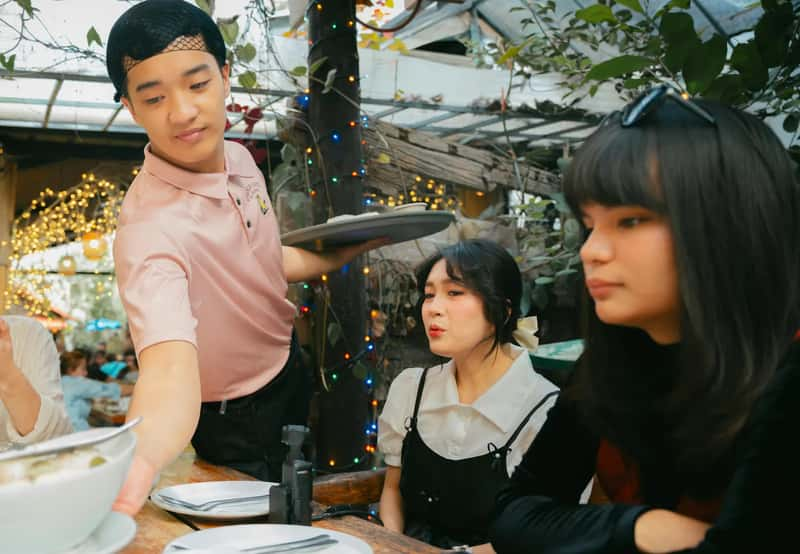
You didn’t own that plate.
You knew that.
And still – when it vanished, something in you reached for it.
Psychologists describe scarcity as a perception that what we want is in short supply or difficult to obtain. Because we cannot easily secure the thing in question, that quest preoccupies us. The object denied to us grows in importance in our minds. That’s the Ownership Illusion in motion. The plate wasn’t precious. But the moment it was taken – without your consent, without your signal – it became precious. It became a symbol.
When you travel, every object you temporarily hold becomes a tiny territory. The hotel room. The corner table. The window seat. You didn’t build any of it. But your nervous system claims it. Because in an environment where everything is unfamiliar, these small points of possession are the only coordinates you have.
The server wasn’t taking your plate. They were, without meaning to, dismantling one of your few fixed points in an unmoored world.
The panic isn’t greed. It’s navigation.
2. The Tunneling Effect
When you’re in scarcity – real or perceived – your mind narrows.
It locks onto the deficit.
It stops seeing anything else.
When you focus heavily on one thing, there is just less mind to devote to other things. Psychologists call it tunneling – as you devote more and more to dealing with scarcity, you have less and less for other things in your life. For the traveler, this tunnel doesn’t open over money or groceries. It opens over autonomy. Over the feeling that the rules here are not your rules, and you have no reliable map.
The plate leaves early. Your tunnel snaps shut around that single event. Suddenly, you can’t enjoy the wine. You can’t follow the conversation. You’re cataloguing every signal in the room, scanning for the next small loss.
This intense focus on scarcity uses up your mental bandwidth – your brain’s capacity to deal with other things. Your attention is focused on what you lack, as if you have tunnel vision. You can’t see what’s outside the tunnel, so you may neglect other needs or obligations.
You’ve disappeared inside your own alarm system.
The world outside continues, unaware.
3. The Control Transaction
Travel is, fundamentally, a long series of surrenders.
You surrender your bed. Your routine. Your language. Your food timing.
Every surrender is a transaction.
The fear of losing control is a psychological condition where anxiety or panic arises when an individual feels they are no longer in charge of their environment, emotions, thoughts, or actions. But here’s what the textbooks don’t say: for frequent travelers, this fear doesn’t arrive loudly. It doesn’t announce itself. It slips in quietly – disguised as irritation at a waiter, or a stiff body at a dinner table where you can’t control the pace.
Those who experience the fear of losing control may have a strong need for order and structure in their lives, and they may struggle with situations that feel chaotic or unpredictable. The traveler’s version of this is elegant in its deception. They look unbothered. They’ve got the linen trousers and the dog-eared Chatwin novel. But beneath the aesthetic of the seasoned wanderer, they are constantly negotiating – filing silent complaints every time the world refuses to move at their speed.
The plate is just where the negotiation breaks down.
4. The Temporal Dread
You hadn’t finished.
Not just the food – the moment.
And someone else decided it was over.
Scarcity orients the mind automatically and powerfully toward unfulfilled needs. When the plate is removed before your internal clock has wound down, something deeper than appetite gets interrupted. You were still inside the experience. The server, operating by local rhythm – faster turnover, different customs, another world entirely – has cut the scene short.
For the traveler who lives in a perpetual state of “not enough time,” this is unbearable. The context of scarcity makes you myopic – biased toward the here and now. The mind is focused on present scarcity. What surfaces isn’t really frustration at a stranger. It’s the ambient terror of a life spent accelerating – of a self that never quite arrives before the scene changes again.
The meal was supposed to be a landing.
Instead, it became another departure.
5. The Borrowed Self
I remember a dinner in Lisbon. Low-lit, tiled walls, a bottle of Vinho Verde I’d ordered with more confidence than I felt. The server came, reached across me mid-sentence, and lifted my plate with a smile and a word I didn’t understand.
I smiled back.
Inside, something rigid and cold moved through my chest.
I sat with it later. That sensation wasn’t hunger. It was the feeling of being a guest in someone else’s grammar – of performing ease in a world where I hadn’t yet learned the cues. Struggling for resources that one depends on for survival creates a deep sense of insecurity. In the face of such stressful challenges, we develop coping mechanisms and mindsets to help protect our future selves.
For constant travelers, the self becomes a borrowed costume. You assemble a version of yourself appropriate for each new context – looser in Marrakech, more formal in Tokyo, performatively relaxed in Lisbon. But underneath the costume, the original self is watching, hyperalert, ready to react when the mask slips.
When that plate goes, the mask flickers.
And for a single terrible second, you don’t know which version of yourself to be.
6. The Hoarding Instinct
You don’t think of yourself as a hoarder.
But watch what you do with the last bread roll.
Watch how you angle your glass away from the waiter’s reach.
When we believe resources are limited, it’s easy to feel envious of anyone who has “more,” and to view others’ successes as a threat to our own. Competition, hoarding, and comparison stem from this fear that what we think we need is always just out of reach. In a travel context, this hoarding instinct isn’t about bread. It’s about experience. About time. About the sense that the moments here are finite and irreplaceable, and anyone or anything that cuts them short is an adversary.
The traveler in a scarcity loop holds onto meals the way they hold onto good weather – with the white-knuckled awareness that it will not last. Because of this significance attached to them, items can carry a lot of power and meaning, and be hard to let go of. Replace “items” with “moments.” The psychology is identical.
You’re not eating.
You’re preserving.
7. The Exit Strategy Panic
Every traveler has an exit strategy.
Sometimes it’s literal – the cab booked, the next reservation confirmed.
But often it’s psychological.
When something feels scary or unpredictable, the easiest solution is to avoid it. Avoidance provides immediate relief, which reinforces the behavior – if staying home instead of going to a social gathering reduces anxiety, the brain learns that avoidance equals safety. The traveler’s paradox is that they keep moving precisely to outrun this instinct. They go, and go, and go – always arriving somewhere new before the avoidance loop can fully close.
But the plate being cleared too soon triggers the exit panic anyway. The sense of losing control can trigger an innate stress response, leading to a compelling urge to flee from situations that cause anxiety or apprehension. This response stems from feeling powerless and incapable of managing the situation.
The body says: leave.
The traveler, who has built an entire identity around leaving, suddenly has nowhere to go.
And that, precisely, is the terror.
8. The Identity Audit
Here is the question the cleared plate asks you, without words:
Who are you when you have no control over even this?
Travel strips you of your context. Your job title means nothing here. Your neighborhood, your car, your carefully curated apartment – all of it, left at the gate. Material things can be seen as intertwining with one’s identity: “It’s like our stuff defines who we are and our worth.” When the stuff is gone – when the familiar anchors are thousands of miles away – the traveler is left with only the self. And that can be the most disorienting destination of all.
More precisely, it is a manifestation of our search for identity. Who doesn’t want to belong to a group of their choosing, and in so doing take on its beliefs, standards, and forms of possession? This “artificial” scarcity is problematic for identity formation and social relationships.
The panic is the audit.
The plate is just the trigger.
What you’re really being asked is: without your things and your rhythms and your rules, what remains of you?
9. The Feedback Spiral
The anxiety doesn’t stop when the plate is gone.
It loops.
It feeds itself.
Worry is repetitive thinking that is negative and uncontrollable. A positive feedback loop ensues in which worry depletes attention, which in turn worsens worry. In the traveler’s dining room, the spiral looks like this: the plate goes, the panic rises, the panic makes you self-conscious, the self-consciousness makes you scan the room for judgment, the scanning exhausts you, the exhaustion heightens every subsequent stimulus. By the time dessert arrives, you’re not present at all.
You are somewhere between the table and the memory of a meal you feel you didn’t finish.
As one psychologist explains, “the fear isn’t so much about the situation itself but about having a panic attack in a situation where escape is impossible. The anxiety becomes about the anxiety – a classic feedback loop.”
The loop is the cage.
And most travelers don’t even know they’re in it.
10. The Arrival You Keep Postponing
Here is what no travel writer will put on the glossy page:
Some people never arrive.
Not really.
They touch down in city after city, collect the stamps, eat the meals, photograph the light. But inside, there is a permanent sense of transit – a restlessness that no destination resolves. The scarcity mindset leads us to believe that once we get to a particular place or have a certain possession, then we will feel like we are enough. But we can do the things, be the things, and acquire the things, and still, the chasing feeling never goes away.
This is the heaviest loop. The one that the early plate removal exposes in a single, ruthless instant. Because the panic isn’t just about the plate, or the moment, or the loss of control. It’s about the suspicion – quiet, persistent, devastating – that you have been chasing arrival your entire life, and that you have not yet found the place where you finally stop.
Our mindset can shape how we view the world, our resources, and ourselves. A scarcity mindset is rooted in the belief that there’s never enough, keeping us chasing what we lack. For the identity traveler, “what we lack” is not a thing. It is a feeling. The feeling of being finished. Of having had enough. Of sitting back in a chair, in a restaurant, in a foreign city, with a plate in front of you – and knowing, deeply and without anxiety, that you have arrived.
The server didn’t take the plate too early.
You arrived at the table still running.
And so the panic wasn’t about what was lost.
It was about what you haven’t yet been able to give yourself.
We talk about scarcity as if it is always about objects – about money, food, time. But the subtlest and most stubborn form of scarcity is the kind we carry in the chest, behind the sternum, just below the collarbone. It is the scarcity of permission. The permission to be done. To be enough. To let a meal end on someone else’s schedule without feeling that something essential has been stolen.
The traveler in the scarcity loop is not broken. They are, in fact, exquisitely sensitive – tuned to every frequency of loss in an environment already saturated with impermanence. That sensitivity is not a flaw. It built the itineraries. It fueled the curiosity. It got them to the table in the first place.
But at some point, the most radical act available to the chronic mover is not to book the next flight. It is to sit with an empty plate, in a restaurant that operates by rules that are not their own, and to let the moment be over – without reaching, without gripping, without grief. Just to sit there, in the quiet after the meal, and realize that nothing was taken. That they were, in fact, already full.