They close their eyes on the plane.
You’re still calculating turbulence intervals.
They’re asleep in the hotel within four minutes. The sheets are unfamiliar. The AC unit hums like a threat. You are still awake at 1:47 AM, cataloguing every sound the building makes.
There is a gap between who you are in daylight – functional, capable, mobile – and who you become the moment the lights go out in a place that isn’t yours. That gap is not a personality quirk. It is not jet lag. It is the distance between a nervous system that has learned to surrender and one that has forgotten how.
1. The Sleeping Partner as Mirror
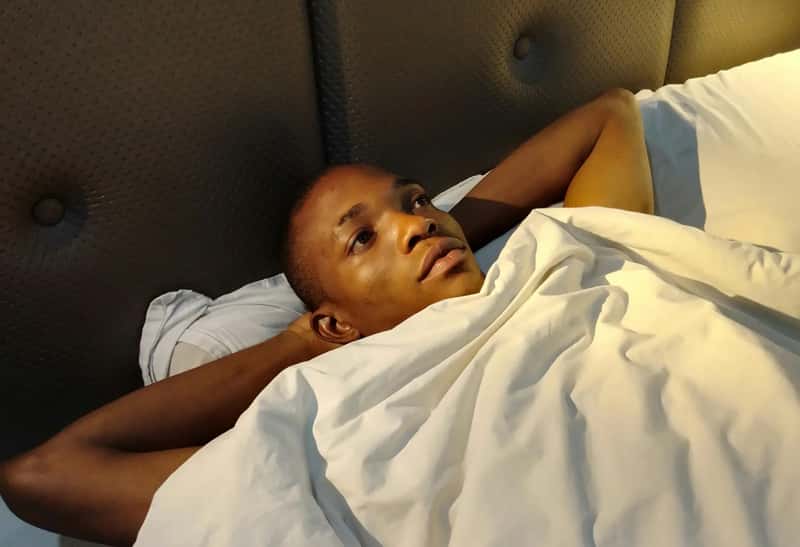
Watch them sleep.
Go ahead. Study the slow rise and fall of the chest. The loose jaw. The total, animal absence of vigilance.
Now notice what happens inside you.
Something tightens. It arrives disguised as irritation – a low-grade resentment that has no polite name. They’re so at ease. And you are not. And that difference, that gap between you in the dark, is one of the loneliest feelings modern travel can produce.
But the resentment is not really about them. It never was. Hypervigilance makes genuine connection difficult because you can’t fully relax and be present with others. When you watch your partner drift off in a strange bed and feel a flicker of quiet fury, what you are actually doing is mourning something. You are mourning the version of yourself that could once surrender like that. You are mourning your own lost ease.
The mirror doesn’t lie. It just shows you what you’ve been avoiding.
2. The Nervous System That Never Got the Memo
Your partner isn’t gifted.
Their nervous system simply received a different set of early instructions.
Hypervigilance is a heightened state of awareness and alertness. While it’s a natural response to danger, chronic hypervigilance occurs when the mind and body remain stuck in “fight or flight” mode, even in safe environments. The key word is chronic. This is not a one-night aberration. This is a system that rewired itself around uncertainty – and never fully rewired back.
When cortisol levels stay high for too long, they damage your ability to rest. Your body feels like it is running a marathon while you are trying to watch TV. This chemical imbalance is why you cannot simply “relax” on command. Your biology is working against your psychology.
Understanding this is not an excuse. It is an orientation. You are not weak. You are not a bad traveler. You are a person whose alarm system is working overtime – and has been for so long that silence feels louder than noise.
3. The Attachment Blueprint Beneath the Bedsheets
Sleep is not just biology.
It is trust made physical.
Adults with insecure attachment often experience anxiety regarding abandonment or difficulty in establishing intimacy, particularly during negative partner interactions. This insecurity is linked to hypervigilance or hyper-arousal, increasing sensitivity to environmental stimuli and resulting in non-restorative sleep. In contrast, secure attachment fosters feelings of safety and security, creating an optimal emotional environment conducive to deep, restorative sleep.
Your ability – or inability – to fall asleep in a foreign place is directly connected to what you learned about safety before you ever booked a flight. The hotel room is just the latest stage. The script was written long before check-in.
The person who sleeps anywhere learned, somewhere and somehow, that the world was safe enough to leave unguarded for eight hours. You may not have received that lesson. Or it may have been revoked.
That is the grief beneath the irritation.
4. The First Night Effect Is Real – But It Isn’t the Whole Story
Science gives us a partial alibi.
Research has long documented what is called the “first night effect” – the tendency for one hemisphere of the brain to remain in a lighter state of sleep in unfamiliar environments, acting as a night watchman. It is evolutionary. It is real. It happens to almost everyone on the first night away from home.
But here is the thing: for most people, it fades by night two.
For some of us, it doesn’t.
A trait characteristic, sleep reactivity is the degree to which stress disrupts sleep, manifesting as difficulty falling and staying asleep. Premorbid sleep reactivity has been shown to identify individuals at risk for future insomnia disorder, such as highly reactive sleepers – whose sleep systems are sensitive to stress – who are at elevated disease risk.
Your partner is low-reactivity. You may be high. That is not a moral failing. It is a nervous system signature – shaped by genetics, history, and accumulated experience. The resentment you feel is aimed at the wrong address.
5. The Night I Lay Awake in Room 412
I will tell you something.
There was a hotel room in a city I won’t name. Room 412. My partner was asleep within minutes, face pressed into a pillow that smelled of someone else’s laundry detergent. I lay flat on my back, eyes open, listening to the ice machine two doors down. Then the elevator. Then a conversation I couldn’t make out. Then silence – which was somehow worse.
I did not feel tired. I felt surveilled. I felt like something was wrong, even though I knew objectively that nothing was wrong. The ceiling was neutral. The room was ordinary.
What I didn’t understand then – what I understand now – is that I wasn’t afraid of Room 412. The traumatic memory “teaches” the brain to expect danger, so the alarm system remains triggered long after the trauma. I was carrying every unfamiliar room I’d ever been unable to trust. Room 412 was just the current address of an old fear.
The real grief was watching someone I loved sleep soundly inside a world I still couldn’t make safe.
6. The Identity of the Light Sleeper
We build identities around our limitations.
You’ve probably told this story at dinner parties. “I’m a terrible sleeper.” “I can’t sleep anywhere but my own bed.” “I’m just a light sleeper.” You say it with a shrug, like it’s a charming quirk – the same register you’d use to confess that you hate cilantro.
But listen to what you’re actually saying.
You’re saying: I have incorporated my hypervigilance into my selfhood.
Many people with hypervigilance don’t see their reactions as intense or unwarranted – in fact, they may feel their actions are necessary to maintain safety and security – but when hypervigilance is getting in the way of them being able to do day-to-day activities and live their life as they want to, it’s something that needs to be addressed.
The “light sleeper” identity is protective. It explains the behavior without exposing the wound. It keeps the real question – when did I stop trusting the world enough to close my eyes in it? – at a comfortable distance.
Identity is the last armor to come off.
7. The Unfair Math of Comparison
Comparison in the dark is a particular kind of cruelty.
You are not just watching your partner sleep. You are performing a real-time audit of everything they have that you do not. Ease. Stillness. An uncomplicated relationship with unconsciousness. And the audit generates a bill you can’t pay in a currency you don’t possess.
Missing out on quality sleep over time not only makes couples feel more pessimistic about their relationship but also exacerbates feelings of anger and diminishes gratitude towards their partner.
This is the insidious arithmetic of sleep inequality in a relationship. Your sleeplessness makes you more irritable. Your irritability makes you less generous toward your partner’s ease. Your lack of generosity generates resentment. And the resentment keeps you awake.
The math circles back on itself until 3 AM becomes its own ecosystem – populated only by you, the ceiling, and your worst interpretations of everything.
8. What “Sleep Anywhere” Actually Signals
Let’s be precise about what your partner’s ability represents.
It is not casual. It is not nothing. The capacity to release consciousness in an unknown environment is, at its neurological root, a profound act of trust. The nervous system exits vigilance not through willpower but through accumulating signals of safety.
Their signals have accumulated. Somewhere in their history, the world gave them enough consistent evidence that lowering the guard was survivable. Maybe even pleasant.
Recovery requires a conscious effort to build safety in your personal environment. You have to convince your brain that it is “allowed” to be vulnerable at home.
What you are witnessing in your sleeping partner is not passive luck. It is the compounded interest of accumulated safety signals. And what you feel when you watch them is not petty jealousy.
It is the recognition of something you once had, or perhaps never had, and now desperately want back.
9. The Relationship Between Control and Surrender
Here is the paradox nobody tells you.
The harder you try to sleep, the less likely you are to sleep.
This is why effort backfires. Trying harder to sleep engages prefrontal problem-solving regions that need to disengage for sleep onset. Sleep is, by neurological design, a surrender. And surrender requires something that hypervigilance has spent years dismantling: the belief that you can stop watching.
What appears on the surface as sleeplessness is often a system that has learned to equate stillness with vulnerability.
This is the psychological core of the whole phenomenon. You are not afraid of the hotel room. You are afraid of the moment you stop monitoring it. You are afraid of what happens when you stop being the last line of defense against a threat you can no longer quite name.
Your partner isn’t braver. Their threat-assessment system simply filed a different report.
10. The Mourning Beneath the Resentment
This is the heaviest truth.
Resentment is grief wearing a cheaper coat.
When you lie awake watching your partner sleep – jaw unclenched, breath slow, body fully committed to the permission of rest – you are not experiencing envy in the conventional sense. Beyond material loss, individuals may experience a sudden collapse in perceived safety and autonomy. Common psychological responses include hypervigilance, intrusive memories, avoidance, distrust, anger, and persistent self-blame. These reactions reflect disruption to core psychological needs for safety and control.
Somewhere, at some point, your sense of safety was disrupted. Maybe dramatically. Maybe so incrementally you couldn’t name the moment it left. And the person sleeping beside you – oblivious, peaceful, mouth slightly open – is a living proof of what an undisrupted nervous system looks like.
That proof is unbearable. Not because of who they are. But because of what they remind you that you have lost.
Understanding hyperarousal through a nervous-system lens can be deeply validating. It reframes symptoms not as personal failure, but as adaptive responses that need support and recalibration. You are not broken. You are responding, with extraordinary fidelity, to a history that taught you the world was unreliable after dark. Your hypervigilance was once your most loyal protector. It kept watch when no one else would. The only problem is that it never learned to clock out.
Healing does not require forgetting what happened. It requires restoring regulation, agency, and a sense of safety within the body and the mind. That process is not quick. It is not linear. It does not happen because you bought a better pillow or downloaded a white noise app. It happens slowly, in small moments of accumulated trust – in rooms, in relationships, in your own body at 3 AM when you notice, for the first time in a long time, that the silence might actually be safe.
The resentment was never really about them sleeping.
It was about you, remembering – however faintly, however painfully – what it once felt like to rest.