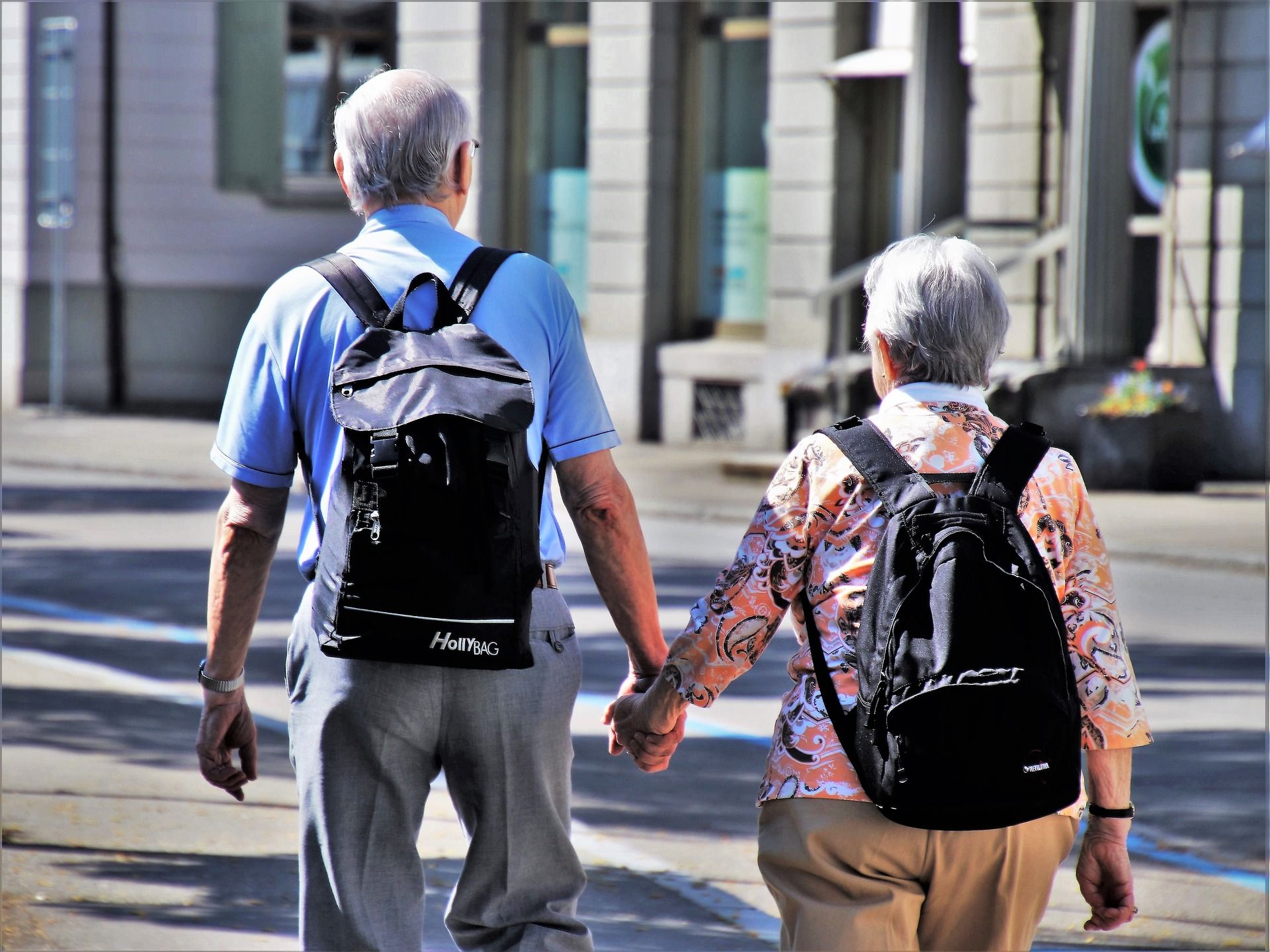
You see them before you register what you’re seeing.
Two people. Old. Slow. His hand. Her hand. Knitted together like something that was never meant to come apart.
And something in your chest drops. Not softly. Like a stone through still water.
You tell yourself it’s the light. The cobblestones. The romance of being somewhere foreign and therefore beautiful. But the light has nothing to do with it.
The truth is more uncomfortable than jet lag and more honest than the wine you’re drinking alone at a table for one. What you are feeling is not admiration. It is not envy in the ordinary sense. It is a very specific, very personal grief – the grief of witnessing something you were never given. A map of permanence you never learned to read.
The Grief That Has No Name
We have a word for missing people who have died. We have a word for missing places. But we have no clean word for missing a stability you never had in the first place.
That is what hits you in the square.
You are not mourning a relationship. You are mourning the architecture of a life that was never built for you. For those who grew up in instability, this yearning may be compounded by a profound sense of loss – for the opportunities, relationships, or experiences that were stolen or disrupted. Whether it’s the loss of a carefree childhood, a sense of safety and security, or the chance to form healthy attachments, nostalgia can serve as a poignant reminder of what was taken away.
And that couple – those two strangers holding hands across sixty years of shared history – they are the reminder standing right there in the open air, asking nothing of you, and costing you everything.
The grief is real. The grief is yours. The grief is not irrational.
It is, in fact, the most honest thing you will feel all week.
The Temporary Identity
Every new city offers you a new character to play.
In Lisbon, you are contemplative. In Tokyo, you are disciplined. In Buenos Aires, you are passionate in a way you never quite manage back home.
The traveler’s identity is, by design, provisional. When taking up life in a foreign country, many feel a loss of identity when the need for belonging to a new group of people arises – and as we are all social beings in need of social interaction to thrive, it always does. At some point, often after the initial honeymoon phase, we realize that what used to be a matter of certainty no longer is.
This is the seduction of travel. You can be anyone. The problem is that “anyone” includes no one in particular.
The old couple in the square did not get to be anyone. They had to be themselves – the same selves, stubbornly, repeatedly, for decades. And somewhere in that stubborn sameness grew something that looks, from across a cobblestone plaza, like peace.
You are watching what commitment to a single self looks like from the outside.
It looks like held hands.
The Exit Strategy
The chronic traveler often has a departure date booked before they’ve fully arrived.
It is a psychological hedge. A pre-emptive goodbye. If you leave before a place can disappoint you, the place never gets the chance.
The loss of a familiar environment can be as distressing as the loss of a person, leading to homesickness, nostalgia, and a profound sense of diminished belonging. The loss of one’s habitual social or occupational role during travel can also lead to a feeling of rootlessness and lost identity.
But here is the dark irony: the exit strategy protects you from nothing. The rootlessness travels with you. It is in your carry-on.
Every square in every city is populated by people who stayed. Who chose the difficulty of depth over the ease of surface. The couple holding hands stayed. They stayed through arguments about money and who forgot to call the doctor and the years when the love felt more like furniture than fire.
They stayed.
And that staying – that unglamorous, unsexy, profoundly human act of staying – is exactly what your perpetual departure has been quietly mourning all along.
The Attachment Blueprint
You did not invent your relationship with impermanence. It was handed to you.
Attachment theory tells us that the patterns established in our earliest years become the operating system for every relationship that follows. A person’s attachment type is a crucial factor in the generation of nostalgia, as it influences whether or not a person would seek the support of interpersonal bonds in the face of distress. There are three proposed attachment types: secure attachment, anxious attachment, and avoidant attachment.
The avoidant traveler keeps moving because stillness feels like danger.
The anxious traveler keeps moving because they are convinced that the next place will finally be the one where they feel at home.
Both of them end up in the same foreign square. Both of them see the same couple. Both of them feel the same cold thing move through their chest.
Nostalgia often taps into a yearning for a sense of safety, security, and comfort that may have been lacking during our formative years. Trauma can disrupt the development of secure attachment bonds and distort perceptions of trust and safety. As a result, nostalgic feelings may be imbued with a deep longing to recapture moments of warmth or connection that were scarce in the individual’s past.
What you are grieving is the blueprint you never received.
The Beautiful Wound
I was in Porto, sitting at the edge of a tiled plaza, and I saw them.
He had a cane. She had a red coat. They moved with the slowness of people who have nowhere urgent to be and the confidence of people who have been navigating each other’s rhythms for long enough that the navigation has become unconscious.
I remember setting down my coffee.
I remember the quality of the ache.
It wasn’t romantic longing. It wasn’t loneliness, exactly. It was something older and more structural – like catching a glimpse of a house you were supposed to grow up in but never did, through a car window, in the rain, too briefly to be sure you really saw it.
Nostalgia can be positive, imbued with a rosy glow of familiarity and belongingness. On the other hand, it can be negative, accompanied by longing, loss, and frustrated desire. Nostalgia often melds both positive and negative experiences.
That is the wound the square opens. It is beautiful because it is evidence that you still know what you are missing. You have not gone numb. You are still capable of recognizing the shape of the thing you never had.
That recognition is not weakness. It is the most intact part of you.
The Performed Self
The modern traveler has learned to perform contentment with extraordinary skill.
The caption says: Wandering and wondering. The reality is: wandering and avoiding.
Immigration and perpetual movement are more than a change of address – they are a fundamental shift in almost every aspect of life. You’re not just learning a new language or adapting to different customs; you’re negotiating who you are when everything familiar has been left behind.
The performed self is exhausting to maintain. It requires a constant supply of new audiences. The moment you stay somewhere long enough for people to see past the performance, the performance begins to crack.
Which is why, paradoxically, many people who claim to love connection keep moving before real connection can form.
The couple in the square has seen each other’s cracks. All of them. For decades. And they are still holding hands.
That is what the performance was always trying to earn and never could.
The Envy We Won’t Admit
There is a very specific kind of envy that attaches itself to people who appear to have what we were never given.
It is not the clean envy of wanting someone else’s shoes or salary. It is something rawer. Seeing friends, family, and sometimes complete strangers engage in life with their loved ones instantly tears open our hearts. It is a natural response to watch someone holding hands and feel that instant stabbing of envy – the overwhelming emotion of all the times we longed to do the exact same things.
Because envy is culturally shamed, very few people are willing to acknowledge it to themselves, much less admit it to others. It has become a lost and forgotten stage of grief.
And this is grief. It qualifies. You are mourning something real.
You are mourning the version of your life in which you also got to learn how to stay. In which someone modeled for you what sustained love looks like from the inside. In which you did not have to cross an ocean to feel the full weight of what you never had.
Naming the envy does not make it shameful. It makes it survivable.
The Identity Gap
There is a version of you that exists only in transit.
Alert. Self-sufficient. Romantic about difficulty. Fluent in the language of departure.
And there is another version – quieter, older in the way that matters – who watches an old couple in a square and goes very still.
Culture, place, and belonging sustain identity. When these elements lose presence, the individual continues functioning – yet something essential begins to loosen.
The gap between who we are in motion and who we are when we stop – that is where the grief lives. That gap is the distance between the identity we perform for new cities and the identity that was never fully formed because the ground was always shifting beneath it.
When individuals reflect on cherished memories, they often find a sense of continuity and purpose in their lives. This retrospective contemplation helps integrate past experiences with the present, fostering a coherent life narrative that supports a stable identity.
The couple in the square has a coherent life narrative. You are still assembling yours from collected fragments of places and selves.
Both conditions are human. Only one of them breaks your heart in a foreign plaza on a Tuesday afternoon.
The Belonging You Carried Without Knowing
Here is the thing no one tells the chronic traveler.
You have not failed to belong. You have been belonging, quietly and imperfectly, to the community of people who also could not stay still. Who also learned early that stillness was not always safe. Who also looked at other people’s ordinary lives and felt that specific, nameless ache.
Belonging is a fundamental human need, and cultural identity is often a key element in fostering that sense of belonging. Feeling connected to a group – whether it’s a family, a cultural community, or a nation – provides individuals with emotional support and psychological security. When people feel like they belong, they experience lower levels of stress and anxiety and are more likely to report higher levels of life satisfaction.
You have been belonging to your own grief. Accompanying it through airports and rented rooms and foreign squares. Refusing to abandon it even when abandonment would have been easier.
That is a form of faithfulness. It is not the kind that ends up holding hands in the sun at eighty. But it is yours. And it is not nothing.
The Heaviest Truth
The old couple is not the point.
They are only a mirror.
What you see when you look at them is not their life. It is the outline of the life you were not given the conditions to build – the blueprint that went missing somewhere between an unstable childhood and the first passport stamp and every carefully planned exit that followed.
The discrepancy between the idyllic version of the past and the painful truths of our upbringing can intensify feelings of loss, longing, and disappointment. But it can also, if you let it, intensify your understanding of what you actually want. Not more stamps in a passport. Not a better angle for the photograph. But something that holds. Something that is still there in the morning. Something that knows your name in more than one language.
Nostalgia connects your past self to your present self – “I was the kind of person who had that experience. I still am that person.” This continuity is psychologically stabilizing, especially during times of uncertainty or change. Looking back at travel experiences helps extract meaning. And looking at two people holding hands in a foreign square can extract meaning too, if you are willing to sit with the discomfort long enough to hear what it is actually saying.
It is saying: you know what you were missing. You have always known. That knowledge did not come from the square. The square just gave it a face.
The grief will pass. The plaza will empty. You will order another coffee or you will walk away into the crooked streets of a city that does not know your history.
But something will have shifted. Not dramatically. Just a quiet millimeter in the direction of honesty.
And maybe that is where the building begins – not in the square, not in the held hands, not in someone else’s sixty-year story – but in the willingness to stand still long enough to grieve the thing you deserved and never received, and to understand, finally, that the grief itself is proof you are still capable of wanting it.