You are standing at a kiosk in a city whose name you still mispronounce.
The headline in front of you is in a script you cannot decode.
You buy it anyway.
You fold it under your arm like it belongs there. Like you belong there.
Travelling alone removes external influences and expectations. Every decision, big or small, comes from your own preferences. This clarity helps surface who you are when you are not performing a role or responding to others’ expectations. You buy newspapers you cannot read because the act of holding the unreadable is itself a form of humility. A gesture that says: there is more to this world than my comprehension of it. And that more – that vast, ink-smelling, headline-screaming more – is the most beautiful thing I have ever tried to hold.
1. The Ritual Seeker
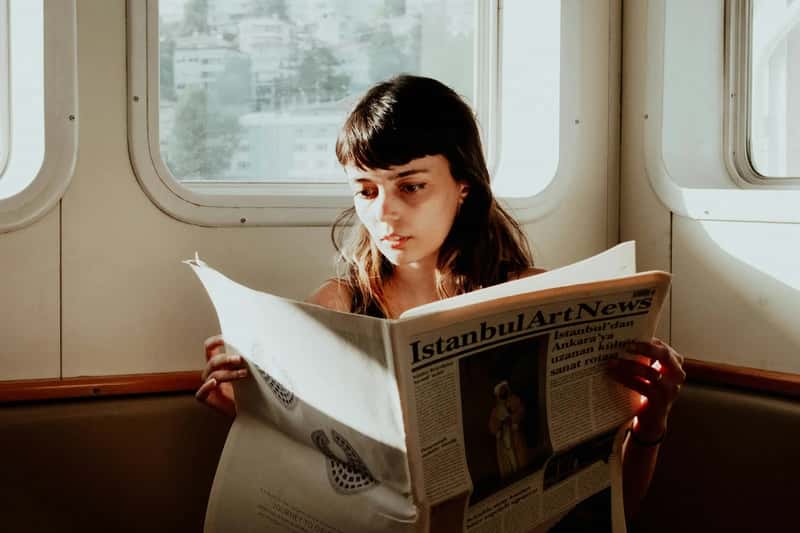
You buy the newspaper because it is a ceremony.
Not information. Ceremony.
Professor James Carey argued that reading a newspaper was like attending mass. When you attend mass, you may not learn anything new. For Carey, it was “a situation in which nothing new is learned but in which a particular view of the world is portrayed and confirmed.”
You are confirming something. You are saying: I was here. I participated in this place’s daily life.
That is not tourism. That is communion.
Rituals are what anchor us, wherever we are. They slow us down, help us feel a sense of belonging, and transform even the simplest gestures into something non-negotiable and memorable.
The ink on your fingers is the proof. You pressed yourself against the texture of someone else’s world. You did not just observe it through glass.
The Ritual Seeker inside you does not want a highlight reel. They want a practice. A daily, unremarkable, deeply human practice. And they will find one anywhere on earth, even in a language made entirely of symbols they will never understand.
2. The Temporary Identity
Here is the quiet truth nobody says out loud at the departure gate.
You are not just going somewhere. You are becoming someone.
Solo travel is instrumental to discovering your own interests and ideas, and being able to fully act on them without other people constraining your choices. In terms of having an audience for your behavior and a clean slate, traveling on your own allows you to cut those ties.
The newspaper under your arm is a costume piece. A prop in the identity you are trying on.
In this city, you could be the kind of person who reads local news with their morning espresso. Who knows which neighborhood is arguing about what zoning law. Who belongs to the argument even if they can’t translate it.
One of the greatest gifts of travel is how it reshapes identity. Away from the routines of daily life, travelers are free to redefine themselves, experiment with new roles, and gain confidence.
The Temporary Identity is not fake. It is a rehearsal. A careful audition for a version of yourself that your home address keeps on the cutting room floor.
You carry the newspaper home in your suitcase. Folded. Unread. But somehow essential.
3. The Belonging Hunger
Somewhere between the newsstand and the café table, something quiet breaks open.
You want to belong here.
Not as a guest. Not as a guest who tips well and takes photographs responsibly. You want to belong the way locals belong – casually, irritably, completely.
Sense of belonging is a fundamental human need that drives individuals to seek connections and express their identity within a group. When tourists develop a sense of belonging through ritualized interactions, they experience a heightened emotional attachment to the destination and its people.
The newspaper is your attempt at that attachment.
You hold their headlines. Their tragedies. Their football scores. Their local political theatre. You hold all of it and you think: maybe belonging is not a matter of language. Maybe it is a matter of proximity. Of willingness.
The Belonging Hunger does not disappear when you return home. It sharpens. It begins to ask uncomfortable questions about why the place you come from has never made you feel this awake.
4. The Exit Strategy
Let’s be honest about something.
Part of you is not here for the culture. Part of you is here because you needed to leave.
One traveler came to realize she wasn’t travelling to escape her life or even to see the world. She travelled to meet the parts of herself that had never been given language.
The newspaper is a decoy. A beautiful, ink-smelling decoy that lets you sit at a café table and appear to be doing something purposeful while your nervous system quietly decompresses from a life that had become too loud, too scheduled, too known.
The Exit Strategy is not cowardice. It is intelligence.
When we pause the day-to-day things that bind our experiences, that allows for other things to come in. You could use that time to do identity-building work in terms of thinking about your future self. When you’re traveling you have the flexibility to do that work which you might not be able to do when you’re stuck in your quotidian routine.
The city does not know who you were last week. That is not nothing. That is everything.
5. The Curiosity Engine
I remember the first time I bought a newspaper I couldn’t read. It was in Lisbon. A Tuesday. The font was beautiful and severe. I sat with it for forty minutes in a square where pigeons moved like slow thoughts across the cobblestones.
I understood nothing. I felt everything.
That is the Curiosity Engine. It is the part of you that is not interested in comprehension. It is interested in contact. In leaning toward the unfamiliar instead of away from it.
Traveling leads you to let your curiosity run free as you explore different places and widen your pool of knowledge. As you immerse yourself in new cultures, your curiosity continues to grow, leading you to keep learning.
The newspaper is not a text. It is a texture. You are running your fingers across a city’s inner life and finding that the sensation tells you more than any translation app ever could.
The most profound identity shifts happen when we approach travel with curiosity rather than judgment.
The Curiosity Engine asks one question on repeat, in every language, on every continent: What is it like to be alive here? It will never stop asking. You should hope it never does.
6. The Narrative Reconstructor
You have been telling a story about yourself for years.
The story has a genre. A tone. A cast of supporting characters who expect you to behave in certain ways.
Travel interrupts the story. The newspaper is a page from a completely different book.
We all carry internal stories about who we are and what we’re capable of. Travel provides the perfect opportunity to revise these narratives in powerful ways.
When you hold headlines written in a script that your brain cannot decode, you are briefly, mercifully released from your own narrative. You are just a person at a table. No plot. No backstory. No one waiting for you to be consistent.
This reflects the beginning of self-authorship – the shift from relying on external expectations to inner voice. It is also the beginning of reconstructing a narrative identity: the sense of self we construct through our life stories, shaped by both culture and meaning.
The Narrative Reconstructor is not trying to erase the old story. They are trying to edit it. To find out which chapters were chosen for them and which ones they actually wrote.
7. The Empathy Architect
The paper you are holding has someone’s obituary in it.
Someone’s wedding announcement. Someone’s furious letter to the editor about a pothole on a street you will never walk down.
You cannot read any of it. But you know it’s there. And something in you responds to that knowledge.
Some scholars believe that “by listening to others about their cultures, ideas, religions, ways of life, joys and struggles, our own knowledge, compassion, and perspectives deepen and expand. This strengthens our understanding that we’re all more alike than different because at the core of all people is the desire to feel love, joy, peace, and happiness.”
The Empathy Architect is the part of you that wants to feel the weight of other people’s daily concerns. Not to understand them intellectually. To feel them. To acknowledge that across town, in a language you don’t speak, someone is worried about the same things that keep you awake at 3 AM.
New experiences create new brain connections. And new connections with the lives of strangers rewire the empathy centers in ways that no documentary, no news feed, and no well-intentioned podcast ever quite manages to reach.
8. The Permanence Chaser
There is something about a newspaper that is achingly mortal.
It is yesterday’s news the moment it is printed. It will be fish wrap by next Tuesday. The urgency on the front page will be forgotten before the ink fully dries.
You buy it because you want to hold something that is passing.
The memories created during travel often outlast material possessions. A sunset over the ocean, laughter shared with strangers, or the challenge of climbing a mountain become stories that shape identity.
The newspaper is that object made physical. The proof that you were present during a specific moment in a specific city’s life. That on this Tuesday, in this square, while this headline was happening, you were also happening.
It’s these small traditions that often stick with travelers long after the moment has passed.
The Permanence Chaser does not want to be remembered by others. They want to remember themselves. They are building a private archive of being alive, and some of the most important entries in that archive are written in languages they will never learn to read.
9. The Threshold Walker
This is the heaviest one.
The one that sits at the bottom of all the others, holding them up like a foundation that the house was built on before anyone thought to ask what the house was for.
The Threshold Walker is the part of you that lives permanently on the edge of two worlds.
Not fully here. Not fully there. Fluent in the grammar of transition but struggling with the syntax of arrival.
Your identity may have expanded during travel, but your environment at home may not have changed. The discomfort signals growth and the need to intentionally integrate your new experiences into daily life.
The newspaper is the Threshold Walker’s talisman. Their way of saying: I acknowledge that I am on the edge of someone else’s world. I am not pretending to cross all the way over. But I am standing here, on the threshold, with my hand against the doorframe, feeling the warmth from inside.
Changes in self-identity underpin perceptions of transformation, and these changes are prompted by meaningful self-reflection, growth, dynamic self-discovery, and social comparison.
The Threshold Walker knows something that people who stay home sometimes never learn: that the edges of things are where the most honest living happens. Not the center of the party. Not the safest seat at the table. The doorway. The threshold. The place that is neither here nor there and is therefore, somehow, everywhere at once.
So you tuck it under your arm. You carry it to a table. You order something you point to on a menu. And you sit with the comfortable weight of not knowing, which is the closest thing to peace that some of us will ever find.
Maybe you are not looking for a place. Maybe you are looking for the version of yourself that only surfaces when no one knows your name – the one who buys the unreadable newspaper, who sits in the square with the slow pigeons, who presses their hand against the doorframe of someone else’s entire world and feels, for just a moment, the warmth from inside.
That person does not need a translation. They just need to keep walking toward the next threshold, the next kiosk, the next headline in a language that the map of their life was never drawn to hold.