The terminal is lit like a stage set at 4 AM.
You are the only one awake in gate C-17.
Your passport is in your bag. You checked it eleven minutes ago. And six minutes before that.
Your hand is already moving toward the zipper again.
There is a word for the gap between the person you performed this morning – capable, composed, boarding pass downloaded – and the person who actually sat down in this chair: the Identity Gap. It is the distance between the traveler you pack for – curious, open, unguarded – and the person who actually boards the plane, shoulders tight, scanning the cabin. The traveler you perform and the nervous system you actually carry. They are not the same person. They have never been the same person.
The passport check is not about the passport. It is a ritual. A small, private séance with your own fear. And the habits that feed it are quiet, ordinary, and devastatingly effective at keeping you precisely where panic lives – in the gap between who you are and who you believe you need to be to survive a world that feels, at all times, slightly out of your control.
1. The Compulsive Confirmation Loop
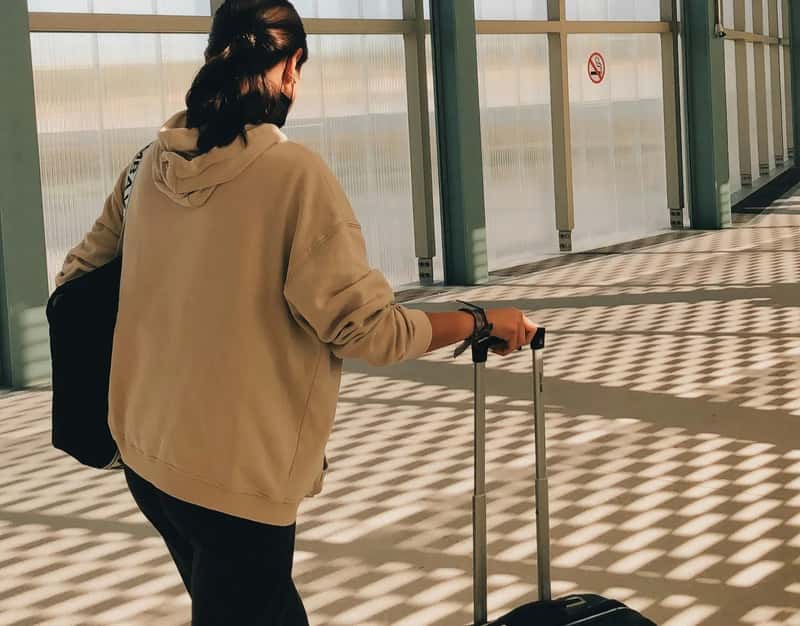
You know it’s there.
You physically placed it there. You watched your own hand do it.
And still, you check.
You know your passport is in your bag. You checked it five minutes ago. And yet, as you wait in line, you find yourself unzipping your bag again. This repetitive checking isn’t about memory – it’s about anxiety.
Psychologists call it compulsive reassurance-seeking. You’re trying to calm the fear of “what if” by physically confirming your documents are still there. It works for approximately thirty seconds. Then the doubt reassembles itself in the dark, quiet and precise, and your hand moves again toward the zipper.
Your brain doesn’t trust memory alone – it needs physical proof, over and over again. This is not a travel quirk. This is not organizational diligence. This is your nervous system running a script written long before this particular airport, this particular departure. The passport is just the prop it chose today.
Every confirmation that doesn’t produce relief is telling you something. Not about the passport. About the loop itself. The habit is the problem. The document is innocent.
2. The Catastrophic Itinerary
Every minute is accounted for.
Every restaurant is pre-approved. Every transit route is printed and color-coded and backed up in the cloud and photographed and forwarded to someone at home who doesn’t know why they have it.
Psychologists say anxiety thrives in unpredictability. By planning every moment, you create a sense of control – even if it leaves no room for spontaneity or relaxation. Ironically, rigid plans can backfire when something inevitably goes wrong, triggering even more stress.
The itinerary is not a travel document. It is a negotiation with chaos. A formal attempt to make the uncontrollable sign a contract it was never going to honor. You are not preparing for a trip. You are constructing a psychological fortress and calling it an agenda.
When the delay happens – and it will happen, the delay always happens – the fortress collapses. And you are left not just dealing with the delay but with the entire architecture of your need for control, suddenly exposed in a fluorescent-lit airport corridor at 6 PM on a Tuesday.
Real travelers leave gaps in the plan. Gaps are where travel lives. They are where you accidentally find the thing you came for.
3. The Premature Arrival
Your flight boards at 3 PM.
You are at the gate at 10:30 AM.
You tell yourself this is discipline. Efficiency. Professionalism.
For anxious travelers, getting to the airport early isn’t just about being prepared – it’s about control. Psychologists call this anticipatory anxiety: the stress that builds in expectation of a future event.
While being punctual is good, extreme earliness often signals underlying anxiety. You’d rather sit at the gate for hours than deal with the discomfort of rushing. The extra time doesn’t always bring peace, though – you just spend it scanning departure boards and nervously sipping overpriced coffee.
The early arrival is not about efficiency. It is about the two hours you are buying from your own nervous system. You are paying, with your time and your autonomy, for the temporary illusion that nothing can ambush you. You have secured the perimeter. You have eliminated the variables. You have, for exactly as long as the gate agents can keep the flight on schedule, managed to keep the panic just behind you rather than directly in front of you.
But the panic is patient. It can wait two hours in a hard plastic chair.
4. The Exit Cartography
You find it within ninety seconds of entering any new space.
The exit. The side door. The fire escape. The stairwell with the push bar.
Your nervous system is conditioned to react fast to potential threats. You are constantly looking for escape routes, analyzing people’s moods, or anticipating worst-case scenarios.
But here is what the exits have never led to: rest. Every exit leads to another room. Another space to scan. Another perimeter to establish.
You have been doing this for years. Maybe decades. In restaurants, you sit with your back to the wall. In hotel rooms, you check the lock three times and note the distance to the stairwell. In unfamiliar cities, you map the route home before you allow yourself to enjoy the street you’re on. This is not caution. This is hypervigilance – a condition where sensory information is inaccurately and rapidly filtered in an enhanced state of sensory sensitivity, linked to a dysregulated nervous system. The exits keep multiplying because the threat keeps manufacturing itself inside you, independent of geography.
5. The Performed Calm
I remember standing in a departure hall in Kuala Lumpur, watching myself perform competence for no one in particular.
I had my bag organized. My boarding pass cached. My expression neutral. My internal state was a seven-alarm situation I was not going to let anyone see in a public space.
The performance of calm is its own exhausting labor. Hypervigilance makes your brain prioritize survival over presence. Even when you’re physically safe, your body stays braced. The seduction of the temporary only lasts as long as the nervous system allows it.
Performed calm is not the same as actual calm. One is a face. One is a nervous system at rest. Most anxious travelers have become extraordinary actors in the first category and have never experienced the second. The habit of performing tranquility actively delays the moment you might actually feel it, because performance requires distance – and distance from your own interior is the mechanism that keeps the panic locked in and sealed, building pressure you’ll release in a hotel room at midnight for reasons you can’t explain to anyone including yourself.
6. The Hypervigilant Scan
You read the room before you enter it.
You read the faces before you read the menu. You read the flight attendant’s expression before you read the safety card. You are, at all times, running a diagnostic.
Hypervigilance is a common symptom of anxiety disorders, where you remain in a constant state of heightened alertness, scanning for potential threats even when you’re safe. This persistent watchfulness isn’t the same as being naturally cautious; it’s an exhausting state that interferes with your ability to relax, focus, and enjoy daily activities.
Hypervigilance stems from your brain’s threat-detection system staying activated when it should be at rest, making you feel like danger is always just around the corner. The constant scanning, monitoring, and threat assessment drains your mental and physical energy, affecting relationships, work performance, and overall quality of life.
The scan is automatic. It was installed long before you had language for it. It fires in quiet lobbies and loud markets and peaceful hotel pools with equal urgency. You did not choose this. But you have practiced it into a reflex. And every environment you enter, you teach it to run faster.
7. The Luggage Fortress
You shrink-wrap the bag.
You TSA-lock every zipper. You photograph the contents. You weigh it twice at home and once at the airport just to be certain, because certainty is the only currency your nervous system accepts.
Some travelers are so worried about their luggage getting damaged or stolen during travel that they go to extreme lengths, like shrink-wrapping their bags. “While luggage mishandling does happen, the anxiety behind this behavior is often exaggerated,” says one clinical psychologist.
The luggage is not just luggage. The luggage contains evidence of who you are when you arrive somewhere. Your clothes, your toiletries, the small objects you carry to remind yourself that you exist outside of airports. Losing the bag is not just an inconvenience – in the mind of an anxious traveler, it is an identity crisis packaged in a delayed-baggage notification. The fortress around the suitcase is really a fortress around the self. And you build it every single time, because the alternative – trusting the system, trusting the process, trusting that you will be okay with or without your moisturizer – feels structurally impossible.
8. The Overpack as Armor
You packed for every version of yourself that might be needed.
The cold version. The formal version. The sick version. The stranded-for-a-week-due-to-a-volcanic-eruption version.
Travel entails less structure and control than our daily lives. Travel is unpredictable. Feeling anxious doesn’t always mean you dislike travel itself – it might mean you’re nervous about the loss of control, the unknown, or the “what ifs” that come with leaving home.
The overpack is a physical manifestation of “what if” thinking. Each extra item is a hedge against a future scenario your nervous system has already run to its worst conclusion. The anxiety doesn’t live in the suitcase. But it packed it. It chose every contingency layer, every backup cable, every third pair of shoes for the occasion that hasn’t happened yet and statistically probably never will. The weight you carry onto the plane is the weight of every worst-case scenario you’ve been carrying since long before you booked the ticket. You didn’t pack too much. Your anxiety did.
9. The Pre-Trip Spiral
The trip is three weeks away.
You are already exhausted by it.
Travel anxiety is a condition that occurs when one anticipates, prepares for, or engages in the travel process. It is characterized by heightened or excessive worry about planning, packing, engaging in travel, or concerns about unexpected events during the trip.
Research suggests that anxiety spurs selective attention in your brain. Then, it creates a feedback loop: you look for a specific threat and you get more anxious, which causes you to look for more threats.
The pre-trip spiral begins the moment the booking is confirmed. It runs in the background like an application you didn’t open but can’t close. It manifests as research. Obsessive, compulsive, exhaustive research – reviews read at midnight, health advisories consumed before breakfast, every possible disruption scenario pre-lived in the imagination until the trip has been psychologically completed, in its worst possible form, before a single bag has been packed. You arrive at the departure gate having already survived the catastrophe. The price is that you arrive hollowed out, wired on cortisol, unable to feel the actual trip that is right in front of you.
10. The Identity Left at the Border
This is the one that costs the most.
Not the lost sleep. Not the overpacked bag. Not the frantic passport checks or the two-hour early arrivals or the color-coded contingency plans.
This.
If you’ve lived with hypervigilance for years, it can feel like part of your identity – but it is not your identity. It’s a pattern your body learned, and patterns can change.
Hypervigilance often develops after trauma, chronic stress, or environments where you had to stay alert to protect yourself. In those moments, it served a purpose: it helped you survive. The challenge is that your nervous system doesn’t always know when it’s okay to relax.
The deepest cost of travel anxiety is not what it does to the trip. It is what it does to the traveler. It erases you – incrementally, invisibly, over years of check-ins and check-outs and document-verifications – until the person who boards the plane is not really present in their own departure. There is a particular freedom in temporariness. A hotel room holds no history. A new city holds no one who knew you before. You can be, for a few days, whoever the light makes you. But the hypervigilant traveler can never quite get there. The freedom is always just out of reach. The nervous system claims it before the soul can spend it.
The passport you keep checking is already proof of who you are. Stamped and valid and entirely yours.
The question the anxiety is actually asking – the one underneath all the zippers and itineraries and exit-mapping and early arrivals – is not “where is my passport?” It is: am I still here? Am I still intact? Will I be okay if I let go, even briefly, of the grip? And the terrible, tender truth is that the checking never answers it. Hypervigilance creates a feedback loop – high sensitivity to danger makes you notice things that trigger anxiety, and these triggers convince you to be even more vigilant. The loop does not resolve. It compounds. Every reassurance plants the seed of the next doubt.
What would it mean to put your hand on the bag and not unzip it? To feel the shape of the passport through the fabric and decide that is enough? Not because the fear is gone. But because you are choosing, this once, to exist in the present tense instead of in the catastrophic future your nervous system keeps insisting on writing without your permission.
The world is still there, outside the terminal window. The city you are flying toward does not know your anxiety score. It only knows the hour you arrive, the street you walk down first, the thing that catches your eye before the hypervigilance fires. Travel should feel like relief. And sometimes – briefly – it does. That brief window, that interval of genuine presence between the wheels lifting and the panic reasserting itself, is not a malfunction. It is a glimpse of the person you were before the world taught you that constant readiness was the price of survival.
The passport is in the bag. It has been there the whole time. It will still be there when you land.