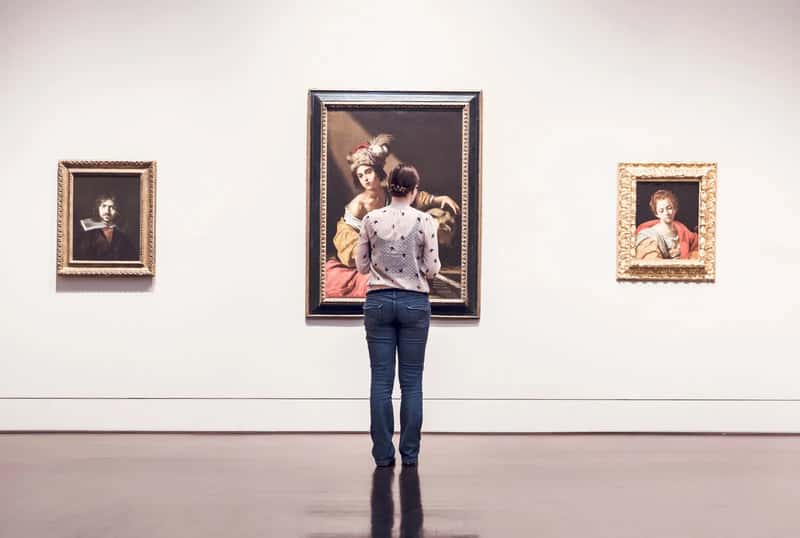
You are standing in front of a canvas in a gallery in a city that does not know your name.
No one here knows what year broke you.
No one knows who left. Or what you couldn’t say at the funeral.
And then something cracks open – not loudly, not dramatically – just a warm, private unraveling behind your sternum, and suddenly you are crying in front of a painting you do not even fully understand.
Here is the thing: that moment is not embarrassing. It is not random. It is not a quirk of jet lag or cheap wine at the hotel bar the night before. It is your brain doing something extraordinarily precise – something it has been waiting for the right geography to attempt. The “you” that exists at home – the one with a job title, a history, a grief schedule – is temporarily suspended. And the one left standing in that gallery is just a person. Raw. Without context. Finally permissioned to feel.
1. The Permission Slip You Never Got at Home
At home, grief has a schedule.
It is permitted at funerals. Briefly tolerated in the car. Absolutely not welcome at the office, the dinner table, the school pickup line.
Art evokes an outflow of emotions repressed in everyday life. We live in a world where the full expression of emotion is not socially accepted. If we saw someone weep deeply when they had a hard day at work, we would think they were crazy. Because display rules don’t allow us to experience the full extent of our emotions, we learn to suppress much of what we are feeling.
Travel removes those display rules temporarily.
No one in that gallery in Rotterdam or Seoul or Buenos Aires has any social contract with you. There is no shared context. No one to pull you aside afterward and ask if you’re “doing okay” with that tone that means please say yes. The anonymity is, in effect, a permission slip – one issued quietly the moment your passport is stamped.
You did not travel to grieve. But your nervous system knew the appointment was long overdue.
2. The Temporary Identity
The traveler’s identity is provisional by design.
You are unmoored from your biography. Some travelers want the pleasure of being somewhere they do not have to explain themselves – the freedom of entering a city or neighborhood without the usual biography attached. They want to be read first as a traveler, not as a job title, an online persona, or a walking archive of prior decisions.
That architectural removal of the known self is not incidental.
It is the mechanism. It is why the gallery works as a grief container in a way that your therapist’s office might not. You did not consciously prepare a version of yourself to show this gallery. You arrived as a tourist. Unbriefed. Unbraced.
And the painting found the exact seam you’d been keeping sealed.
Anonymous travel offers a softer, more practical version of reinvention. A traveler does not need a whole new life to benefit from partial obscurity. Sometimes the partial obscurity is enough. Sometimes just not being recognized is all the brain needs to finally exhale.
3. The Gallery as a Neutral Container
There is something specific about the architecture of a gallery.
The hush. The deliberate emptiness of the walls between works. The way footsteps echo in a way that makes you feel singular and small simultaneously. A museum can function as a safe, neutral space where emotions we’ve suppressed or neglected in our daily lives might finally find an outlet.
This is not metaphorical. It is clinical.
The gallery environment is physically designed to slow you down. High ceilings. Controlled light. Beyond the exhibits themselves, the museum environment often cultivates a unique atmosphere that can facilitate emotional experiences. Unlike the hustle and bustle of daily life, museums typically offer a quiet, contemplative space.
That contemplative space becomes, for the traveling griever, a confessional. Except no one asks you anything. You simply stand there, and the painting receives you as you are.
There is a specific kind of mercy in being received without being questioned.
4. The Science of Aesthetic Tears
Let’s be precise about what is happening neurologically.
This is not sentiment. Research explores a fundamental similarity between cognitive models for crying and conceptions of insight – all of which center on a process of initial discrepancy, followed by schema change, and conclude in a proposed adjustment or transformation of one’s self image and world-view.
In simpler terms: when art breaks your schema – when it shows you something your defenses weren’t prepared to deflect – your brain undergoes a small but seismic reorganization. And tears are the physical signal of that reorganization occurring.
Research has argued that tears may represent one of the only physical responses specifically linked to self and schema change, and therefore one of the few explicit indicators of this progression.
This means that crying in a gallery is not weakness. It is evidence of insight. Of a mind in the middle of becoming something slightly different than it was three minutes ago.
The painting did not make you sad. It made you more honest.
5. What I Left in a Gallery in Lisbon
I am not going to name the painting. That feels like a violation of whatever it was.
I was traveling alone. I had been functioning well for two years following the kind of loss that people call “complicated grief” – which is really just the clinical term for grief that doesn’t follow the approved timeline. I had not cried at the right moments. I had cried at a commercial about a dog once and felt nothing at the hospital. That’s how it works sometimes.
In a small gallery on a side street, I stood in front of something large and dark and textured, and I felt the two years arrive all at once. Not loudly. Not in the way films depict it. Just a quiet, total opening. And then it was over. And I walked outside into the afternoon light and bought an espresso and felt, for the first time in a very long time, like I was living in the correct tense.
Many find that creative expression during travel leads to emotional processing that logical thinking cannot access. That is the most accurate sentence I have read about what happened to me in that room.
6. The Exhaustion Effect
Travel dismantles your defenses through sheer logistics.
You are tired. You are disoriented. You are slightly dehydrated and mildly overwhelmed. And this is, paradoxically, exactly the right condition for emotional honesty. As our brains work hard to process and integrate complex historical facts, artistic theories, and cultural nuances, our emotional defenses can sometimes lower. Mental fatigue can make us more susceptible to emotional triggers, allowing feelings to surface more easily than they might in a less intellectually demanding environment.
The exhaustion is not an obstacle. It is the door.
Typical sufferers are impressionable people who are stressed by travel and may be struggling with jet lag. The very friction of being abroad – the visa queues, the unfamiliar metro maps, the language you stumble through – wears down the psychic muscle you’ve been using to keep everything managed.
And then a painting catches you unguarded. Right at the moment your armor is heaviest and your grip is lightest.
7. The Stendhal Threshold
There is a named phenomenon for when art overwhelms the body completely.
Stendhal syndrome is a psychosomatic condition involving rapid heartbeat, confusion, hallucinations, and even fainting, allegedly occurring when individuals become exposed to objects, artworks, or phenomena of great beauty.
Most of us don’t reach that extreme. But we sit closer to that threshold than we admit.
Stendhal syndrome, historically rooted in the nuanced experiences of artists, writers and travellers, manifests as intense emotional and physiological reactions to the sublime beauty encountered within art and architecture.
The tears in the gallery are the mild end of that same spectrum. The body registering that something significant is happening. That beauty – or the grief inside beauty – is too large for the usual containers.
Traveling is believed to be a possible cause of the emotional processes as reported in the clinical cases of Stendhal syndrome. The travel isn’t just backdrop. It is a co-conspirator. It weakens the fortress so that the art can get through.
8. The Mirror in the Brushstroke
Modern art, specifically, has an unusual capability.
It is often abstract enough to function as a mirror rather than a window. It does not show you a scene. It shows you a feeling. And feelings, unlike scenes, are impossible to intellectualize your way past. Visual art, in particular, has an unparalleled ability to bypass our rational minds and speak directly to our emotions. A masterful painting can capture the full spectrum of human feeling in a single frame. When we encounter such works, we don’t just see them; we feel them. This can trigger a deep empathetic response.
But there is something else at work in the abstract.
In some cases, we actually see our own experiences in the work, inspiring a sort of meta-empathy with ourselves. Our ability to connect with the subjects depicted in art, while retaining some distance from the work, allows us a novel perspective into our own lives. This perspective leads some people to have almost spiritual “aha!” moments of understanding and connectedness upon seeing art.
The abstract painting gives your stored grief a shape it never had before. And sometimes, simply having a shape is enough to release it.
9. The Exit Strategy
Grief needs an exit strategy. This is what no one tells you.
It cannot be parked indefinitely. It does not expire on its own. Left unprocessed, it becomes infrastructure – invisible, load-bearing, shaping everything without announcing itself.
Solo travel is as much an inner journey as an external one. Being away from your usual environment offers the mental space to reflect on personal goals, re-evaluate priorities, and reconnect with your thoughts and emotions.
That mental space is the exit ramp your stored grief has been searching for.
The gallery, in a foreign city, with strangers who will never know your name – it becomes the location where the exit finally presents itself. Unfamiliar environments often help people see things with fresh eyes and release past emotional burdens more easily. Not because the environment is therapeutic in a clinical sense. But because it is genuinely, structurally, psychologically safe in the way that home – loaded with context, expectation, and memory – sometimes is not.
You took the exit you’d been driving past for years. You just needed to be in a different city to see it.
10. The One Who Returns Is Never Exactly the One Who Left
There is something permanent about what happens in those rooms.
The moment the gallery receives your grief – when the tears come in front of the Mark Rothko dark rectangle, or the Louise Bourgeois spider, or the Joan Mitchell color field – something irreversible occurs. Results showed, with cross-cultural consistency, significant relation between feeling like crying and a collection of responses indicating a full progression to aesthetic experience, as well as to final reported self-reflection and epiphany.
An epiphany. In a gallery. In a foreign city. Alone.
This is not incidental. This process explores a fundamental similarity between cognitive models for crying and conceptions of insight, enlightenment or, in the context of art, “aesthetic experience” – all of which center on a process of initial discrepancy, followed by schema change, and conclude in a proposed adjustment or transformation of one’s self image and world-view.
You are not the same person who walked in past the coat check. The schema has shifted. The grief has moved. Not vanished – grief does not vanish – but moved. From the sealed chamber to somewhere with more circulation. Somewhere you can finally feel it without being leveled by it.
That is the heaviest truth of all this: you did not choose to go to the gallery to heal. Healing chose the gallery because it was the only room where you were finally no one.
The flight home is quieter than the one out. Not because less is happening. Because more has already happened.
You will return to your life – to the job title, the context, the people who love you under the weight of their own knowing – and you will carry the gallery back inside you like a second passport. You will not fully be able to explain what shifted. Grief rarely gives you language that fits in casual conversation. But you will notice it in the way you hold certain silences differently. In the way a late afternoon light hits a wall and you let yourself feel it, just for a moment, before moving on.
The painting didn’t fix anything. It just showed you that you were still there – underneath all the performance, all the management, all the years of functioning beautifully in the wrong direction. You were still there, warm and unfinished and exactly as human as you were the last time you let yourself be.
Somewhere, in a gallery that doesn’t know your name, that might have been enough.