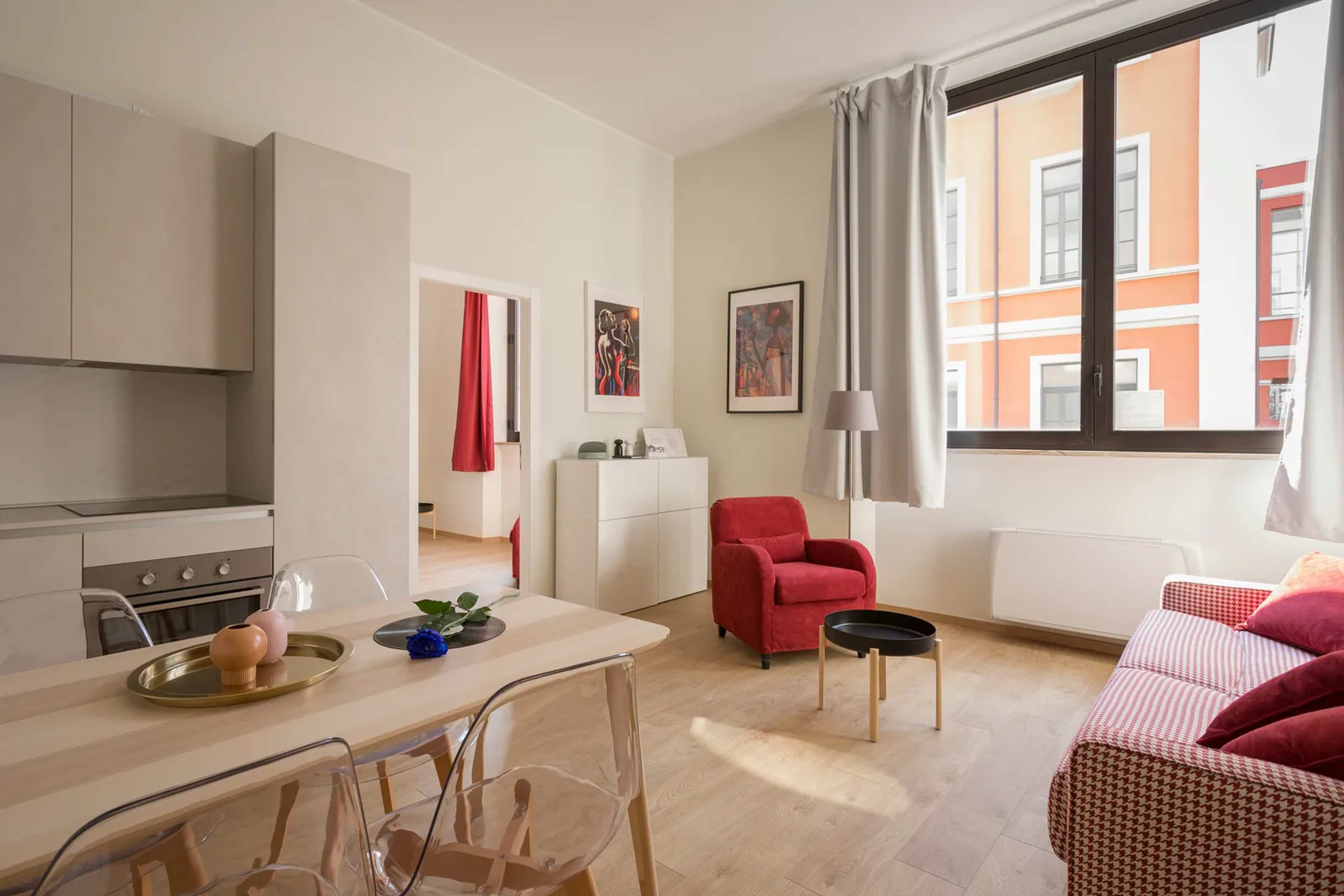
You check the lock twice.
Then a third time.
You slide the deadbolt. Test the chain. Peer through the peephole into the hallway that belongs to no one you know.
The room is fine. The rating was four-point-nine. The host left locally sourced coffee on a wooden tray that someone arranged to look like warmth. And yet your nervous system is running its own checklist – one that has nothing to do with this apartment, this city, or this trip.
There is a version of you that travels freely. Unbothered. Light. And then there is the version standing at the door at 11 PM in a stranger’s home, running diagnostics on every window latch like a night-shift security guard no one hired. The gap between those two selves is not a character flaw. It is a wound that found a stage.
1. The Primary Territory Collapse

Before we talk about Airbnbs, we need to talk about what home actually is to the human brain.
Not a building. Not a lease agreement.
Psychologist Irwin Altman argued that many people see their home as a “primary territory” – distinct from secondary territories like workplaces and bars, and tertiary spaces like park benches. Primary territories are understood as extensions of the self, places where the self is protected against others.
That distinction matters enormously.
When your primary territory is violated – through burglary, domestic violence, or any uninvited presence – the wound is not just about the physical space. Domestic intrusion is a potentially traumatic experience because most people consider their home an extension of the self and a place where the self is protected. Intrusions to such a highly valued place are therefore considered as attacks on one’s personhood, safety, and privacy.
The Airbnb you’re standing in right now? It has no idea you’ve been there before. In a different house. A different life.
2. The Alarm That Never Resets
Here is the clinical truth beneath the ritual of the double-checked door.
Your brain is not overreacting. It is operating precisely as it was trained to.
Hypervigilance refers to a state of constant, heightened alertness – always watching, always waiting for danger – even when the environment is safe. In the context of PTSD, it is one of the core symptoms that keeps the “alarm system” running long after the traumatic threat has passed.
The trauma of domestic intrusion rewires the threat-detection system.
When someone experiences trauma, the body’s protective alarm system – the fight-or-flight response – engages in full force. Normally, once a threat passes, that system quiets and returns to baseline. But in PTSD, something changes – the “off switch” doesn’t fully reset. Instead, the brain and body remain sensitized, ready to detect danger at all times.
So you’re not being paranoid in the Airbnb. You’re being fluent in a language your body learned in a room it will never fully leave.
3. The Sensory Mismatch Report
The checklist starts before you even touch the lock.
It starts with the smell.
The lighting is wrong. The pillow smells like someone else’s detergent. The ambient sound of the neighborhood is unfamiliar – wrong kind of traffic, wrong frequency of sirens, wrong quality of silence. Every sensory mismatch is a small alarm. The brain catalogues them. It does not sleep until it has processed them.
For most travelers, this is mild inconvenience.
For someone carrying domestic intrusion trauma, each mismatch is a data point feeding an existing threat model. The brain is not registering a strange pillow. It is registering an environment it cannot yet classify as safe.
The security audit you run on arrival – the windows, the door, the shadows – is your nervous system’s attempt to generate enough data to finally, maybe, classify this unfamiliar space as something other than a risk.
It rarely works on the first pass. Which is why you check again.
4. The Inviolability Myth, Shattered
There was a time when you believed certain spaces were inviolable.
Then someone walked through a door that was supposed to be yours.
Intrusions to highly valued territories are potentially traumatic because they shatter victims’ beliefs in the inviolability of those territories. That shattering is not metaphorical. It is a genuine cognitive restructuring – the kind that doesn’t reverse itself simply because time passes or geography changes.
A break-in shatters that fundamental sense of safety. If this sacred space is at risk, where can you be truly safe?
That is the question that follows you into every temporary dwelling you ever rent.
The Airbnb is just the newest room where the old question lives. You scan the windows not because this host is dangerous. You scan them because you already know the answer to the question, and you are quietly, exhaustingly trying to disprove it.
5. The Ritual Anchor (A Personal Note)
I want to stop here for a moment. Because theory only goes so far.
I remember standing in an Airbnb in Lisbon – beautiful, expensive, well-reviewed – and spending the first forty minutes of my stay not looking out at the river, not opening the wine, not doing anything a person who paid for that view should do. I was checking the door. The windows. The closet. Opening drawers with that specific careful deliberateness that pretends to be casual but isn’t.
I hadn’t been robbed recently. Nothing dramatic had happened in the preceding months. But somewhere in my body’s long memory was a history of spaces that stopped feeling safe before I was ready for them to. And so every new unfamiliar space became an opportunity for the body to run its old program.
The act of checking all closets and rooms upon arrival signifies a necessary ritualistic behavior to temporarily reinstate perceived control over the domestic domain.
Temporary. That word is doing a lot of work. Because the control never fully sticks. You just buy yourself enough quiet to open the wine. Some nights, that’s enough.
6. The Environmental Betrayal
The specific cruelty of domestic intrusion trauma is its location.
Other traumas happen in the world – in streets, in cars, in open and avoidable spaces. You can build distance from them. You can choose different routes.
When individuals are victims of violent crime outside the home, they engage in avoidance behaviors to cope with their trauma. When a person is a victim of a home invasion, they cannot avoid the scene of their victimization, and they no longer feel safe in their homes. As such, victims of home invasion encounter unique challenges as a result of their victimization.
The scene of the crime is the kitchen. The bedroom. The hallway you walk every morning.
The psychological signature left by this event is defined by environmental betrayal. Every physical space – the foyer, the living room, the bedroom – was successfully colonized by the threat.
So you travel. You move. You book Airbnbs in cities where no one knows you and nothing has happened. And in doing so, you discover the bitter irony: unfamiliar spaces trigger the same alarm as the violated one. There is no geography that feels neutral. Only geography that feels differently dangerous.
7. The Territorial Marking Instinct
Watch what you do when you arrive.
You unpack more than you need to. You place your toiletries on the bathroom shelf with more intention than the task requires. You move a chair two inches. You put your book on the nightstand even though you won’t read it.
There is a clinical term for what happens when you spread your things across the available surfaces of an unfamiliar room. It’s called marking. Marking is the act of placing physical indicators to signal territorial claims.
But in a rented room, who exactly are you marking territory against?
In an Airbnb, there is no one to deter. The threat is existential, not physical. You are not keeping other people out. You are keeping the feeling of erasure at bay.
This is what domestic intrusion trauma does to the act of travel. It turns every arrival into a tiny reclamation project. You are not decorating. You are defending. You are quietly insisting that this body, this life, this specific and irreplaceable self – belongs somewhere. Even if only until checkout.
8. The Body That Learned Too Well
The nervous system is a loyal and terrible student.
It learns from experience. It does not unlearn without deliberate intervention.
Your brain learns from experience, especially threatening ones. When you face trauma or chronic stress, your neural pathways adapt to prioritize survival. Research on brain changes from PTSD shows that traumatic experiences literally reshape the structures responsible for threat detection, making your brain more sensitive to potential danger.
This is not weakness. It is biology doing exactly what biology is designed to do.
When you live with hypervigilance, your brain isn’t being dramatic. It’s operating exactly as it was designed to after experiencing threat or trauma. Understanding the neuroscience behind this response can help you recognize that hypervigilance isn’t a character flaw or weakness, but a measurable change in how your brain processes information about safety and danger.
The Airbnb security audit is the body’s report. It is thorough, involuntary, and exhausting. And it is, at its root, an act of love – the nervous system trying to protect someone it once failed to keep safe.
9. The Identity That Travels Lighter Than You
There is another version of you on this trip.
The one in the photographs. The one who ordered the local dish and found the bar down the alley and felt, briefly, like someone unencumbered.
That version of you is real. It is not performance.
But emotional hypervigilance keeps your nervous system braced for impact, even when no danger is present. While it may have once helped you stay safe, over time it can make connection exhausting, rest difficult, and trust feel risky.
The traveler who checks the lock three times and the traveler who drinks wine on the balcony at sunset are the same person. This is the identity gap that nobody photographs. The self that moves through the world in two registers simultaneously – the one experiencing the beauty, and the one quietly scanning the perimeter of every beautiful thing.
Travel does not cure this. It just gives the gap a more interesting backdrop.
10. The Weight of the Walk-Through
You do it every time.
Bedroom. Bathroom. That space behind the door. The closet you open with a kind of practiced nonchalance that fools exactly no one, least of all yourself.
Many studies show that home intrusion puts individuals at higher risk of post-traumatic stress disorder (PTSD) and other forms of psychological distress. And that distress does not require a dramatic inciting incident. It accumulates. It layers. It travels.
The lasting presence of hypervigilance, emotional distress, and maladaptive behaviors highlights the complex nature of emotional and psychological adjustment after a home invasion robbery.
But here is what the research does not capture fully: the strange tenderness of the walk-through.
Because somewhere in the ritual – in the checking of the window latch, in the testing of the deadbolt, in the brief examination of the space behind the shower curtain – there is a person trying, in the only language their body knows, to say: I deserve to feel safe here. Even here. Even now. Even in a room that will forget me by morning.
That is not pathology dressed up as caution. That is grief, doing reconnaissance.
The room will never be fully safe. Not this one. Not the one at home. Safety, it turns out, is not a property of spaces. It is a negotiation the nervous system conducts, moment by moment, with a world it has learned to distrust at a very specific address.
What shifts – slowly, with time and sometimes with help – is not the absence of the checklist. It is your relationship to the person running it. The moment you stop being embarrassed by the walk-through and start being curious about it, something loosens. Not everything. But enough.
Overcoming hypervigilance requires teaching your body and mind that they are finally able to feel safe. That teaching takes longer than a weekend trip. It takes longer than a year. It happens in increments so small you almost miss them – until one night, in a city that doesn’t know your name, you check the lock only once. And then you sit down. And you let the room be quiet.
The deadbolt holds. The window stays shut. And for a moment – just a moment – so do you.