The restaurant smells like cumin and old wood.
You finally chose something.
Something that was yours.
Then they leaned over the menu and said, “Can we just share a couple of things?”
And something in your chest went very, very quiet. Then very, very loud.
Here is what nobody tells you about travel: the longer you move, the smaller your world of control becomes. The hotel room is not yours. The itinerary bends to weather. The language doesn’t cooperate. The currency confuses. Every hour on the road chips away at the careful architecture of selfhood you built back home – the coffee you make exactly the same way, the route you walk without thinking, the dinner you order without consulting anyone. Travel strips the scaffolding. What remains, trembling and exposed, is the raw need to be the one who decides something. Anything.
1. The Plate Is a Territory
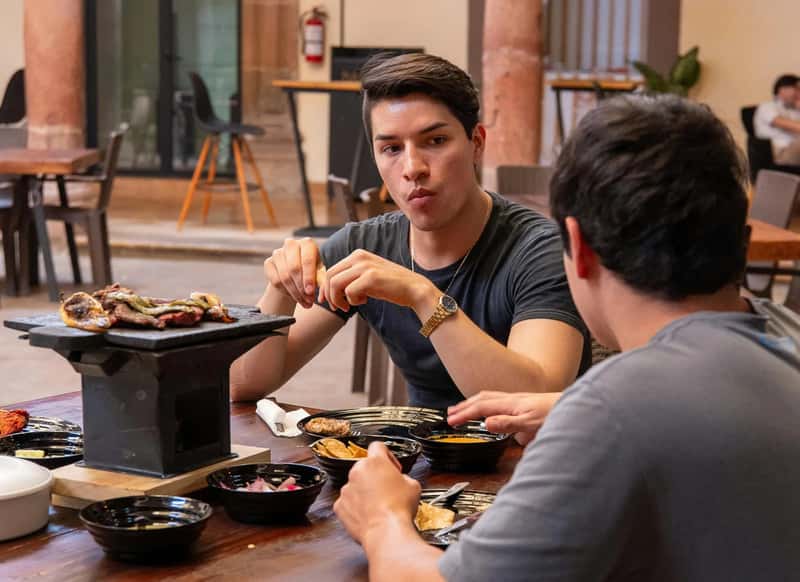
Let’s be honest about what a meal is when you’re traveling.
It is not just food.
It is the one decision in a twelve-hour day that required no negotiation.
When someone asks for a bite, it feels like they’re being asked to compromise not just their meal, but their commitment to themselves. “Just one bite” becomes an existential threat to their autonomy.
The plate is a map of who you are right now, in this city, in this hour. The lamb dish you pointed at because the waiter’s eyes lit up. The side of fermented vegetables you weren’t sure about but ordered anyway. These are micro-decisions that cost nothing and mean everything – because they are evidence that you still exist as an individual inside a shared itinerary.
Sharing the plate means sharing the evidence.
Your partner isn’t being unreasonable. They’re being human.
But the irritation you feel is also human – and it is pointing at something far older than this meal.
2. The Attachment Echo
Your relationship with shared food started long before this trip.
It started in a kitchen you grew up in.
Attachment theory explains how people bond and regulate their emotions, with styles rooted in early interactions with primary caregivers. The three main styles are secure, anxious, and avoidant.
Researchers found that people high on attachment avoidance were less likely to share food or date a potential partner who had dissimilar food preferences.
That is not a quirk. That is a wound with a very specific shape.
If closeness was unpredictable in your early life – offered and then withdrawn, given and then weaponized – you learned to keep certain things only for yourself. The avoidant traveler doesn’t guard their plate out of greed. They guard it out of memory. The body remembers being taken from. It doesn’t always know that you’re in a different country now, with a different person, at a table lit by a candle that smells of beeswax and somewhere better.
The irritation is not about the food. It never was.
3. The Compression Effect
Shared travel compresses identity.
You wake in the same room. You move at the same pace. You consult each other before every turn, every ticket, every museum. The longer the trip, the more the edges of your individual self begin to blur – and the mind, quietly and without announcement, starts looking for surfaces to push against.
Autonomy is self-determination. More specifically, autonomy in a relationship is choosing your actions freely, feeling authentic, and behaving in a way that aligns with your wants and values.
When you’ve been moving together for days, the meal becomes one of the only acts of pure individual choosing left.
The body craves even symbolic sovereignty.
The irritation at the shared-meal question is the psyche’s early warning system saying: we are disappearing into we, and it is starting to frighten the part of us that needs to be an I.
This is not a character flaw.
This is the compression effect – and it is loudest at the dinner table.
4. The Rationalization Armor
Watch what happens in the seconds after the question.
A reason appears instantly. Fully formed. Impeccably logical.
“I just don’t want to end up hungry.” Or: “Their portions are small here.” Or the classic: “I’ve been thinking about this dish all day.”
Anxiety emerges when internal needs clash, and to mitigate the tension, the ego deploys strategies of self-deception to avoid the discomfort. The unacceptable thought or emotion may be denied, rationalized, or projected onto someone else.
Rationalization is the smoothest of the defensive systems. It presents itself as reason while doing the work of fear. You are not lying – you genuinely believe the logical story your mind constructed in 0.3 seconds. But beneath it is something that never got a chance to speak: I need this to be mine.
The armor is convincing because it was built quickly and built well.
The question is not whether your reason is valid. It probably is. The question is what the reason is protecting.
5. The Cartography of One
I remember a night in Lisbon. Third evening of a long trip. A restaurant I had circled on a paper map – actual paper, the kind that folds badly and tears at the creases.
My travel companion pointed at something on my plate and said, “Is that good? Can I try?”
I felt it. The tightening. The almost-no.
It arrived before I could think it. And afterwards, quietly horrified at myself – because I love this person, and it was just food – I sat with the feeling instead of shooing it away. What I found was not greed or selfishness. What I found was exhaustion. Fourteen days of agreeing on everything. Fourteen days of editing myself in small ways a hundred times a day. That bite of octopus was mine because nothing else had been.
The irritation was not directed at her.
It was a map of everywhere my name had been crossed out that week, and a single dish in a restaurant in Lisbon was the only territory I had left.
It’s rarely about the food itself. That reluctance to pass the popcorn or share dessert reflects deeper patterns around autonomy, security, and emotional regulation.
6. The Boundary That Travels
Boundaries are usually discussed in the context of the home. The relationship. The family dinner table with someone who asks too many questions.
But boundaries travel with you.
They fold into your carry-on alongside the extra socks and the half-read novel. They arrive in every new city, rumpled and slightly jet-lagged, but functional.
In psychology, autonomy is seen as a fundamental human need. It is essential to individual well-being, motivation, and psychological health.
The traveler who resists food-sharing is not being precious. They are, in a very direct way, practicing boundary maintenance – a skill the road keeps trying to erode. Every compromise feels like a small surrender. Every surrender adds up. The defensive system watches the ledger.
When it fires over a shared appetizer, it is not overreacting.
It is doing the math correctly. It has simply assigned too much symbolic weight to one line item.
The work is not to eliminate the boundary. The work is to renegotiate which battles the boundary actually needs to fight.
7. The Exit Strategy
There is a particular kind of traveler who books their meals alone, even on group trips.
They slip away at 6 PM. A small table. A corner. A book they aren’t really reading.
People who struggle with food sharing often display what psychologists call attachment avoidance – a reluctance to form close personal bonds that extends far beyond the dinner table. They’re the ones who need their own popcorn at the movies, even when sharing would be cheaper. They order individual appetizers rather than communal plates. It’s not about the food; it’s about maintaining boundaries.
The solo dinner is an exit strategy. Not an escape from the other person – a return to the self.
The mind needs a room of its own, even when the trip doesn’t provide one. When that psychological room collapses – shared everything, decided together, consumed in common – the defensive system will eventually construct one out of whatever material is available. Sometimes that material is a plate of food and a suddenly short temper.
The irritation is architecture. It is the mind building a wall because someone forgot to put a door in.
8. The Identity Theft You Didn’t Report
Here is a quiet truth about long-term travel partnerships: after enough days, you begin to perform yourself for the other person rather than simply being yourself.
You become the version of you that they know. Their understanding of you becomes a soft cage. A comfortable one. But still.
People low in autonomy are characterized by relationship-contingent self-esteem – meaning that one’s self-regard depends on the nature, process, and outcome of the relationship.
When partners experience little autonomy in the relationship, they are more likely to interpret their partner’s behavior as a personal attack, judgment, or expectation, causing them to react defensively, to withdraw, or to counterattack.
The meal question lands like an audit. Are you still you, or have you become a version of yourself assembled for this person’s convenience? The irritation is identity asserting itself. It is the psyche filing a police report for the slow, unreported theft of personhood that happens inside shared experience.
Nobody took it from you on purpose.
That’s what makes it so hard to name.
9. The Projection Window
Sometimes the anger at the meal request is not about the meal, or even about this trip.
Sometimes it is borrowed anger. Old anger. Anger with a return address that no longer exists.
Among the purposes of defense mechanisms is to protect the mind, self, and ego from anxiety or to provide a refuge from a situation with which one cannot cope at that moment.
A parent who always reached across the plate without asking. A sibling who took without reciprocating. A long-ago relationship where shared meals were a precursor to something being taken in a much larger way. The traveling mind is a compressed archive. Stress and unfamiliarity are excellent decompression tools. Old files open in new cities.
Your travel partner asked about the bread basket.
You are answering someone else entirely.
Defense mechanisms are complex psychological strategies employed by the human mind to cope with and adapt to the challenges of reality. These mechanisms serve to protect the individual’s self-esteem, sense of identity, and overall psychological well-being.
That is not a character flaw. That is the human mind doing its ancient, exhausting, necessary work.
The strange thing about identifying these systems – naming them, watching them work – is that the irritation does not disappear. It simply becomes legible. You can read it now instead of just feeling it. And a feeling you can read is one you can carry differently.
The other person across the table is not the enemy of your autonomy. They are, in fact, the witness to it – the one person who has seen you choose a hundred small things across a hundred miles, and has loved you through each decision. The tightness in your chest when they reach for your plate is not about them. It is a letter from a version of you that is tired and understated and in desperate need of being seen as singular, even for the length of one meal.
The next time it happens – the question, the lean, the hopeful look over the table – notice the feeling before you answer it. Not to suppress it. Not to override it. Just to let it tell you what it came to say. Because underneath the irritation, past the defense, through the armor of the perfectly logical reason, there is a very simple sentence waiting in the quiet: I just needed something that was only mine.