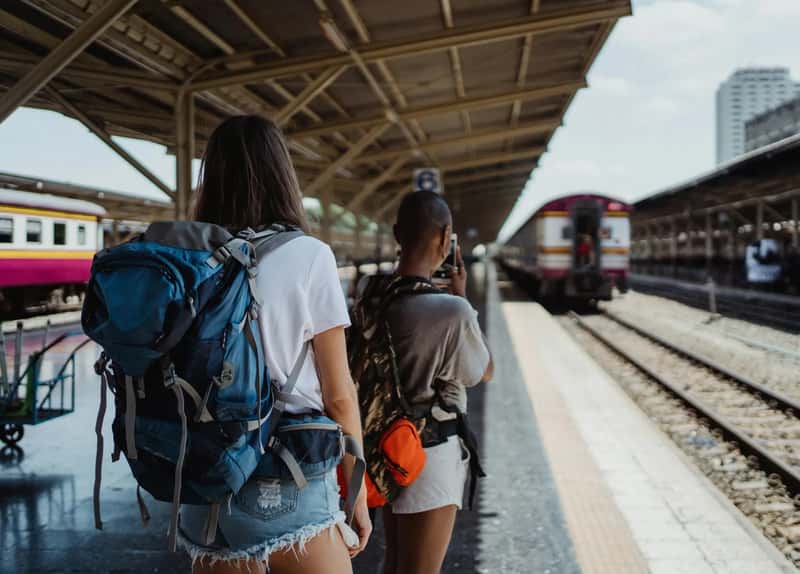
The platform is right there.
The train leaves in four minutes.
You know the direction. You’ve checked it twice.
And still – you walk.
There’s a version of you that moves through cities with confidence, asks strangers for directions without flinching. But when it comes to accidentally boarding the wrong train, you completely freak out. Somewhere between the idea of travel and the reality of slight vulnerability, a gap opens up.
It’s a gap in identity – between the self you perform for the world and the trembling, uncertain self that stands at the edge of a platform, terrified of making the smallest mistake. The traveler in you has quietly learned defensive responses to avoid any situation that might make you vulnerable even for 5 minutes.
You are the person who’d rather add thirty minutes to their journey by choosing to walk than risk one second of visible confusion. But that doesn’t mean you are lost. You’re just existing in this identity gap.
The Overcalculation
You checked the route before you left the hotel.
Then again on the street.
Then once more standing outside the station, even though nothing had changed.
Anxiety increases attention to negative choice options, the likelihood that ambiguous options will be interpreted negatively, and the tendency to avoid potential negative outcomes – even at the cost of missing potential gains. That last part is the one that stings. You’re not just protecting yourself from a wrong turn. You are actively trading real movement for the illusion of safety. The overcalculation isn’t a problem-solving strategy. It’s a ritual. A prayer whispered to the god of certainty. You repeat the checking not because the information will change, but because the act of checking soothes a nervous system that has decided transit is threat. The map is not a tool anymore. It is a security blanket. And you carry it everywhere.
The Preemptive Exit
You plan the escape before you’ve even arrived.
Which door gets you closest to the exit. Which carriage is safest. Where to stand if you need to leave quickly.
Most travelers who deal with transit anxiety experience the feeling of being locked up and not being able to escape. They perceive the mobility system as complex and overwhelming, while mobility-related information can trigger panic or lower stress levels. The preemptive exit is your brain’s response to that trapped feeling. It builds the escape hatch before the door even closes. This is not irrational – it is hyperrational. Your mind has done the work of a catastrophist architect, designing an emergency exit into every situation before the situation has even unfolded. The tragedy is not that you plan. The tragedy is that the planning consumes the experience. You’re already halfway out the door before you’ve had a chance to look out the window.
The Comfort Route Addiction
There is a way you know. So you take it.
Every time. Even when a faster route exists. Even when the longer path adds twenty minutes to a tired body.
In order to limit the chances of experiencing an anxiety attack while traveling, many people develop coping strategies, including traveling with a companion, staying in familiar environments, or avoiding specific locations entirely. The comfort route addiction is the transportation version of always ordering the same thing at a restaurant. It feels like preference. It presents itself as habit. But underneath it is something older and more desperate – a refusal to risk the small humiliation of getting it wrong in public. The known road doesn’t just save time. It saves face. It saves the self-concept of the person who has quietly decided that competence is not something to be developed but something to be performed, and that performance requires a script, and the script requires a route you’ve already memorised.
The Reassurance Loop
You ask someone which platform. They tell you. You ask again, just to confirm. Then you find a sign and read it three times anyway.
Anxiety often drives people to seek validation from others before making a decision. While it might feel comforting in the moment, relying too heavily on external opinions can erode your ability to trust yourself. The reassurance loop is one of the cruelest mechanics of travel anxiety because it is designed to reduce distress, but it does the opposite. Every time you ask for confirmation, your brain files a small receipt: *I could not trust myself here.* Over months, over years, the receipts stack up into a conviction. The conviction becomes a fact. The fact becomes your identity. You are the person who needs to double-check. Who cannot simply know. The loop is not a failure of intelligence. It is a failure of self-trust – and self-trust, unlike a train timetable, cannot be looked up.
The Public Mistake Phobia
I remember standing in a metro station in a city I didn’t know.
I had the right ticket. I had the right line. But the doors were on the opposite side and everyone moved before I understood what was happening.
I stepped off. I waited for the next train. My face was hot. No one noticed. No one cared. And still, for the rest of the day, I felt like I’d been caught at something.
The real issue is not failure itself – it is the emotional meaning attached to it. Failure is often linked with embarrassment, judgment, or loss of self-worth. That is the architecture of the public mistake phobia. It is not about the wrong train. It is about what the wrong train means about you. In the private courtroom of the anxious traveler, boarding the wrong carriage is evidence – evidence that you don’t belong here, that you are not the sophisticated, worldly person you’ve been pretending to be. The sentence is disproportionate to the crime. But then again, the crime was never really about the train.
The Information Hoarding
You screenshot the timetable.
Then download the offline map.
Then screenshot the offline map.
Then read three blog posts about the transit system of a city you’re visiting for forty-eight hours.
Gaining more information over an extended period helps uncertainty-avoiding travelers reduce the anxiety associated with travel. This is the mechanism that information hoarding is built on – and it is, in small doses, entirely rational. The problem begins when the gathering never stops. When every new piece of data doesn’t close the anxiety loop but opens a new one. Many people experience fear of making wrong decisions. This fear creates overthinking, analysis paralysis, and hesitation – causing people to endlessly compare options, seek external validation, or delay decisions entirely. The information hoarder is not preparing for a journey. They are trying to eliminate the journey’s essential nature – its uncertainty, its aliveness, the possibility that something unplanned and beautiful might happen because you didn’t know exactly where you were going.
The Social Camouflage
You watch which way the crowd moves. Then you move with it.
Not because you’ve made a decision. Because the crowd has made one for you.
Humans are social creatures, wired to fit in. The fear of standing out or being judged often leads us to follow the crowd, even when we know better. Social camouflage in transit is a particular art form. The anxious traveler becomes a student of body language. Which platform do the locals gravitate toward? Where do the confident people stand? The goal is indistinguishability – to move through a transit system without ever revealing that you don’t know what you’re doing. The tragedy of social camouflage is its efficiency. It works. You arrive at the right place. You feel the quiet relief of not having been exposed. And your brain logs another data point: *I survived because I followed. Not because I led.* The competence stays permanently external. It never comes home.
The False Departure
You leave forty-five minutes early for a twenty-minute journey.
You arrive so far ahead of time that you sit on a bench outside and simply wait.
When confronted with stimuli or situations that are unpleasant or threatening, individuals tend to engage in avoidance behaviors in order to create an actual or psychological distance. Although such behaviors may be adaptive as a short-term coping strategy, excessive or maladaptive avoidance behaviors can perpetuate anxiety and impair daily functioning in the long run. The false departure is the time-based expression of that logic. Build in so much buffer that no mistake is possible. Arrive so early that the scenario of being late – of running, of being seen running, of missing the thing and having to explain yourself – becomes mathematically impossible. But what gets erased in the buffer zone is not just the risk. It’s the experience. Those forty-five minutes are not a gift of time. They are a ransom paid to a fear that will collect again tomorrow, and the day after, and always charge a little more.
The Anchor Dependency
You travel better with someone else.
Not because you need company. Because you need a person to absorb the decisions.
When they lead, the vulnerability is theirs. When they get it wrong, it is a shared mistake, not a personal indictment.
Safety behaviors are the things you do, either mentally or in actions, to prevent whatever you fear might happen. For example, if you fear driving, you might only drive when a trusted relative or friend is with you to provide a sense of safety. The anchor dependency works the same way in transit. The companion is not a companion. They are a buffer. A mobile reassurance system. A warm body who stands between you and the exposure of not knowing. And the cruelty of the anchor dependency is not in the using – it is in what happens when the anchor is gone. Alone at a station in a foreign city, the ground feels less solid. Not because the ground changed. Because the ground was never yours to begin with.
The Identity Contraction
This is the one that takes longest to name.
The slow narrowing of where you go. The gradual shortening of how far you’re willing to travel. The way the map of your life – its edges, its ambitions, its willingness to be lost – quietly shrinks.
It is the often unwarranted avoidance displayed by anxious individuals that is the major root of impairment and disability, as it prevents them from engaging in social interactions, walking the streets, or attending to their feelings. The identity contraction does not announce itself. It doesn’t arrive in a single moment of defeat. It accumulates in the small decisions: the unfamiliar neighborhood you don’t explore, the faster route you never try, the city you decide you couldn’t manage alone. Avoidance and safety behaviors become habits that make anxiety worse and harder to overcome. And so the world, which was supposed to expand every time you traveled, quietly folds itself smaller. Not because the world changed. Because you taught your brain that the world was too much – and your brain, loyal and terrible, believed you.
There is a version of identity travel that the glossy magazines don’t cover. Not the discovery of self through mountain passes and perfect golden-hour photography. The other kind. The kind where you negotiate, in real time, with a frightened part of your brain that is doing its absolute best – that learned its lessons about safety and exposure from real moments of real vulnerability, and is simply still running that old operating system in a new city.
The thirty-minute walk is not weakness. It is the accumulation of every time someone made you feel foolish for not knowing. Every moment you were exposed as uncertain and found the exposure unbearable. The brain that chooses the long way round is not broken. It is overprotective. It loves you so fiercely that it would rather steal your afternoon than let you feel that feeling again.
The question is never whether the train is going in the right direction. The question is whether you have ever been allowed – truly, quietly allowed – to be the person who doesn’t know, who boards anyway, who laughs when it goes wrong, who gets off at the next stop and figures it out from there. That person exists. They are standing on the platform right now. Waiting for you to stop walking, and simply board.