You picture a horn blast, a slow wave from the rail, then open water. What actually happens in the sixty minutes before that horn sounds looks nothing like the postcard – it’s closer to a countdown at mission control, with dozens of professionals racing a clock that doesn’t wait for anyone.
Miss one step in that final hour and a multi-million-dollar vessel simply doesn’t move, full stop. Here’s what really happens, minute by minute, starting with the paperwork that can quietly end a voyage before it even begins.
#10 – The Paperwork That Can Ground a Multi-Million-Dollar Ship
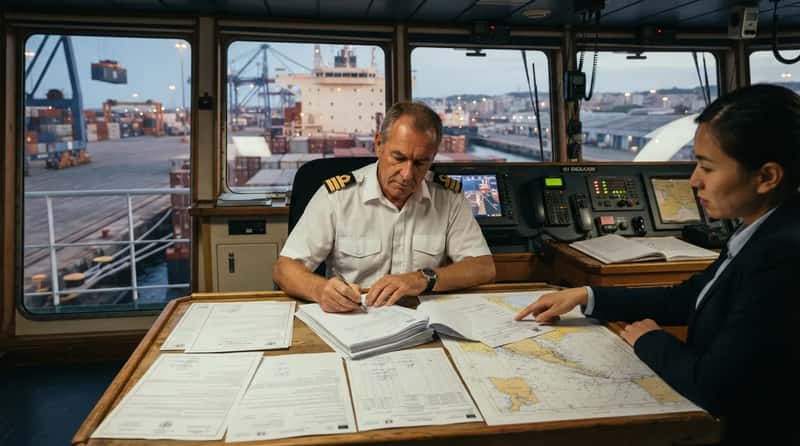
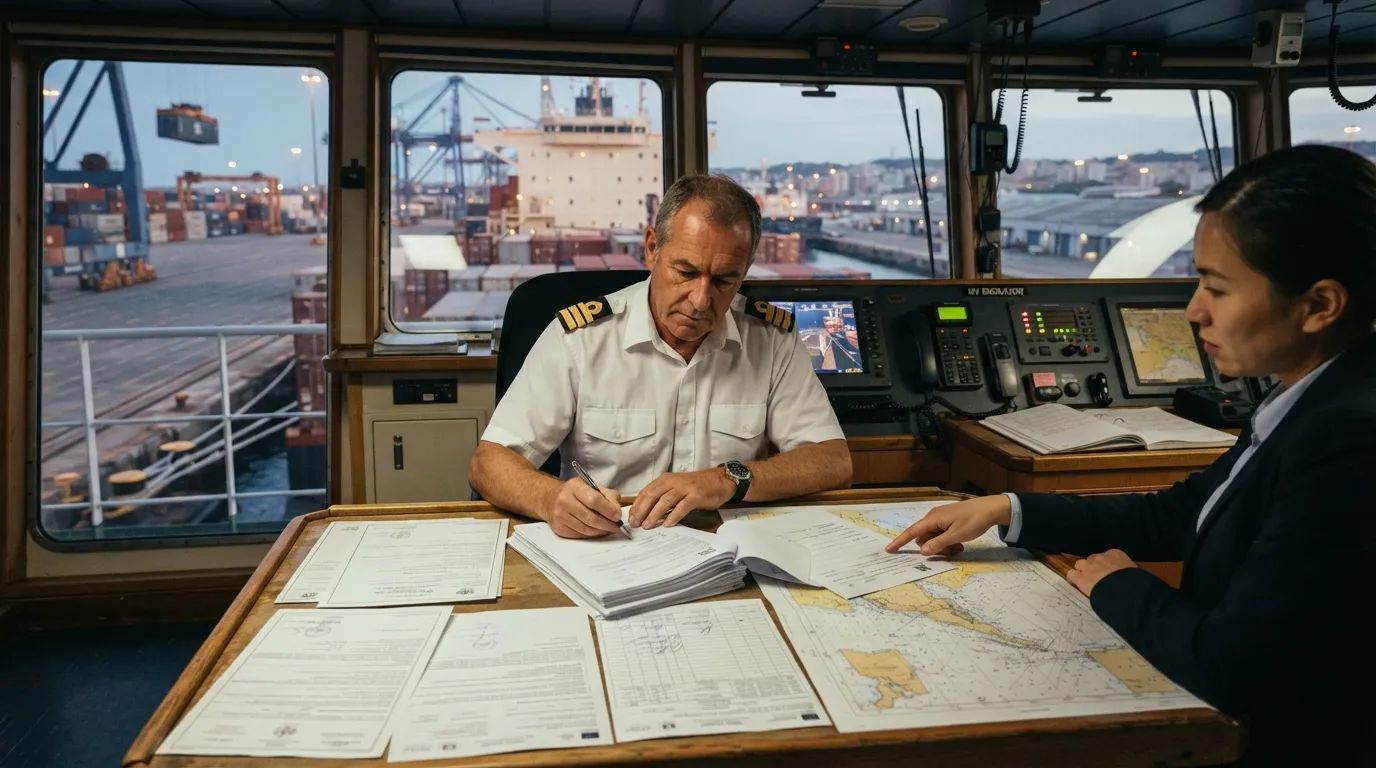
Before a single mooring line gets touched, the paper trail has to be airtight.
Every statutory certificate, port clearance document, cargo manifest, and voyage plan gets checked line by line. A missing or expired certificate doesn’t just cause a headache – it can legally chain the ship to the dock.
The Master’s signature has to appear on every required document, and the GMDSS distress system must be logged as fully operational before anyone even considers untying a rope.
A ship that fails a port authority document check in the final hour can miss its tide window entirely – costing the operator thousands in berth fees and rebooking costs.
Port slots are finite. Miss yours, and there’s no do-over – you wait in line behind everyone else.
But paperwork is only the opening move. The real race starts on the bridge.
#9 – The Bridge Wakes Up
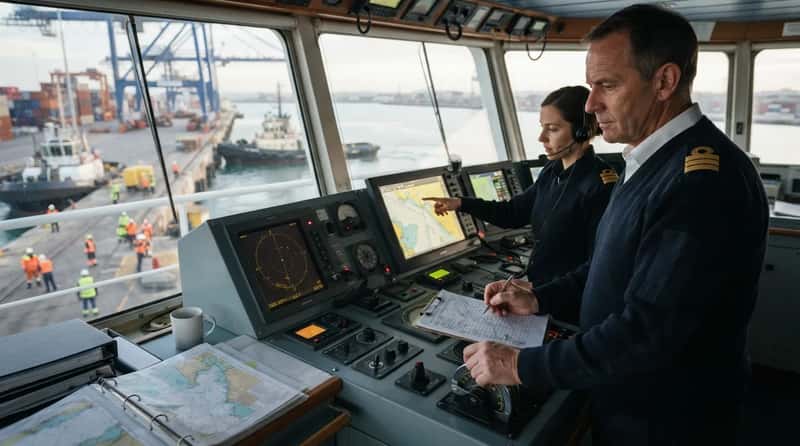
While dockworkers hustle the last pallets aboard, the bridge is already deep into a checklist that leaves nothing to chance.
Passage plans, weather, crew briefings, communications gear, navigation systems, steering, thrusters, moorings, hull openings – every item gets signed off one by one.
Officers confirm the charts are corrected up to date and that the passage plan accounts for the ship’s draft, the tide, and any patch of water where visibility might vanish.
Fast Facts
- Passage plan is checked against draft, tide, and visibility risks
- Steering, thrusters, and moorings are tested item by item
- One designated officer signs off the entire checklist
- The Master must be told the second anything fails
Nothing on that bridge is assumed to be working; everything is tested.
One unchecked box can cascade into something much bigger. That’s exactly what the next system is built to catch.
#8 – The Machines Get Interrogated, Not Just Switched On
You’d assume navigation electronics just quietly hum along in the background. In the final hour before departure, nothing is assumed – everything gets interrogated.
Anchors, cables, winches, GMDSS, BNWAS, gyro and magnetic compasses, ARPA, steering gear, navigation lights, GPS, the VDR – each one is tested live, one at a time.
GPS, radar, AIS, ECDIS, the gyro compass, and every communication system must prove full functionality before the ship is cleared to move an inch.
A radar that blinks out in a busy shipping lane is a collision waiting to happen.
Even the engine telegraph – the line that carries speed commands straight from the Captain to the engine room – gets cycled through its full range of settings. Better to find a stuck lever now than in a crowded channel.
The machinery side of this process is just as intense. What happens down in the engine room would surprise most passengers.
#7 – The Engine Room Goes to War
While the bridge works through its electronics, the engine department is running its own parallel race against the clock.
The main engine, auxiliary systems, fuel levels, cooling systems, and emergency generators all get verified in this window. A cold engine can’t just fire up on command – it needs a controlled warm-up and pressure checks before it can safely answer the bridge.
Engineers check oil levels, sound the bunker tanks to measure fuel, and keep fuel temperature near 40 degrees Celsius, because heavy fuel oil turns dangerously thick if it gets too cold.
An engine that can’t answer “full astern” in a crowded harbor is an emergency, not an inconvenience.
Every engine movement during departure is logged in real time. If what the bridge ordered doesn’t match what the engine delivered, someone has to explain that in writing – which is exactly why the next check matters so much.
#6 – The Stowaway Search Nobody Talks About
Here’s something almost nobody outside the industry knows happens in that final hour.
Crews carry out a full inspection of accommodation spaces, storerooms, holds, and lockers – specifically hunting for stowaways. This isn’t a courtesy sweep; it’s a legal requirement.
The Master’s checklist calls for a formal stowaway search right alongside the passenger and crew headcount.
If a stowaway is discovered at sea, the ship may be legally obligated to return to port – a hugely expensive, schedule-destroying outcome.
International law puts that responsibility squarely on the ship operator, which is exactly why this search happens without exception, every single time. Ports with a history of stowaway incidents sometimes get swept more than once.
The headcount itself sounds simple. It almost never is.
#5 – The Crew Count That Can’t Be Wrong
Getting an exact headcount on a vessel with dozens – sometimes hundreds – of crew members sounds like basic math. It isn’t.
Certificates, licenses, medical fitness records, rest-hour logs, and watchkeeping schedules all have to check out before departure. A crew member who hasn’t logged mandatory rest under the Maritime Labour Convention legally cannot stand watch, no matter how short-staffed the ship is.
Worth Knowing
- Seafarers need at least 10 hours of rest in any 24-hour period
- Rest can be split into two blocks, but one must be at least 6 hours long
- A minimum of 77 hours of rest is required across any 7-day stretch
- Falling short of these limits legally bars a crew member from standing watch
Every department has to give positive confirmation of readiness before the Master will even consider signing off.
A single officer who is medically unfit can delay a vessel just as effectively as a broken engine.
This is also when mooring gang assignments get locked in – who takes the bow lines, who takes the stern, who talks directly to the bridge. That coordination is about to matter a great deal, because someone else is about to step aboard and take control.
#4 – The Pilot Arrives and Takes the Helm
Here’s a detail that surprises a lot of people: in most commercial ports, the ship’s own Captain doesn’t actually steer the vessel out of the berth.
A harbor pilot does. Local pilotage is mandatory in most major ports, and this specialist – someone who knows every depth, current, and turning basin in that specific harbor – boards in the final approach to departure.
Quick Compare
- Captain: commands the ship and holds final responsibility
- Pilot: knows the harbor’s depths, currents, and turning basins
- Captain: manages the crew and overall vessel safety
- Pilot: directs the precise maneuvers needed to clear the berth
The most critical moment of the entire hour might be the Master-Pilot exchange, a structured briefing where tug bollard pull and mooring bitt strength are discussed in detail to figure out exactly how much tug power the ship can safely handle.
This conversation – typically just 5 to 10 minutes – is where most serious departure incidents get caught before they ever happen.
The pilot knows things the Master simply can’t: tug limitations, local crew competence, how much swinging room actually exists. Once Master and pilot are aligned, the muscle arrives.
#3 – The Tugboats Move In
No matter how enormous or powerful a modern ship is, pulling away from a tight berth alone is rarely attempted.
Tugboats apply sideways force to physically peel the hull off the pier – even large ships with thrusters can struggle to shift sideways, and wind alone can pin a vessel against its fenders.
Once clear, tugs help the ship pivot into the right heading. A well-timed push on the bow or pull on the stern can swing thousands of tons into position.
Mistiming a tug release in a strong current has caused real collisions, even with experienced crews at the helm.
In most countries, the pilot and tug captains talk to each other in the local language, so the Master has to read the situation and anticipate tug moves without catching every word. The tension on the bridge in this phase is real – and it’s about to become literal.
#2 – The Last Lines Let Go
The moment the mooring lines release is, operationally, the point of no return.
A responsible officer commands each mooring party, in constant contact with the bridge – and if they’re using a portable radio, the ship has to be clearly identified by name so nothing gets confused with a neighboring vessel.
Tide direction and wind determine the exact order lines get cast off. Get that sequence wrong, and the bow or stern can swing straight into the pier – or into the ship docked next door.
At a Glance
- Springs release first, then breast lines, then head and stern lines last
- Crew clears the “snap-back zone” the instant lines go
- Tide and wind direction dictate the exact release order
- A wrong sequence can swing the bow or stern into the pier
Heavy lines under tension store enormous energy – a snapped mooring line can travel at lethal speed.
That’s why every crew member stays clear of the snap-back zone, a rule drilled into every seafarer from day one.
The ship is finally free. But free doesn’t mean safe yet.
#1 – The Moment the Telegraph Rings
Everything from the last fifty-nine minutes funnels into one moment: the first engine order leaves the bridge.
Every word on every radio channel is controlled and recorded, using standard marine VHF frequencies and IMO Standard Marine Communication Phrases understood by pilots and crews worldwide.
Emergency plans – for engine failure, anchor release, a parted tow line – have already been mentally rehearsed and physically checked.
The anchor, counterintuitively, stays ready to drop throughout the departure – it’s the emergency brake of a moving ship.
The exact procedure shifts slightly by vessel type, but the framework never changes. When that telegraph finally rings and the pilot calls the first order, sixty minutes of checklists, tests, and split-second decisions become one quiet, irreversible fact: the harbor is behind you, and the open water is ahead.
The Bottom Line
The hour before a ship leaves port isn’t a countdown – it’s a synchronized machine built from paperwork, live equipment tests, crew verifications, stowaway sweeps, pilot briefings, tugboat choreography, and split-second line releases.
Every single one of those steps exists because, somewhere, at some point, skipping it went catastrophically wrong.
Most people sipping coffee on a cruise deck have no idea that dozens of professionals just spent sixty minutes running flat-out to make that departure look effortless.
Next time you feel a ship ease away from the pier, you’ll know exactly what it took to get there.