
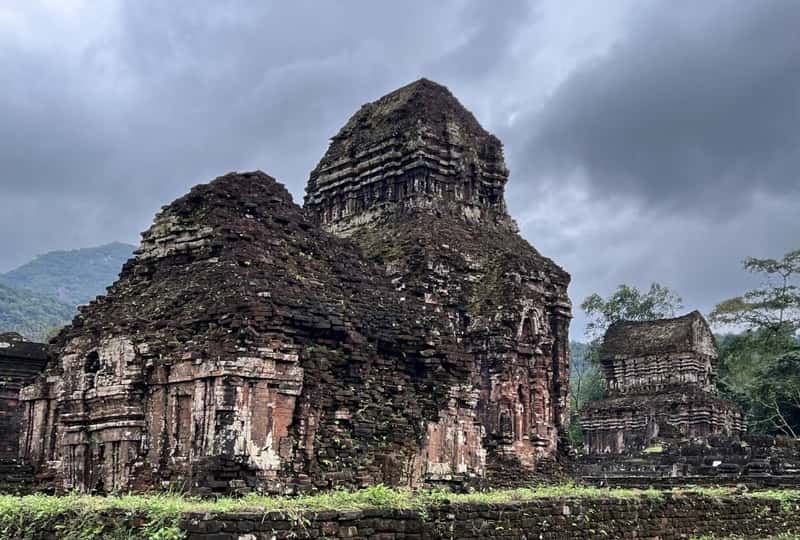
Hidden in a green valley surrounded by low mountains in Quang Nam Province, Mỹ Sơn Sanctuary is one of Vietnam’s most important historical and archaeological sites. Located about an hour from Hoi An, this UNESCO World Heritage Site was once the spiritual centre of the Champa Kingdom, being a powerful maritime civilisation that controlled large parts of central Vietnam for over a thousand years.
My Son is a location that feels quiet and reflective. It is a place of brick towers, faded carvings, jungle air, and centuries of layered history. Visiting it gives you a deeper understanding of Vietnam’s cultural diversity and its ancient connections to India and Southeast Asia.
The Champa Kingdom and the Birth of a Sacred Valley
The Champa Kingdom flourished from roughly the 2nd to the 15th century along Vietnam’s central coastline. The Cham people were heavily influenced by Indian culture through maritime trade, adopting Hinduism as their dominant religion, particularly the worship of Shiva.
My Son was established in the 4th century by King Bhadravarman I as a royal religious sanctuary, and it became the spiritual heart of Champa, where kings were crowned, honoured, and commemorated. Over time, successive rulers constructed temple towers dedicated to Hindu deities, particularly Lord Shiva, under the name Bhadresvara.
The valley’s secluded position was intentional, as it was surrounded by mountains and fed by nearby rivers. It symbolised a sacred, protected space – a physical representation of Mount Meru, the mythological centre of the universe in Hindu cosmology.
At its peak, My Son contained over 70 temple structures. Today, fewer remain intact due to natural decay and war damage, but what survives is enough to convey its original importance.
Architectural Features: Brick Without Visible Mortar
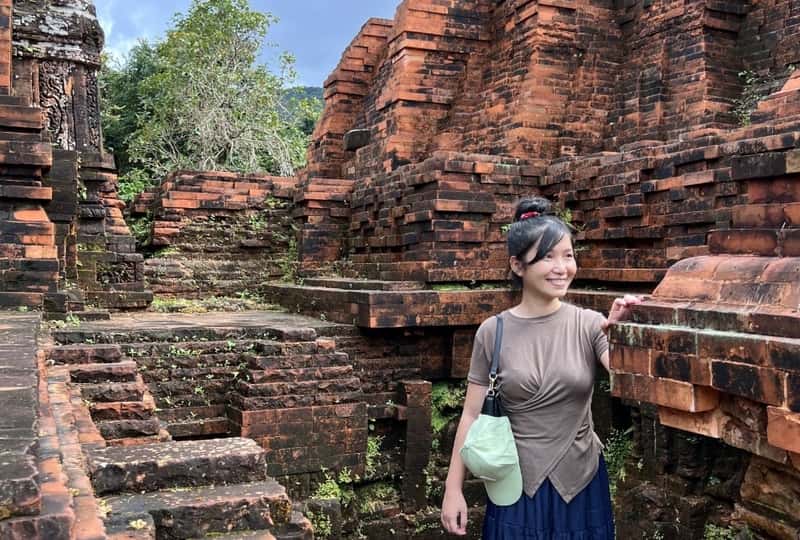
One of the most fascinating aspects of My Son is its construction technique. The towers are built primarily from red brick, yet the bricks fit together with almost invisible joints. Scholars still debate how the Cham achieved this, with some theories suggesting a special plant-based adhesive was used, while others propose that the bricks were fired after assembly.
Each main temple tower (kalan) would house a linga, a symbolic representation of Shiva, while surrounding structures served ceremonial and ritual functions.
When walking through the site, look for sandstone carvings of Hindu deities, decorative floral and geometric patterns, mythical creatures such as nagas, garudas and other symbolic guardians and intricate doorframes and lintels.
War Damage and Restoration Efforts

During the Vietnam War, My Son was heavily bombed because of its strategic valley location. Several temple groups were destroyed, and large bomb craters are still visible in the surrounding landscape.
This location is an important part of Vietnamese history, as My Son is not just an ancient ruin, but a reminder of modern conflict layered onto a much older civilisation.
Since the 1990s, international restoration projects, including collaboration with Italian and Indian conservation teams, have worked to stabilise and restore remaining structures. Restoration continues today, and you may see areas under preservation when you visit.
What to Expect When Visiting
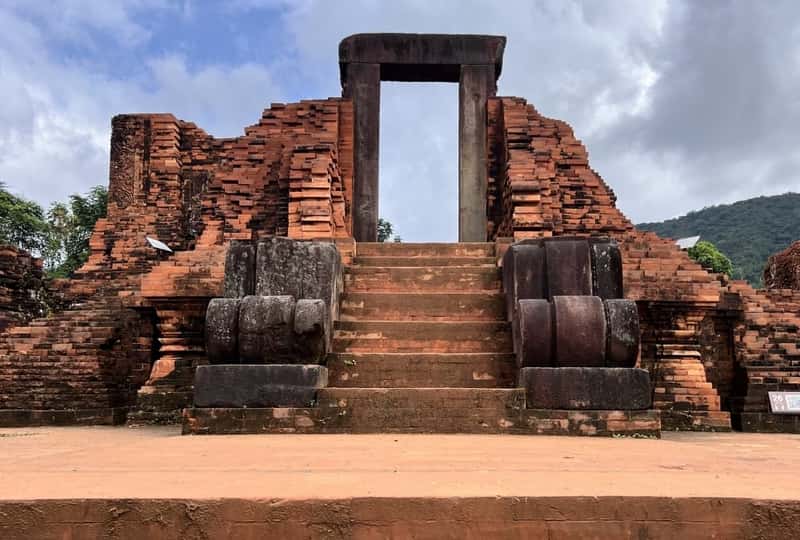
My Son is divided into lettered groups (A, B, C, D, etc.), representing clusters of temples built in different time periods.
Most visitors will arrive at the visitor centre and take an electric shuttle into the valley, where you will walk a circular route through the temple groups. Walking around isn’t difficult as the terrain is mostly flat, but there’s little to no natural shade, so be prepared, as, if you’re unlucky, such as myself, you might need to cut your trip short due to heat stroke.
Practical Advice for Walking the Grounds

My Son sits in an open valley with very little shade once you leave the tree-lined entrance path. Especially during the dry season (roughly February to August), the heat can be intense by late morning.
Bring plenty of water, as there are limited facilities within the main temple area, and dehydration can occur quickly in central Vietnam’s intense humidity. Carry an umbrella or wear a wide-brimmed hat to help with limited shade, and an umbrella will also provide rain protection if the weather shifts suddenly.
Wear lightweight, breathable fabrics to improve airflow, and wear proper footwear, as some areas have uneven stones, loose gravel, and worn steps. Early morning is the best time to go, as it is cooler and the soft light enhances the red brick tones beautifully. If you’re driving by scooter or motorbike, early mornings are particularly great as driving under the harsh midday sun can quickly lead to bad sunburns that you don’t even realise you’re getting until it’s too late.
Even during the rainy season, it’s necessary to bring protection, as sudden downpours can occur quickly and surfaces become slippery. Take between 1.5 and 3 hours to explore comfortably, but if you enjoy archaeology and reading signage carefully, you may want more time.
Cultural Significance Beyond the Ruins
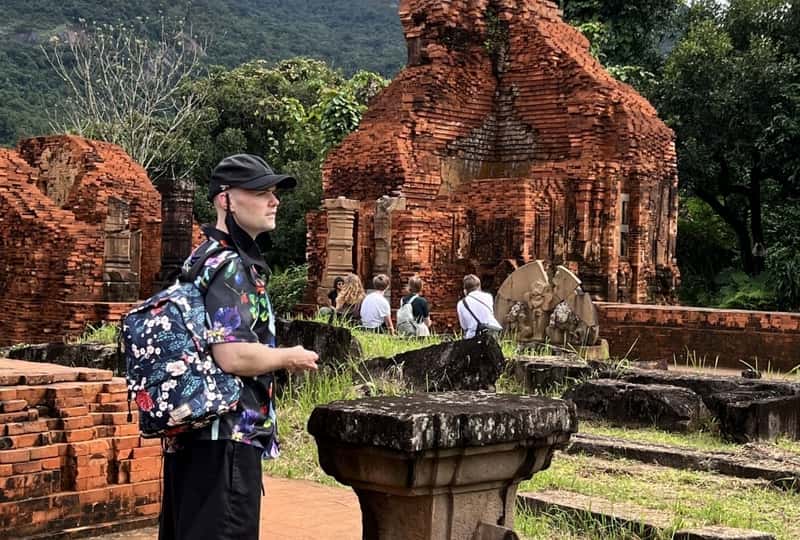
My Son is important not only for its architecture but also for what it represents culturally. It reflects the spread of Hinduism into Southeast Asia, maritime trade routes linking India and Vietnam, the political authority of the Cham rulers, and a civilisation distinct from later Vietnamese dynasties.
The Cham people still live in Vietnam today, particularly in southern provinces such as Ninh Thuan and Binh Thuan, with elements of Cham language, traditions, and religious practices continuing, preserving a link to the culture that built My Son.
Understanding this context makes the visit far richer. You’re not just looking at “ruins”; you’re standing in what was once the spiritual core of a kingdom that shaped central Vietnam for centuries.
Comparing Expectations: Smaller but Meaningful
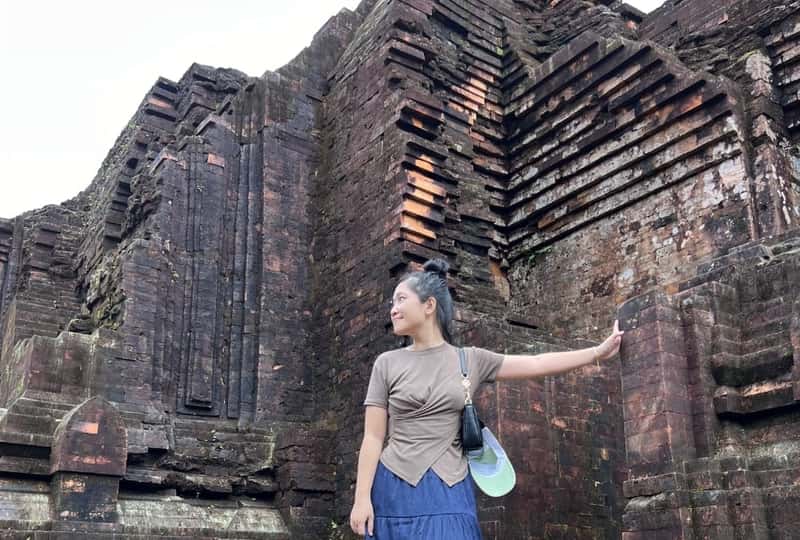
When coming to My Son, it’s important to keep your expectations in check. While some travellers arrive expecting something on the scale of Angkor Wat in Cambodia, My Son is actually much smaller, and not much of what it once was remains. While it doesn’t overwhelm with size, it does offer intimacy and historical depth.
Because of war damage and time, many structures have partially collapsed. However, that fragmentation gives the site a certain atmosphere – red brick rising from green jungle, towers standing against blue sky, silence broken only by insects and wind.
Getting There
My Son is most commonly visited from Hoi An which is approximately 1 hour by car, or Da Nang, around 1.5 hours.
You can get to My Son by Private driver organised with a half-day tour, or take a motorbike solo. Many travellers combine My Son with Hoi An in the same trip, exploring ancient Cham heritage one day and historic trading houses the next.
Final Thoughts
After driving dramatic coastal roads like Hai Van Pass, My Son offers a different experience – one rooted in stillness rather than motion. The valley once echoed with ritual chants and royal ceremonies; today it sits quietly under an open sky.
It reminds visitors that Vietnam’s history stretches far beyond imperial Hue or French colonial architecture. It includes a thousand-year Cham civilisation that connected Southeast Asia to the wider Indian Ocean world.
Walking among the red brick towers, carrying water under the sun, you begin to feel the scale of time – centuries of devotion, destruction, and preservation layered in one valley.