The map is already open before the plane lands.
You don’t ask for directions.
You never did.
There’s a particular kind of person who moves through a foreign city like water through stone – quietly, efficiently, without friction. They find the side-street café without a recommendation. They board the correct metro line without panic. They eat alone at a table for two and feel nothing but the particular, clean satisfaction of a plan that held. To outsiders, this looks like mastery. And it is. But mastery is never just one thing. It is always built from something. And what this specific mastery is built from – that’s the conversation nobody is having at the arrivals gate.
The identity gap lives here: between the person who looks supremely capable in Terminal 4 at 6 AM and the person who quietly decided, somewhere much earlier in life, that relying on others was a losing bet. Between the self who navigates flawlessly and the self who never quite learned how to ask for help without feeling like it cost them something.
If you feel more at home in transit than in your living room, you aren’t lost. You’re just existing in the gap.
The Cartographer’s Instinct
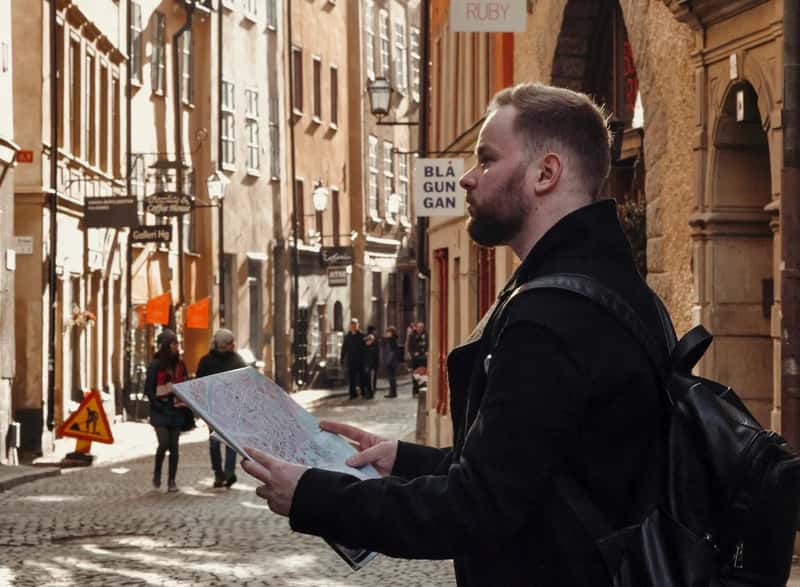
When you’re responsible for planning your itinerary, navigating new environments, and solving problems on your own, you quickly learn to trust yourself and your instincts. That is the clean version of the story. The textbook version.
The real version is messier.
The solo city navigator doesn’t just trust their instincts. They have elevated their instincts into something almost devotional – a private religion built on the altar of their own judgment. They read maps the way other people read faces. They memorize metro lines with the same intensity others reserve for a lover’s schedule.
The traveler can better articulate clearly, honestly, and without ambiguity who they are when no one is looking. Their own decision-making skills are put to the test without any affirmation or approval from anyone.
This is the cartographer’s instinct. Not just the ability to find a place. The compulsion to find it alone. The slight unease when someone offers to show the way.
It looks like skill. It is skill. But skill, like scar tissue, tends to grow thickest over old wounds.
The Provisional Self
A foreign city offers something rare and chemically addictive: the chance to be nobody’s anything for a while.
No role. No history. No accumulated reputation for being the one who always needs to check the map twice.
From a psychological perspective, solo travel creates a distinctive environment characterized by autonomy, novelty, and controlled separation from familiar social contexts. That separation isn’t incidental. For many solo travelers, it is the entire product being purchased.
A provisional self is one that doesn’t have to answer for its past. It only has to navigate its present. And in a city where no one knows your name, where every street is a blank slate and every café is a fresh context, the provisional self can breathe in a way the permanent self – burdened by expectation and history – rarely can.
This is not escapism. Or rather, it is not only escapism.
It is, for a certain kind of person, the only environment where they finally feel like themselves.
The Exit Strategy
Solo travel strips away the safety net of having someone else to rely on, which can be daunting at first but ultimately empowering. That’s the hopeful framing.
But there’s a shadow version of that sentence.
For some people, the absence of a safety net isn’t something they overcame. It’s the condition they were trained in from childhood. The solo traveler who never feels awkward in a foreign city didn’t necessarily build that capability from scratch. They may have arrived at adulthood already carrying it – already practiced in the art of self-sufficiency because the alternatives had been, at some point, quietly removed.
Attachment avoidance is theorized to arise when people have experienced neglect within important relationships, producing beliefs that close others cannot be relied upon when needed.
The exit strategy was the original strategy. Moving alone wasn’t a choice they made on a gap year. It was a pattern they inherited from a room where asking for help was too dangerous to risk.
The Autonomy Paradox
Here is where it gets uncomfortable.
For people who genuinely prefer solo travel, the ability to control the texture of their experience isn’t a preference – it is a psychological requirement woven into the architecture of who they are.
That’s not a flaw. But it is a fact worth sitting with.
The person who must control every detail of their journey – the route, the restaurant, the departure time, the hotel floor – isn’t always doing so from a position of strength. Sometimes they’re doing so from a position of hypervigilance. From a nervous system that learned, early, that when someone else held the wheel, things went wrong.
Studies suggest that solo travel may produce even greater stress reduction due to increased autonomy and reduced social obligation stress. That phrase – social obligation stress – is doing enormous psychological work. It names the invisible tax that group travel levies on certain nervous systems.
Autonomy, in this light, is both liberation and armor. The paradox is that both can be true simultaneously, and neither cancels the other out.
The Weight of the Internal Compass
I remember standing in a city I had never been to, at a crossroads with four identical-looking streets, my phone dead, no one beside me. I remember the specific quality of the silence before I chose a direction.
I remember not being afraid.
And I remember, only later, wondering if the absence of fear was strength – or if it was simply the absence of anyone to show the fear to.
My mind, often loud with contingency plans and imagined criticism, was unusually quiet. This was my first glimpse of autonomy, a shift from waiting for external permission to listening inward.
The internal compass is real. It works. But it is also a closed system. It recalibrates constantly on its own signal. It never checks in with anyone else’s signal to see whether it might be slightly off-course. The person who trusts their own navigation above all else is capable. But they are also, quietly, alone in a way that goes beyond geography.
The Deactivation Mechanism
Psychology has a name for the mental architecture behind this kind of radical self-reliance.
Attachment avoidance reflects a strong preference for self-reliance, as well as discomfort with closeness and intimacy with others.
In practical terms, what this looks like on the ground in a foreign city is a person who declines the local’s offer to walk them somewhere. Who thanks the hotel concierge and then quietly disregards every recommendation. Who feels, when a travel companion begins to lead, a low-grade resistance they cannot entirely explain.
They often see others as unreliable or dishonest, while believing they are independent, capable, and don’t really need support from anyone else.
This is the deactivation mechanism. It runs quietly, in the background, like an operating system that is never visible but governs everything. It keeps the traveler moving. It keeps them competent. And it keeps them, in a very specific way, at a permanent distance from everyone around them – even when those people are trying to help.
The Temporary Identity
Travel, for the self-sufficient solo navigator, provides something that ordinary life struggles to offer: a temporary identity that is entirely theirs.
Traveling alone often prompts moments of introspection. No longer are there additional influences from friends, family members, or a partner – the opinions and suggestions – with which to guide an individual’s desires, goals, and fears.
Without others to reflect them back to themselves, these travelers finally stop performing.
That is the seduction. In the foreign city, there is no social contract to uphold. No one is waiting for them to be the reliable one, the decisive one, the one who holds it together. They can simply be themselves – whoever that is when the stage is empty and the audience has gone home.
Their identity may have expanded during travel, but their environment at home may not have changed. The discomfort signals growth and the need to intentionally integrate new experiences into daily life.
The temporary identity is, in many ways, the truest one. The tragedy is that it can only exist at a remove from everyone who knows them.
The Cost of Competence
Competence has a cost. This is the part the travel content doesn’t show you.
The most interesting findings had to do with avoidantly attached people, who prioritize independence over intimacy and tend to distrust other people. This group reported being satisfied with their single status – but less happy with life overall.
Satisfaction with the solo condition. Dissatisfaction with the overall condition. That gap – between being good at independence and being nourished by it – is where the cost lives.
The person who navigates a foreign city without awkwardness has purchased their competence at a specific price: they have invested so heavily in their own judgment that other people’s judgment has been quietly devalued. Not out of arrogance. Out of architecture.
At its core, dismissive avoidant attachment isn’t about rejecting love – it’s about wrestling with what love might cost. The self-reliant exterior often hides old wounds, scars from moments when reaching out felt unsafe.
Competence, carried long enough, can become its own kind of cage. Elegant. Airtight. Entirely self-constructed.
The Loneliness Frequency
There is a particular kind of loneliness that only arrives in beautiful places.
Not the aching loneliness of the abandoned. The quiet, ambient loneliness of the self-contained. The loneliness of standing at the edge of something magnificent – a harbor at dusk, a square filling with evening light, a rooftop view that seems almost obscene in its beauty – and having no one’s hand to touch.
Insecure avoidants can be susceptible to loneliness as a result of exaggerating their self-reliance and overdoing their independence.
This loneliness doesn’t announce itself. It doesn’t show up as tears or distress. It shows up as a faint sense that the moment is slightly incomplete. That something is present in the periphery that they can’t quite name.
What is characteristic of this attachment style is, above all, a negative view of human nature, translating itself into a discomfort that accompanies dependence on others, lack of trust, and emotional distance from interaction with partners.
The loneliness frequency runs low. It rarely overpowers the signal of competence and movement. But at altitude – physically, metaphorically – it makes itself known.
The Softest Form of Courage
There is a version of this story that ends with a revelation. With the self-sufficient traveler finally asking for directions and discovering that the world didn’t end. That the stranger was kind. That surrender is sometimes just arrival by a different route.
That version is true. And it is also too easy.
The real work – the harder navigation – is not learning to find a foreign street. Solo travel helps to tackle and overcome anxiety, because you have no choice but to deal with situations that arise. There is not another person with you to lean on for support, and therefore you learn to trust your own judgement, which in the long-run reduces anxiety in uncertain situations. But the deepest uncertainty – the one that doesn’t appear on any map – is the uncertainty of allowing someone else to lead. Of accepting that their route might also get you somewhere worth being.
With compassion – from others and from themselves – curiosity, and a bit of courage, even the most independent souls can discover that connection doesn’t have to mean losing themselves. In fact, it can make them feel more whole.
The softest form of courage is not the one exercised at midnight in an unfamiliar city. It is the one exercised when someone you trust extends their hand and you – against every trained instinct, against every map you’ve memorized, against every version of yourself that never needed anyone – reach back.
The self-sufficient traveler has crossed borders most people never attempt. They have sat alone in rooms where they did not speak the language and navigated home anyway. That is real. That is theirs. No one is asking them to forfeit it.
What they are being asked – quietly, by no one in particular, by the specific ache that arrives in beautiful places – is whether the map they’ve been reading was always drawn entirely by their own hand. And whether, somewhere on the route they didn’t take, there might have been someone worth getting a little lost with.
Some cities can only be found when you stop looking.
Recommended Reads:
- People Who Are Unusually Good At Spotting Patterns In Foreign Cities Didn’t Just “Learn” It—Certain Childhood Conditions Actually Wired Their Brains To Be Hyper-Aware
- People Who Grew Up With Instability Often Become Adult Travelers Who Never Fully Believe Things Will Work Out Until They Are Actually Back Home