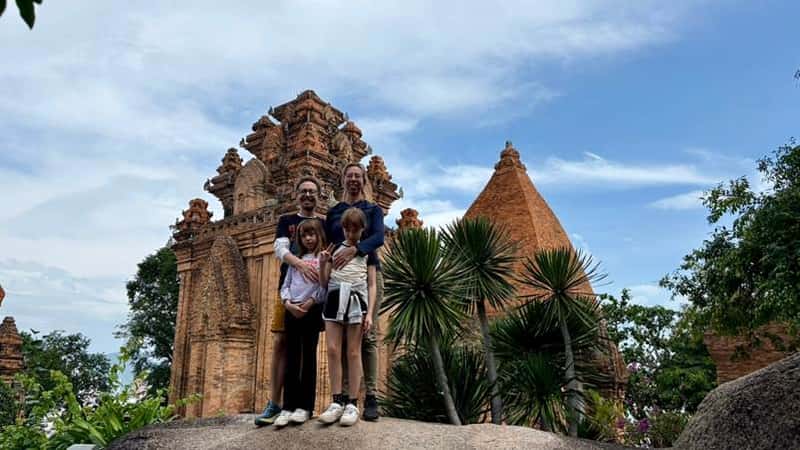
Some places in Vietnam win you over with beauty. Others do it by catching you completely off guard. Po Nagar Cham Towers belong firmly to the second category. I liked them instantly, mostly because they felt nothing like the rest of Vietnam I had been traveling through. Different shapes, different color, different mood, different cultural energy altogether. It was as if, mid-trip, Vietnam suddenly decided to show me a plot twist.
Set on a small hill overlooking the Cai River in Nha Trang, Po Nagar doesn’t whisper politely for your attention—it states its presence. You arrive expecting more Vietnam, and instead you get something that feels closer to India, older than the country’s current borders, and refreshingly unconcerned with fitting in.
A Population You Don’t Expect (But Should)
The towers were built between the 7th and 12th centuries AD by the Cham people, a seafaring, trading civilization that once controlled large parts of central and southern Vietnam. The Cham were not culturally Vietnamese in the way we understand it today. They were looking outward, across the sea, absorbing strong Indian influences—especially Hinduism—and building a world that followed different rules.
Po Nagar was dedicated to Yan Po Nagar, a powerful female deity linked to creation, fertility, and the land itself. Already, this changes the tone. This isn’t a distant, abstract god—it’s a grounded, maternal presence, very much tied to everyday life. The site feels less like a monument and more like a place that was meant to be used, touched, and believed in.
Architecture That Refuses to Be Polite

Architecturally, Po Nagar is blunt—in the best way. The towers are built from red brick, stacked with such precision that even today no one is entirely sure how the Cham managed it. The structures are solid, vertical, and unapologetically serious. No lightness, no decorative overload, no attempt to charm. Compared to the more elegant or ornamental buildings you see elsewhere in Vietnam, these towers feel earthy and muscular, like they grew out of the hill rather than being placed on it.
Po Nagar is still very much alive. People come here to pray, light incense, make offerings. Cham descendants share the space with Vietnamese worshippers and curious visitors, and somehow it all works without feeling staged. I saw people in traditional clothing performing a ritual next to a tourist trying to figure out where to stand for a photo—and neither feels out of place.
Why It Works Surprisingly Well for Kids
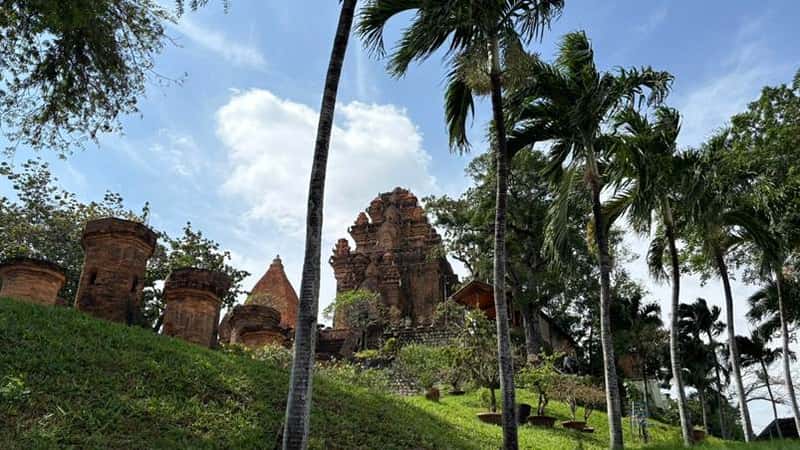
Po Nagar is also an unexpectedly good stop if you’re traveling with children. The site is varied and open, not a single monument you walk around and leave. There are green gardens, wide paths, small stairways, and different levels to explore, which immediately makes it more engaging.
Kids can climb certain areas (not the monuments themselves, obviously), wander between smaller shrines and temple spaces, notice flowers, altars, statues, and offerings. There’s a sense of discovery rather than instruction, and the panoramic views from the hilltop give them a clear reward for the walking. It’s visually rich, tactile, and full of small details—exactly the kind of place that keeps their attention without anyone needing to explain too much.
How to Get There
The Po Nagar Cham Towers are located just north of the city center of Nha Trang, and getting there is very easy. From anywhere in central Nha Trang, the site is about 1.5–2 miles away. A taxi or ride-hailing service will get you there in 5–10 minutes, depending on traffic, and is the most convenient option. If you prefer walking and the weather isn’t too hot, it’s also possible to reach Po Nagar on foot from the city center in about 30–40 minutes, crossing the Cai River and approaching the hill from below. Motorbike taxis are another common and inexpensive alternative.
Once you arrive, the visit itself doesn’t take long—about 45 minutes to an hour—but the elevated position and views over the river make it feel like a meaningful stop rather than a quick checkbox.
Why It Worked So Well for Me
In the middle of a Vietnam itinerary full of beautiful landscapes, cities, and very recognizable visual patterns, Po Nagar felt like a welcome disruption. I liked it because it reminded me that countries are never one story. They’re layered, sometimes messy, and often full of chapters that don’t get enough attention. A reminder that different populations lived here, believed differently, built differently—and left traces that still matter. It added depth to my trip and made Vietnam feel bigger, more complex, and more interesting.
It’s not the loudest attraction in Vietnam, and it’s certainly not the flashiest. But it has personality. And sometimes, that’s exactly what you want when a trip starts feeling a little too predictable. One might says that this is the kind of place that sneaks up on you. And you like it.