The door never locked.
Your thoughts were never yours.
The house was full of people, and somehow, that made you lonelier than any forest ever could.
You scroll past the image of a fog-wrapped cabin – woodsmoke curling from the chimney, a single lamp glowing in the window – and something in your chest moves. Not toward it. Toward yourself. There is a version of you that already lives there. A version that never had to share.
That is the Identity Gap. The chasm between the person you performed at the kitchen table – agreeable, visible, always emotionally available – and the person who needed silence like oxygen. The cabin isn’t an aesthetic. It’s a document of everything you were denied.
1. The Unlocked Door
It starts with something small.
A door that was never knocked on. A journal that was read. A phone call listened to from the hallway.
Children who experience chronic privacy violations – whether through constant surveillance, reading of personal messages, or public exposure of private moments – may develop heightened anxiety, difficulty trusting others, and a weakened sense of personal agency.
You learned that your interior life was not safe inside those walls.
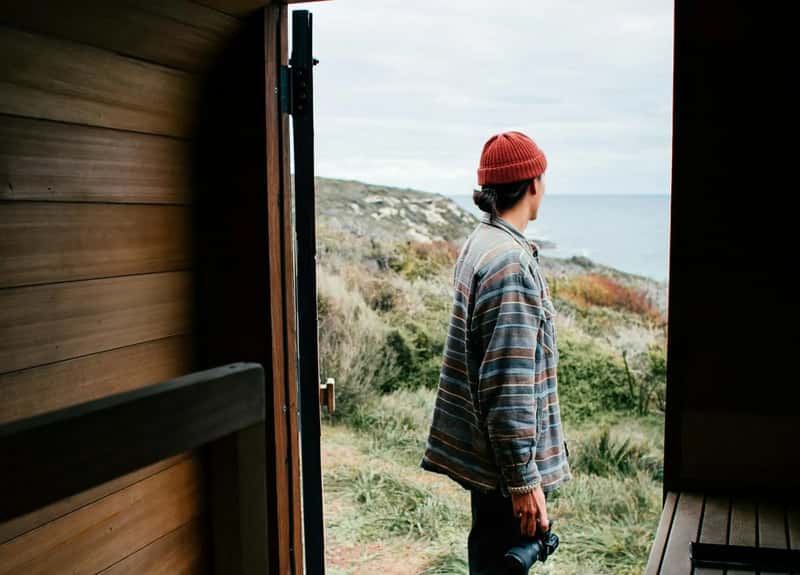
So you built an interior cabin instead. Somewhere no one could enter. You decorated it with mossy stones and rain-soaked pine boards. You put a lock on the door – the kind that exists only in imagination – and you have been returning to it ever since.
These effects can persist well into adulthood. The wood-paneled Pinterest board you curate at midnight is not a hobby. It is a floor plan for the self you never got to keep.
2. The Enmeshed Architecture
Some houses aren’t homes. They are systems.
Enmeshed parenting refers to a dysfunctional family dynamic in which parent-child boundaries are blurred, roles are mixed up, and a child’s autonomy is stifled. Family therapist Salvador Minuchin coined the term enmeshment to describe families with diffuse boundaries, where personal boundaries are so permeable that individuals lose a clear sense of self.
You didn’t lose your room. You lost your outline.
In an enmeshed family, members are overly involved in each other’s emotional lives and identities, far beyond normal parental closeness. There is a blurring of boundaries between family members, leading to a lack of autonomy and independence for the child.
The cabin in your mind has only one chair. One mug. One window facing away from the road. That is not antisocial. That is the exact square footage of the self you were never allowed to inhabit. You’re not obsessed with remoteness. You’re obsessed with singularity. With being one, whole, uncrossed-into person.
3. The Body That Remembered
The mind forgets. The nervous system does not.
As Dr. Bessel van der Kolk states in his best-selling book, “The Body Keeps the Score,” trauma is stored in the body as memory, attached to strong and disturbing body sensations. These feelings can be so intense that what is happening now in the present actually feels the same as it did in the past.
You walk into a crowded room and your shoulders go up. You stay too long at a party and your jaw tightens. You drive home from your parents’ house with the windows down, breathing like you’ve been underwater.
Chronic enmeshment can lead to an overactive stressed body system, making individuals more prone to anxiety, hypervigilance, and emotional exhaustion.
The remote hut is not a fantasy about disconnecting from the world. It is a fantasy about regulating a nervous system that was never given the chance to rest at the place that was supposed to be safest. Home. The word itself became a trigger. The cabin became the antidote.
4. The Invisible Child
There is a particular kind of childhood disappearance.
Not the neglected kind – the over-witnessed kind. You were seen constantly and known barely at all.
The child is not allowed to be emotionally independent, and therefore becomes more attuned to their parents’ needs than their own.
You became an expert in other people’s weather systems. You read the room before you entered it. You modulated your volume, your mood, your very hunger, based on what the house required of you that day.
Enmeshment is detrimental to the child’s individual autonomy. The unhealthy attachment to the parent leaves little room for the child’s own growth and development. It’s hard to understand what your needs and wants are when you’re always focused on someone else’s.
The cabin fantasy is about radical self-return. Wood and silence as instruments of self-archaeology. You aren’t running from people. You are running toward a version of yourself that only emerges when no one needs anything from you.
5. The Fort Under the Table
I remember the first time I truly understood the cabin obsession. I was eight, and I had built a structure behind the sofa with two kitchen chairs and a bedsheet. I ate crackers in it alone. I don’t remember what I was hiding from. I remember what I was hiding toward – something quiet, something defined, something mine.
Psychology would, years later, hand me the language for it.
Research on young children’s place experiences shows that even children aged three to five actively seek out special places in their homes – spots for playing, hiding, resting, and exploring. Through these self-initiated activities, children gain a sense of spatial autonomy and control over their environment, which is important to the development of their place identity and environmental competency.
Studies have also found that children are drawn to small, enclosed spaces – under tables, behind curtains, or in makeshift forts – because these spaces give them a feeling of ownership. The act of claiming a space as “mine” is one of the earliest expressions of personal boundaries.
The cabin is just the adult version of the fort under the table. Only now, it has a better view.
6. The Exit Strategy
Everyone who grew up in a surveillance household develops one.
An exit strategy. A psychic emergency door. A place in the mind that belongs to no family system, no emotional debt, no unspoken contract.
An adult raised in an enmeshed family may have difficulty separating from the family. They may rely heavily on parental advice or have compromised decision-making skills.
The cabin is the exit strategy made physical. Made warm. Made into something with a kettle and a fireside chair and a horizon that does not ask anything of you.
For young people with higher preference for solitude, seeking high-quality time away from others may be restorative and lead to positive outcomes.
You are not broken for wanting to disappear into the trees. You are someone who was never given a room of your own and found a way to build one out of longing and wilderness and the particular silence of falling snow. That is resourcefulness. That is survival. That is, if you look at it sideways, beautiful.
7. The Identity That Silence Built
There is a version of you that only exists in quiet.
Not the quiet of depression. The quiet of return. The quiet of a mind that has stopped translating itself into someone else’s language.
In adolescence, solitude provides a context to work through important developmental tasks, such as gaining autonomy and forming strong identities. Researchers could thus expand beyond affective outcomes to include factors related to autonomy and identity formation.
You never got that adolescent solitude. The house was always full of need. Your development happened in the margins – in the car alone, in the five-minute shower, in the brief mercy of a long walk.
Privacy serves a deeper purpose in a child’s life than simply having a room with a closed door. It is closely tied to the development of self-identity, emotional regulation, and personal boundaries. When children are given moments alone – to think, play, daydream, or simply be – they begin processing their experiences on their own terms.
The cabin is the daydream that finally has a roof on it. It is where the identity you were quietly building all those years gets to finally, fully, move in.
8. The Noise You’re Escaping
People assume cabin-core is about nature.
It isn’t. It’s about noise.
The specific noise of a household where emotional boundaries do not exist – where someone else’s crisis is always your emergency, where your silence is always interpreted as abandonment, where love comes in the form of intrusion.
Enmeshment trauma arises from the chronic violation of personal boundaries, emotional over-dependence, and the suppression of individual needs and desires within the family system.
The remote hut isn’t about being unreachable to everyone. It is about being unreachable to the specific frequency of that original noise. The one that said your inner life was a public resource. The one that made “home” sound like “obligation.”
Incorporating natural elements – plants, natural lighting, or views of nature – can help create a calming atmosphere. Exposure to nature has been shown to reduce stress and improve overall well-being.
The trees don’t need anything from you. That is the whole point of the trees.
9. The Temporary Identity
Here is what no one tells you about the cabin obsession.
It is not just about being alone. It is about being temporary. About inhabiting a space that does not require you to be consistent, legible, or accountable to a past version of yourself.
As one design psychologist explained, “Past attachments to spaces from your childhood can be positive or negative. From zero to five are your formative years for attaching to another person. That’s your blueprint for how you operate. Based on how that went for you, it colors how you attach to people in your adult life.”
In a rented cabin or a borrowed hut, you are nobody’s child. Nobody’s emotional support. Nobody’s keeper. You are just a person in a chair near a window, which is, if you think about it, the most radical form of freedom available to someone who grew up as an emotional infrastructure for other people’s falling-apart.
The temporariness is the point. You can be a new person here. Or, more accurately, the original one.
10. The Soft Return
This is the heaviest part.
The cabin obsession is not really about escaping. It is about returning. To a self that was present before the family system required it to disappear. Before privacy became something you had to earn, or steal, or grieve.
A positive experience of solitude is only possible when one is securely attached – and secure attachment requires the potential for aloneness.
You were not given that attachment. So you built the aloneness first. You built the hut in your mind before you had the words for what it was you were building toward.
The natural environment has been the exclusive focus of research underscoring the role of nature as a therapeutic setting and the benefits of direct interaction with flora and fauna.
Somatic embodiment and how nature aids in regulating the nervous system and promoting healing through sensory immersion in natural environments – this is what the researchers call it. You just call it: the place where I can finally hear myself think.
The obsession was never neurotic. It was navigational.
There is something worth sitting with in all of this. The people who pin the most remote, fog-soaked, firelit cabins to their boards at 2 AM are not escaping civilization. They are, in their quiet and searching way, trying to complete something that was left unfinished a long time ago – before they had the capacity to name what was being taken.
Privacy, to a child who never had it, becomes a form of mythology. A place so sacred and so absent that it takes on the dimensions of the divine. You can spend a lifetime building temples to it – in aesthetic boards, in solo travel, in the fantasy of a hut at the edge of a treeline where no one knows your name and the silence is so thick it has texture.
What you are really building, every time, is a room inside yourself that no one ever walked into without knocking. And maybe that is enough. Maybe the longing itself – the reaching toward the woodsmoke and the solitude and the single mug on the windowsill – is the proof that somewhere inside you, the self survived. It just learned to live somewhere quieter than home.