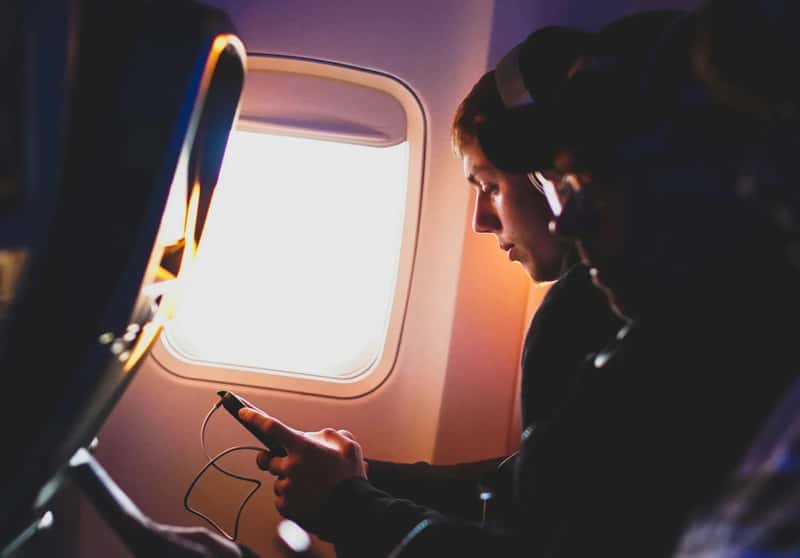
The cabin lights go dark at 36,000 feet.
Everyone else is asleep.
You are not.
Your thumb is on the screen. Tracing. Measuring. Watching a tiny animated plane crawl across a pixelated ocean like it is the most important data you have ever consumed in your life.
There is a word for the gap between the person who boards a flight and the person who sits in that seat watching altitude numbers tick down with an almost religious focus. That word is not “anxious.” It is not “neurotic.” It is something much older. It is the gap between the self who is in control – the one who drives, decides, reroutes – and the self who is suddenly cargo. Strapped in. Hurtling through a void. Utterly subject to someone else’s expertise, someone else’s instrument panel, someone else’s calm.
This is why the fear of flying is so hard. Even though flying is considerably safer than most modes of transport, it lacks the one thing we need to feel like it is safe: the illusion of control. And in the absence of that illusion, the mind does not go quiet. It finds a screen. It finds a map. It finds ten data points to hold onto while the turbulence rolls through and the overhead bins rattle and the whole aluminum tube bends, just slightly, in ways that physics allows but your nervous system does not.
1. The Witness Anchor
When the body is trapped, the mind becomes a detective.
It narrows its focus. It finds something – anything – to observe with precision.
The flight map is the perfect object for this. It is moving. It is data-rich. It is measurable. Research suggests that one’s psychological state has a significant impact on information-seeking behavior. When anxiety climbs, the brain does not shut down. It seeks more information – frantically, hungrily, scanning for anything that confirms you are still here, still locatable, still witnessed by the world below.
Watching the map is the mind’s way of bearing witness to itself.
It says: I know where I am. I am 4,200 miles from home. I am over the North Atlantic. I am at 38,000 feet. I am real. I exist. I can be found.
This is not trivial. In environments that strip away agency, knowing your coordinates is a primal form of self-preservation. The map does not calm the fear. It locates the self inside the fear, which is enough to keep the panic from going total.
2. The Illusion of Participation
Watching is not the same as controlling. But the brain does not always know the difference.
Coined by psychologist Ellen Langer, the Illusion of Control is a psychological bias causing an overestimation of one’s ability to control events. People experiencing this phenomenon will believe they can influence situations and outcomes that are, in reality, completely up to chance.
The flight tracker feeds this beautifully.
When you watch the altitude, something in your nervous system registers it as participation. You are monitoring. You are engaged. You are – in some wordless, pre-rational part of your brain – helping. The plane stays up partly because you are watching it stay up. This is irrational. This is also deeply, recognizably human.
We press the elevator button repeatedly in a rush. We blow on dice before we roll them. Illusions of control may have origins in early civilizations for survival purposes. Early humans developed ceremonies and rituals to appeal to the forces of nature. If rain occurred after a ceremony, people assumed they had persuaded natural forces to intervene, granting themselves the illusion of control.
The flight map is the modern ceremony. The ritual of watching.
3. The Data Blanket
Numbers are not warm. But they feel safe.
Speed: 578 mph. Altitude: 37,400 ft. Time to destination: 4h 22m. Outside temperature: -62°C. These numbers do nothing for you. They cannot reroute turbulence. They cannot guarantee arrival. But they wrap around a frightened mind like a blanket wraps around a cold body – not solving anything, just containing the chaos.
High illusion of control – the belief that one has control over an outcome that is, in actuality, uncontrollable – has been associated with happiness, motivation, effective task performance, and adaptive coping to stressful events.
The data becomes the coping. The numbers become the thing between you and the void. As long as you are reading the screen, you are not falling. As long as the altitude indicator is steady, you are not in freefall. The information is the anchor point. The numbers are the rope.
It is not rational. But very few survival strategies are.
4. The Countdown Mechanism
The anxious mind cannot tolerate open-ended uncertainty.
It needs an end. A defined perimeter to the suffering.
The flight tracker provides exactly this. Four hours and twelve minutes. Then three hours fifty-eight. Then three hours forty-four. The countdown is everything when you are locked in a pressurized tube with no exit. Fear of not being in control of the situation can trigger anxiety. This feeling can be magnified when flying, as passengers have limited control over the aircraft.
But a countdown changes the emotional landscape entirely. It converts boundless dread into a finite ordeal. It says: this has an edge. This ends. You will land. The seat belt sign will ding off. You will walk through a jetway smelling of recycled air and bad carpet. You will be standing on something solid. The countdown makes the intolerable manageable. Not comfortable. Just survivable. Which, in the dark at 36,000 feet, is exactly enough.
5. The Cartographic Self
I remember a flight somewhere over Greenland. Middle of the night. The window beside me was a rectangle of absolute black. No stars. No ocean. Nothing but dark and the faint hum of engines I was trying very hard not to think about.
I was not watching a movie. I was not reading. I was staring at the map with the intensity of a surgeon, watching the little plane icon cross the edge of the ice sheet. And something in me relaxed – just slightly – when I could see that we were over land again. Even uninhabitable land. Even a land of ice and no roads. It was land. It was locatable. I was locatable.
Stressing over situations beyond your control can lead to feelings of helplessness or anxiety. When facing a challenge, asking yourself “what can I actually control here?” and shifting your focus to what you can do can help you feel more empowered and less overwhelmed.
The map gave me the only “what I can do” available: I could know where I was. That was the whole deal. And it was enough to keep me from the edge.
6. The Hypervigilance Loop
Anxiety does not sit still. It scans.
People with flying anxiety may become hyper-aware of their surroundings, constantly scanning for signs of danger or discomfort. This is the nervous system doing its job – looking for the threat, trying to identify it, trying to categorize it into something manageable.
The flight tracker hijacks this loop in a useful way.
It gives the hypervigilance somewhere to go. Instead of scanning the ceiling of the cabin for signs of structural stress, instead of watching the flight attendants’ faces for micro-expressions of concern, instead of interpreting every engine sound change as a harbinger of catastrophe – the anxious passenger has a screen. A contained world of information. The hypervigilance feeds the tracker. The tracker feeds back reassurance. The loop becomes, if not comfortable, at least circular rather than escalating. The anxiety has a job. The job has a product. The product is: we are still on course.
7. The Locus Shift
Control is not binary. It is a spectrum. And the brain knows this.
Locus of control is a psychological concept that explores whether you believe you’re in charge of your life, or if other forces are more at play. Psychologist Julian Rotter introduced the idea in the 1950s, explaining that people tend to think of control in two different ways: internal and external.
Passengers who obsessively track the flight map are performing a micro-shift of their locus of control. They cannot fly the plane. But they can know what the plane is doing. They cannot change the route. But they can monitor it. They cannot command the weather. But they can watch the turbulence zones on the map and brace in advance rather than be ambushed.
People with an external locus of control are more likely to experience anxiety since they believe that they are not in control of their lives. The map is a tool for dragging the locus – just slightly, just enough – back toward internal. It says: I know something. I am informed. I am not merely subject to this. I am watching it. Watching is a form of power, even when the power is only cognitive.
8. The Temporal Anchor
Time behaves strangely in the air.
It distorts. It slows when you are afraid. A five-minute bout of turbulence can feel like twenty. An hour at altitude can feel like a week. The mind untethered from land loses its grip on ordinary time. And without time – without the measurable passage of minutes and miles – anxiety balloons.
The flight tracker restores temporal reality. One frequent flier’s obsession with pinpointing her location in the sky dates to a turbulent flight, after which she keeps her eye on the elevation to see how much the plane has dropped in shaky air. This is the temporal anchor in action: using real-time data as a clock. As a grounding device. When you know that fourteen minutes have passed since the last waypoint, when you can see the plane has moved measurably across the screen, time resumes its normal shape. The present moment becomes navigable again. The future – the landing – feels closer. Reachable. Time, like the self, needs coordinates.
9. The Safety Ritual
Every anxious flier has a ritual. Most of them do not call it that.
They call it preference. Habit. Just what they do. The identification of common safety-seeking behaviors and their role in the maintenance of threat perception has formed the basis of many evidence-based treatments targeting specific anxiety disorders.
The flight map is a safety ritual. It is the modern equivalent of the pre-flight ceremony. You pull it up before takeoff. You check it obsessively at the first sign of a bump. You do not close it until the wheels touch down. The ritual is the anchor. The sequence is the control. When everything else is uncertain, the ritual provides a predictable script: open the map, check the altitude, check the speed, check the time remaining. Do it again in ten minutes. Do it again after the turbulence.
The ritual does not change the flight. It changes the flier. It moves them from passive passenger to active monitor. And that tiny reclassification is sometimes all the mind needs to pull itself back from the ledge of full panic.
10. The Quiet Negotiation With Fate
At its deepest layer, obsessive flight tracking is not about information at all.
It is about conversation.
The traveler bent over the screen in the dark is not reading data. They are negotiating. With the aircraft. With the atmosphere. With whatever force governs the space between departure and arrival. Numerous studies show that feelings of lack of control can lead to anxiety, helplessness, pessimism, failure to act when it is possible to influence events, and even depression. The screen is the antidote to all of these – not because it restores actual control, but because it restores the feeling of agency. The feeling that you are in dialogue with your own fate rather than simply subject to it.
This is the oldest human impulse. The perception that one’s actions influence outcomes may prevent despair during stress and encourage motivated behavior to cope. Watching the screen is the action. The outcome – safe landing – is what the watching is meant to influence. Not rationally. Not logically. But in the deep grammar of the anxious human animal, it is enough. The watching is the prayer. The data is the liturgy. The landing is the answer.
There is something quietly beautiful about a cabin full of people in the dark, each one locked in their own private negotiation with altitude. Some are sleeping. Some are watching films and laughing softly at nothing. And some – the ones this whole piece has been about – are holding a glowing screen like a compass, watching a small animated aircraft inch its way across the map of the world.
They are not broken. Some psychologists believe the illusion of control can be beneficial, as it may reduce feelings of helplessness and boost well-being by fostering confidence in one’s ability to create change. The flight tracker is their confidence. Their compass. Their proof that the self can locate itself even when the body has surrendered all navigation to someone else. They are not anxious people pretending to be calm. They are anxious people doing the only rational thing available: holding onto something that moves, so that they can feel like they are moving with it rather than being moved.
The next time you see someone on a flight who hasn’t looked up from the map in two hours – who is watching the altitude change by increments of ten, who flinches at every waypoint update, who has memorized the route as if they themselves plotted it – don’t smile knowingly. Don’t shake your head. Just recognize that they are doing what the mind has always done when the body has no other option. They are finding the ground from 38,000 feet up. They are making a home out of data in a place where no home exists. And when the wheels finally touch down, and the map becomes unnecessary, they will close it without ceremony, breathe out something they’ve been holding since takeoff, and quietly return to being someone who is in control of something again.
Until the next flight. Until the screen comes alive. Until the little plane starts moving. And the watching begins.