You land in a city you’ve never seen.
You walk past the ornate facades. Past the pastel plazas. Past the postcard-perfect squares.
And then you see it – grey, blunt, uncompromising – and something in your chest goes quiet.
Not uncomfortable quiet. Recognizing quiet.
Most travelers photograph the cathedrals. You photograph the concrete. And you’ve never quite known why – until now. There is a version of you that was built long before you ever booked a flight. That version learned, early and hard, that softness was a liability. That ornament was a lie. That only the things which showed their structure – raw, honest, armored – could be trusted. You carry that version everywhere. Through every time zone. Every transit hall. Every foreign street. You dress it up as aesthetic preference. You call it “taste.” But taste, as any psychologist will tell you, is autobiography in disguise.
1. The Concrete Mirror
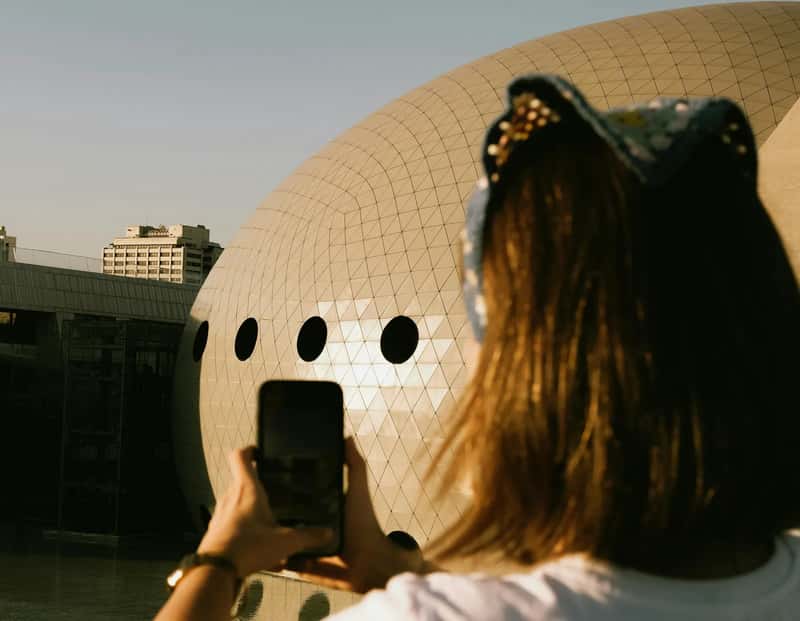
Brutalist architecture often elicits strong reactions – discomfort, awe, indifference, or affection – because its formal language and social history activate sensory, cognitive, and cultural responses.
But for a specific kind of traveler, the reaction isn’t discomfort. It’s recognition.
That is the first clue.
When you stand in front of a brutalist government building in Belgrade or a Soviet-era housing block in Minsk and feel something warm – something almost like belonging – you are not having an architectural response. You are having a psychological one.
The tension between the physical and the psychological is real, whereby corporeal struggle intertwines with an abstract, aesthetic admiration of the brutalist objects. That tension is the mirror. The concrete is reflecting something back at you that softer buildings never could. It’s reflecting the part of you that was also designed for function over feeling. That was also built to withstand.
The question is: when did you first decide that surviving was more important than being seen?
2. The Childhood Blueprint
Architecture does not exist in a vacuum. Neither does preference.
The places that feel like home – even foreign ones – follow a psychological logic that runs deeper than conscious thought. That logic was written in your first years of life.
Caregivers who are strict and emotionally distant, do not tolerate expressions of feelings, and expect their child to be independent and tough might raise children with an avoidant attachment style.
That child grows up. Books plane tickets. Walks through foreign cities with a camera and a particular eye.
This attachment style usually develops as a result of emotional rejection and neglect from primary caregivers in early childhood. For these individuals, avoidance and withdrawal become their strategy to protect themselves from experiencing more pain and abandonment.
Brutalist buildings do not ask you to feel. They do not beg for emotional response the way a baroque cathedral does. They simply stand. They endure. For someone who learned very early that needing warmth was dangerous, that kind of mute endurance is not cold. It is deeply, achingly familiar.
3. The Honest Wall
Here is what brutalism is, stripped of art history.
Core traits of Brutalism include functionalist design, daring geometry, overbearing scale, and the blatant exposure of structural materials, chiefly concrete and steel.
There is no decoration. No concealment. No performance of warmth it doesn’t actually possess.
Brutalism embodies honesty of structure and material, an emphasis on craft and tectonics, and an anti-decoration ethic.
Now consider the psychology of someone who grew up in a home where emotional warmth was performed – where smiles concealed threat, where gentleness was weaponized, where the surface was decorated but the structure was rotten. For that person, a building that refuses to perform warmth is not alienating. It is trustworthy. It shows you exactly what it is made of. You know where you stand. You always know where you stand.
And in a life full of people who didn’t show you their structure, that is everything.
4. The Avoidant Traveler
There is a specific type of traveler who moves through cities like a researcher rather than a tourist. Observing. Cataloguing. Never quite arriving.
Avoidant attachment in adults may, from the outside, look like self-confidence and self-sufficiency. This is because the avoidant attachment style causes a low tolerance for emotional or physical intimacy.
Travel, for this person, is not leisure. It is regulation.
Over time, avoidant individuals learn to suppress physiological responses related to distress. It does not mean that they do not feel distress, but it appears that they cannot generate a solution when they feel overwhelmed. As a result, they overregulate their affect to appear as if they are unaffected.
Movement keeps the overregulation running. A new city means new stimulation, new external demands, a reason to be in your head instead of your chest. And brutalist architecture, with its austere looks and repetitive elements, does not demand emotional response. It permits emotional silence. For the avoidant traveler, that silence isn’t emptiness. It’s relief.
5. The Personal Reckoning
I remember the first time I stood in front of a brutalist tower in a city I couldn’t pronounce.
It was raining. The concrete was wet and grey and looked like it had been poured by someone who was deeply, philosophically uninterested in your opinion of it. And I loved it immediately.
I stood there for a long time. Not photographing. Just standing.
It took me years to understand what I was actually doing. I was standing in front of a building that reminded me of the emotional climate I grew up in – austere, functional, stripped of unnecessary softness – and feeling, for the first time in a long time, like I wasn’t the strange one.
Children who have an avoidant attachment pattern have learnt that their emotions are not responded to empathically. Such children have learnt to anticipate that expressions of their emotions will anger or irritate their carer.
The building didn’t anger. Didn’t irritate. Didn’t require me to be smaller. It just stood there, in the rain, being exactly what it was. I think that’s the closest I’d felt to safe in a very long time.
6. The Comfort of Imperfection
Brutalism does not age gracefully. It stains. It cracks. The concrete weeps mineral streaks down its face over decades.
And somehow, that is part of the appeal.
“Architecture physically represents imperfection – both in terms of buildings and cities and, more importantly, acknowledges that we humans are not perfect.”
For someone raised in a home where perfection was demanded and failure was punished, a building that wears its aging openly is an act of radical honesty.
While brutalism favors functionality over aesthetics, accepting urban imperfections is a form of acknowledging that beauty and utility can coexist without pretense.
There is a psychological permission embedded in that imperfection. Permission to be flawed and structural at the same time. Permission to hold weight while also showing wear. The traveler who finds this beautiful is not morbid. They are, at a subconscious level, finally being told – by a building, in a foreign city, in a language that has no words – that their own cracks are not disqualifying.
7. The Deactivating Strategy
Psychology has a clinical term for the behavior pattern that brutalist-preferring travelers often unconsciously enact.
People with an avoidant attachment style tend to cope with challenging relationship situations by pulling away, breaking up, or distancing themselves emotionally and physically from friends and family. These behaviors are known as deactivating strategies, and they essentially help maintain a comfortable buffer between the avoidant person and others.
Travel is a deactivating strategy with a passport.
You can’t be emotionally available to people back home when you are standing in front of a concrete monolith in a city twelve time zones away. The geography does the emotional work for you. The brutalist skyline is the buffer made physical – massive, angular, impenetrable.
Deactivating strategies are essentially ways to escape or minimize the emotional pain and frustration caused by attachment figures who were unavailable, unsympathetic, or unresponsive. Their primary purpose is to “turn off” or dampen the attachment system, preventing feelings of vulnerability, rejection, or disappointment.
The tragedy is not that the strategy works. It’s that it works too well. The city ends. The flight home begins. And the walls come with you.
8. The Architecture of Self-Reliance
There is something else brutalism offers the traveler who grew up learning to need nothing.
Pure self-sufficiency. Massive self-containment. A building that requires no validation from you in order to stand.
Avoidant adults tend to be independent. Their self-esteem is high and they do not rely on others for reassurance or emotional support. Such individuals might invest in their professional development and are likely to build up their confidence on each personal success.
The brutalist tower is the architectural expression of this psychology. It does not lean on neighboring structures. It does not borrow ornament from historical styles. It stands alone, in its own material, by its own structural logic. It is, in the deepest sense, what psychologist John Bowlby called “compulsive self-reliance” – made permanent in concrete and steel.
The traveler who photographs these buildings is, on some level, photographing themselves. Documenting the version of the self they built when no one else was available to build a shelter for them.
9. The Uncanny Recognition
Psychologists use the word “uncanny” to describe the eerie feeling of encountering something simultaneously foreign and familiar.
That is the precise sensation that brutalism produces in the emotionally armored traveler. Foreign city. Unknown country. And yet the building feels like home.
The emotional qualities of brutalist constructions, viewed through a neo-phenomenological perspective, suggest that their affectivity may be one possible solution to the problem of lost resonance in contemporary society.
Lost resonance. Think about that phrase. The traveler who grew up in an emotionally unavailable household knows something about lost resonance – about reaching toward connection and finding only silence. Brutalism, paradoxically, restores that resonance. Not by offering warmth, but by offering recognition. The building says: I too was built for function, not comfort. I too was asked to hold enormous weight without complaint. I too was never decorated to seem more gentle than I am.
With over 50 years of extensive research on attachment theory, psychologists agree that your earliest emotional bonds with your primary caregiver can directly impact your future relationships. That includes your relationship with cities. With buildings. With the skylines that make you feel, inexplicably, like you’ve come home.
10. The Weight of What Was Built
This is the heaviest truth of all, and it deserves to be said plainly.
The child who built emotional walls in order to survive did something extraordinary. They engineered a psychological structure under conditions that would have collapsed a more warmly-attached child. They learned, without blueprints, how to bear weight. How to stand without support. How to function when the material they had to work with was raw and unforgiving.
If children do not experience their caregivers’ sensitivity to their needs, they may develop physical and emotional independence. In the short term, this can act as a positive, protective factor. However, it can be damaging in the long term as they disconnect from their feelings and emotional needs.
The brutalist building honors that engineering. It says: this too was built under duress. This too was designed to hold rather than to please. And it still stands.
Since the 2000s, cultural opinion has shifted; many brutalist buildings are now appreciated for their boldness and craftsmanship. The same shift is available to the people who love them. The same reappraisal. The same recognition that what was once dismissed as cold or harsh or difficult was, in fact, something that had survived everything thrown at it – and was still, undeniably, standing.
There is a particular kind of grief that arrives slowly. Not as weeping, but as a quiet settling – like concrete curing. It arrives when you finally understand that the aesthetic you thought was purely intellectual is, in fact, the most personal thing about you. That every grey facade you’ve ever found beautiful was a letter you were writing to the child who had to become a building before they were ready.
The traveler moves through foreign cities carrying that child in their chest. They point their camera at the structures that feel like kin. They stand in the rain in front of unmoved, unmoving walls and feel something they cannot name at dinner parties. They book the next flight before the current one has landed. They call it wanderlust. They call it a passion for architecture. They call it anything except what it is: a search for the place where their particular shape of survival is finally understood.
You don’t have to stop finding brutalism beautiful. But perhaps the more important question – the one that waits for you past the customs desk, past the taxi queue, past every magnificent slab of grey you’ve ever stood before – is this: what would it feel like to finally build something with windows?