The city does not care about you.
The concrete does.
You stand in front of a building that most people cross the street to avoid, and something in your chest goes quiet.
Not empty. Quiet. There is a difference, and you have always known it.
Most people walk through cities looking for beauty. You walk through cities looking for something that finally looks like the inside of you – heavy, load-bearing, stripped of every pretense that was never yours to carry anyway. The identity gap is real. It is the chasm between the person you perform in fluorescent-lit offices and soft-furnished waiting rooms, and the person who actually survived what you survived. One of them smiles on cue. The other one recognizes a brutalist building from half a block away and slows down.
1. The Structural Self
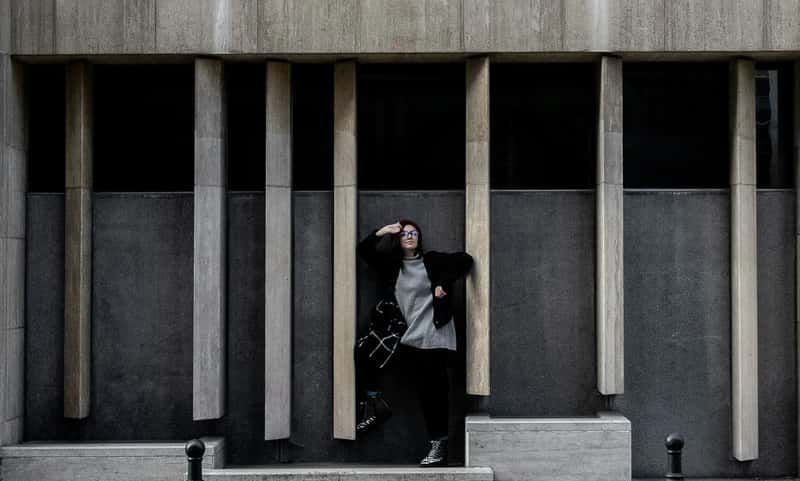
Psychologists have a name for the internal architecture that develops in response to early adversity: emotional walling. Not coldness. Not indifference. Structural necessity. When an environment is unpredictable or unsafe, the psyche does what any good engineer would do – it builds load-bearing walls. It creates internal systems of support that don’t depend on softness or decoration.
The walls are not a flaw. They were always a feature.
They were what kept you vertical when nothing else would.
When something or someone strips you down to function – when softness becomes a liability and every resource goes toward staying upright – you stop decorating. You become structural. You become load-bearing. You become, in the most literal psychological sense, brutalist.
And then one day, you turn a corner in a city you barely know, and there it is. A building built the same way you were. You don’t need to explain yourself to it. It already knows.
2. The Honest Building
Most architecture lies to you.
It hides its bones. It smooths its seams. It decorates over the very joints that hold it together, as though the truth of construction is something to be ashamed of.
Brutalist buildings are known for minimalist construction showcasing the bare building materials and structural elements over decorative design. There is no concealment. No flattery. What holds the weight is exactly what you see.
That radical transparency is not a design flaw. It is, for some people, a form of profound communication.
For people who spent years maintaining an elaborate emotional performance – being fine, being capable, being whatever the room required – there is something almost violently comforting about a structure that refuses to pretend. The concrete isn’t trying to look like marble. The steel isn’t painted to look like something warmer. Brutalism was a design philosophy where every element had a purpose, and nothing was decorative for its own sake. If you were raised in an environment where pretending was survival, an honest building feels like an exhale.
Finally. Something that tells the truth.
3. The Recognition Signal
There is a phenomenon that happens in the body before the mind catches up.
You feel it before you can name it.
Brutalist architecture often elicits strong reactions – discomfort, awe, indifference, or affection – because its formal language and social history activate sensory, cognitive, and cultural responses.
For most people, the discomfort wins. The mass is too heavy. The angles are too unforgiving. The lack of ornament registers as a lack of welcome.
But for others – the ones who grew up in environments that were also heavy and unforgiving and relentlessly functional – the reaction is different.
For people who grew up inside systems that were cold and surveilling, this isn’t discomfort. It’s recognition. The building isn’t triggering something dark. It is acknowledging something true. It is saying: I was also built for conditions that were not gentle. I was also made to endure. You are not alone in how you were constructed.
That is not haunting. That is witness. And witness, for the chronically unseen, is everything.
4. The Trauma Blueprint
The connection between brutalism and psychological survival goes deeper than aesthetics. It goes all the way back to the architects themselves.
It’s been suggested that Brutalism’s psychological roots lie in the trauma experienced by its key architects, many of whom were shaped by neurological disorders, war, and post-traumatic stress disorder. Neuroscience now confirms what trauma specialists have long suspected: prolonged exposure to near-death experiences rewires the brain, shrinking the areas responsible for emotional connection and making the sufferer permanently hypervigilant. PTSD sufferers tend to try to create the environments that deal with their trauma, fixating on repetition and control as a subconscious way of mastering their fears.
The building, then, is not just a building.
It is a psychological record. A survival document poured in concrete and left standing for whoever needs to read it.
This could explain why modernist architecture, particularly in its Brutalist form, so often resembles the ruined landscapes of war – concrete walls like trenches, windowless façades like bunkers, vast, empty plazas like bombed-out streets. In this interpretation, Brutalism is not just an architectural failure; it is a psychological imprint of the traumas of the 20th century.
Wounded things build in their own image. Always.
5. The Weight You Recognize
I remember the first brutalist building that stopped me cold.
It was in a city I was passing through during a period of my life I have never fully described to anyone. I was in the middle of one of those years where you maintain the surface because the alternative is too expensive. The building was grey. Enormous. It looked like it had been designed by someone who had given up on beauty as a concept and decided that endurance was enough.
I stood in front of it for a long time. And I thought: yes. That is exactly what it looks like. That is exactly what it costs.
People who carry invisible weight – grief they never named, trauma they never processed, responsibilities absorbed in childhood – often find that an overwhelmingly heavy structure is the first environment that finally matches their interior weather. The outside world is light and cheerful and full of people who seem effortless. The brutalist building is not effortless. It is enormous and difficult and utterly, unapologetically present. You don’t have to explain yourself to a building that already knows.
I didn’t cry. I took a photograph. Sometimes that is what we do with the things that see us.
6. The Body’s Archive
The experience of moving through a brutalist space is not only psychological. It is deeply, irreversibly physical.
Despite researching Brutalist architecture for years, one researcher was unprepared for the true corporeal experience of exploring these buildings. Reading back through their journals, they were struck by an evident conflict between stylistic admiration and physical uneasiness.
That conflict is familiar to anyone who has ever loved something that also made them uncomfortable.
Analysing Brutalist objects through a corporeal perspective helped to further understanding of the experience of living within them in a way that abstract thought could never have done. The tension between the physical and the psychological, whereby corporeal struggle intertwines with an abstract, aesthetic admiration of the Brutalist objects, is what defines the experience.
The body knows what the mind is still processing. The body slows down. The breath drops. Something ancient and pre-verbal inside you says: here. This one. This one understands.
You don’t choose brutalist architecture. It chooses you back.
7. The Permanence Hunger
There is a particular kind of person who has never felt certain that what they love will still be there in the morning.
They pack light. They leave before they’re left. They have rehearsed exits in rooms they were only just invited into. For them, impermanence is not philosophy. It is history.
People who have experienced profound instability – in families, in relationships, in their own sense of self – often develop an almost reverent relationship with permanence. The brutalist structure cannot be easily destroyed. It was engineered to outlast its critics. It weathers. It darkens. It acquires the patina of endurance. This is not coincidental in its appeal.
The traveler who has relocated twelve times in ten years. The person whose sense of home was always conditional. They look at a brutalist building and feel something they haven’t felt in a long time: the comfort of a thing that will not disappear while you’re not looking.
Stability, for the chronically unstable, is not boring. It is revolutionary.
8. The Imperfection Contract
There is a movement – quiet, deliberate, growing – that uses the psychology of brutalist architecture as a direct therapeutic tool.
The ImperfectCity initiative uses the psychology of brutalist architecture to free young people from an unrealistic “culture of perfection” and help them thrive.
The logic is clean. A building that was never beautiful, that was criticized on the day it was built and every day since, that still stands, still functions, still holds people inside its walls – that building is making an argument. The argument is this: you do not have to be perfect to be worth preserving.
The team behind ImperfectCity aims to demonstrate that the harshness of béton brut is instantly softened when collaboration and cohesion happen inside its walls. It is a reminder that, while brutalism favors functionality over aesthetics, accepting urban imperfections means serving society honestly.
For people who have spent their entire lives believing their worth was conditional on their polish – their performance, their presentation, their perfectly managed exterior – a building that never apologized for what it was carries an almost unbearable tenderness.
9. The Survival Aesthetic
The people who are drawn to these buildings are often the ones who know what it costs to be built for endurance rather than beauty. They know what it means to have your ornaments stripped away by circumstance. They became their own architects. They poured their own foundations. And when they stand in front of a building that went through the same process – a building that survived its own war and still stands – something in the chest recognizes it. Survival knows survival. It always does.
This is identity travel at its most elemental.
Not looking for a postcard. Looking for a mirror.
Brutalist architecture has increased in its relevance precisely because it offers an unparalleled projection surface for our persistent musings on catastrophe. The key designs in the Brutalist canon seem catastrophe-proof; their rigidity and defiant lack of inessential elements putting their apparent durability on par with that of natural monuments.
You did not travel to be impressed. You traveled to be witnessed. The grey cathedral of concrete standing in the rain at the end of the avenue is doing exactly that.
10. The Architecture of Becoming
The deepest truth about brutalist attraction is this: it is not about the past.
It is about permission.
Brutalist architecture stands as a complex exploration of the intersections between architecture, trauma, and the search for identity. Its use as both a visual and symbolic tool offers a profound commentary on the emotional and psychological barriers that individuals face when attempting to rebuild their lives after trauma.
The person who stands before a brutalist structure and feels something unlock inside them is not wallowing. They are receiving confirmation. Confirmation that what they built inside themselves to survive was valid. Was necessary. Was, in its own undecorated way, beautiful.
Another reason for the enduring power of brutalism is the style’s honesty. Just as a brutalist protagonist openly portrays himself to the world, so do brutalist buildings. The world, however, is not always willing to accept these structures – and neither is it willing to accept those who built themselves from the same raw materials. Brutalism is the “perfect visual allegory for exploring postwar trauma as it relates to postwar architecture.”
And postwar trauma does not require a war. It only requires a life that was, for some period of time, genuinely difficult to survive. Most lives qualify. Most people just never found the building that said so out loud.
Until they did.
There is something quietly sacred about the moment a person realizes that their damage has an aesthetic. That the internal landscape they have been navigating alone – the stripped walls, the exposed load-bearing structures, the total absence of decorative excess – has been rendered in concrete and steel and placed in a public square for anyone to see. That other people walk past it every day and call it ugly, while you stand in front of it and finally, finally feel understood. The building did not need your approval. Neither, it turns out, did you. You both just needed to outlast the people who said you should have been built differently.
The traveler who seeks brutalist architecture is not looking for discomfort. They are looking for the only kind of company that never asks them to be more palatable, more ornate, more pleasing than the moment requires. They are looking for the company of honest, heavy, enduring things. They are looking for themselves rendered at a scale large enough to finally be undeniable. And in the grey monolith at the end of the grey street in the grey November light of some city they barely know, they find it. Not beauty. Not warmth. Something better.
Recognition.
Go find your building.