You book the ticket at midnight.
Not a package. Not a guided tour. Somewhere no one will recognize you.
Somewhere the crowd hasn’t landed yet.
There is a gap between the person you perform at home and the person who materializes the moment the plane wheels leave the tarmac. It is thin, that gap. Paper-thin. But you live inside it. You have built an entire travel philosophy around it.
The tourist hubs terrify you – not because of the lines, not because of the selfie sticks. They terrify you because they hold a mirror up, and the reflection is too crowded to be entirely yours.
1. The Curated Self
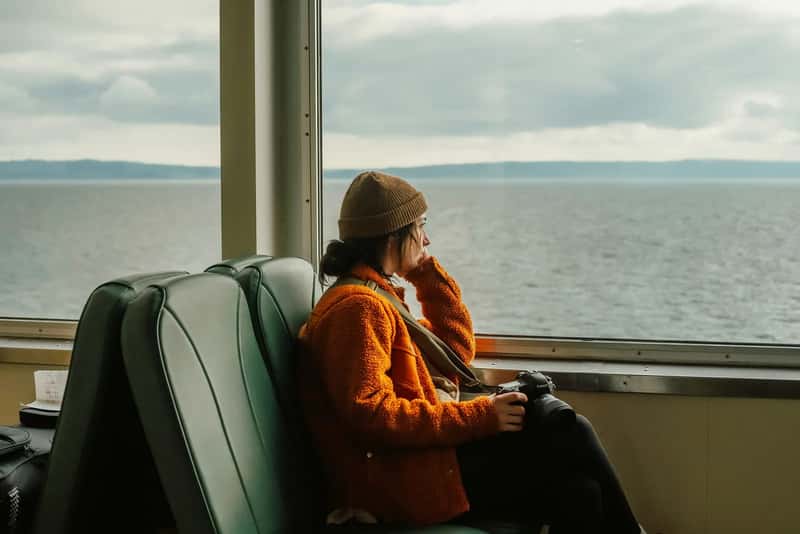
Solo travel strips away the daily roles you play at home – employee, partner, parent – allowing your core identity space to breathe and be re-examined.
That stripping is the point.
But here’s the dark edge of it: some travelers don’t go away to find themselves. They go away to perform a version of themselves they can only maintain in unfamiliar places.
The “off-the-beaten-path” philosophy is, at its core, a curation project.
You curate the backdrop. You curate the absence of witnesses who knew the old you. You curate the silence necessary to hear a version of yourself you prefer.
Every decision, big or small, comes from your own preferences. This clarity helps surface who you are when you are not performing a role or responding to others’ expectations.
The trouble is: a curated self is still a costume.
The tourist hub rips the costume off. The crowd makes you anonymous – but not in the way you planned.
2. The Exit Strategy
Every avoided tourist hub is a small, quiet exit.
An exit from recognition. From comparison. From the socialperformance of being impressive about where you went.
Our discontent about who we are can be refashioned, unconsciously, as discontent about where we are. We avoid confronting and overcoming the internal roots of our distress when we locate the causes of our distress in the world – in external factors.
This is the psychological sleight of hand that no travel influencer will name.
You tell yourself you hate the Eiffel Tower because it’s crowded. You tell yourself you prefer the unnamed village two hours east. But the real story is quieter and more honest: the unnamed village doesn’t demand anything from you.
It doesn’t have a consensus about who you should be.
The exit strategy feels like freedom. Sometimes it is. But often, it is avoidance dressed in hiking boots and a linen shirt.
3. The Temporary Identity
From a psychological perspective, solo travel creates a distinctive environment characterized by autonomy, novelty, and controlled separation from familiar social contexts.
That controlled separation is where the temporary identity is born.
You become someone slightly different in Oaxaca than you are in Ohio. Slightly bolder in Tbilisi than in the Tuesday morning team meeting.
Psychologists have a word for this: identity malleability.
The problem isn’t the temporary identity. The problem is what happens when that identity requires remoteness to survive. When it can only breathe where no one else is breathing.
One is still left with the problem of how to bring a preferred sense of self back home. Constant solo travel can feel like a way to keep that self alive, but this may not be viable or ultimately best for one’s well-being.
The remote café, the unnamed alley, the unmarked trail – they’re not just destinations. They’re incubators for a self that hasn’t figured out how to exist under fluorescent lighting.
4. The Crowd as Mirror
Stand in any major tourist hub and watch a solo traveler’s face.
There is a specific micro-expression that passes across it. A tightening. A recalibration.
The crowd does something psychologically violent to the solo identity traveler: it reflects them back as ordinary.
Making a tourist identity salient increases consumer self-disclosure – counter to the common intuition that consumers tend to be more cautious and less self-expressive when traveling to an unfamiliar place.
But the avoider of tourist hubs isn’t afraid of unfamiliarity. They’re afraid of familiarity.
Afraid of recognizing, in the sea of selfie takers, the same hunger they carry. The same restlessness. The same search.
The crowd doesn’t erase identity. It democratizes it. And for a traveler whose entire self-concept depends on being singular – being different, being deeper – that democratization is the most terrifying destination of all.
5. The Inner Compass
I remember the first time I chose a side street in Lisbon over the celebrated square everyone had marked on their maps.
I told myself it was instinct. I told myself it was taste. I sat at a plastic chair outside a café that served coffee in paper cups and felt, for forty minutes, entirely like myself.
Only later did I understand what I was protecting.
Not the experience. The experience was ordinary. I was protecting the feeling of having chosen something no algorithm had suggested. Something no itinerary had pre-approved.
I began to realise I wasn’t travelling to escape my life or even to see the world. I travelled to meet the parts of myself that had never been given language.
That is the inner compass speaking. And it is not always pointing toward authenticity. Sometimes it is pointing away from exposure. The compass and the exit sign can look identical in the dark.
6. The Social Subtraction
Tourist hubs are social pressure chambers.
They demand performance. They demand the photograph, the opinion, the comparison. They force you into a conversation with every other human who has ever wanted to see the same thing.
When travelling solo, travellers remove themselves from the continual negotiation that is often difficult with group dynamics. Travellers have control of the decisions and actions, and what to eat, what to do, and when to have a break. Having this control removes perceived obligation and makes preferences resurface that might have become obscured by social obligation.
Avoiding tourist hubs is an extreme version of this impulse.
It is social subtraction – the removal of every potential witness to the gap between who you are and who you are trying to become.
The quiet village doesn’t ask you to justify your choices. It doesn’t compare you to anyone. That absence of comparison is not minimalism. It is a psychological survival mechanism wearing the clothes of wanderlust.
7. The Narrative Armor
“I don’t do tourist traps.”
You’ve heard it. You may have said it. Six words that carry the weight of an entire identity fortress.
The process of documenting and sharing solo travel experiences can play a significant role in narrative identity reconstruction. As you craft and share stories about your journey, you’re actively engaging in the process of making meaning from your experiences and integrating them into your sense of self.
The narrative armor is forged in the places no one else went.
You become the person with the better story. The deeper story. The story that signals taste, intelligence, a refusal to be herded.
But armor is heavy. And underneath it, there is always someone who is afraid the simpler story – the crowded one, the mainstream one – might be just as valid.
The narrative armor protects a fragile identity not from the tourist hub itself, but from the possibility that the tourist hub holds something true.
8. The Solitude Addiction
There is a point in the solo travel psychology where solitude stops being medicine and starts being a requirement.
Prolonged periods of solitude can sometimes lead to feelings of loneliness, identity confusion, or difficulty readjusting to life back home.
The signs are subtle at first. Irritation when a destination becomes popular. A low-grade grief when a hidden café gets a write-up in a travel magazine.
The solitude addict doesn’t want discovery. They want exclusive custody.
Crowded destinations can undermine the reflective space central to the experience.
That is the psychological truth embedded in the preference for empty places. The crowd interrupts the internal monologue. And for a traveler whose identity exists primarily in that monologue – the quiet voice that says “I am this kind of person” – the interruption feels like erasure.
The tourist hub doesn’t erase you. But it drowns out the frequency you’ve been broadcasting to yourself.
9. The Collapse Risk
Here is what no one says at the hostel bar, over the warm beer and the practiced story about the unmarked road:
The identity built entirely in transit is fragile.
When you return to a structured life, with exceptionally predictable surroundings and limited choices, an old sense of predictability may seem suffocating. The emptiness of returning from travelling is not a simple feeling of nostalgia and space. The emptiness may also be a sign of just a small expansion of your identity that can’t fully be embraced in your past context.
The collapse risk is real.
The more remote the places you’ve required to feel like yourself, the more uninhabitable the ordinary becomes.
While solo travel can often result in a profound change within the individual traveller, the real challenge may start when you come home from your travels. The certainty, independence, and outlook acquired in life may just not fit in with your daily routines.
The collapse isn’t dramatic. It’s a slow, grey Tuesday. Coffee in a familiar mug. A self that doesn’t quite fit the room it came home to.
10. The Integration
The heaviest truth of identity travel is this: the gap never closes on its own.
Empirical research examining solo travelers’ reflective processes found that participants engaged in extensive self-evaluation, questioning assumptions, and reconstructing personal narratives. Many reported that solo travel provided their first opportunity for sustained, undistracted self-reflection, leading to significant insights about values, desires, and life direction.
But insight and integration are different animals entirely.
Insight happens on the unnamed road. Integration happens at the kitchen table, in the difficult conversation, in the ordinary Wednesday that doesn’t offer a backdrop worth photographing.
Values clarification – the process of identifying what matters most – is fundamental to authentic identity development. Solo travel facilitates this process by placing individuals in situations where values become tangibly evident through choices and emotional responses.
The tourist hub avoider has done the excavation work. They have gone deep into the self in places where the self had room to breathe.
The final and most frightening journey is not to the unmarked village. It is back. Back into the crowd. Back into the hub. Standing in the square with everyone else and discovering that the identity holds – that it was never actually dependent on the emptiness.
That is the integration. That is the work the quiet roads were always preparing you for.
The crowd is not your enemy. It is the final exam.
And the solo traveler who has done the real work – who has sat in enough unnamed cafés, walked enough unlit streets, asked themselves enough uncomfortable questions in the dark – eventually discovers something that no hidden destination can offer: the ability to be entirely themselves in the most ordinary, crowded, Instagram-saturated square on earth.
Not because the crowd has changed.
Because they have.
Somewhere between the departure gate and the return, the fragile thing became durable – not by avoiding the weight of the world, but by learning, slowly and imperfectly, how to carry it.