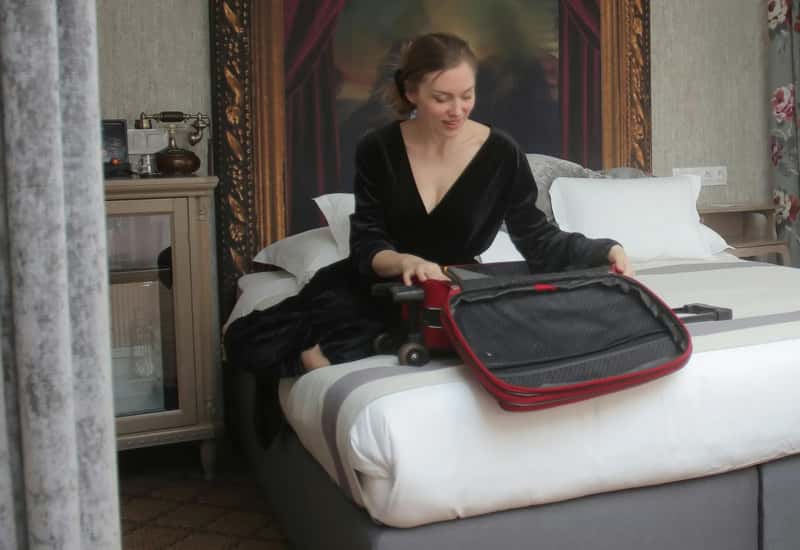
The hotel room smells like someone else’s life.
You set your bag down. Then you pick it up again.
The suitcase zipper sounds too loud in a quiet you didn’t earn.
You are a guest in a space that does not know your name.
And yet – the first thing you want to do is unpack.
Not because you need your things. Because you need to feel like something here is yours.
The need to immediately unpack is not neurosis. It is not fussiness. It is something far older and far more aching than either of those words. It is the human animal, stripped of its territory, doing the only thing it knows: arranging the evidence of itself in rows, and waiting to feel like it lives somewhere.
1. The Territorial Animal
Let’s be honest about what we are.
Every day, without thinking about it, we claim spaces as our own – placing a bag on a chair to “save” it, arranging personal items on a desk, feeling a jolt of discomfort when a stranger stands too close. These are all expressions of territoriality: a deeply rooted pattern of behavior in which individuals assert control over physical spaces, objects, or even ideas.
We are, at a cellular level, border-drawing creatures.
One of the most influential explanations for this comes from evolutionary psychology, which argues that territoriality evolved as an adaptive strategy to help humans secure access to essential resources like food, shelter, and mates. Individuals who successfully defended their territory had a better chance of survival and reproduction, passing on these tendencies to future generations.
So when you frantically pull folded shirts from your suitcase the second you arrive somewhere new, understand this: you are not being practical. You are being prehistoric. The lizard brain doesn’t distinguish between a savanna and a Suite 204. It just knows it doesn’t own this ground yet.
And it doesn’t like that one bit.
2. The Personalization Instinct
Here is what the unpacking ritual actually is.
It is decoration. It is staking a claim. It is an act of psychological vandalism dressed as tidiness.
Territories allow people to manage and communicate their sense of who they are. When we move into a new office, house, or apartment, often the first things unpacked and displayed are highly personal possessions or decorations associated with the permanent places in our lives – and there is evidence that this personalization of new spaces may predict success and longevity there.
Read that again. Success and longevity.
The toothbrush placed on the bathroom ledge. The phone charger snaked along the nightstand. The jacket draped over the chair rather than left in the suitcase. These are not casual acts. Personalization is one of the most visible expressions of territoriality – it involves adding personal items or modifications to a space to make it reflect your identity.
You are not unpacking clothes. You are building a ghost of home in a room that will forget you existed by checkout time tomorrow.
3. The Switching Cost
There is a reason that not everyone unpacks immediately – and it is just as psychologically revealing.
Some travelers leave the suitcase open on the floor like a wound. They pull things out one item at a time, reluctantly, as though committing to the space means surrendering to it.
Travel loads the nervous system with new routes, faces, and sounds. When we return or arrive somewhere unfamiliar, executive function lags. Psychologists sometimes call this a “switching cost” – the time and energy it takes to move between contexts.
For these people, the unpacked suitcase is a refusal. A protest. A way of saying: I am not all the way here yet.
The ones who unpack in minutes are saying the opposite. They are sprinting toward belonging in a place that hasn’t offered it. Both responses are survival strategies. Both responses are exhausting.
The gap between them is the gap between anxiety and denial.
4. The Ownership Illusion
Here is the darkest part of the whole performance.
It doesn’t work. Not really.
Psychological ownership refers to the deep-seated feeling of possession that can arise even in the absence of legal ownership. A student may feel a sense of ownership over a specific seat in a classroom, leading to feelings of irritation if someone else occupies it. This phenomenon can manifest in various contexts, where a sense of belonging can enhance engagement.
The key word is feeling. It is a feeling of possession. Not possession itself.
You can line your toiletries up on the bathroom shelf in perfect order. You can hang your clothes in the wardrobe and leave your shoes by the door like you live here. And when the housekeeper comes in the next morning and moves everything back to their factory-default positions, you will feel something close to grief.
Because the claim you staked was never real. Territorial indicators are the physical signs that communicate ownership or control of a space, and they exist on a spectrum – from highly temporary to deeply permanent. A hotel room keeps you at the temporary end. Always.
5. The Identity in Transit
I want to tell you something personal here.
There was a trip – a conference in a city I’d visited a dozen times – where I arrived at the hotel and unpacked my entire bag within six minutes of closing the door. Not because I needed anything. I had nowhere to be for three hours. I unpacked because the room felt like a judgment. Beige walls. Generic art. A TV remote in a sealed plastic bag. The room was a category, not a place. And I needed, urgently, to be a person and not a category myself.
I arranged my notebook on the desk. My pen beside it. My book on the nightstand. My shoes under the chair as though I owned the chair.
I sat down and felt – for approximately eleven minutes – like I belonged there.
Then the feeling evaporated. Because psychologists have long recognized that our surroundings act as an extension of identity – the objects, colors, and routines that make up “home” help to stabilize our sense of self. Eleven minutes of borrowed objects cannot replicate a life’s worth of self-stabilization.
I knew that. I unpacked anyway.
6. The Control Ritual
The need to unpack isn’t just about territory. It is about the illusion of control in a situation that offers almost none.
There’s a psychological reason for our instinctive pull to nesting, and it has to do with control – or at least the illusion of it.
Think about the math of a hotel room. You didn’t choose the bed firmness. You didn’t choose the carpet color. You can’t adjust the thermostat past a locked range. The water pressure is predetermined. The checkout time is non-negotiable. You are a temporary occupant inside someone else’s carefully managed system.
Against all that powerlessness, agency comes through micro-control – when larger life events feel beyond our influence, small, successful acts of organization provide reassurance and rebuild confidence.
The act of putting your shampoo in the shower caddy is, neurologically speaking, a tiny act of defiance against the universe’s indifference to your comfort. Which is, when you think about it, one of the most human things imaginable.
7. The Anxiety Architecture
Nesting behavior under stress is not casual tidiness. It is architecture built from anxiety.
There’s scientific evidence of the correlation between stress and ritualization – redundant, repetitive behaviors like washing dishes or scrubbing counters. One study in the journal Current Biology posits that rituals like cleaning and organizing might even be an effective coping mechanism for anxiety, with higher-anxiety individuals making more rigid and repetitive movements as a coping strategy.
The compulsive unpacker. The person who re-folds the same shirt twice. The traveler who lines up their products in the bathroom by height.
These are not fussy people. These are anxious people doing the best they can with the tools they have.
Not all nesting is restorative. For some, it can tip into perfectionism or avoidance – an attempt to tidy feelings rather than experience them. The difference lies in intention: are you making space to breathe, or trying to erase discomfort?
The honest answer, for most of us arriving somewhere foreign and unfamiliar, is both. Simultaneously.
8. The Place You Don’t Belong
The deepest bruise of travel is not the jet lag. It is the belonging gap.
Research on place attachment among natives and non-natives has found an interesting pattern: for people born in a place, attachment and identity tend to develop together. For non-natives, emotional attachment to a new location often develops before a sense of identity with it. You might grow to love a city long before you truly feel you belong there.
This is the condition of every traveler. Every transplant. Every person standing in a lobby that does not know their face.
You can love a place passionately and still be a stranger in it. The unpacking is the nervous system’s way of trying to collapse that timeline – to achieve belonging through the placement of objects, since it cannot achieve it through time and memory.
When attachment to place is disrupted – through forced relocation, natural disaster, or simply movement – the psychological effects can be severe. The psychiatrist Mindy Fullilove has described the emotional consequences of displacement as comparable to grief, noting that losing a meaningful place can trigger feelings of anxiety, depression, and identity fragmentation.
Even temporary displacement, it turns out, costs something real.
9. The Marking Behavior
There is a clinical term for what happens when you spread your things across the available surfaces of an unfamiliar room.
It’s called marking.
Marking is the act of placing physical indicators to signal territorial claims. It is closely related to personalization but tends to be more functional than expressive. Leaving a jacket on a chair in a crowded café, spreading books across a library table to reserve space – these are all common examples of marking behavior.
In a hotel, in an Airbnb, in a guest bedroom in someone else’s house – you are doing exactly this. You are marking.
Even temporary cues – like a water bottle placed on a gym bench – are remarkably effective at deterring others from using the space. These acts function as what communication researcher Mark Knapp described as preventative defense: by placing belongings in a space, you are preemptively stopping others from occupying it before any conflict arises.
There is nobody to stop. You have a private room. The marking isn’t for the outside world. It is entirely, privately, for you. A signal sent from one part of yourself to another.
We are here. We exist. This is, for now, ours.
10. The Self That Can’t Be Unpacked
Here is what all of this leads to. Here is the weight of it.
Every suitcase you’ve ever frantically emptied upon arrival was a search. Not for a drawer to put your things in. For a self that could survive without its familiar backdrop.
A sense of belonging – the subjective feeling of deep connection with social groups, physical places, and individual and collective experiences – is a fundamental human need that predicts numerous mental, physical, social, economic, and behavioral outcomes.
Fundamental. Not optional. Not a preference. A need.
And here is what travel does: it removes the scaffolding of belonging with efficient, indifferent precision. New city. New bed. New light coming through different windows at a different angle. Your usual coffee shop doesn’t exist here. Your usual morning walk leads somewhere wrong. The mirrors are in different places. You look different in them.
The expansion that travel brings can make home look too small. But it also makes the traveler feel, if only momentarily, unscaled – belonging to nothing, recognized by no one, a temporary citizen of a temporary room.
So you unpack. You line up your things. You build a tiny altar of ownership in borrowed square footage and tell yourself it counts.
And maybe it does. Not because it creates belonging – but because it creates the motion of reaching for it. And sometimes the reaching is the only honest thing we have.
We carry our homes in objects because we cannot carry them in bodies. And every new room is a quiet test – do I still exist here? Am I still the same person without my own walls around me? The answer, whispered back by a hotel room that will forget your face the moment you leave, is always the same complicated, devastating, entirely bearable: yes. Mostly. For now.
So the next time you unpack before you’ve even looked out the window – before you’ve learned which tap is hot, before you’ve found the light switch by the bed – don’t rush to call it anxiety or control or territorial instinct. Call it what it actually is: a love letter written in folded laundry, addressed to a self that is still learning it doesn’t need a permanent address to be real.