The boarding gate smells like recycled air and quiet dread.
Your phone is at 12%.
You have no paper backup.
You are, technically, nowhere.
This is the modern traveler’s condition – not lost in a romantic sense, but dissolved. Digitized into a sequence of QR codes and push notifications, reduced to a biometric scan and a loyalty number, moving through the world without ever quite touching it. The identity gap is the distance between the person you perform online and the person who stands barefoot in a foreign city at midnight, genuinely unsure what comes next. It is the space between the curated travel reel and the raw, unwashed experience of actually being somewhere new.
1. The Muted Traveler
Something happened quietly, somewhere between the first e-ticket and the contactless boarding pass.
We stopped touching travel.
The paper ticket had weight. It had font. It had the faint chemical smell of a thermal printer and the soft crease from being folded into a coat pocket. When multiple low-level sensory inputs are stripped away simultaneously – the physical document, the tactile friction, the small rituals of handling – the nervous system loses its anchors. What we called “convenience” was actually sensory amputation. We traded the texture of experience for the frictionlessness of a screen.
Psychology has a name for what happens next.
It is called “Digital Fatigue” – a phenomenon that is increasingly relevant not just to workplace burnout but to the growing place digital platforms occupy in the intimate, personal act of travel itself.
The muted traveler is not lazy. They are overstimulated and undersensed at the same time. That is a very specific kind of exhaustion.
2. The Ritual of the Tangible
There is a reason the paper ticket survived as long as it did.
It was not inefficiency. It was ceremony.
The linear, near-ritualistic properties of analog processes – dismissed as inconvenient – are precisely what make them therapeutic. During uncertain times, following certain rituals gives us a sense of structure and regularity. The act of sliding a paper ticket across a counter, of watching a stamp descend with authority, of folding that proof of departure into your breast pocket – these are not trivial gestures. They are somatic contracts with the present moment.
The body knows it is going somewhere.
The mind follows.
The processes of focus and ritual are proven to be central to mindfulness and a way to alleviate anxiety. According to the National Alliance on Mental Illness, the “structure, regularity and predictability” of linear structure helps center and provide a sense of security.
A digital boarding pass cannot do that. It glows. It waits to be tapped. And then it disappears.
3. The Camera That Forces You to Choose
Film has thirty-six frames.
That is not a limitation. That is an ethical decision.
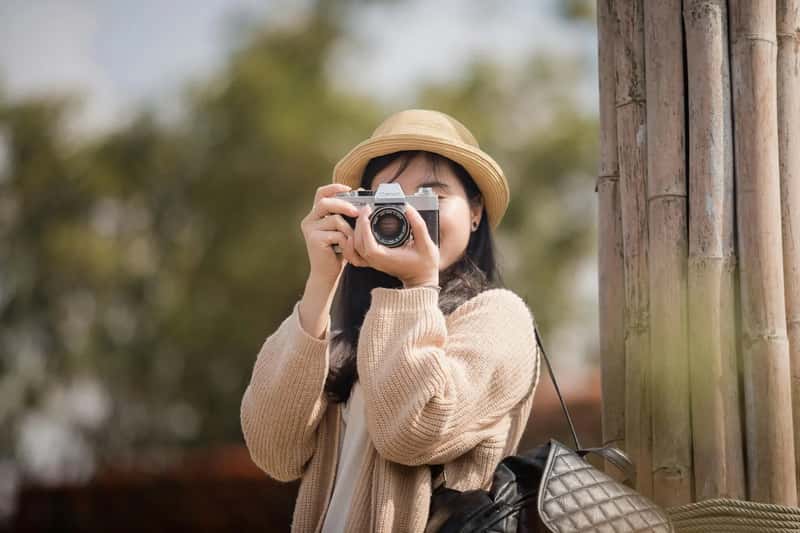
Those limitations help you concentrate on the essentials. To enjoy the moment. To take the time to take a photo and see the pictures weeks later. When you cannot shoot two thousand images of a single sunset, you have to commit. You have to look. You have to decide what is worth preserving from what is just noise.
That decision is a psychological act of enormous consequence.
When someone engages in photography, they are essentially practicing a form of present-moment awareness that mirrors many therapeutic techniques used by mental health professionals. The act of composing a shot requires the photographer to observe their environment carefully, notice details they might otherwise overlook, and make conscious decisions about what to include or exclude from the frame.
The digital traveler photographs everything and remembers nothing. The film traveler photographs one thing and keeps it forever.
4. The Neuroscience of Friction
We have been told friction is the enemy of experience.
The science disagrees.
When photographers manually adjust settings like aperture, shutter speed, and ISO, they must slow down and consider technical factors that affect the final image. This deliberate, methodical approach requires sustained attention and creates natural pauses that interrupt streams of anxious or depressive thinking. The tactile experience of adjusting camera controls, feeling the weight of equipment, and hearing the mechanical sounds of shutters and lenses adds a sensory richness that deepens the meditative quality of the experience.
Friction is presence. Friction is proof that you are here.
When everything is smooth – when your phone checks you in, books your taxi, translates your menu, and predicts your next destination – you become a passenger in your own journey. Not a traveler. A package being delivered to coordinates.
The rough edge of the real world is where identity actually forms.
5. The Weight of the Film Roll (A Personal Account)
I once stood in a market in Lisbon with a loaded film camera and exactly four frames left on the roll.
I did not take a single photograph for eleven minutes.
I stood there, looking. Actually looking. At the light coming off the blue-and-white tiles. At the man with the cart of blood oranges. At the shadow a woman’s hat threw across her face. I was making a decision that felt, absurdly, like it mattered. Four frames left. Which four moments from this street, this hour, this version of myself deserve to be captured?
I have never felt more present anywhere in my life.
Because I looked at every single photo several times – and as I did so, I relived the moment it was taken. That is not nostalgia. That is the sensory loop completing itself. The analog camera forced me into a contract with reality that no cloud-storage album of ten thousand JPEGs has ever managed to replicate.
6. The Tyranny of the Optimized Journey
North American travelers prioritize convenience above all else. They are the most likely to choose flights based on total journey time and fewer layovers. Despite this focus on convenience, they are among the least satisfied travelers globally.
Read that again. The most convenient. The least satisfied.
This is not a coincidence. It is a diagnosis.
The optimization of travel has produced a generation of people who move faster, remember less, and feel almost nothing in transit. Travel rage is rarely about the flight itself; it is about the cumulative erosion of dignity and physical ease. When every stage of the journey is managed, monitored, and pre-resolved, the traveler arrives at their destination having experienced nothing but managed inconvenience.
The inefficiency of the analog journey – the queue for the printed ticket, the wait for the developed photograph – is not waste. It is where meaning accumulates.
7. What Your Phone Stole From Your Eyes
The smartphone camera solved a problem nobody had asked to solve.
It told us: photograph everything, curate later. Keep all of it. Edit all of it. Post the best of it.
What it quietly removed was the discipline of looking before you shoot.
When a photographer is composing a shot, they must become acutely aware of visual elements like light, shadow, color, texture, and form. This heightened attention to sensory details pulls the mind away from abstract worries and grounds it in concrete, observable reality.
The smartphone reverses this sequence. You shoot, then look. Sometimes you never look at all.
This leads to more time at the computer instead of experiencing life. Enjoyment diminishes because every moment becomes a chase for the perfect shot. It feels like enormous pressure. The camera that was supposed to free you to remember everything has instead made you too busy to experience anything.
8. The Analog Artifact as Psychological Anchor
A printed photograph is an object in the world.
It can be placed on a table. It can be dog-eared. It can be found in a coat pocket fifteen years later and stop your breath.
A digital file is a copy of a copy of a copy stored in a server farm in a state you’ve never visited.
Analog photography, more than digital photography, has been chosen by many as a healing process. This is not mere aesthetics. The physical object carries emotional weight precisely because it cost something to create – film, chemistry, time, the careful act of attention. Many photographers report entering a state of calm focus while engaged in their craft, describing it as a form of active meditation that feels more accessible than traditional mindfulness practices – particularly beneficial for people with anxiety disorders, who often find it difficult to sit still for conventional meditation.
The developed photograph is proof that you were really there.
The digital image is a receipt.
9. The Identity Rebuilt in Transit
Travel has always been where identity goes to molt.
You leave as one version of yourself and return as something only slightly different – a millimeter of recalibration that matters enormously over a lifetime.
But the digitized journey collapses this process. More travelers are managing every stage of their journey using smartphones, which means the self never gets a moment to be unmanaged. To be without a script. To make a decision that has no algorithm behind it.
The paper map that you cannot zoom out of. The printed ticket that cannot be digitally re-issued if lost. The film camera that is out of frames at the exact wrong moment. These are not failures of the system. They are invitations to improvise. And improvisation – raw, awkward, embarrassing improvisation – is precisely where the authentic self is located.
Photography naturally shifts attention away from rumination and worry, two cognitive patterns closely associated with anxiety and depression. Instead of being caught up in regretful thoughts about the past or anxious projections about the future, photographers find themselves grounded in the immediate sensory experience of their surroundings. That same principle applies to the whole analog journey.
10. The Revolution Is Quiet and It Smells Like Fixer
There is a revolution happening in the darkroom.
It smells like developer fluid and dusty bellows leather and the specific warmth of a halogen light hitting a reel of just-loaded film.
It is slow. It is inconvenient. It costs more than a cloud subscription.
And it is, quietly, one of the most psychologically radical acts available to a modern traveler.
One photographer describes going straight into analog photography looking for something creative to help with mental health: “I enjoy the way it slows you down when taking a picture… as you take the picture you are just one thing in the final picture.” Being just one thing. Singular. Undivided. Present without a notification badge in the corner of your vision.
The analog approach restores patience and changes the success rate: ten good shots out of thirty-six is better than two hundred out of two thousand five hundred. This is not a photographic statistic. It is a philosophy of living. Of choosing quality of presence over quantity of documentation.
The return to analog travel is not nostalgia for an inconvenient past. It is a deliberate, psychologically informed act of resistance against a world that has decided that experience must be frictionless, optimized, and immediately shareable to count as real.
But it counts as real when it lands in the body. When the paper ticket whispers under your thumb. When the shutter mechanism fires with a solid, mechanical certainty. When you wait fourteen days for your photographs and open the envelope on a Tuesday afternoon in your kitchen and the light from that market in Lisbon is suddenly, impossibly, right there in your hands.
The digital world did not mute us maliciously. It muted us efficiently. One smooth surface at a time. One frictionless interface replacing one textured reality. Until we were moving through places without touching them, documenting without seeing, traveling without arriving.
The analog traveler is not a Luddite. They are a person who has noticed the silence where the senses used to be, and decided – deliberately, inconveniently, joyfully – to make some noise.
So take the paper ticket. Load the film. Let the map fold wrong. Let yourself be, for one uncurated hour, a body in a place with no backup signal – just the particular smell of a city you do not yet know, finding its way in through a window you opened yourself.