The train pulls out of the station.
Nobody speaks.
Nobody performs.
You sit there and you feel something you haven’t felt in years.
You feel the outline of yourself.
There is an identity gap ripping through this generation. A chasm between the self that performs for an algorithm and the self that actually exists underneath all of it – raw, exhausted, and desperate for a moment that belongs only to it. We have spent a decade building digital personas with the same manic energy we used to reserve for survival. We optimized, we posted, we notified, we responded. We mistook noise for meaning. And now, quietly, in stolen pockets of a moving train, something is shifting.
1. The Dopamine Hangover
A decade of algorithmic living has left the nervous system in a state of chronic siege.
It is not dramatic to say this. It is clinical.
From a psychological standpoint, social media dynamics activate the mesolimbic dopamine system, reinforcing the role of social affirmation in self-perception. Every notification, every like, every scroll-and-reward cycle has been training the brain like a lab rat in a Skinner box.
The result?
That anxious buzz you feel at 9 p.m. – even after a full day – is a nervous system overloaded by constant digital input.
The silent carriage is not an indulgence. It is a detox ward. It is the only place where the dopamine cycle is interrupted not by willpower, but by a social contract enforced by strangers who, like you, have had enough. They boarded this carriage with an intention. They chose quiet the same way a person dying of thirst chooses water.
And that choice – that quiet, radical refusal of stimulation – is the first honest thing many of them will have done all week.
2. The New Luxury Metric
Luxury used to be loud. Gold watches. Business class. The audible crinkle of a black card.
Not anymore.
The new luxury is uninterrupted cognition. It is the ability to sit inside your own head for forty-five minutes without someone else’s content bleeding into it.
Whole industries now focus on noise reduction: businesses selling acoustic insulation earned over $16 billion last year, and in 2025 the active-noise-canceling headphone industry was worth almost $21 billion.
We are paying extraordinary sums to approximate what a silent train carriage offers for the price of a standard ticket.
According to a study led by Belgian rail operator SNCB-NMBS, 7 passengers out of 10 like the idea of quiet zones, and 30% affirmed they would travel by train more often if a quiet zone were offered.
That number is not a transportation statistic. It is a psychological confession. It is a generation raising its hand and saying: I am willing to reorganize my behavior around silence. I am willing to earn it. In a world engineered for noise, the ability to opt out has become the ultimate status move.
3. The Architecture of Consent
What makes the silent carriage psychologically distinct from simply wearing headphones?
Consent. Collective, pre-agreed, contractual silence.
Passengers choose quiet carriages while booking tickets, and in doing so, they agree to abide by the rules of silence. Booking a seat in a quiet carriage means the passenger agrees to those rules.
This matters more than it sounds.
Most of modern life is noise by default. You have to fight to exit it. Here, quiet is the default. The burden of proof has been flipped. The social architecture itself protects your mental state before you even sit down. You are not the odd one for wanting peace. You are the norm. For a generation conditioned to feel eccentric for needing stillness, that inversion is quietly revolutionary. It is a built environment that validates your nervous system rather than assaulting it.
4. The Body Knows Before the Brain Does
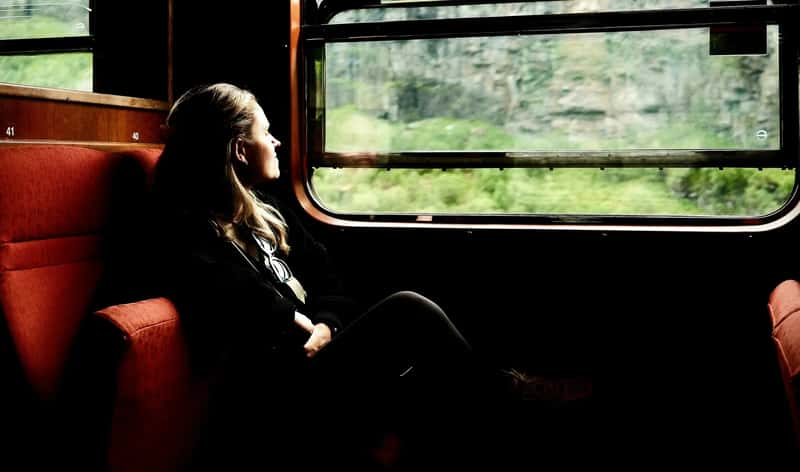
You choose a window seat. You don’t know why. The countryside blurs past.
Your shoulders drop two inches.
You hadn’t noticed they’d been up near your ears for three days.
“Inner silence” – defined as a state of quiet within the mind, a lack of chatter or distractions – seems to activate the ventral vagus nerve into quieting the autonomic nervous system, favoring social engagement and reducing nervous system activity.
The body is not waiting for your permission to exhale. It begins the moment the ambient conditions allow it. Noise-induced stress responses activate the hypothalamic–pituitary–adrenal axis and the sympathetic nervous system. Remove the noise, and the axis begins to power down. The biology is not metaphorical. It is happening in your bloodstream, your cortisol levels, your jaw muscles. The silent carriage is not a mood. It is a physiological event.
5. The 7:43 From Nowhere
I found my first silent carriage by accident. I was running late, exhausted, over-caffeinated, and I threw myself into the nearest available seat.
A woman across the aisle gave me a look. Not unkind. Just very deliberate.
I looked around and saw the sign. The small, unassuming “S” on the window.
I closed my laptop. I put my phone face-down. And then something strange happened. I started noticing things. The particular grey of the sky over the industrial outskirts. The way an older man across from me was reading an actual paper book, turning pages with the focus of someone who had nowhere else to be. The train rhythm. The in-breath and out-breath of travel itself.
I arrived at my destination having done absolutely nothing – and feeling, for the first time in weeks, like a full human being.
Re-negotiating a relationship with technology and digital noise can make you feel more alive. I didn’t understand that intellectually until I experienced it viscerally, in motion, at 70 miles per hour, saying absolutely nothing at all.
6. The Performed Self vs. The Traveling Self
On social media, you are always arriving somewhere.
In transit, you are just between.
And that “between” is where the performed self goes quiet.
Research using Impression Management Theory and Cognitive Dissonance Theory found that teens and young adults experience dissonance when their social media presence conflicts with their real-world identity, often leading to discomfort and eventual withdrawal.
The silent carriage has no audience. Nobody is watching your face for a reaction. Nobody is expecting you to perform presence or productivity or contentment. You are simply a body in a seat, temporarily unassigned to any role. The identity you have been curating – the one you built notification by notification, post by post – has no jurisdiction here. What remains when the performance stops is the closest thing to a true self that modern life will offer you on a Tuesday morning.
7. The Noise We Normalized
We did not notice the volume rising. It happened incrementally, like water temperature in the old frog metaphor.
Today’s world is designed for mental overstimulation. Smartwatches buzz, group chats ping, and algorithms pull you into infinite scroll.
We now check our phones over 205 times a day – a sign not of productivity, but of addiction to stimulation.
Two hundred and five times. That is a disturbance every five minutes of waking life. A flinch reflex disguised as connection. This creates a reinforcing cycle where we need to shout louder and louder so that we don’t become the noise ourselves. We became both the screamer and the screamed-at. The silent carriage is the first environment in years that breaks that cycle without demanding we explain ourselves. There is no opt-out form. There is no digital wellness app. There is only the sign, the agreement, and the mercy of strangers who want the same thing you do.
8. The Geography of Psychological Safety
Not all quiet is equal.
The quiet of an empty apartment after a fight is heavy.
The quiet of 3 a.m. insomnia is hostile.
But the quiet of a shared, consensual, moving space? That is something different entirely.
Silence possesses sociological dimensions – when an individual communicates through silence, they not only convey personal sentiments but may also represent broader collective concerns.
In the silent carriage, the collective concern being expressed is unmistakable: we are all, every one of us, a little broken by the noise. And there is a specific safety in that shared admission. You are not uniquely fragile here. You are not the only one who needed this. The subdued atmosphere can be understood as a collective effort to make a crowded space more manageable. Psychological safety is not always built from conversation. Sometimes it is built from the mutual decision to stop.
9. The Attention Economy’s Biggest Threat
The tech platforms are not neutral.
They have a financial stake in your inability to sit quietly.
Platforms diminish our capacity to pay attention, making us feel poor in attention through overstimulation and addiction tactics.
Studies show that digital mental overstimulation overwhelms the brain’s capacity to process input, leading to chronic stress, fractured focus, and emotional fatigue.
The silent carriage is, in the most literal sense, a boycott. Every person who books a seat in that carriage is withdrawing their attention from the machine for the duration of the journey. They are refusing to be monetized for forty-three minutes. The platforms cannot follow you there. The algorithm has no reach through the window. There are no engagement metrics on the Flemish countryside at dusk. What you spend your attention on in that carriage belongs entirely to you. The solution to not becoming someone else’s noise is to remove yourself from the environment that creates the noise. The silent carriage is that removal, made physical, made architectural, made real.
10. The Identity That Survives the Journey
Here is the hardest question this trend asks.
Who are you when no one is watching and nothing is pinging and there is nothing to react to?
Not who you perform. Not who your analytics suggest. Not the person the algorithm has learned to expect.
Who. Are. You.
The polarities of inner quietness versus inner turmoil, time alone versus time with others, and inner order versus chaos illustrate the fundamental tension between the self and the other.
Silence can be rendered as a psycholinguistic space, a sociocultural practice, and a psychosocial marker of agency. The silent carriage, then, is not just a feature on a booking website. It is a space where agency is reclaimed. Where the self that exists below the performance has room to surface. Many passengers who choose this carriage are not consciously seeking identity reconstruction. They think they are just avoiding someone’s speakerphone call. But what they are actually doing is far older and far stranger: they are practicing the art of existing without witness.
And somewhere between the first station and the last, without fanfare, without a caption, without a single notification – they remember something about themselves they had almost entirely forgotten.
The remembering is not dramatic. It rarely announces itself. It arrives the way good things always arrive when you finally stop moving fast enough to let them: as a small warmth somewhere behind the sternum, as a breath that goes all the way down, as the sudden, startling recognition that the landscape outside the window is genuinely beautiful, and that you are genuinely here to see it.
This generation was told that connection was the answer. More connection. Faster connection. Constant connection. Nobody mentioned the cost. Nobody put a warning label on the decade. As digital communication becomes increasingly frequent and immediate, individuals are experiencing new forms of emotional fatigue, anxiety, and information overload – and in this context, digital silence plays a critical role in protecting mental health. The silent carriage did not invent this need. It simply had the decency to acknowledge it exists.
The train keeps moving. Outside, the world goes on at full volume. Inside this one carriage, in this narrow corridor of reclaimed quiet, something irreducible persists – the faint, stubborn signal of a self that was always there, waiting patiently beneath the noise for you to come back to it.